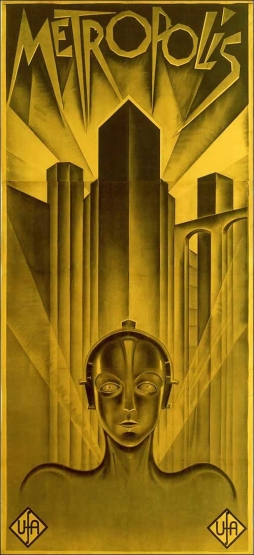
 I’ve always had a fascination with Frtiz Lang’s Metropolis that I’ve never been able to explain. Obviously, it’s a visually powerful film and a tremendous influence on later films and later sf. But that imaginative magnificence seemed almost disconnected from the actual story of the movie. To a large extent, that’s because the Metropolis I knew for most of my life was a greatly-reduced version of Lang’s film. On its premiere in 1927, the movie was 4189 metres (13,823 feet) long, and ran 153 minutes; it was subsequently edited heavily, down to about 3100 to 3200 metres, without the input of husband-and-wife team of director Fritz Lang and scriptwriter Thea von Harbou. For decades, only short versions of Metropolis were believed to have survived, with major subplots and characters missing from the movie. A 2002 re-edit from rediscovered footage recreated something close to the original 1927 film and a 2010 version, based on a newly-recovered negative of the film, finally returned Metropolis to Lang and von Harbou’s original vision. Still, even seeing the whole thing, I have that sense of a kind of gap between the literal content of the film and what might be called its latent content — the mythic feel of the world it imagines.
I didn’t entirely understand that gap until I read Thea von Harbou’s novel of the story. Published in 1925, the book clarifies a number of things: elements of the plot, the character motivation, and the symbolism. The use of the pentacle, the presence of a cathedral, the imagery of Babel and Apocalypse, the vision of Moloch superimposed over Metropolis’s machines, and especially the seemingly self-destructive urge of Joh Frederson, “the Master of Metropolis,” all become clearer. At the same time, I was conscious that I was reading the book with memory of the film always present. It seems to me that the two things, book and movie, work together to make a rich and full experience out of a distinctive fusing of science fiction and the gothic.
It has to be said that there’s been some difference of opinions about the book. Critic Holger Bachmann describes the novel as “a disparate, trivialized collection of motifs from various literary sources,” and refers to its “trivial romanticism.” John Clute, in the entry on von Harbou in the SF Encyclopedia, states that novel doesn’t have much of the film’s “symbolic force.” Personally, I tend to agree with Gary Westfahl, who stated that “von Harbou excelled in the one aspect of literary craftsmanship that critics tend to ignore because it is utterly beyond their ability to comprehend: the power of myth-making.” The sense of latent power I felt in the film of Metropolis has to do with its evocation of myth, both old and new, and I think that’s more clearly present in the book. It’s not a technical triumph like the film, but it’s not to be overlooked.
…
Read More Read More
 This summer, Tor Books announced that it would release Liu Cixin’s science fiction series, The Three-Body Trilogy, in an English translation by Ken Liu. The series has sold 400,000 copies in Chinese, and helped inspire a renaissance of science fiction in China. As of yet I haven’t seen a publication date for the first volume, The Three-Body Problem, but Tor states that it will be the first genre science fiction novel from mainland China to be published in English.
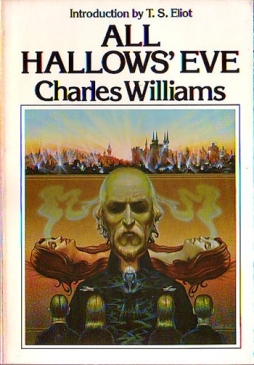 I observed the other day that the end of October’s a good time for reading classic weird fiction. This morning, as young ghosts and goblins of all sorts are preparing their evening’s depredations, I’m writing about a subject I’ve wanted to deal with for a while: the novels of Charles Williams. Williams was born in 1886, and died in 1945; a scholar, poet, editor, and theologian as well as a novelist, he’s probably the third-best-known of the informal group of Oxford Christians called the Inklings, behind C.S. Lewis and J.R.R. Tolkien. A Christian fascinated with the occult, his novels are tales of the supernatural and the numinous at play in the ‘real’ world. He wrote of ghosts, magi, and the Holy Grail, among other things, and his stories, laboured and profound, are some of the strangest fantasies I know.
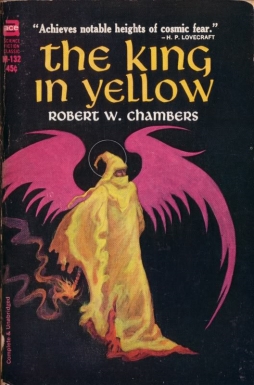 October draws to a close and so it’s time to turn to horror and the supernatural, to the weird tale and the things that cannot be known. Today, I want to look at one of the founding classics of the weird, Robert W. Chambers’s collection of linked short stories, The King in Yellow. Published in 1895, it was celebrated by H.P. Lovecraft, who used some of the book’s ideas in his Cthulhu mythos; in fact, the book’s inspired a mythos of its own, complete with
  A little while ago,
 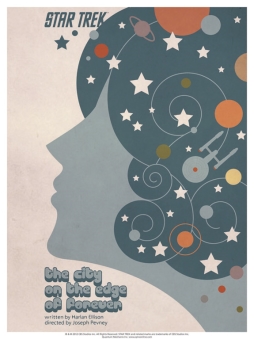 This is the second part of my attempt to write about Star Trek, and specifically the episode “The City on the Edge of Forever.” For reasons which I hope will soon make sense
 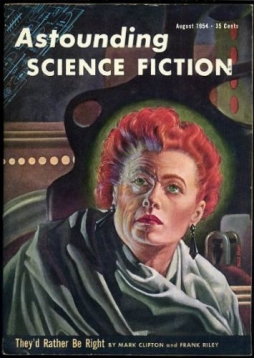 I want to write about Star Trek. Specifically, about the episode “The City on the Edge of Forever.” But I’m not going to do that right now. I’ll get there, but I’m going to start off by writing about a well-known prose sf story that to me parallels “City” in some interesting ways. Then, in my next post, I’ll go on to write about the Trek episode and make a fuller comparison (edit to add: time having passed,
 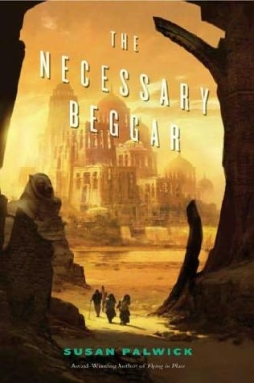 Of the many useful terms suggested by John Clute in The Encyclopedia of Fantasy, perhaps the most useful is the idea of ‘thinning.’ Clute sees certain archetypal patterns frequently recurring in fantastic fiction and thinning’s a part of that. It is the lessening that afflicts threatened fantasylands, a type of diminishment. It’s the fading of magic, the passing of the great old order. Sometimes, eventually, the greatness of the past is restored, though perhaps in a different form.
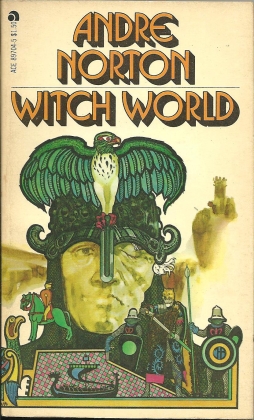 Somehow, when I was growing up, I missed Witch World. Some of the books in the series were always around, as I remember it, in my local libraries and bookstores, but I don’t think I ever read one — if only because I always try to read a series in order, and finding Witch World itself was not always easy. Somewhere along the line, though, I picked up a used copy, and set it aside to be read later. As it happens, there’s been a certain amount of talk about Andre Norton lately,
 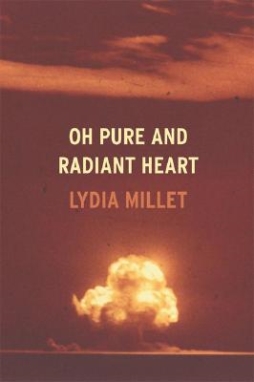 It’s not uncommon for writers of fictions called ‘literary’ to use science-fictional or fantastic elements in their work. And it’s not uncommon for sf readers to suggest that they’re using those elements wrongly, with a lack of understanding of the material they’re working with — usually, depending on the specific case, either because the writer didn’t understand the history of the way the element in question has been treated in prior (genre) works, or simply because they haven’t thought the logic of what they’re doing through in a rigorous way. Personally, I find this is rarely a problem in the fantastic ‘literary’ works that I read. And, intriguingly, when it is a problem, it’s not necessarily a significant problem.