“A Fighting Fantasy Gamebook In Which YOU Are The Hero!”: The Warlock of Firetop Mountain
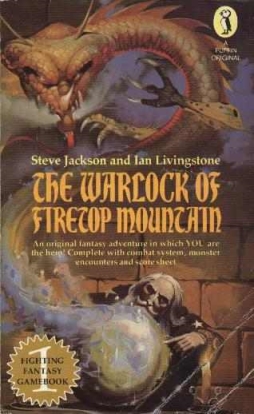 It’s a time for looking back, as the old year ends. Now so it happens that on a Boxing Day sale I picked up a book I loved as a child; and therefore it seems fitting to write a little about it, now, glancing back down the vanished days of this and other years, and to try to again see the pleasure I once had. Will it come again, as I work through the text? If I work on the text, then no. Because this text, more than most, is not made for working. It is a thing to be played.
This is not a story I once loved, except in a way it is. There’s no strong central protagonist, except that in a way there is that as well. It’s a book-length riddle. It’s a maze through which you must find your way, filled with wrong turnings and frustrating locks. It is a story you can shape with a pencil and two dice: you are a hero with a sword, who must explore a wizard’s underground lair, before finally defeating the great mage in battle and taking his treasure. You choose your own adventure, flipping from one numbered section to another depending on the decisions you take faced with a given situation. More than most novels, the reader must shape the story; for the reader is the hero. This is The Warlock of Firetop Mountain, written by Steve Jackson and Ian Livingstone. First published in 1982, it was the first of what became a line of several dozen gamebooks, as well as a full-fledged role-playing game. Warlock inspired direct sequels, a computer game, and even several non-interactive novels. You can learn more about the books at their web site.
Not long ago, Black Gate’s redoubtable Nick Ozment looked at The Warlock of Firetop Mountain and several other of the Fighting Fantasy gamebooks. Nick remembered playing other Fighting Fantasy books, but not this one specifically. My experience roughly mirrored his: it was relatively easy to get to the end of the book, but incredibly difficult to actually win a complete victory. Nick liked the art — Firetop’s profusely illustrated by Russ Nicholson (you can see some of these pictures below) — but found the conception of the book’s dungeon improbable. I agree with both points. But I found myself wondering if there wasn’t something else to say about the book. I remembered playing through it in the early 80s, drawing out maps, trying again and again to make it through to the end. Why was I held so deeply in the book’s spell? Does it hold up?
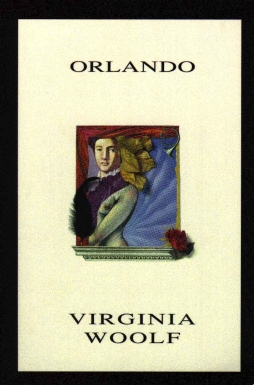 For some years now I’ve been wanting to reread Virginia Woolf’s Orlando. I first read the book about twenty years ago, and though I enjoyed it I came away confused. I felt as though on some level I really hadn’t understood the book. As though I hadn’t grasped how to read it. So, time having passed and me having (maybe) come to understand a bit more about books and reading, I sat down with Orlando again. And, as I’d hoped, I enjoyed it more thoroughly this time around, and felt as though I’d understood it a little better than I had. What surprised me was the reason for that understanding. I felt as though I’d worked out how to approach the book not because of any greater knowledge of modernism, or even because I’d read other books by Woolf, but because I now had a greater experience of early fantasy. More than I’d remembered or understood when I first read the book, Orlando is of a piece with the fantastic fiction of its time.
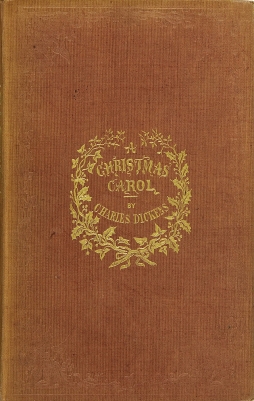 It’s one of the most famous stories in the English-speaking world, and it is a fantasy. A Gothic fantasy of Christmas, and the meaning thereof: the story of the miser and the three spirits. It’s been retold any number of times, parodied, set in America, updated to the modern day, acted out with mice and ducks, with frogs and pigs. It’s easy to overlook how powerful the original work really is.
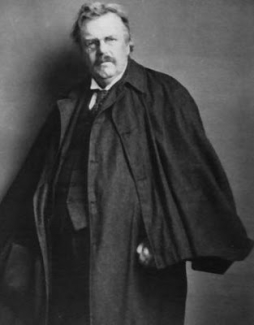 Last week, in a post about Neil Gaiman’s Sandman, I said that certain habits of Gaiman’s plotting reminded me of G.K. Chesterton. It seemed to me that I’d referred to Chesterton fairly often in my posts here, so I did a search of the Black Gate archive. I found that I had in fact mentioned Chesterton a number of times, but that neither I nor anyone else had yet written a post for Black Gate specifically about him or any of his works. I’ve therefore put together this piece to give an overview of the man and his writing. It’s insufficient; Chesterton’s difficult to describe, more so than most writers. But one has to begin somewhere. He’s an important early fantasist, admired by figures as diverse as Gaiman, Borges,
  There’s a certain kind of structure I’ve lately begun to notice in certain novels. These books read like puzzles, telling one story directly and overtly while implying a second story, or highly variant reading of the first story, through carefully-placed gaps, contradictions, and seemingly-irrelevant details. Throwaway references in highly-disparate points of the book might imply a completely different way to read at least the plot and often the tone or theme. It’s something Gene Wolfe does a lot; other examples I’ve noticed lately are
 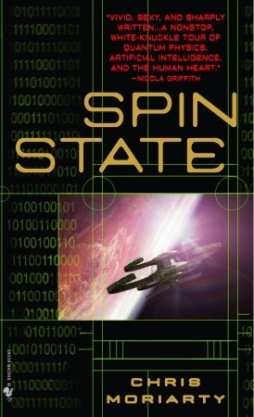 My reading’s defined, largely, by sheer chance. I stumble across something at a used-book sale, buy it along with a box of other books, put it on my shelf and forget about it, then finally years later take it down and read it and, often, realise I should have started in on it long before. Which is a long way around to explaining how I just now came to read Chris Moriarty’s debut novel Spin State, which was published in 2003. And why I’m only now writing about the best work of 21st-century science fiction I personally have read.
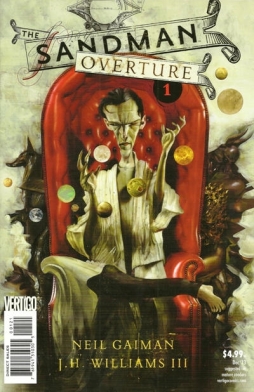 Late last October, the first issue of Sandman: Overture reached comic store shelves. The start of a new bimonthly six-part story, with art by J.H. Williams III, it’s a prologue to writer Neil Gaiman’s widely-acclaimed Sandman series, which ran for 75 issues (plus a special, some spin-off miniseries, a novella, and a collection of short comics stories) from 1988 to 1996. The series built in popularity as it went on and seems to have continued to find an audience in the years since its conclusion. It’s sustained a level of commercial appeal — perhaps as much as any single comic series, it helped to create the contemporary market for trade paperbacks — while also drawing critical praise, both inside and outside of comics. Issues or storylines of the main series were repeatedly nominated for the British Fantasy Awards, and once for the Stoker, while one issue won the 1991 World Fantasy Award.
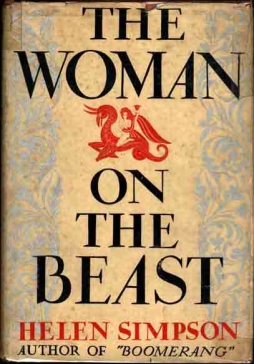 One of the distinct pleasures of used-book sales is finding an old book about which you know nothing, and making a cheap gamble: a literary bet that the story will prove worth the coin. You hope it pays off with unsuspected greatness, but for me as a reader the bet’s covered if I find something memorably strange. Not necessarily greatly strange, but eccentric, interesting, and outside the received narratives of literary histories (and genre histories past). Which brings me to Helen Simpson’s 1933 novel The Woman on the Beast: Seen From Three Angles.