Browsed by
Author: John ONeill

New Treasures: The Best Science Fiction and Fantasy of the Year, Volume Six
New Treasures: The Best Science Fiction and Fantasy of the Year, Volume Six

years-best-sf-sixIn the days of my halcyon youth (no, I’m not 100% sure what that word means either, but I’ve always liked it), I used to look forward to the Year’s Best SF collections from Terry Carr, Lin Carter, and Donald Wollheim. I was still being introduced the riches of the field, and those Best Of volumes were a terrific shortcut to discovering the finest writers out there.

In our modern times this tradition is carried on by Rich Horton, David Hartwell & Kathryn Cramer, Gardner Dozois, and the talented Mr. Jonathan Strahan, who’s now up to his sixth volume of The Best Science Fiction and Fantasy of the Year.

I’ve found his past collections excellent, and this year looks to be no exception. Here’s a peek at the contents:

An ancient society of cartographer wasps create delicately inscribed maps; a bodyjacking parasite is faced with imminent extinction; an AI makes a desperate gambit to protect its child from a ravenous dragon; a professor of music struggles with the knowledge that murder is not too high a price for fame; living origami carries a mother’s last words to her child; a steam girl conquers the realm of imagination; Aliens attack Venus, ignoring an incredulous earth; a child is born on Mars…

For the sixth year in a row, master anthologist Jonathan Strahan has collected stories that captivate, entertain, and showcase the very best the genre has to offer. Critically acclaimed, and with a reputation for including award-winning speculative fiction, The Best Science Fiction and Fantasy of the Year is the only major “best of” anthology to collect both fantasy and science fiction under one cover.

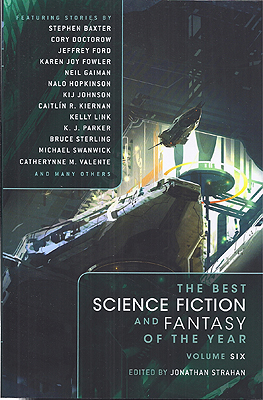
The Best Science Fiction and Fantasy of the Year, Volume Six is published by Night Shade Books. It is 606 pages for $19.99 in trade paperback, with a cover by Sparth.  Buy it online from one of my favorite book sellers, Mark V. Ziesing at Ziesing.com.
The 2011 Bram Stoker Award Winners

The 2011 Bram Stoker Award Winners

flesh-eatersThis week the Horror Writers Association announced the winners of the 2011 Bram Stoker Awards at its annual banquet at the World Horror Convention. This year it was held in Salt Lake City, Utah, and it marked the 25th Anniversary of the awards. A total of 12 awards were given in 11 categories, including one tie:

    Superior Achievement in a NOVEL
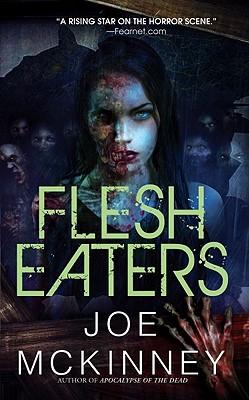
    Flesh Eaters by Joe McKinney (Pinnacle Books)
    Superior Achievement in a FIRST NOVEL
    Isis Unbound by Allyson Bird (Dark Regions Press)
    Superior Achievement in a YOUNG ADULT NOVEL (tie)
    > The Screaming Season by Nancy Holder (Razorbill)
    > Dust and Decay by Jonathan Maberry (Simon & Schuster Books for Young Readers)

    Superior Achievement in a GRAPHIC NOVEL
    Neonomicon by Alan Moore (Avatar Press)

    Superior Achievement in LONG FICTION
    “The Ballad of Ballard and Sandrine” by Peter Straub (Conjunctions: 56)

    Superior Achievement in SHORT FICTION
    “Herman Wouk Is Still Alive” by Stephen King (The Atlantic Magazine, May 2011)

    Superior Achievement in a SCREENPLAY
    American Horror Story, episode #12: “Afterbirth” by Jessica Sharzer (20th Century Fox Television)

    Superior Achievement in a FICTION COLLECTION
    The Corn Maiden and Other Nightmares by Joyce Carol Oates (Mysterious Press)

    Superior Achievement in an ANTHOLOGY
    Demons: Encounters with the Devil and his Minions, Fallen Angels and the Possessed edited by John Skipp (Black Dog and Leventhal)

    Superior Achievement in NON-FICTION
    Stephen King: A Literary Companion by Rocky Wood (McFarland & Company, Inc., Publishers)

    Superior Achievement in a POETRY COLLECTION
    How to Recognize a Demon Has Become Your Friend by Linda Addison (Necon Ebooks)

The HWA, in conjunction with the Bram Stoker Family Estate and the Rosenbach Museum & Library, also presented the special one-time only Vampire Novel of the Century Award to:

    I Am Legend by Richard Matheson

Read complete details about this year’s awards at the Horror Writers Association website.

Knights of the Dinner Table: The Java Joint Strips

Knights of the Dinner Table: The Java Joint Strips

java-jointYears ago, before I started Black Gate magazine, I worked with David Kenzer in the Commerce Drive offices of Motorola here in Chicago. Dave is the founder of Kenzer & Company, publishers of the award-winning Hackmaster role playing game and Jolly Blackburn’s brilliant Knights of the Dinner Table comic.

KenzerCo was the first investor in Black Gate, and without Dave’s early advice and guidance I never could have gotten off the ground. But perhaps the most important contribution he made to our success was his offer to include an original Knights of the Dinner Table strip in every issue. It was an incredible gesture of faith in my fledgling enterprise, and it helped bring my new magazine to the attention of thousands of gaming fans. Brian Jelke at KenzerCo wrote a proposal for a strip centered around a coffee shop, Steve Johansson signed on to do the art, and The Java Joint was born. It has appeared in virtually every issue of Black Gate, and in July of last year KenzerCo packaged up all the stories — together with a brand new 8-page strip — in Knights of the Dinner Table: The Java Joint Strips, published in print and PDF format.

I’ve written about my days with Dave at Commerce Drive, the multi-million dollar software deals and creative projects we did together, a few times now, including in  “How To Succeed in Business,” my editorial for Black Gate 11, and in my portion of the Tribute to Gary Gygax here on the blog in 2008. In my introduction to this new collection I tell the full story of our adventures together for the first time.

Read More Read More

Letters to Black Gate: Poul Anderson, Digital Publishing, and The Dying Earth

Letters to Black Gate: Poul Anderson, Digital Publishing, and The Dying Earth

Michael Fierce writes:

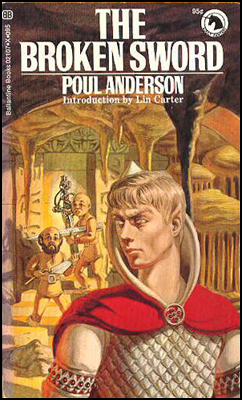
I just wanted to say that I really love Ryan Harvey’s article on Poul Anderson’s The Broken Sword. I’ve read the revised version many times and have always wanted to read the original, and now, after reading his article, am even more enthused to do so. Really excellent breakdown and the format was very reader-friendly with some visually pleasing colors that really grabbed me.

I know many things about many great books but he definitely takes the cake on his knowledge on that one. I’m going to have to come to your site more if there’s quality writing at that level. Thanks again!

You’re welcome, Michael. And if you enjoyed Ryan’s post, you may enjoy Brian Murphy’s “In the grip of “The Northern Thing:” My Top 10 Northern Inspired Stories” (here), in which he examines Poul Anderson’s Hrolf Kraki’s Saga and The Broken Sword, Nancy Farmer’s The Sea of Trolls, and seven other neglected fantasy classics of the north.

I enjoy the Black Gate website. The posts are often interesting and cover such a broad range of ‘fantasy’ topics that there is something for every fan of the field.

I don’t recall seeing that you folks are open for submissions in the couple of years I’ve been an irregular reader (not that I read in an irregular fashion….). Has there been any thought to an online-only edition or two each year? I’m guessing you get a lot of publishable material that just doesn’t fit into the two print issues. And it would allow for additional as well as more timely reviews and whatnot.

Just curious. I know it would take a lot of work, but it wouldn’t have to have all the bells and whistles (i.e. tons of illustrations) that go in the print edition. My own online newsletters (solarpons.com and Baker Street Essays) are simple affairs put together in MS Publisher and I write almost all the content. I would think Black Gate could produce a content-filled online edition that would get a lot of readers. Perhaps you could include blog posts from some of your staff. I recently found Howard Andrew Jones’ blog post about the definition of sword and sorcery. Interesting read!

I am in no way minimizing the work required. But I would think you wouldn’t have much problem getting contributions, at least.

Keep up the great work!

Bob Byrne

Bob, your note is rather prophetic. As we’ve announced in the Black Gate newsgroup and other places, we are launching a digital version of the magazine this year.

Read More Read More

Vintage Treasures: The Bantam Giant Novels of Lawrence Schoonover

Vintage Treasures: The Bantam Giant Novels of Lawrence Schoonover

golden-exile3Who the heck is Lawrence Schoonover?

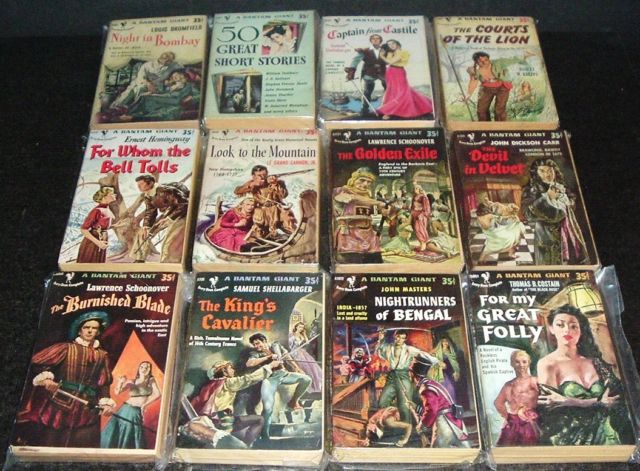
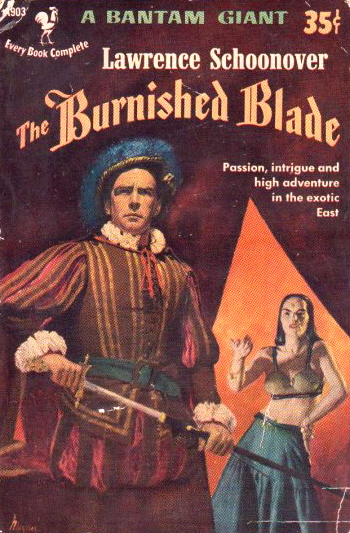
I had no idea. At least until I found myself in an unexpected bidding war for a beautiful collection of Bantam Giant paperbacks on eBay, including two by Mr Schoonover: The Golden Exile and The Burnished Blade (cover here).

Don’t know much more about him. I’m sure a trip to Wikipedia would tell me lots about Schoonover but, really, his covers tell me pretty much everything I need. Apparently he wrote big fat adventure novels featuring dudes with swords, exotic settings, and women who had little use for clothing. I’m a fan.

And it certainly doesn’t hurt that his novels were published as Bantam Giants.

There’s just something about the Bantam Giants that really brings out the collector in me. If you’re any kind of paperback aficionado, you know what I’m talking about.

The first Bantam Giants appeared in 1951, during the tenure of the legendary Ian Ballantine. I don’t believe they were numbered separately from Bantam’s usual sequencing, which makes cataloging them somewhat problematic, but their ranks included James Michener, Emile Zola, Harold Robbins, Sinclair Lewis, Robert Wilder, C. S. Forester and many, many more.

Some of the best literature of the 20th Century appeared in paperback as Bantam Giants, such as Robert Penn Warren’s All The King’s Men and Ernest Hemingway’s For Whom the Bell Tolls.

They also included a superb assortment of classic adventure novels from Rafael Sabatini, Thomas R. Costain, John Masters, John Dickson Carr, and even some dude named Lawrence Schoonover.

If you're the one who outbid me for this eBay lot, you should be ashamed of yourself.

There was also a smattering of science fiction and fantasy, such as Aldous Huxley’s Brave New World, Ray Bradbury’s classic anthology The Circus of Dr. Lao and Other Improbable Stories, John Collier’s Fancies and Goodnights, and novels by Bradbury and Jerry Sohl.

I think a large part of the appeal of Bantam Giants is their sheer size. They promise a lot of reading for your 35 cents. And dang, they look good don’t they? Just check out that beautiful eBay lot at left (click for bigger version.)

‘Course, I’d know a lot more about Schoonover if I’d just managed to win that damn auction. Since I didn’t, I was forced to hunt down virtually every single title in the set individually on eBay. I finally managed to complete that daunting task late last week. It’s okay, I’m sure the kids didn’t really need that college fund.

And before you ask which I’m going to read first, I think that should be fairly obvious. I’m curious about all of them, but before anything else I have to find out just what the Great Folly of that young lady in the bottom right is.

Even though I think I have a pretty good idea.

This Week’s Bargain SF & Fantasy Games at Amazon.com

This Week’s Bargain SF & Fantasy Games at Amazon.com

underdarkI keep sitting down at my computer to write Black Gate blog posts, and then spending all my time browsing Amazon.com.

I used to think Amazon would never replace brick and mortar bookstores, “because you can’t browse books online, you know.” Shows you what I know. Amazon has turned online browsing into an art. These days I browse in my jammies with my iPad, both feet on the back of the couch.

I need to reclaim some of these lost hours by pretending I’m doing something useful. Get your feet off the couch and mow the lawn!, my wife says. Can’t, working on a blog post, I tell her. And pass me that blanket, my toes are cold.

Which brings us nicely to this week’s list of discount SF and fantasy titles at Amazon.com, compiled through countless hours of diligent research by your faithful scout. Don’t thank me, glad to do it. At least until the damn lawn stops growing.

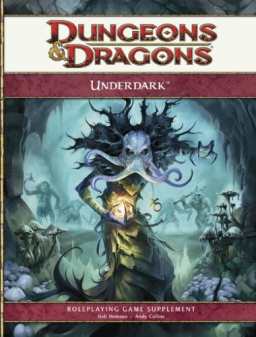
In the spirit of the excellent recent gaming posts, this week I’ve been shopping for discount game titles. I’ve found more than a few — including the splendid D&D supplements Underdark, Death’s Reach, and Demon Queen’s Enclave from Wizards of the Coast, and the excellent computer RPG Mount & Blade.

As long as we’re talking about computer games, I slipped in some of my recent favorites: the popular RPG Neverwinter Nights 2 Gold, the complete Dawn of War collection, the space empire sim Sword of the Stars Ultimate Collection, the new-generation platform game Trine, space fighting sim X3: Terran Conflict 2.0, and the criminally overlooked action RPG Titan Quest Gold.

All these titles are eligible for free shipping on orders over $25.

Many of the discounts we told you about last week are still available; you can see that list here.

All Hail the Barbarian Prince

All Hail the Barbarian Prince

barbarian-prince-256One of the great things about having a blog is that you get to celebrate all things cool. Books, movies, comics, games… if it keeps you up late at night, after your spouse has gone to bed wearing lingerie and a disappointed look, it’s usually worth at least a few paragraphs here.

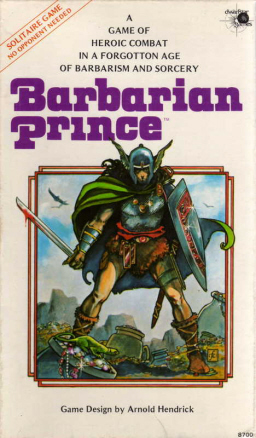
Of course you need to take things a little more seriously when talking about the real classics, the enduring masterpieces that define our very culture. And that goes double when we turn our attention to the supreme achievement of Western Civilization, the pinnacle of some three billions years of planetary evolution, Arnold Hendrick’s Barbarian Prince.

Howard Andrew Jones did just that in his splendid post Return of the Barbarian Prince this week. It’s a terrific article and interview, capturing much of the fun of this sublime solo mini-game, except for his obvious lies about being able to win.

You can’t win at Barbarian Prince. The game is an existential commentary on the nihilistic underpinings of modern evolutionary thought. I thought that was obvious. All games end in ignoble death, usually in the form of a starving goblin tribe that beats you to a pulp and steals your fur-lined booties.

Listen, I’ve owned the game for nearly 30 years. Spent many evenings rolling dice and moving my lead miniature around the little map, befriending elves and exploring ancient crypts, and I have never won. Barbarian Prince is the beautiful girl I lusted after in high school.  She hangs out and flirts like a Vegas show girl, but there’s no way she’s going out with me.

At least I’m in good company. The distinguished John C. Hocking has never won the game. None of my friends have ever won. Only my false friends like Howard, who called last week to tell me he won a game on the first turn. Dude, if you’re going to fib, at least make it believable.

Well, the good news is that now you can experience the timeless agony of Barbarian Prince for yourself. Now you too can spend your evenings cursing up a blue streak and throwing the map across the room. The original Dwarfstar boxed edition is unspeakably rare (most copies were destroyed in a blind rage, presumably), but you can download the complete game here, and Todd Sanders’ new revised version is available here.

Howard tells me he’s mailing me a deluxe copy of the revised Sanders version, hand-made with carefully crafted components, which I anxiously await. Maybe a little of his luck will rub off on me. Maybe I’ll discover he’s adjusted the rules to make the game winnable. Maybe Todd’s revisions will clarify things just enough to lead me to victory. Or maybe there’s another tribe of starving goblins in my future, waiting to take my last copper piece and turn my skull into a drinking cup.

Time will tell.

M.A.R. Barker, Nov 3 1929 – March 16, 2012

M.A.R. Barker, Nov 3 1929 – March 16, 2012

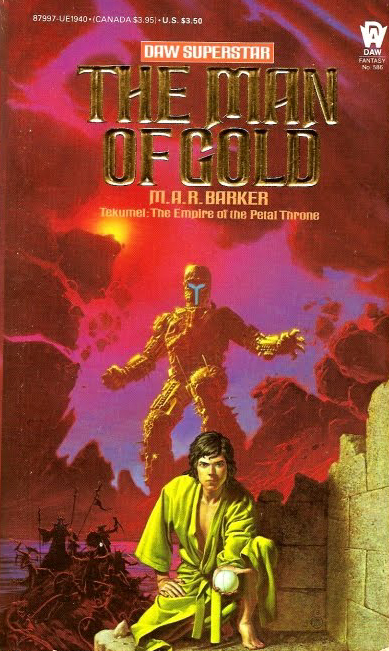
manofgoldWhile I was at the games auction at Gary Con on Sunday, Luke Gygax solemnly paid tribute to those industry giants we lost in the last year, including Jim Roslof and Jean Wells, both early and influential TSR employees.

But I was startled when Luke added that M.A.R. Barker, the grand old man of role playing, had died last week at the age of 82.

M.A.R (Muhammad Abd-al-Rahman) Barker is not particularly well remembered today. He wasn’t especially prolific as an author, with five novels to his credit — the last three published by obscure small press publishers. But everyone who paid attention to TSR in the heady early days of role playing knew M.A.R. Barker, the creator of Empire of the Petal Throne and the fantasy world of Tékumel.

Barker created Tékumel in the decades from 1940 to 1970. Wholly unique, Tékumel was a science fantasy setting inspired by Indian, Middle Eastern, Egyptian and Meso-American mythology, a world colonized by humans and alien species some 60,000 years in the future. Perhaps most intriguing, Tékumel was largely free of Tolkien’s influence as it was well established long before the publication of The Lords of the Rings — the only major RPG setting of the 20th Century that could make that claim.

In the early 1970s Barker met one of the original Dungeons & Dragons playtesters, Mike Mornard, and was introduced to the game. It didn’t take long to realize the potential of the D&D ruleset, and he quickly adapted it for his own use and self-published Empire of the Petal Throne in 1974. One of his occasional players was D&D co-creator Dave Arneson, who called Barker his favorite Game Master — and EPT his favorite RPG.

Read More Read More

Gary Con IV Report

Gary Con IV Report

gary-con2Yesterday I drove up to Lake Geneva, the birthplace of Dungeons and Dragons, for Gary Con IV, the annual gathering in honor of Gary Gygax, the father of role-playing games.

I really enjoy Gary Con. In both locale and tone it’s very much what I imagine the earliest GenCon gaming conventions — which took place in Lake Geneva over thirty years ago — were like.

Just like the early GenCons it’s small and very friendly, with a focus on vintage gaming and first edition D&D/AD&D, with many early TSR employees and industry giants from that era in attendance.

Just a few of the distinguished guests this year included Basic D&D boxed set author Frank  Mentzer; Knights of the Dinner Table creator Jolly Blackburn; author and Dragonlance co-creator Margaret Weis; long-time TSR employee Mike Carr, author of In Search of the Unknown and many others; Troll Lord Games CEO Stephen Chenault; classic AD&D artists Jeff Easley and Jeff Dee; founding Dragon editor Tim Kask; KenzerCo chief David Kenzer; Metamorphosis Alpha creator Jame M. Ward;  Snit’s Revenge creator Tom Wham; Dungeons & Dragons 3.0 co-creator Skip Williams, and many others.

One of the marvelous things about small conventions, of course, is that it’s possible to talk to the guests — unlike big cons where they are usually mobbed.

Read More Read More

New Treasures: The Wesleyan Anthology of Science Fiction

New Treasures: The Wesleyan Anthology of Science Fiction

wesleyan-anthologyWow. This may be the finest SF anthology I’ve ever seen. It’s certainly the best I’ve come across in many years.

Editing an anthology — especially a reprint anthology — is a delicate balancing act. You want to include the very finest stories you can, of course. But you’d prefer not to fill your book with tales your readers have seen a dozen times over.

I’m not sure I’ve seen a book that manages this as well as The Wesleyan Anthology of Science Fiction. Starting with Nathaniel Hawthorne’s “Rappaccini’s Daughter” (published 1844) and ending with Ted Chiang’s “Exhalation” (2008) it spans 164 years of science fiction publishing, including some of the finest SF stories ever written — Edmond Hamilton’s “The Man Who Evolved” (1931), James Patrick Kelly’s “Think Like a Dinosaur” (1995) — alongside dozens I’ve never read. Virtually every major SF and fantasy short fiction writer of the last 164 years is represented, from H. G. Wells, C.L. Moore and Stanley Weinbaum to Samuel R. Delany, Philip K. Dick, Gene Wolfe and Charles Stross.

The Wesleyan Anthology has a grand total of six editors, which tells you right off the bat it’s an academic endeavor targeted at libraries and school curriculum. All six are editors for Science Fiction Studies, DePauw University’s long-running critical journal, and they do a fine job of introducing the tales. Now, academic anthologies like this usually don’t appeal to me. They typically devote a considerable page count to proto-SF of the late 1800s or early 1900s, and that stuff puts my feet to sleep.

Not this time.  By the fifth tale we’re already into the 1930s, and the editors pay proper respect to both the Golden Age of SF — the Campbell authors of the 1940s like Asimov and Simak — and the earlier pulp writers of the mid-30s such as Hamilton and Leslie F. Stone. They’ve even plucked some tales from the pulps that I’ve never heard of, and that takes some effort.

I first laid eyes on The Wesleyan Anthology at Wiscon last year when SF author Richard Chwedyk showed me his copy with some wonder and amazement. Alice bought me my copy for Christmas, and I’ve been slowly (very slowly) making my way through it. The Wesleyan Anthology is $39.95 for 787 pages in trade paperback, and is published by Wesleyan University Press. Do yourself a favor and check it out.