Browsed by
Author: John ONeill

Tor Releases The Devil Delivered and Other Tales by Steven Erikson

Tor Releases The Devil Delivered and Other Tales by Steven Erikson

the-devil-delivered-and-other-tales2I know we’ve got a lot of Steven Erikson fans out there. We’ve got your back.

On Tuesday Tor Book released The Devil Delivered and Other Tales, the latest collection of a trio of fantasy novellas from Steven Erikson, following 2009’s Bauchelain and Korbal Broach, which gathered three short novels of the Malazan Empire.

Like Bauchelain and Korbal Broach, The Devil Delivered and Other Tales features work previously printed in expensive limited edition hardcovers from PS Publishing: The Devil Delivered (from March 2005), Fishin’ with Grandma Matchie (November 2005), and Revolvo (December 2008). Most of them are no longer available, or available only at collector’s prices, so if you’re an Erikson fan who hasn’t seen them before this edition is a bargain.

Unlike Bauchelain and Korbal Broach, this volume features standalone tales unrelated to his popular Malazan Empire setting. Here’s the summary for the first story, The Devil Delivered:

Mind the Hole. In a world of ozone depletion, toxic deadzones, internicine brew-ups and lifeless oceans, nothing has changed. Or so it seems, but in the break-away Lakota Nation, in the heart of a land blistered beneath an ozone hole the size of the Great Plains of North America, something is happening. Tracked by a growing global audience of online subversives and electronic muckers, a lone anthropologist wanders the deadlands, recording observations that threaten to bring the world’s powers to their knees. Past and future; restless ghosts and rogue corporations; rad-shielded cities and unprotected peripheral populations; all now face each other, across a chasm once wide but growing ever narrower. Mother Earth is poisoned beyond any hope of resuscitation. Humanity beyond any hope of redemption — but one last lesson of life awaits. When Nature starts losing the game, Nature changes the rules. We’ve turned paradise into Hell, and in Hell, the Devil Delivers.

The Devil Delivered and Other Tales is $14.99 in trade paperback for 336 pages. It was published by Tor Books on June 19, 2012.

The Spectre Library Brings Rare Pulp Fantasy Back to Life

The Spectre Library Brings Rare Pulp Fantasy Back to Life

the-living-deadWhen I originally wrote the title above, it was “The Spectre Library Brings Rare Pulp Fantasy Back to Print.” I had to change it when I realized it wasn’t true. Damn digital books… I have to change the way I speak now.

Let me start over.

The Spectre Library, a small press outfit known primarily for reprinting the works of Victor Rousseau, has produced Kindle versions of all four of Michael Waugh’s rare short novelettes:

The Living Dead
Back From the Dead
Fangs of the Vampire
The Mystery of the Abominable Snowman

All four were originally produced by Cleveland Publishing Co., an Australian publisher, in pamphlet format between 1954 – 55. They are quite short, between 45 and 48 print pages.

The Kindle versions feature the original cover art, and are priced at $9.99 each (click on the image at right for bigger version).

On their website The Spectre Library says they “issue lost, rare works of fiction, with a focus upon publishing jacketed limited edition smythe-sewn hardcovers of Weird, Adventure, Detective, Crime, Oriental and Fantastic Content.” Sounds like an enlightened calling to me.

They also have an excellent gallery of cover art of Science Fiction, Fantasy, Weird & Occult publications — including paperbacks, digests, pamphlets, pulps, and magazines — from Britain, Australia and Canada between 1930-1966. It is curated by Morgan A. Wallace.

Vintage Treasures: Science and Sorcery edited by Garret Ford

Vintage Treasures: Science and Sorcery edited by Garret Ford

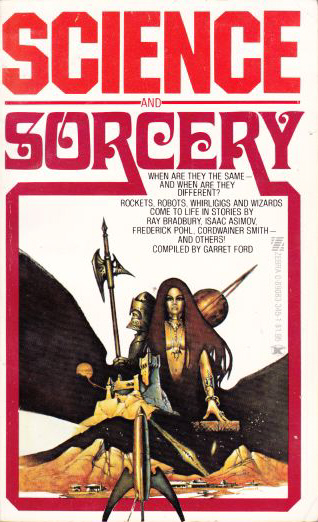
science-and-sorceryA few days ago I mentioned Martin H. Greenberg’s impressive collection of paperback SF and Fantasy, and the three boxes of that collection I carted back from the Windy City Pulp and Paperback Show. Two are now incorporated in my library. I set aside roughly a dozen of the more interesting titles to talk about here, and the first one is Science and Sorcery, an anthology of pulp SF stories from 1978.

It was published by Zebra, a pretty low-budget outfit. So low-budget, in fact, that it doesn’t even have a table of contents.

Who publishes an anthology without a table of contents? That’s pretty edgy. A publisher desperate to save paper, apparently. The whole thing feels slapped together, from the introduction on the back of the title page to the oddly formatted first story, Cordwainer Smith’s “Scanners Live in Vain” (page 3).

Fortunately, science fiction fans are a diligent and industrious lot, and I found a complete TOC online (at the book’s Wikipedia page, believe it or not). Here it is:

  • “Scanners Live in Vain”, by Cordwainer Smith
  • “The Little Man on the Subway,” by Isaac Asimov & James MacCreigh
  • “What Goes Up,” by Alfred Coppel
  • “Kleon of the Golden Sun,” by Ed Earl Repp
  • “How High on the Ladder?” by Leo Paige
  • “Footprints,” by Robert E. Gilbert
  • “The Naming of Names,” by Ray Bradbury
  • “The Eyes,” by Henry Hasse
  • “The Scarlet Lunes,” by Stanton A. Coblentz
  • “Demobilization,” by George R. Cowie
  • “Voices from the Cliff,” by John Martin Leahy
  • “The Lost Chord,” by Sam Moskowitz
  • “The Watchers,” by R. H. Deutsch
  • “The Peaceful Martian,” by J. T. Oliver
  • “Escape to Yesterday,” by Arthur J. Burks

A pretty eclectic mix, to be honest. Can’t remember the last time I saw an anthology with fiction by Sam Moskowitz. Or James MacCreigh, Ed Earl Repp, Leo Paige, Robert E. Gilbert, George R. Cowie, John Martin Leahy, R. H. Deutsch, or J. T. Oliver, for that matter. I don’t want to say this anthology primarily consists of nobodies, but it looks like this anthology primarily consists of nobodies.

Read More Read More

New Treasures: Necropolis by Michael Dempsey

New Treasures: Necropolis by Michael Dempsey

necropolis-by-michael-dempseyBack in April I told you about this sale at Night Shade Books (now expired). I took advantage of it myself, and ordered roughly a dozen titles.

I finally found time to put them away this week. They look terrific, and I hope to tell you about some of them over the next few weeks.

Let’s start with Michael Dempsey’s Necropolis, a delicious-looking cross of science fantasy and pulp detective novel:

Paul Donner is a NYPD detective struggling with a drinking problem and a marriage on the rocks. Then he and his wife get dead — shot to death in a “random” crime. Fifty years later, Donner is back — revived courtesy of the Shift, a process whereby inanimate DNA is re-activated.

This new “reborn” underclass is not only alive again, they’re growing younger, destined for a second childhood. The freakish side-effect of a retroviral attack on New York, the Shift has turned the world upside down. Beneath the protective geodesic Blister, clocks run backwards, technology is hidden behind a noir facade, and you can see Elvis and Radio City Music Hall ever night. In this unfamiliar retro-futurist world of flying Studebakers and plasma tommy guns, Donner must search for those responsible for the destruction of his life. His quest for retribution, aided by Maggie, his holographic Girl Friday, leads him to the heart of the mystery surrounding the Shift’s origin and up against those who would use it to control a terrified nation.

Night Shade is discovering and promoting a lot of new talent, and Necropolis is a fine example. It’s Dempsey’s first novel, although he wrote for network TV in the mid-90s.

Necropolis is 361 pages in trade paperback, with a $14.99 cover price. It was released in October 2011. The cover art is by E.M. Gist. You can order it directly from Night Shade here.

See the complete list of New Treasures features here.

Star Trek is New Again With Fresh Animated Intro

Star Trek is New Again With Fresh Animated Intro

Our buddy John DeNardo at SF Signal tells us about this extremely cool re-imagining of the original Star Trek intro, with William Shatner’s famous voice over… and some very compelling animation.

Keep your eye out for a red shirt who buys it half a second after beaming down, right around the 20 second mark.

The video was produced by The Quintek Group, a digital retouching studio in the Detroit area.

I got seriously nostalgic watching this. It makes me want to blow the dust off my DVD box set of Star Trek Season One and enjoy a few episodes.

Thanks, John. Owe you one.

The Retro Pulp Art of Tim Anderson

The Retro Pulp Art of Tim Anderson

blade-runner-pulpWe love pulp fiction. And we love classic SF & fantasy movies.

So what’s not to love about Tim Anderson’s re-imaginings of classic SF films as pulp paperbacks?

Anderson is a concept designer for Electronic Arts in Salt Lake City. He’s also worked as a concept designer for Paramount Licensing, Inc., Radical Comics, and various independent filmmakers.

He’s started working on a personal side project that he hoped would motivate him “into thinking more graphically,” a series of highly detailed period paperback covers for some of the most famous SF films of the 20th Century.

Here’s what he says about his Blade Runner piece at right (click for a bigger version):

If you haven’t guessed by now, I’m a huge sci-fi fan, and a huge fan of Ridley Scott. Here’s a pulp cover I have had in the works off and on for a while now. I was inspired by the detective pulp covers of Robert McGinnis. If ever there was a sci-fi movie that lent itself well to a detective pulp cover, it’s Blade Runner.

Anyone who’s a fan of the great Robert McGinnis is okay by us.

Check out Tim Anderson’s versions of Alien, The Matrix and others here.

A Tale of a Vanished Writer: Geoffrey Huntington’s The Ravenscliff Series

A Tale of a Vanished Writer: Geoffrey Huntington’s The Ravenscliff Series

demon-witch-2If you follow what we call “the industry,” you’re probably aware of a routine publishing phenomenon: a new writer appears, publishes 2-3 novels, and then vanishes. Frequently right in the middle of a promising new series.

Here’s another routine phenomenon: I discover them ten years later.

Fricken’ hell. Where do all these vanished writers come from? People puzzle over where they go; I just want to know how they keep popping up. Vanished writers. They’re all over the place, like discount car insurance.

Last month I bought a collection of 240 new science fiction and fantasy paperbacks (Told you I buy collections. They’re like boxes of Christmas.) This one was an eclectic mix of remaindered titles from the last ten years, all in terrific shape, at about a buck a book. The seller still has a few lots left on eBay, if you’re interested.

Anyway. One of the chief joys of buying books by the quarter ton is finding bizarre stuff you don’t normally come across. (The other is coming up with creative ways to sneak them into the house without your spouse knowing, but that’s a different topic.) One of the many interesting items I came across in the first lot was the 2004 YA novel Demon Witch by Geoffrey Huntington, with this intriguing description on the back cover:

Long before the days of Madman Jackson Muir, a witch named Isobel the Apostate waged war upon her fellow sorcerers, the noble order of the Nightwing. Burned at the stake for her crimes, Isobel vowed to return and conquer the world. Now that she is back, the only person who can prevent hell on earth is fourteen-year-old Devon March. In a battle that takes him from modern-day Ravenscliff to Tudor England and back, Devon must unleash the Nightwing power within himself and call upon friendships in the strangest places to stand against an evil that has waited five centuries for revenge. For at Ravenscliff, friends come in all shapes and sizes — and enemies are everywhere.

Witches, sorcerers, secret orders, and burnin’ stuff at the stake. That sounded pretty good. Naturally, the cover proclaimed it was Book II of The Ravenscliff Series. Which I’d never heard of.

Read More Read More

Thank You, Martin H. Greenberg (and Doug Ellis)

Thank You, Martin H. Greenberg (and Doug Ellis)

martin-h-greenberg-paperback-lot-small

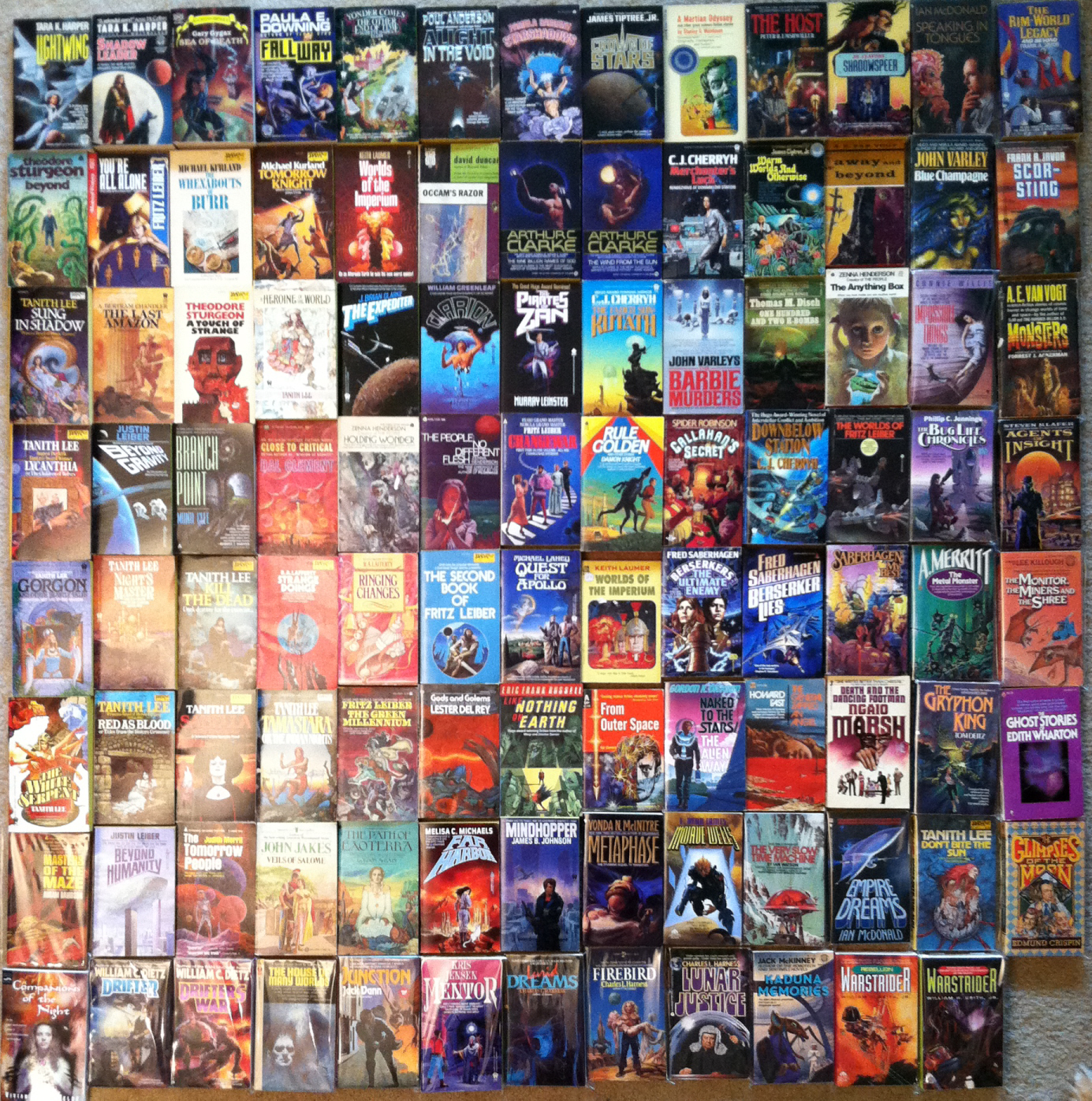
That’s a pic of one of the boxes I unloaded in my library this morning. It contained 103 paperbacks from the vast collection of the great Martin H. Greenberg, one of the most prolific and talented anthologists our field has ever seen (click for a more legible version). Greenberg died almost exactly a year ago, on June 25, 2011. He left behind some 2,500 anthologies and other books he created — including over 120 co-edited with his friend Isaac Asimov — and his company Tekno Books, a book packager which produced nearly 150 books a year. I wrote about six of them just last week in my article TSR’s Amazing Science Fiction Anthologies.

He also left behind a massive collection in his home in Green Bay, which was purchased by Chicago collectors Doug Ellis and Bob Weinberg. They’ve been gradually selling the high value stuff — autographed vintage hardcovers, things like that. Doug runs the Windy City Pulp and Paper show every year, and he brought some of it to the show.

I’m usually a pretty social guy. Put me in a room with fellow collectors and I’ll happily spend my hours chatting. But as I passed Doug’s booth, I saw countless boxes of what looked like beautiful, unread vintage paperbacks stacked in neat rows, all priced at a buck. I started to browse, then select a few books, and finally obsessively dig through every single box, much to the annoyance of the always patient Jason Waltz and my other companions.

Read More Read More

A Dance With Dragons wins the 2012 Locus Award for Best Fantasy Novel

A Dance With Dragons wins the 2012 Locus Award for Best Fantasy Novel

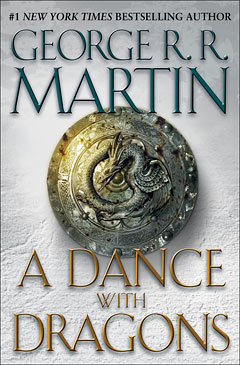
a-dance-with-dragonsThe winners of the 2012 Locus Awards were announced today:

Fantasy Novel — A Dance with Dragons, George R.R. Martin
Science Fiction Novel — Embassytown, China Miéville
First Novel — The Night Circus, Erin Morgenstern
Young Adult Book — The Girl Who Circumnavigated Fairyland in a Ship of Her Own Making, Catherynne M. Valente
Novella — “Silently and Very Fast,” Catherynne M. Valente (WSFA; Clarkesworld)
Novelette — “White Lines on a Green Field”, Catherynne M. Valente (Subterranean Fall ’11)
Short Story — “The Case of Death and Honey”, Neil Gaiman (A Study in Sherlock)
Anthology — The Year’s Best Science Fiction: Twenty-eighth Annual Collection, edited by Gardner Dozois
Collection — The Bible Repairman and Other Stories, Tim Powers
Non-fiction — Evaporating Genres: Essays on Fantastic Literature, Gary K. Wolfe
Art Book — Spectrum 18, Cathy Fenner & Arnie Fenner
Artist — Shaun Tan
Editor — Ellen Datlow
Magazine — Asimov’s Science Fiction
Publisher — Tor

The Locus Awards are presented annually to winners of Locus Magazine’s readers’ poll. The award was first given in 1971; last year’s fantasy winner was Kraken, by China Miéville. We reported on the 2011 awards here.

Congratulations to the winners, and special congratulations to Cat Valente for sweeping three categories: Young Adult Book, Novelette  and Novella.

Complete details on the 2012 winners, including all the nominees, are available at Locus Online.

New Treasures: Dungeons & Dragons Into the Unknown: The Dungeon Survival Handbook

New Treasures: Dungeons & Dragons Into the Unknown: The Dungeon Survival Handbook

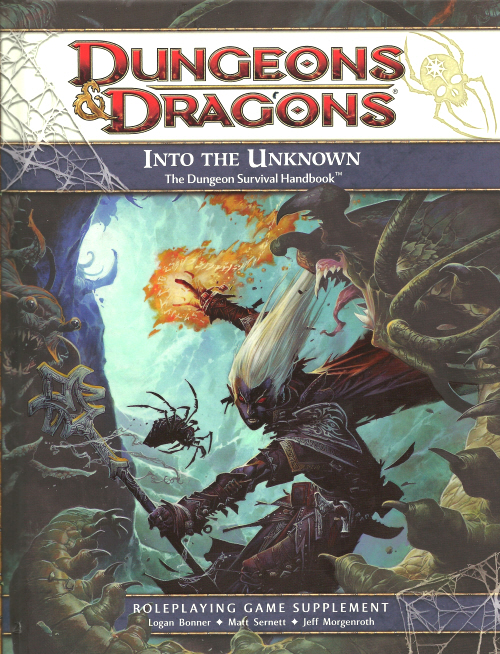
into-the-unknownI don’t get to play D&D as much as I’d like these days. Which means that my enjoyment of the latest supplements chiefly depends on how fun they are to read. By that measure, Into the Unknown: The Dungeon Survival Handbook is one of the best books to come from Wizards of the Coast in a while.

What makes this one stand out? On the surface it’s pretty lightweight, described as

A guide for players and Dungeon Masters who want to play in a Dungeons & Dragons game that explores dungeons and plumbs the blackest reaches of the Underdark… Players will find an assortment of new powers, equipment, feats, character themes, and player races, including the kobold and the goblin. For Dungeon Masters, the book is a trove of dungeon-building advice and details, including lore on classic dungeon monsters, some quirky companions for adventurers, a few timeless treasures, and tips for incorporating players’ character themes into an adventure.

Yeah, we’ve seen this book a few times over the decades. A collection of vague dungeoneering advice, some monsters that didn’t make the cut for other modules, and a few new feats. Reminiscent of the 1986 title that finally convinced me I could ignore future TSR hardcovers, The Dungeoneer’s Survival Guide.

At least, that’s what I thought until I opened it.

My favorite section is a 17-page chunk of Chapter 2 titled “Infamous Dungeons,” which takes a detailed look at some of the most popular publications in D&D history, from Castle Ravenloft to The Temple of Elemental Evil to The Gates of Firestorm Peak. Not half-hearted marketing pieces, but warts-and-all descriptions of classic dungeons alongside pics of the original modules. Here’s a brief excerpt from the assessment of 1980’s The Ghost Tower of Inverness:

That publication was preceded by a tournament version that one could purchase only at WinterCon VIII in 1979 in a zip bag containing 40 loose-leaf pages. But even its more professionally published form, the adventure’s tournament pedigree was on full display. Discussions of scoring the players’ efforts riddle the adventure text, which presents an oftentimes nonsensical dungeon full of desperation-inducing challenges… Since then, the Ghost Tower of Inverness has appeared from time to time in various products. Most recently, it was featured in the D&D Encounters season March of the Phantom Brigade.

Read More Read More