Browsed by
Author: John ONeill

The Top 40 Black Gate Posts in August

The Top 40 Black Gate Posts in August

fifty-shades-of-greyAugust was a busy month here at the Black Gate rooftop headquarters. Theo Beale observed that 50 Shades of Grey, “according to its description it is little more than John Norman’s Gor brought back to Earth, minus the sword battles and the awesome tarn birds.” Brian Murphy reported on the debate surrounding breaking The Hobbit into three films, and Andrew Zimmerman Jones, live at the scene for the Dungeons & Dragons Next keynote at GenCon 2012, checked in with all the details.

I covered the controversy at Weird Tales magazine as the editorial team abruptly aborted plans to publish an excerpt of Victoria Foyt’s Saving the Pearls: Revealing Eden, and Scott Taylor brought us several more installments of his popular Art of the Genre column. Howard Andrew Jones explored the pleasures of the classic Jungle Stories pulp, and C.S.E. Cooney reviewed William Alexander’s novel Goblin Secrets. And that’s just a sample of the Top 10 articles.

Missed any of the news and updates when they were hot off the press? Not to worry — here’s your chance to catch up. What follows are the 40 most popular articles on the Black Gate blog in August. Don’t thank us, it’s our job.

  1. 50 shades of Paedo?
  2. Weird-Tales Pulls Novel Excerpt Following Fan Uproar
  3. Category: New Treasures
  4. Three Hobbit films for the LOTR fans =Trouble
  5. GenCon 2012: Dungeons & Dragons Next keynote Liveblog
  6. Vintage Treasures: The Barbarians Anthology Series
  7. Art of the Genre: The Art of Steampunk Couture
  8. Art of the Genre: When Music and Gaming mix
  9. Escape to the Jungle
  10. Goblin Secrets: A Review
  11. A Brick-and-Mortar bookstore score
  12. The thrill of the Unexpected: Why I Edit Clockwork Phoenix
  13. Black Gate Goes to the Summer Movies: Total Recall 2012
  14. Black Gate Goes to the Summer Movies: The Bourne Legacy
  15. Solomon Kane Crosses the Atlantic to U.S. Movie Theaters in September
  16. Category: Comics
  17. Read More Read More

Black Gate to Publish Online Fiction Starting Sunday, September 30

Black Gate to Publish Online Fiction Starting Sunday, September 30

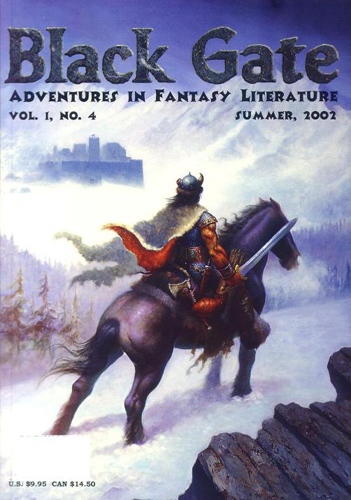
black-gate-4-smallWe are very pleased to announce that Black Gate magazine, your home for the finest in adventure fantasy, will begin publishing original online fiction starting Sunday, September 30.

Holy crap, that’s tomorrow.

Wow. Uh, well, into the breach. Best way to do this is to jump right in, and figure it out as we go.

New fiction will be published right here on our website every Sunday, starting tomorrow. Here’s what’s coming in the next two months:

  • “The Duelist,” by Jason Thummel
  • “The Quintessence of Absence,” by Sean McLachlan
  • “The Daughter’s Dowry,” by Aaron Bradford Starr
  • “A Phoenix in Darkness,” by Donald S. Crankshaw
  • Novel excerpt: Queen of Thorns, by Dave Gross
  • “Godmother Lizard,” by C.S.E. Cooney
  • “The Poison Well” by Judith Berman
  • Novel excerpt: Bones of the Old Ones, by Howard Andrew Jones
  • Novel excerpt: The Black Fire Concerto, by Mike Allen

What can you expect from online fiction at Black Gate? We will be presenting original fiction from some of our most popular contributors, as well as exciting new authors and many of the best writers in the industry. All stories are presented completely free of charge.

We will be offering fiction at all lengths, including short stories, novellas, and novel excerpts. It’s just like reading an issue of Black Gate, except you can do it from the comfort of your couch. Or that uncomfortable chair in front of the computer, whatever.

Join us tomorrow as Jason Thummel brings us a riveting tale of a talented swordsman who finds himself caught up in a web of deceit and far-reaching ambition in a fast-paced tale of action in a violent city, “The Duelist.”

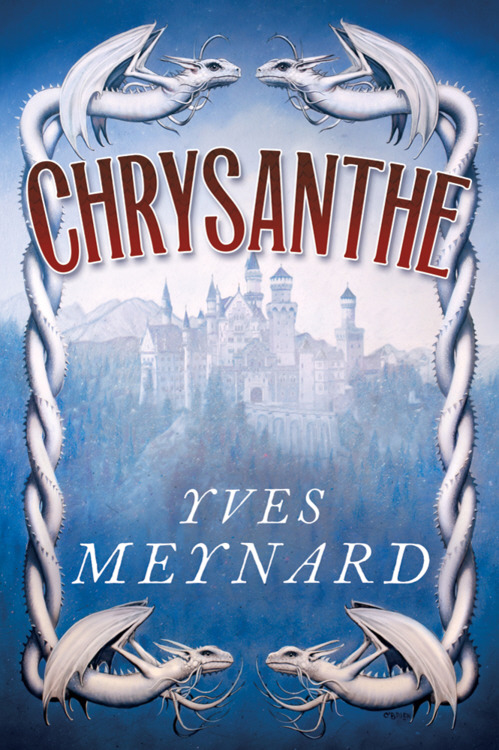
New Treasures: Chrysanthe by Yves Meynard

New Treasures: Chrysanthe by Yves Meynard

chrysantheI first met Yves Meynard at the World Fantasy Convention in Montreal in 2001. Yes, that was the year of 9/11, when the entire country stopped flying for weeks. I still remember my flight into Montreal… it was scarcely a month after the attacks and the cabin was virtually empty. You could wander around and take whatever seat you wanted.

Sadly, the same was more or less true of the convention. The World Fantasy Convention typically sells somewhere around 1,000 memberships, but a lot more were sold than used that year. Some estimates put the number of attendees at around 200. Whatever the case, it was the smallest and most intimate convention I’ve ever attended.

Which wasn’t wholly a bad thing. I remember the convention chiefly for the many great conversations I had. I’d lived in Ottawa — less than two hours away — until 1987, and this was a chance to re-connect with Canadian friends, including Mark Shainblum, Don Bassingthwaite, Claude Lalumiere, Rodger Turner, and Charles de Lint. In short order, I found myself introduced to some of the best French Canadian fantasy writers on the scene, including Jean-Louis Trudel and Yves Meynard.

I hit it off with Yves immediately. He was a fellow editor, the literary editor for French Canadian SF magazine Solaris, and his widely-praised first novel, The Book of Knights, had been published by Tor in 1999.

He was already being recognized as a major talent. Ursula K. Le Guin called The Book of Knights “An unpredictable, brilliantly imaginative, and very engaging fantasy,” and Locus magazine, commenting on editor David Hartwell’s annual accomplishments, said:

In terms of both mature craft and originality of imagination, Hartwell’s major discovery this year has to be the French-Canadian writer Yves Meynard.

Yves turned out to be a fascinating guy with a deep appreciation of Canadian fantasy in both French and English. He wrote fluently in both languages, a skill I envied, and we had several great talks.

Read More Read More

Roy Thomas’s Alter Ego looks at Sword & Sorcery in the Comics

Roy Thomas’s Alter Ego looks at Sword & Sorcery in the Comics

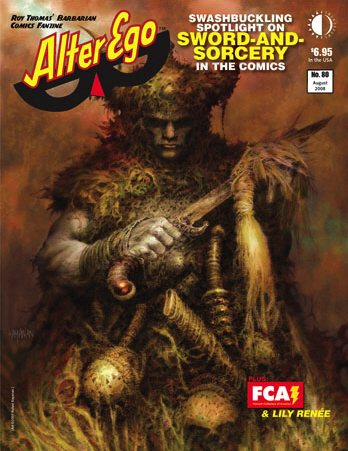
alter-ego-80Roy Thomas’s Alter Ego is a terrific magazine — packed with articles, interviews, and loads of art from vintage comics. So packed, in fact, that I can’t remember the last time I read one cover-to-cover. These days when a new issue arrives, I flip though it joyfully, then add it to the teetering stack to be enjoyed later.

That stack finally toppled, spilling all over the floor, and while I was cleaning it up and carting it to the basement (excuse me, to the Cave of Wonders), I found a handful of issues from 2008 and 2009 I’d been meaning to blog about. Specifically, those containing a massive three-part investigation of, and tribute to, Sword & Sorcery in the Comics.

Better late than never, I thought, and brought them back up out of the subterranean vault. Let’s start with the first one, Alter Ego #80, dated August 2008. It is wrapped in a new cover by Rafael Kayanan and contains John Wells’s fabulously detailed 34-page article “Sword & Sorcery in the Comics: Part I of a Study of Robert E. Howard’s Legacy in Four Colors — and in Black-&-White.” As Thomas says in his editorial:

You’d have thought I’d have done this a long time before now, wouldn’t you? Devote an issue of Alter Ego to sword-and-sorcery in comics, I mean… I just kept putting it off. It’s a big subject, after all, because, much as I’d like to think otherwise, comic book S&S didn’t begin with Marvel’s Conan the Barbarian #1 in 1970 — or even with the couple of forerunners at DC (“Nightmaster”) and Marvel (“Starr the Slayer”) in the previous twelvemonth…

“Sword & Sorcery in the Comics” proved way too big a subject to cover in one issue… in the end, because we wanted to illustrate nearly every one of the examples of the game we were discussing, we found ourselves with only room for the S&S overview I talked John Wells into writing especially for this magazine… in Alter Ego #83, Part Two will be slashing its way toward you. After that, we’ll keep the S&S segments coming, every few issues, till we’ve covered the genre the way we’ve always intended to! We figured it’s high time.

Appropriately enough, Wells begins his article with a look at Robert E. Howard and his profound influence on the entire field.

Read More Read More

Jolly Blackburn’s Knights of the Dinner Table #191 Shipping Next Week

Jolly Blackburn’s Knights of the Dinner Table #191 Shipping Next Week

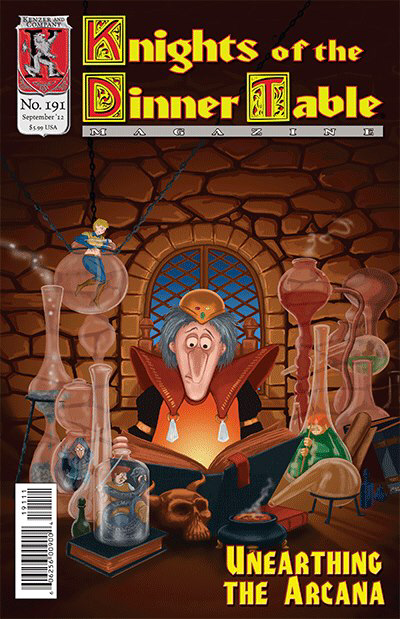
kodt-191Time to remind all you people that you should be reading Knights of the Dinner Table.

Why? Because it’s one of the best comics on the market. And for gamers it’s a lot more than that — it’s one of the finest magazines out there, packed with articles, reviews, and ads for the best new games.

Knights of the Dinner Table follows the misadventures of a group of misfits from Muncie, Indiana, whose love of gaming routinely trumps normal social conventions, and occasionally even their sense of self preservation. If you’re a Black Gate reader you’re already familiar with the Knights: the Java Joint strip in the back of every issue draws from the same cast of characters. Knights of the Dinner Table: The Java Joint, collecting the complete Black Gate strips, is now available in print and PDF.

You can try KODT for free online with the weekly Knights of the Dinner Table web comic. The current “Celebrity Hack” strip, featuring Seinfeld characters playing Hackmaster, is more than worth the trip.

In addition to a great cover by artist George Vrbanic, spoofing the original Unearthed Arcana art by Jeff Easley, issue 191 features 8 complete comic strips, plus feature articles including “Siftings of a Hoarder’s Lair: An inventory of things found in a Kobold’s Lair,” by Barbara Blackburn. This issue’s GameMaster’s Workshop looks at Bait and Tackle: Adventure Hooks on the Fly, Denizens of Tellene: Shazahn Ghanim, and Gaming the Movies covers the film Outpost.

All that plus regular columns Tales from the Table, Web Scryer: the Best of the RPG Web, and reviews of Masque of the Red Death, The Drifter’s Escape, The Tempus novels, Ugg-Tect, Flapjacks & Sasquatches, and Decktet. See this complete list of contents here

Knights of the Dinner Table is published monthly by Kenzer & Company. Issues are 64 pages, black & white, and priced at $5.99. It gets my highest recommendation.

New Treasures: Warhammer: Dreadfleet

New Treasures: Warhammer: Dreadfleet

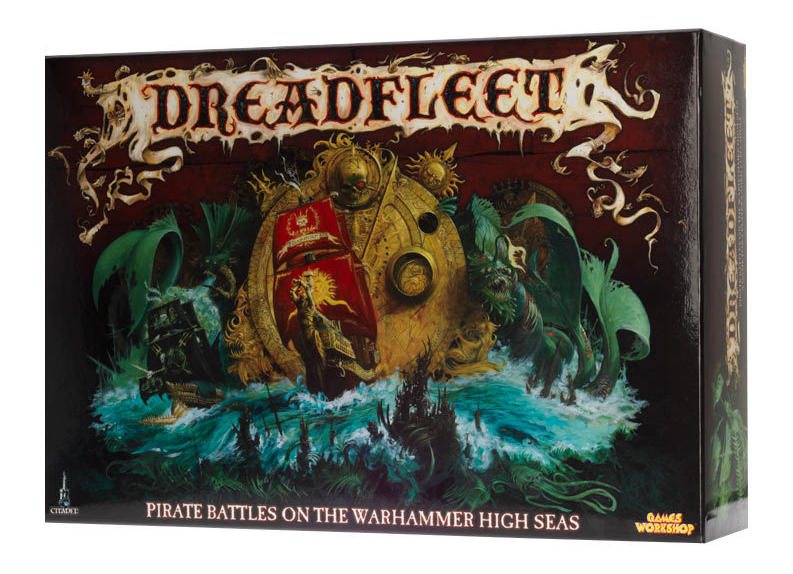
dreadfleetThere are games that are perfect for an impulse buy, and there are games you need to budget for. And then there are games that you lust after for months, scrimping and saving, until you’ve collected enough pennies to seal the deal.

Such a game is Dreadfleet, a prize I’ve been eyeing for many months. It finally arrived on Friday, and I’ve been cooing over it ever since. I haven’t had a chance to try it yet, but I’m sure if I leave it out where Drew can find it, he’ll ask to play it with me.

Dreadfleet is a tabletop miniatures board game from Games Workshop, which means it comes packed with dozens of great toys and a fabulous back story. The back story this time deals with the dread pirate Captain Roth, sailing the high seas to avenge the death of his family at the hands of the Vampire Count Noctilus. Dreadfleet is set in Games Workshop’s popular Warhammer universe, and was designed by Phil Kelly with art by John Blanche and Alex Boyd.

Captain Roth’s hunt for the legendary Dreadfleet has led him deep into the fabled Galleon’s Graveyard. With the aid of the world’s most dangerous pirate lords, the Captain intends to send the Vampire Count Noctilus to a watery grave. Yet the count has allies too, each at the helm of a gigantic and unnatural warship. Can the pirate lords battle through legions of skeletal sailors, zombie sea monsters, and hurricanes of raw magic to slay the master of the Galleon’s Graveyard once and for all?

Dreadfleet is a game for two players that allows you to enact an intrepid vampire hunt in a nautical otherworld. One player commands the pirate lords of Sartosa whilst the other controls a coalition of dark and dangerous Undead captains. Dreadfleet is quick to learn but hard to master, and provides countless hours of swashbuckling fun, thunderous broadsides, and heroic derring-do as you navigate twelve exciting scenarios. Will the Captain get his vengeance upon his deathless nemesis, or will the Galleon’s graveyard claim their lives too?

Vampire lords, zombie sea monsters, undead pirates, strange magics… what more could you ask for? The action takes places on a gorgeous seascape mat measuring 5 feet by 3.5 feet, involving 10 miniature warships averaging around three to four inches. The miniatures come unpainted and require assembly, so bear that in mind if you expect to pick it up and be playing in minutes.

The game is designed for two players, but includes scenarios playable by up to ten. Although Games Workshop has a reputation for producing countless supplemental miniatures (just look at their Warhammer 40,000 line), as far as I can tell, Dreadfleet is a stand-alone product with no plans for auxiliary units.

Dreadfleet was published by Games Workshop in October 2011; it retails for $114.99. It is recommended for ages 12 and up.

Meeting Your Heroes: David Kyle

Meeting Your Heroes: David Kyle

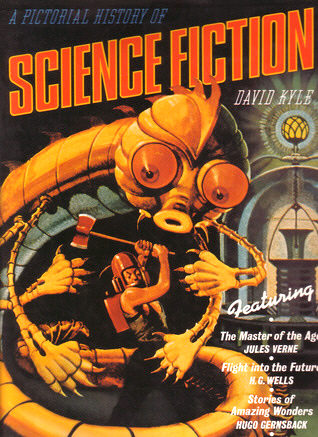
a-pictorial-history-of-science-fictionThere are a handful of people whom I credit with introducing me to science fiction.

The first was my classmate John MacMaster, who brought me two science fiction novels when I was bedridden for a few days in the seventh grade. The second was Jacques Sadoul, whose 2000 A.D.: Illustrations From the Golden Age of Science Fiction Pulps turned my early curiosity into a full-fledged obsession with early SF and fantasy magazines. The third was Isaac Asimov, whose pulp anthology Before the Golden Age and Foundation Trilogy thoroughly captured my young imagination.

The man who cemented that early interest, and who brought all my young obsessions together — monster movies, pulps, magazines, comics, Star Wars, and even Isaac Asimov — and showed me that they were all aspects of the rich branch of art and literature known as Science Fiction, was David Kyle.

He did this through two magnificent books that I read over and over again as I lay in bed much too late on school nights: A Pictorial History of Science Fiction (Hamlyn Publishing Group, 1977) and The Illustrated Book of Science Fiction Ideas & Dreams (Hamlyn, 1977).

Both books were very popular in the 70s, especially following the release of Star Wars and the surge of interest in all things science fiction. Deluxe oversize hardcovers copiously illustrated with pictures of early SF writers, pulp art, and numerous books cover and movie stills, they were immaculately designed and gorgeous to look at. But it was Kyle’s text that really drew me in. Here was a man who had been a part of science fiction since its earliest days — a Futurian who attended the first Worldcon in 1939 and a founder of Gnome Press in 1948 with Martin Greenberg — and who still spoke of it with wonder and deep appreciation.

It’s through Gnome Press that David made perhaps his most significant contribution to science fiction, publishing nearly a hundred of the most important books in the genre — including first editions of Robert A. Heinlein’s Sixth Column and Methuselah’s Children, The Coming of Conan and Conan the Conqueror by Robert E. Howard, I, Robot and Foundation by Isaac Asimov, Clifford D. Simak’s City, C.L. Moore’s Judgment Night and Shambleau and Others, Two Sought Adventure by Fritz Leiber, plus Arthur C. Clarke, Edward E. Smith, L. Ron Hubbard, Leigh Brackett, Murray Leinster, A. E. van Vogt, and many others. He kept the most important writers in the field in print at a time when they appeared only in magazines, and is directly responsible for introducing them to a whole new generation.

I first met David Kyle at the World Fantasy convention in 1984, in my home town of Ottawa, where I was able to shake his hand and say a few words of appreciation. But it was at Worldcon three weeks ago that I had a chance to talk with him at length, and really get to know one of the most important early writers and publishers in the industry. It was one of the highlights of the con for me.

Read More Read More

A Circle of Cats by Charles de Lint and Charles Vess

A Circle of Cats by Charles de Lint and Charles Vess

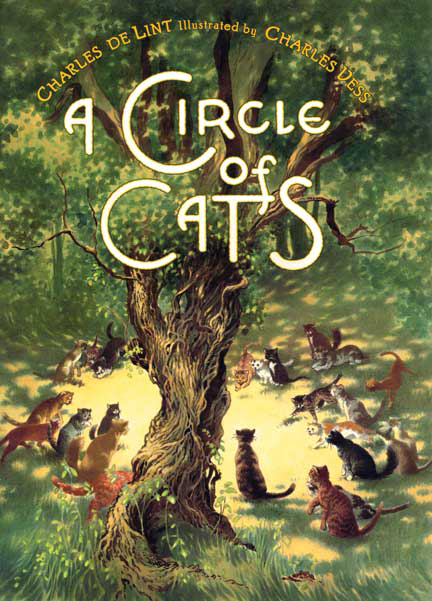
a-circle-of-catsIt’s always a pleasure when two creators I admire collaborate. Case in point: A Circle of Cats, a Charles de Lint short story gorgeously illustrated by Charles Vess.

Although it’s very short (48 pages, at least half of which is full-color artwork), A Circle of Cats is a complete and satisfying tale. It tells the story of Lillian, a 12-year-old orphan who lives on the edge of a vast and very old wood with her aunt. One day, after all her chores are done, Lillian chases a deer into a part of the woods she’s never explored before. Falling asleep at the foot of a great gnarled tree, she disturbs a snake that strikes her three times.

As she lays dying, a circle of cats forms around her, for Lillian has found their ancient gathering place. The cats decide to intervene, and when Lillian awakens, she finds herself in the body of a kitten.

What Lillian finds as she explores the woods as a cat, and the strange creatures she meets, form the bulk of the tale. But as night arrives and her elderly aunt begins a desperate search deeper and deeper into the woods for her, Lillian’s efforts to find a way to return to human form become more determined. Ultimately, she learns that getting what she wants will require help from friends she didn’t know she had, and an unusual sacrifice.

Fans of de Lint and Vess’s earlier collaboration, the massive illustrated fantasy Seven Wild Sisters (Subterranean Press, May 2002), will find both the setting and some of the characters familiar, including Aunt Lillian, The Apple Tree Man, and The Father of Cats. De Lint and Vess also collaborated on Medicine Road (Tachyon Publications, June 2009), featuring the further adventures of the red-haired Dillard twins, Laurel and Bess, from Seven Wild Sisters.

While it is primarily intended for young readers, A Circle of Cats is still a fine introduction to Charles de Lint’s fiction, as it has all the hallmarks of his work, including fascinating characters, magical settings, and a story richly suffused in myth. Vess, the artist behind The Book of Ballads and three books with Neil Gaiman (Instructions, Blueberry Girl, and the illustrated version of Stardust), delivers his usual excellent artwork.

A Circle of Cats was published in hardcover by Viking Juvenile in June, 2003. It is 48 pages in full color, with a cover price of $16.99.

Vintage Treasures: Into the Aether, by Richard A. Lupoff

Vintage Treasures: Into the Aether, by Richard A. Lupoff

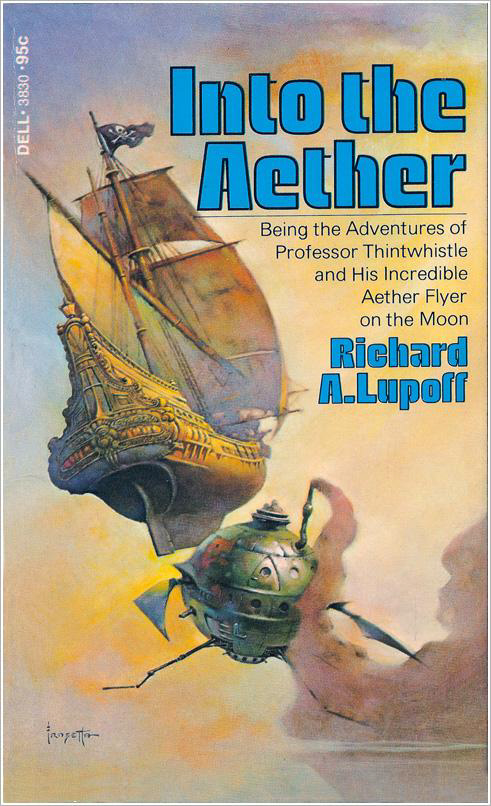
into-the-aetherWhew. What a week. About two hours ago I returned from Canada, where my family celebrated my mother’s 75th birthday on the shores of Lake Huron. It was great to see everyone again, even if it did mean sixteen hours of driving — and writing my last few blog articles in advance, so I could schedule them for publication while I was on the road.

Now that I’m back, I’m pretty tuckered. All I want to do is curl up next to a window, watch the wind and the rain, and read a good book. I’m not up to any of the imposing fat fantasies that pass for novels these days, and as I made a pass through my library, my hand alighted on a slender paperback from 1974 with an enticing Frazetta cover: Richard A. Lupoff’s Into the Aether.

Subtitled “Being the Adventures of Professor Thintwhistle and His Incredible Aether Flyer on the Moon,” it looks like just the kind of fantasy romp I need tonight. Here’s the enticing text on the back cover:

When the ‘Chester A. Arthur’, the world’s first and only coal/steam/paddlewheel-propelled spaceship rose into the skies over Buffalo Falls, Pa., who would have expected what followed?

Will Professor Thintwhistle and his crew be able to return to earth? Will Miss Taphammer ever find them? Will Jefferson Jackson Clay’s foul plot succeed? And what of the King of the Cats?

Find the answers to these and more thrilling questions in Into the Aether.

Richard A. Lupoff was fairly respected among my circle of discerning science fiction readers when I first purchased it, lo those many decades ago. His most popular novel was probably Sandworld, featuring as it did a desert planet and alien vampires, but his sword & sorcery epic Sword of the Demon was also highly regarded. I’ve never had a chance to read Into the Aether though, and it sounds like a lot of fun.

One of the definite rewards of having a library is that no purchase is ever truly wasted. I’m not sure precisely how long this book has been patiently waiting on my shelves, but for the next few hours I expect to be happily transported back to 1974. And from there, on to the moon.

Into the Aether was published in January 1974 by Dell. It is 220 pages in paperback, with an original cover price of 95 cents.

Boxed Set of the Year: American Science Fiction: Nine Classic Novels of the 1950s, edited by Gary K. Wolfe

Boxed Set of the Year: American Science Fiction: Nine Classic Novels of the 1950s, edited by Gary K. Wolfe

american-science-fictionWe’re lucky enough to receive a lot of review books here at the Black Gate rooftop headquarters. Having the latest fantasy and SF novels arrive at our door before they’re available in stores never gets old, let me tell you.

Of course, cataloging them all and dropping them in the mail for our trusted circle of reviewers gets a little routine after a while. But it’s worth it for those special titles that come in once or twice a month, the ones you drop everything to gawk at. I’ve been a blogger for 16 years, and a publisher and editor for over a decade, but at heart I’m still a fanboy. And every month there’s at least one new book that proves it.

And then there are those special items that come in once or twice a year that you know that you’re not going to bother cataloging or telling the reviewers about. Because you’re never going to part with it. Such a treasure arrived a few weeks ago.

I’m talking about American Science Fiction: Nine Classic Novels of the 1950s, a two-volume set published by The Library of America and edited by Gary K. Wolfe. If I were stranded on a desert island tomorrow, this is the one item I would bring. For one thing, it’s big enough to practically be a life raft.

But just don’t take my word for it. Here’s what Western Civilization’s finest Arbiter of Taste, the distinguished Mr. James Enge, had to say on Wednesday:

Wow. Fritz Leiber, Leigh Brackett, Pohl & Kornbluth, Blish, Heinlein, Matheson, Bester, Sturgeon, and Burdys — all swept into the Library of America, and in appropriately lurid covers, too. Overdue, but somehow I never thought I’d see it.

Indeed. American Science Fiction: Nine Classic Novels of the 1950s is a gorgeous set of volumes collecting the most essential SF of perhaps the most important decade in the history of the genre.

Read More Read More