Browsed by
Author: Bob Byrne

The Public Life of Sherlock Holmes: Solar Pons & The Dorak Affair
The Public Life of Sherlock Holmes: Solar Pons & The Dorak Affair

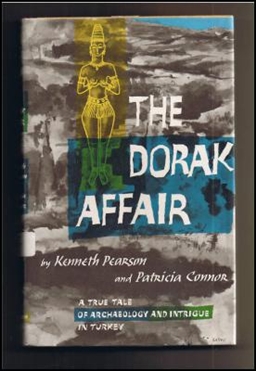
Dorak_BookOne of my favorite Solar Pons stories by August Derleth is “The Adventure of the Golden Bracelet.” If you’ve read that one, you know that an archeologist discovered a fabulous treasure horde at a mysterious woman’s house, made rubbings of the pieces, then found himself embroiled in a scandal when the items turned out to be stolen and no trace of the woman could be found. Pons figures things out and it’s quite a tale.

Derleth didn’t spin this tale out of whole cloth. It relied heavily on The Dorak Affair. James Mellaart was a well-known archeologist with some great successes in Turkey. Riding on a train in Turkey, a woman came in and sat across from him.

She wore a bracelet like the ones found at Troy. She gave her name as Anna Papastrati and said she had many more like it at home. Mellaart accepted her offer to go see them.

She revealed a large collection of artifacts, which she said came from tombs her family uncovered in the village of Dorak. The elated Mellaart was convinced he had proof regarding the Yortans, Troy’s sea-faring neighbors.

He spent three days and nights at her house (certainly bold for the married man), making sketches of the collection. She promised to send him photographs he showed her of the tombs. The photos never came, but after a time, Mellaart did receive a letter from her, saying he could use his sketches in an article.

…

Read More Read More

Discovering Robert E. Howard: David Hardy on El Borak – The First and Last REH Hero

Discovering Robert E. Howard: David Hardy on El Borak – The First and Last REH Hero

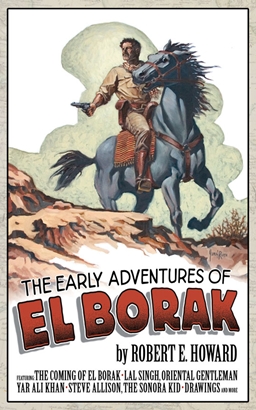
ElBorak_EarlyToday, our ‘Discovering Robert E. Howard’ series talks about my favorite REH stories: those featuring El Borak. David Hardy wrote the introduction to the Robert E. Howard Foundation’s The Early Adventures of El Borak and he also contributed what is essentially the afterward to Del Rey’s El Borak and Other Desert Adventures.  There’s no one better suited to expound on Francis Xavier Gordon, so enough blathering from me. Let’s check out ‘The Swift.’


Francis Xavier Gordon, known from Stamboul to the China Sea as “El Borak”-the Swift-is perhaps the first of Robert E. Howard’s characters, and the last. El Borak is one of those distinctive characters that could only come from the fertile imagination of REH. He is a Texas gunslinger from El Paso, an adventurer, who has cast his lot in the deserts and mountains of Arabia and Afghanistan. There’s a little bit of John Wesley Hardin in his makeup, a bit of Lawrence of Arabia, and just a touch of Genghis Khan.

Howard described the origin of Gordon and other characters to Alvin Earl Perry: “The first character I ever created was Francis Xavier Gordon, El Borak, the hero of “The Daughter of Erlik Khan” (Top Notch), etc. I don’t remember his genesis. He came to life in my mind when I was about ten years old.”

That would put El Borak’s origins about 1915, the year Rafael Sabatini’s pirate novel The Sea Hawk appeared. The titular Sea Hawk is an Englishman who joins the corsairs of the Barbary Coast. There is also a supporting character named El Borak. Howard also noted that Bran Mak Morn, hero of “Worms of the Earth,” bore a resemblance to El Borak.

…

Read More Read More

The Public Life of Sherlock Holmes: What to Write About?

The Public Life of Sherlock Holmes: What to Write About?

The itsy-bitsy spider, went up the water spout...
The itsy-bitsy spider, went up the water spout…

For the past 76 Monday mornings, The Public Life of Sherlock Holmes has appeared here at Black Gate. I’ve written a couple other posts, but this column is why they keep me around. Well, that and I work for free.

Most of my posts involve (a little or a lot of) re-reading. Which means that more often than I would like, what I want to post on a particular Monday isn’t ready to go. For example, I’ve read ten books and watched one tv pilot for a post on Erle Stanley Gardner’s ‘Cool and Lam’ private eye books (fantastic stuff). And I still need to read more.

And I’ve listened to at least six dozen radio shows for posts on Yours Truly, Johnny Dollar, The Fat Man and Box 13: with more listening to go. So, for this week’s post, I thought I’d talk about some of the subjects that I have started digging into, but which I’m not ready to tackle yet:

Sherlock Holmes A to Z – A post that’s going to include at least one recommended author, movie or book title for every letter of the alphabet (this is a fun one).

…

Read More Read More

The Public Life of Sherlock Holmes: Ronald Howard – A Younger Holmes

The Public Life of Sherlock Holmes: Ronald Howard – A Younger Holmes

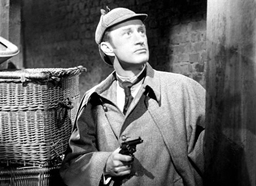
RonHoward_GunSheldon Reynolds, an American producer, went to England looking for an actor to cast as Holmes in a new television series. Alan Wheatley had appeared in six televised plays (filmed live) for the BBC in 1951. Reynolds had much broader horizons. He found Ronald Howard, son of the famous English actor Leslie Howard. It was the senior Howard who insisted that Humphrey Bogart get to reprise his role of Duke Mantee when the successful play was turned into a film. It was Bogart’s first success on screen and helped launch his career. Howard was killed during World War II when the Nazis shot down his commercial plane over the Bay of Biscay.

Ronald Howard sold his house and took his family to France in early 1954. The entire series was to be shot there to save on costs. Reynolds had used this approach before, filming the American series Foreign Intrigue, in Stockholm for reasons of economy.  This time he would be an American producer, with a British Sherlock Holmes, shooting a television show in France.

…

Read More Read More

Discovering Robert E. Howard: Pigeons From Hell From Lovecraft by Don Herron

Discovering Robert E. Howard: Pigeons From Hell From Lovecraft by Don Herron

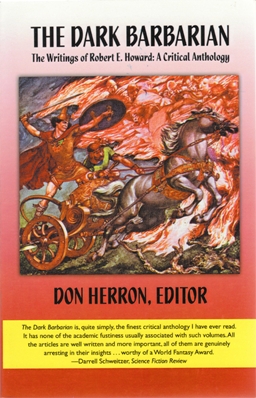
Herron_DarkBarbarianBefore the Cumberbunnies took over and flooded the internet with “I heart Sherlock” memes, the term ‘Sherlockian’ referred to those who studied (and often wrote about) Arthur Conan Doyle’s sixty stories of Sherlock Holmes. Some  of it was dead serious, some was tongue in cheek and much was in between. Monsignor Ronald Knox’s 1921 “Studies in the Literature of Sherlock Holmes” is the cornerstone of Holmes studies.

With that, I tell you that that Don Herron is THE Ronald Knox of Robert E. Howard. “Conan vs. Conantics” and the ensuing “The Dark Barbarian” showed that Howard could be analyzed and treated as literature. As well as something to stir up debate! If you haven’t read the over-600 page essay collection, “The Dark Barbarian That Towers Over All,” you need to pony up $4.99 and get the kindle version now.

And with that, Herron, who is also a noted expert on Dashiell Hammett (this man knows good writing) is going to treat you to a little Howardiana regarding REH’s most chilling horror story, “Pigeons From Hell.”


Recently I did a reread on H. P. Lovecraft’s Fungi from Yuggoth sonnet cycle and had a Hey, Wait a Minute moment. . .

Deep into his follow-up book to A Look Behind the Derleth Mythos, John D. Haefele had asked me to look the poems over. Haefele is surveying Lovecraft’s Great Tales — not just the top achievements, but how the fiction developed as it went along, leading to the break-out stories — not just Lovecraft’s own writing, but how his discoveries of authors such as Robert W. Chambers and Arthur Machen and the ongoing cross-influences of his fellow pulpsters such as Frank Belknap Long, Clark Ashton Smith, and Robert E. Howard display in the ongoing saga that would become known as the Cthulhu Mythos.

…

Read More Read More

The Public Life of Sherlock Holmes: Ramblings on REH

The Public Life of Sherlock Holmes: Ramblings on REH

Ramblings_KullAxeIn a way, Robert E. Howard’s career is similar to that of Dashiell Hammett. Both men had huge impacts on their genres (Howard wrote many styles, but he’s best known for his sword and sorcery tales). Both were early practitioners in said genres. Both men wrote excellent stories for about a decade. And both men ended their careers on their own.

Hammett, who seemed more interested in a dissolute lifestyle than in writing, effectively walked away from his typewriter. He wrote his last novel in 1934 (The Thin Man) but produced literally nothing for the remaining twenty-five years of his life. He could have gone back to writing the hard-boiled stories that made his career, but he voluntarily ended his writing life.

In 1936, Howard’s mother was failing in a coma. He walked outside to his car, pulled out a gun and killed himself. His writing career was more effectively finished than Hammett’s would be.

Both were supremely skilled writers who chose to deprive the world of their talent and left decades of stories unwritten. But there was a key difference between the two. From the beginning, Hammett was acclaimed and recognized as the leader in his field. Though Carroll John Daly came first (barely), there is no comparison between the two in critical view.

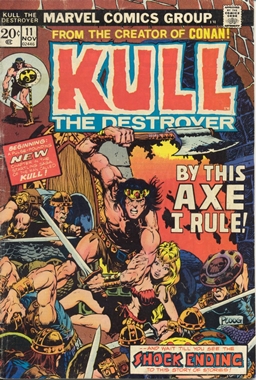
Howard was not critically lauded. His first Conan tale, “The Phoenix on the Sword” (a rewriting of the Kull story, “By This Axe I Rule!”), appeared in Weird Tales in December of 1932. The next two Conan tales were outright rejected!

…

Read More Read More

Discovering Robert E. Howard: Jeffrey Shanks on The Worldbuilding of REH

Discovering Robert E. Howard: Jeffrey Shanks on The Worldbuilding of REH

Conan_WBHyboriaWe are trying to look at as broad a range of topics related to Robert E. Howard as we can in this series. Characters, genres, events, themes: Black Gate really wants to showcase the many facets of the man and his works.

Today’s guest post is such an example. Jeff Shanks wrote the introduction to the just published facsimile edition of Howard’s essay, The Hyborian Age and is the REH consultant on Modiphius’ upcoming Conan RPG  (we’re gonna have a post for that, too!). I can’t think of anyone better to write about one of my favorite subjects,  world-building.


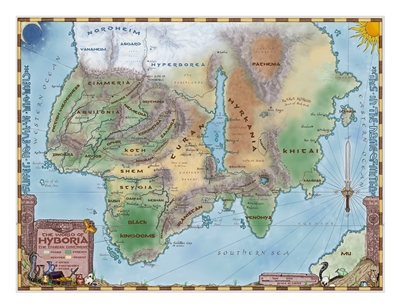
While Robert E. Howard is known as the creator of a number of memorable heroic protagonists, such as Kull of Atlantis, Solomon Kane, Bran Mak Morn, and, of course, Conan the Cimmerian, his efforts as a pioneer in fantasy world-building are often overlooked. When it is remarked upon at all, Howard’s creation of the Hyborian Age of Conan is generally described as a fairly impromptu effort — a hodge-podge of fictitious kingdoms based on thinly-disguised real world historical analogues, thrown together hastily in early 1932 after the first Conan story was accepted by Weird Tales.

…

Read More Read More

The Public Life of Sherlock Holmes: The Moriarty Chronicles

The Public Life of Sherlock Holmes: The Moriarty Chronicles

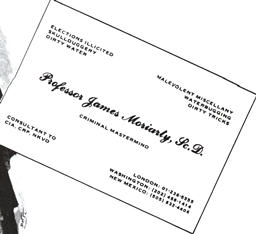
Moriarty_CardPerhaps my favorite Sherlock Holmes pastiche is 1974’s The Return of Moriarty by John Gardner. In it, Professor Moriarty (who did not perish at the Reichenbach Falls) is a Victorian Era godfather, with a criminal organization the envy of the American mob in the Roaring Twenties. A sequel followed it the next year, The Revenge of Moriarty. The trilogy was completed with Moriarty, just a few weeks before Gardner passed away in 2008.

Having completed one muddle of a screenplay about a Civil War naval battle, I took it upon myself to contact John and tell him I was writing a pilot for a proposed TV series about The Return. Extremely polite and friendly, he told me to send it to him when I was done. I did. He and his agent, less than impressed with this amateur effort from a self-taught screenwriter, understandably, passed.

I stayed in email contact with John (who was always nice) up until his death, taking one serious stab at revising the pilot and expanding it to two-hours. I never did resubmit it to his agent (John having passed away by then).

So, read on about The Moriarty Chronicles, a British TV series you, alas, will never see.

…

Read More Read More

The Public Life of Sherlock Holmes: By Crom – Are Conan Pastiches Official?

The Public Life of Sherlock Holmes: By Crom – Are Conan Pastiches Official?

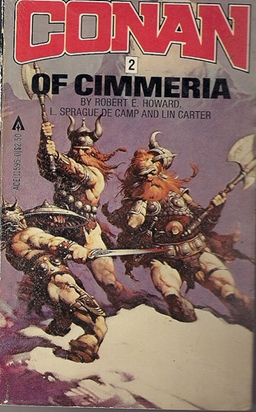
ConaPas_Ace2Today’s post is actually about Robert E. Howard’s Conan, but (in a stunning surprise) it’s got some Sherlock Holmes at the foundation. No, Conan never met the great detective…

Hopefully you’ve been checking in on our summer series, Discovering Robert E. Howard. There are plenty more posts coming, so stay tuned. While I very much like Howard and his works, I came late to his stories and I’m certainly no expert.

There is one area I’ve found…curious, which relates to the “official” status that seems to be accorded to the authorized pastiches written since Howard’s death. It’s quite different in the Holmes world.

There are sixty official Sherlock Holmes tales. Period. Fifty-six short stories and four novels (more novellas, really), all penned by Sir Arthur Conan Doyle and published during his lifetime. There are two Holmes short-shorts, “How Watson Learned the Trick” and “The Field Bazaar” and there is no disputing that they were written by Doyle. But they are not included (by anyone, I believe) in the official count.

You, oh enlightened one, know that the Doyle Estate tried to include a sixty-first story, found among ACD’s papers by a researcher, but it turned out to have been written by Arthur Whitaker.

To quote myself, from my first Solar Pons post here at Black Gate:

Parodies are stories that poke fun at Holmes. But the more serious Holmes tales, those that attempt to portray Sir Arthur Conan Doyle’s detective to varying levels, are called pastiches. Just about the earliest ‘serious’ attempt at a Holmes copy was by Vincent Starrett, who wrote “The Adventure of the Unique Hamlet” in 1920.

Doyle’s son Adrian, sitting at his father’s very desk, produced The Exploits of Sherlock Holmes (half of the stories were co-written with John Dickson Carr, who would quit mid-project).

…

Read More Read More

Discovering Robert E. Howard: Wally Conger on “Rogues in the House”

Discovering Robert E. Howard: Wally Conger on “Rogues in the House”

BG_RoguesComicOne of the cool things about being an active member in the Sherlock Holmes community is that I run across a broad spectrum of people with other common interests outside of the world’s first private consulting detective. Wally Conger and I have had back and forth conversations on versions of The Hound of the Baskervilles and other topics.

We may not agree on season three of Sherlock, but we do both enjoy reading Conan. So, I asked him to review “Rogues in the House,” which I knew he had just read. He was kind enough to do just that…


By the time Robert E. Howard launched into writing “Rogues in the House” in January 1933, he already had 10 Conan tales under his belt. He was very comfortable with the character.

In fact, upon publication of the story in the January 1934 issue of Weird Tales, Howard wrote to fellow writer Clark Ashton Smith:

Glad you liked ‘Rogues in the House.’ That was one of those yarns which seemed to write itself. I didn’t rewrite it even once. As I remember I only erased and changed one word in it, and then sent it in just as it was written. I had a splitting sick headache, too, when I wrote the first half, but that didn’t seem to affect my work any.

I wish to thunder I could write with equal ease all the time. Ordinarily I revise even my Conan yarns once or twice, and the other stuff I hammer out by main strength.

…

Read More Read More