Browsed by
Author: Bob Byrne

The Mandalorian: Star Wars goes Old Wild West

The Mandalorian: Star Wars goes Old Wild West

Mandalorian_HimEDITEDI read my buddy William Patrick Maynard’s post on Guy Boothby’s The Curse of the Snake, and I decided to write a The Public Life of Sherlock Holmes essay on Boothby’s gentleman thief, Simon Carne. But then, I signed up for a one-week Disney+ free trial. And my son and I watched the first three episodes of The Mandalorian, and I knew that Boothby could wait.

I was ten years old when my dad took me to see the first Star Wars movie at the theater. So, I go back to the beginning. I like Star Wars, but I’m not a fanatic. I didn’t care for the second trilogy and I think it was more than ten years before I saw one (I forgot which). I liked Solo, but didn’t like The Last Jedi. I quite enjoyed Star Wars Rebels, but my son likes Star Wars Resistance way more than I do. I’m not predisposed for, or against, a Star Wars production. I judge each one on how much I enjoy watching it.

And right out of the gate, I like The Mandalorian more than a chunk of the movie franchise. Most of my knowledge of Mandalorians comes from Rebels. I don’t know that I ever pondered that Boba and Jango Fett were ones. I just knew they were bounty hunters.

Jon Favreau, who played a huge part in the success of the Marvel franchise, is the creator of this one, and I think he nailed it.

The imdb.com description is pretty accurate:

The travails of a lone gunfighter in the outer reaches of the galaxy, far from the authority of the New Republic.

I immediately picked up on the vibe of the lone gunslinger, wandering from town to town – in this case, as a bounty hunter on a job. We never see star Pedro Pascal’s face, as he never takes off his helmet. He only speaks the bare minimum, making him the stranger of few words.

Read More Read More

Black Gate Online Fiction: ‘The Jarvis Pendragon Files – The Adventure of the Speckled Band’

Black Gate Online Fiction: ‘The Jarvis Pendragon Files – The Adventure of the Speckled Band’

The sitting room of 221b Baker Street London

My friend Sherlock Holmes, with whom I shared lodgings and adventures, had already breakfasted and was slumped in his favorite chair when I descended to our sitting one room one November morning. From the discarded newspapers strewn about the floor, I knew that he had failed to find one of those interesting crimes which so intrigued him.

Shortly after hearing my footsteps on the stairs, Mrs. Hudson arrived with fresh coffee, some fish left over from the previous night’s meal, devilled kidneys (which Holmes despised), bacon and toast. As Holmes had rather churlishly replied to my greeting, I set to breaking my fast.

After the dishes had been cleared away and I was settled in my own chair, sorting through the post, I held a letter out towards him. “Here’s one for you, Holmes. From a “Jarvis Pendragon, DC.”

I looked at him, puzzled. “What does ‘DC’ stand for?”

He broke through the malaise enough to negligently wave a hand. “Who knows? Pray, read it. Perhaps it will enliven this otherwise intolerably boring morning.”

I have mentioned before in these recountings of Sherlock Holmes’ cases, that humility is not a trait for which he has much admiration. On more than one occasion, he has identified modesty not as a virtue, but as a distortion of the truth. And I have excluded many of his own statements about his powers of observation and deduction that were quite the opposite of ‘humble.’

Of course, his belief in his talents and abilities, which he had honed to razor sharpness, were justified. But, as his roommate, companion, and if I may add, useful assistant, on his adventures, his self-aggrandizement could be more than a trifle wearying.

So, it was with some amusement, as I was to discover, that I read aloud his letter.

But first, he forestalled me with an upraised hand. “Be not so hasty, Watson. What can you tell me from an inspection of the envelope?”

I turned it over in my hands slowly, my eyes scanning the surface for any clues or hints.

“Brighton postmark. Common envelope. Careful handwriting on the address. Clearly legible. I see nothing else of note, Holmes.”

He shook his head in disapproval, but said nothing.

Read More Read More

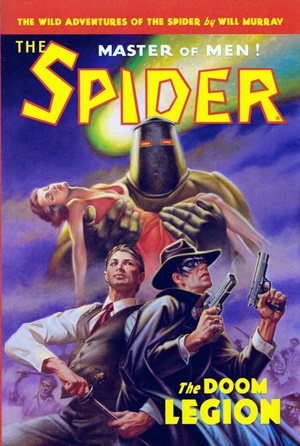
A (Black) Gat in the Hand: Will Murray on The Spider

A (Black) Gat in the Hand: Will Murray on The Spider

Murray_SpiderdoomLegionEDITED“You’re the second guy I’ve met within hours who seems to think a gat in the hand means a world by the tail.” – Phillip Marlowe in Raymond Chandler’s The Big Sleep

(Gat — Prohibition Era term for a gun. Shortened version of Gatling Gun)

You know, of course, that Will Murray carried on the adventure tales of the Doc Savage – because you read about it here!  Will is also carrying on the adventures of another legendary pulp figure – The Shadow.  So, he’s making another guest post here in the series. Read on for: Secret Origins of the Spider.

I have to confess that writing The Spider is a completely different experience for me than writing the Wild Adventures of Doc Savage, Tarzan, John Carter, or any of the other classic pulp heroes I’ve been privileged to bring back to life in new novels.

With these other pulp heroes, it’s largely a matter of concocting a logical plot and having the heroes go through their customary pieces, although I seem to have quickly become an accidental king of crossovers since I’ve managed to convince the various license holders to permit me to have a few of them collide, such as Doc Savage and The Shadow, Tarzan of the Apes and King Kong. Most recently, the Spider encountered both Jimmy Christopher of Operator #5 magazine fame and G-8, but without his Battle Aces in my first Spider novel, The Doom Legion. So some of their customary paces are not so customary.

When I acquired a license to the Spider a few years ago, I asked the late Joel Frieman of Argosy Communications about a mystery that had vexed me for a long time. Namely, why did Canadian novelist R.T.M. Scott write only the first two Spider novels, and then give way to Norvell W. Page, who worked under the house name of Grant Stockbridge?

Joel knew Popular Publications founder Harry Steeger and got the answer from him.

Watching the phenomenal sales growth of Street & Smith’s Shadow Magazine, he naturally itched to produce something in that emerging category. But Steeger didn’t want to get sued. So he conferred with his attorney and asked, essentially, how do we do something like The Shadow and not risk an expensive lawsuit?

Read More Read More

A (Black) Gat in the Hand: Steve Scott on John D. MacDonald’s ‘Park Falkner’

A (Black) Gat in the Hand: Steve Scott on John D. MacDonald’s ‘Park Falkner’

MacDonald_BreatheNoMoreEDITED“You’re the second guy I’ve met within hours who seems to think a gat in the hand means a world by the tail.” – Phillip Marlowe in Raymond Chandler’s The Big Sleep

(Gat — Prohibition Era term for a gun. Shortened version of Gatling Gun)

Steve Scott runs The Trap of Solid Gold. It’s not just a blog dedicated to my favorite author. It’s THE blog dedicated to the late, great John D. MacDonald. It is absolutely the best place on the web to read about JDM. Period. I was going to do a post on an early, quickly aborted attempt by MacDonald to write a series character – if two stories qualifies as a series. Then I remembered, I had read a post by Steve on one of those stories. Turns out, he’d covered both of them. And his essays were FAR better than anything I could have come up with. So, I got permission from Steve to combine them and run a long post as part of A (Black) Gat in the Hand. Woohoo! Read on about the not-a-private eye, Park Falkner

Story One – “Breathe No More My Lovely”

Long before Travis McGee was even a random thought in the mind of author John D MacDonald, before he had established himself as a first-rate writer of crime fiction, before he had even a full year of life as a published author, MacDonald began experimenting with a “series” character. In two early Doc Savage submissions, “Private War” in December 1946 and “Eight Dozen Agents” in January 1947, he created a hero he called Benton Walters. Having never read either of these stories, I don’t know if Walters was a private eye, a secret agent or a super hero.

According to Ed Hirshberg, he was a “war veteran… working at a humdrum civilian job somewhere in the northeastern United States…” who was disillusioned with his “unexciting” postwar job. Sounds like a great idea for a series. I do know that MacDonald quickly dropped the idea, writing to Babette Rosmond (the editor of Doc Savage):

“Honest to God — I’m never going to start another series. They are limiting and I hate them.”

Sixteen years later Travis McGee was attempting to have a quiet evening a home while Chookie McCall was dancing up a storm in the lounge of The Busted Flush.

Read More Read More

A (Black) Gat in the Hand: Frank Schildiner on ‘The Bad Guys of Pulp’

A (Black) Gat in the Hand: Frank Schildiner on ‘The Bad Guys of Pulp’

Schildiner_LesHabits1EDITEDMy buddy Frank Schildiner is a prolific New Pulpster who wrote about Max Allen Collins in the first run of A (Black) Gat in the Hand. I immediately turned back to him and he’s back again for round two with a look at the bad guys of pulp. 

“You’re the second guy I’ve met within hours who seems to think a gat in the hand means a world by the tail.” – Phillip Marlowe in Raymond Chandler’s The Big Sleep

(Gat — Prohibition Era term for a gun. Shortened version of Gatling Gun)

  “Bring on the Bad Guys…Pulp Edition”

“The battle line between good and evil runs through the heart of every man.” – Aleksandr Solzhenitsyn

“There’s something about America’s sweetheart and America’s bad boy. That juxtaposition is what everyone desires.” – Machine Gun Kelly

Bad guy, villain, evildoer, crook, criminal, and gangster. Fiction has a love affair with these characters ranging from low-level sneak thieves to wizards intent on destroying all life on Earth. In many cases, the villain is the driving force behind the tale. Where would fiction be without Lady MacBeth, Grendel’s Mother, Long John Silver, or Count Dracula?

Though the villain is often the impetus, they rarely hold the place of protagonist in novels until recent times. A few famous characters did achieve notoriety, influencing fiction to this day.

The first true villain-centered, serialized fiction was probably Paul Féval’s series Les Habits Noirs. The eleven novels reveal a worldwide criminal conspiracy led by the evil, manipulative, and possibly immortal, Colonel Bozzo-Corona. The Colonel, and his organization the Black Coats, battled the forces of good as well as each other in tales which thrilled readers for thirty-one years.

Read More Read More

Nero Wolfe’s Brownstone: 3 Good Reasons – Murder is Corny

Nero Wolfe’s Brownstone: 3 Good Reasons – Murder is Corny

Nero WolfeAlas – the home front is a bit…chaotic, with my wife halfway around the world on a mission and trip and the eleven-year old still needing school transportation – among other things. I didn’t get to finish editing this week’s A (Black) Gat in the Hand post – so, here’s the second entry in a feature which I hope will be part of a Nero Wolfe column next year. You can read my first try, covering “Not Quite Dead Enough.”

With a goal of eventually tackling every tale of the Corpus, I’ll give three reasons why the particular story at hand is the best Nero Wolfe of them all. Since I’m writing over seventy ‘Best Story’ essays, the point isn’t actually to pick one – just to point out some of what is good in every adventure featuring Wolfe and Archie (BTW – I got the idea from Hither Came Conan from this Wolfe series!). And I’ll toss in one reason it’s not the best story. Now – These essays will contain SPOILERS. You have been warned!

The Story

Today’s story is “Murder is Corny,” from Trio for Blunt Instruments. Nero Wolfe is upset because the weekly delivery of fresh corn is late. It finally arrives in the hands of Inspector Cramer, who got it from the scene of the murder of the delivery man. Archie had had a few dates with Susan McLeod, the farmer’s daughter, and she has unintentionally framed him for murder. Cramer arrests Archie, and to preserve his comfort level, Wolfe takes on the case, with Archie as his client.


3 GOOD REASONS

ONE – The Corn

This story contains one of my favorite openings. Every Tuesday, from July 20 to October 5, sixteen ears of just-picked corn are delivered to the brownstone from the farm of Duncan McLeod. Wolfe, of course, is very particular about the corn, including the requirements that it must be picked not more than three hours before he receives it, and that it must arrive between 5:30 and 6:30. Fritz prepares all of it for that evening’s dinner. But on this September Tuesday, the corn never arrives and Fritz has to make do with stuffed eggplant. Oh, the horror!

Wolfe is out of sorts and doesn’t engage Archie in their usual post-dinner conversation, over coffee in the office. He is standing at the giant globe, whirling it and scowling at it. This is unwarranted physical exertion on Wolfe’s part!

Inspector Cramer rings the doorbell and is admitted, carrying a carton with Wolfe’s name on it. He marches down the hall, deposits it on Wolfe’s desk and cuts the cord around the box. As Wolfe comes over to his desk, Cramer opens the flaps, holds up an ear of corn and says, “If you were going to have this for dinner, I guess it’s too late.”

Read More Read More

A (Black) Gat in the Hand: Andrew Salmon on David Montrose

A (Black) Gat in the Hand: Andrew Salmon on David Montrose

This week, I got fellow Sherlock Holmes friend Andrew Salmon to hold forth on hardboiled pulp. You’d be surprised how many Holmes fans are also pulpsters. Andrew is a leading light in the New Pulp movement (along with some other Black Gate guest posters, like Frank Schildiner, Will Murray and Duane Spurlock – who wrote last week’s post). Today, he takes us international, so read on!

“You’re the second guy I’ve met within hours who seems to think a gat in the hand means a world by the tail.” – Phillip Marlowe in Raymond Chandler’s The Big Sleep

(Gat — Prohibition Era term for a gun. Shortened version of Gatling Gun)

A FRIEND IN TEED – The Lost World of Montreal Noir

Montrose_DorvalEDITEDThoughts of hardboiled fiction’s history conjure Mike Hammer’s New York or the sunny California of Sam Spade and Lew Archer. But the rich tradition of the genre along with Noir has expanded immensely, yielding rich gold mines in Berlin Noir and Dublin Noir to name two of many.

And yet there is a closer example of the universality of mean streets all over the world laid out in grimy exuberance in a hardboiled tale well told – and it is not a recent offshoot. I’m talking about the little known, until recently, forgotten hardboiled Canadian noir of the 1950s.

These were paperbacks to be found on spinner racks on both sides of the border. Issued by small printing houses in small print runs for the much smaller population of Canada, the pulp yarns churned out by a host of writers was long forgotten and scarce hardly sums up their availability. They aren’t collectible offerings from big names in publishing. The books came and went to molder in attics, landfills and to find second use helping to start fires on cold Canadian nights. Lost to time.

Until Ricochet Books, an arm of Vehicule Publishing, decided to pick up the gauntlet laid down by Hard Case Crime Books (among others) and began hunting up these lost gems. The books are widely available now in new editions with the old, classic covers and I urge you to look them up.

For the sake of this piece, however, I’d like to focus on a trio of novels that best fit the hardboiled school. Author Charles Ross Graham, writing as David Montrose, produced three Russell Teed novels between 1950 and 1953. Teed’s a former reporter turned private eye and in typically understated Canadian fashion works insurance claims and other non-violent crimes.

That is until the first book, The Crime on Cote Des Neiges (1951), which has him thrown into the investigation of a bootlegger’s murder. The police are convinced the widow is the guilty party and Teed has to get her out from under before it’s too late. What follows is an engaging mystery the hard drinking Teed weaves his way through amidst an entertaining presentation of Montreal when it was the Sin City of the North.

Read More Read More

A (Black) Gat in the Hand: Duane Spurlock on T.T. Flynn’s Westerns

A (Black) Gat in the Hand: Duane Spurlock on T.T. Flynn’s Westerns

Flynn_DeepCanonEDITEDAnd we’re back live here at A (Black) Gat in the Hand. And we went big, making our first foray into that venerable pulp genre, The Western. I lobbied author Duane Spurlock to join in during the column’s first run, and he decided it was easier to write a post than have me pestering him again. I discovered T.T. Flynn through his Dime Detective stories about racetrack bookie Joe Maddox. But Flynn would go on to a long, successful career writing Westerns. Read what Duane has to tell us!

“You’re the second guy I’ve met within hours who seems to think a gat in the hand means a world by the tail.” – Phillip Marlowe in Raymond Chandler’s The Big Sleep

(Gat — Prohibition Era term for a gun. Shortened version of Gatling Gun)

When we discuss hard-boiled narrative, the default topic typically is crime fiction—usually the pulp-magazine-era tales from Black Mask and its contemporary competitors through the digest era, culminating in the pages of Manhunt and engendering the rise of the paperback original novel. Bob Byrne  has been admirably addressing the earlier realm of hard-boiled narrative in his Black Gat essays.

But hard-boiled writing encompasses more than the works of Carroll John Daly, Dashiell Hammett, Raymond Chandler and their followers. The western genre is a prime example.

These days, if someone mentions the hard-boiled western, what usually come to mind are the violent Spaghetti Western film genre and the resulting prodigious output from the Piccadilly Cowboys and The Man With No Name novels written by Joe Millard and others. Actually, the western and hard-boiled narrative have a long, intertwined history. It began at least with the novel that launched what we recognize as the literary western romance: the 1902 bestseller by Owen Wister, The Virginian, which includes the famous line, “When you call me that, SMILE!” If that’s not hard boiled, I’m not sure where we’ll go with this discussion.

(1902: Twenty years before Daly published ‘the first hard-boiled story,’ “The False Burton Combs” in Black Mask and before Hammett’s first stories, “Holiday” and “The Parthian Knot,” appeared in Pearson’s Magazine and The Smart Set; twenty-one years before Ernest Hemingway’s first short stories were published in Paris, “Three Stories and Ten Poems“)

Of course, the western and the crime story are closely related: since most involve robbers, rustlers, and murderers, we don’t really need John Cawelti’s The Six-Gun Mystique or Richard Slotkin’s Gunfighter Nation to make those connections. During the pulp era, many writers worked in both western and crime/mystery genres, as a number of contemporary authors continue to do – the late Ed Gorman, Loren Estleman, Bill Pronzini, Robert Randisi, and the late Bill Crider have all created excellent tales in both arenas). Among them was T.T. Flynn, whose writing career began in the 1920s.

Read More Read More

A (Black) Gat in the Hand: Hard Boiled Holmes

A (Black) Gat in the Hand: Hard Boiled Holmes

HBH_Murder

OK: The kidney stone passed and I spent last week trying to dig myself out of…well, everything! So, it’s another repeat colum this week. I happen to think this the best thing I ever wrote before I joined Black Gate. Yeah – you’re actually getting my good stuff here at Black Gate. Sad, ain’t it?

I wrote this for Sherlock Magazine, where I wrote a column reviewing mystery websites. Then-editor David Stuart Davies (a notable writer of Sherlock Holmes stories and non-fiction) let me write a feature. I will probably revisit this some day, as I’ve learned a lot more about hardboiled since then; but I still think this is pretty darn good. Let me know what you think!

And we’ll be back on track next week. 

“You’re the second guy I’ve met within hours who seems to think a gat in the hand means a world by the tail.” – Phillip Marlowe in Raymond Chandler’s The Big Sleep

(Gat — Prohibition Era term for a gun. Shortened version of Gatling Gun)

By now, readers of this column (all three of you) know that I’m ‘all-in’ on Sherlock Holmes and Solar Pons. But I am also a long-time hard boiled fiction afficionado. I’ve got a section of the bookshelves well-stocked with private eye/police novels and short stories, from Hammett and Daly to Stone and Burke.

Now, I wouldn’t bet my house on the premise of the following essay, which first appeared in Sherlock Magazine back when I was a columnist for that fine, now defunct periodical. But I believe that I make a more compelling argument than you thought possible at first glance. The roots of the American hard boiled school can be seen in Sherlock Holmes and the Victorian Era. Yes, really.

And if any of the hard boiled heroes mentioned catch your fancy, leave a comment. I’ll be glad to tell you more about them. Without further ado, I bring you “Hard Boiled Holmes.”

“But down these mean streets a man must go who is not himself mean, who is neither tarnished nor afraid.”

Raymond Chandler wrote these words in his essay, ‘The Simple Art of Murder.’ Ever since, the term ‘mean streets’ has been associated with the hard-boiled genre. One thinks of tough private eyes with guns, bottles, and beautiful dames. But was it really Chandler who created those words to describe the environment that the classic Philip Marlowe operated in?

Is it possible that it was Victorian London that gave birth to the mean streets, which would later become famous as the settings in the pages of Black Mask? Could it be that Sam Spade and Philip Marlowe were followers in the footsteps of Sherlock Holmes?

Read More Read More

A (Black) Gat in the Hand: A Man Called Spade

A (Black) Gat in the Hand: A Man Called Spade

Spade_Falconbook

You might have noticed that my column – heck, my byline – was absent last week. Having recovered from hernia surgery, I promptly decided to have a kidney stone. It ‘hit’ last Saturday night and for about twenty hours, it was the most pain I’ve had in my life (no wife joke here…). It seems to be comfortable and hasn’t passed yet, though it’s not so bad at the moment. But between missing three days at work, peeing nonstop, and trying to catch up at work while still feeling some pain, this week’s column was pretty far down the list.

So, I decided to re-run one of my hardboiled posts from well before I ever thought of doing an entire column on that topic. I LOVE The Maltese Falcon: book and movie. Not a lot of folks know Hammett wrote a few short stories about Sam Spade: though he seemed to have done so just for some quick cash; and his heart wasn’t really in it. Read on to learn a bit about it all.

“You’re the second guy I’ve met within hours who seems to think a gat in the hand means a world by the tail.” – Phillip Marlowe in Raymond Chandler’s The Big Sleep

(Gat — Prohibition Era term for a gun. Shortened version of Gatling Gun)

In last week’s column, I mentioned The Maltese Falcon, starring Humphrey Bogart. (Did you follow instructions and watch it for the first time?) Over eighty years after its publication, Dashiell Hammett’s The Maltese Falcon stands supreme today as the finest private eye novel ever written. Bogie’s 1941 film proved that the third time is a charm, prior attempts in 1931 and 1936 having failed.

Sam Spade, the quintessential tough guy shamus, appeared in a five-part serial of The Maltese Falcon in Black Mask in 1929. Hammett carefully reworked the pieces into novel form for publication by Alfred E. Knopf in 1930 and detective fiction would have a benchmark that has yet to be surpassed.

Hammett, who wrote over two dozen stories featuring a detective known as The Continental Op (well worth reading), never intended to write more about Samuel Spade, saying he was “done with him” after completing the book-length tale.

Read More Read More