Fantasia 2020, Part XVIII: A Mermaid In Paris
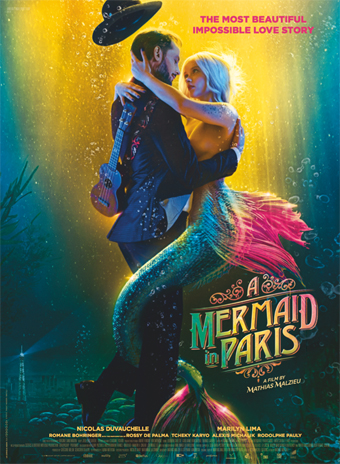 Back in my 2014, my first year covering the Fantasia Festival for Black Gate, I reviewed an animated movie called Jack and the Cuckoo-Clock Heart, the debut film from director Mathias Malzieu. The songwriter and lead singer of French pop band Dionysos, Malzieu’s also a writer; Jack was also a concept album and novel as well as a film. Now Malzieu’s got a new movie, filled with singing and dancing and whimsy. A Mermaid In Paris (Une sirène à Paris) has many of the same visual influences as Jack, but moves beyond them in a new way. Although it has a happier ending, it also has a truer feel for melancholy and grief, and with that a sense of greater depth.
We follow Gaspard (Nicolas Duvauchelle), a singer at a bar owned by his father Camille (Tchéky Karyo) who is thinking about selling the magical place, located on a boat, hidden under a café. One night, Paris is flooded, and Gaspard finds a beautiful mermaid (Marilyn Lima) washed up on the cobbles. He takes her to a hospital where, unknown to him, she gains strength by draining the life of a doctor, Victor (Alexis Michalik), with her song. Unable to get the staff to give her treatment, Gaspard takes her home, not knowing that Victor’s wife Milena (Romane Bohringer) has sworn to find her husband’s killer. Will Lula, the mermaid, kill Gaspard? Will Gaspard, who believes he cannot love a woman after a failed relationship in his past, be drawn to her nevertheless? If so, will Lula survive, who must be returned to her native element?
Such the questions of the film. We get fine answers, though the plot that provides them is a bit ragged, here and there. Specifically, Milena is a little underplayed. Nominally the villain, she doesn’t do that much over the course of the movie, and creates little sense of tension or threat. In a way, that’s a testament to how much Bohringer brings to the part; it’s impossible not to feel for her, and Malzieu’s direction and visual imagination makes her love for Victor a powerful counterpart to the development of Gaspard and Lula’s love.
It’s also true that the basic tone of the movie is one of romance, not logic. Reality is heightened, the visual world of the film shaped by emotion, primarily love. This is the Paris of fairy-tales and dreams: colour is rich, music is everywhere, the people are whimsical and lightly ironic. Where Malzieu’s first film was strongly influenced by Tim Burton, this one marries the Burton feel to Jean-Pierre Jeunet, specifically the Jeunet of Le Fabuleux Destin d’Amélie Poulain. It is the kind of city into which a mermaid might wash up, and if the people of the film show less surprise at a mermaid than you might expect, that’s probably why.

 I try to keep an eye on comics, but like many people my first exposure to Pepe the Frog was as a poorly-drawn meme spouting racism. I remember reading about Pepe’s comics origin, but the name of Matt Furie, the cartoonist who created him, remained a piece of trivia. As did his comic Boy’s Club, where the frog first appeared. Now there’s a documentary telling the whole story of Furie, Pepe, and Boy’s Club — a tale of politics, appropriation, and how art can be used in ways the artist could not imagine, for worse and for better.
 One of the genuinely wonderful things about covering a film festival is occasionally getting to be among the first audiences for a movie trying something new. That is, being an early viewer of a movie that does things unlike other movies, and getting to make one’s own mind up on whether those things work. Movies at a festival have often not had a critical consensus formed around them, and have not yet been defined by other writers or had their influences mapped out. You as the viewer are alone with the thing, almost contextless, in a way that’s rare these days.
 Consider if you will the high school story. By which I mean a story set at a high school, usually involving some members of the student body. It’s relatively unusual for these kinds of stories to be about actual academic achievement, or to put more than maybe one or two members of the faculty in the foreground. It happens, of course. But usually high school stories are about the students, and their lives and interactions, with classes and teachers and adults as external factors that can be used to shape the story but are ultimately incidental to it.

 Watching a film festival at home instead of in theatres raises a question that’s become a much-debated point over the last couple of years: is the experience of viewing a movie on a TV screen essentially different and essentially lesser than watching the same movie in a theatre? I don’t think there’s a single answer to this question. Different movies and different viewers and different circumstances will create better or worse scenarios. I think it is probably safe to say that the theatrical experience has much more sensory power; that the powerful sound system and the controlled environment and the full dark of a theatre will usually be more immediately overwhelming to a viewer. But it’s reasonable to wonder if a movie that relies on sheer sensory power can be called ‘a good movie.’