Bernie Mireault’s THE JAM: URBAN ADVENTURE
 Before he became a regular artist for Black Gate, Bernie Mireault was already something of a Renaissance man in the comics industry. He’s been a writer, artist, letterer, and highly acclaimed colorist, and worked with Matt Wagner (Grendel), Joe Matt, Mike Allred, and many others. His comics include Dr. Robot, Bug-eyed Monster, The Blair Witch Chronicles, and his masterpiece, The Jam.
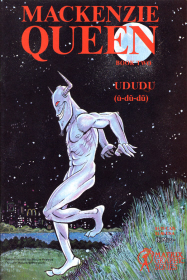
Our first meeting (that we know of) was in 1985, when Bernie crashed at my home in Ottawa, Canada. I was living with my parents while I studied at the University of Ottawa, and Bernie and his fellow creators with Montreal-based Matrix Comics were attending a local comics con. Bernie had just published the first issue of Mackenzie Queen, a marvelous piece of satirical horror featuring an exiled demon with a taste for dripping meat, who learns to be satisfied with Corn Flakes (“at least they drip.”) It was one of the first comics to make me laugh out loud. I’d been corresponding with Mark Shainblum at Matrix for months, and when I learned he was coming to town, I graciously offered my parent’s home as crash space (pretty sure I neglected to check with my parents first, which is part of what made it so gracious). Mark brought Gabriel Morrissette and Bernie Mireault, and the rest is history.
 I say “first meeting that we know of” because Bernie and I were born in the exact same (and very small) place — a Canadian Air Force base in Marville, France — only a few years apart in the early 60s. Did we pass briefly as toddlers in the officer’s mess, and maybe compare our love for cartoons and comics while our fathers saluted each other over trays of french bread and beans? Probably not. But hey, man. It’s possible.
We lost touch for a few years when I moved to the US to finish grad school (and meet a girl from California and get married, but that’s another story). But I followed Bernie’s career closely. It wasn’t hard — he was all over the place, from Wonder Woman to Mr. Monster to Tales of the Batman. He even showed up — along with Matt Wagner — in Joe Matt’s autobiographical classic, Peep Show, as a minor character named only “Bernie.” But I recognized him immediately. Who wouldn’t?
But enough of trying to describe how cool Bernie is. To understand, you need to experience his work. And now you can!


 I was commenting the other day on the surplus number of wonderful S&S anthologies I’ve stumbled on since a friend and I began a collaborative shared world writing project a few weeks ago, both writing stories set in a fantasy/medieval city with a history and a river and neighborhoods and taverns and all the usual trappings. His background in world building (via D&D or whatever) is less than mine, and mine is quite scant, so our efforts have grown in odd bits and pieces: first the tavern, then the name of the city, then a mountain backed up against it, and so on.
 The place is here, the time is now, and the journey into the shadows that we’re about to watch could be our journey.
 I read an interesting post the other day by a thoughtful blogster whose name I cannot now remember and whose post I cannot locate again, who professed his surprise at all the fans of Conan (and Sword & Sorcery in general) who were returning to the fold now, after falling away in the 1980s, after the last Big S&S Boom.
 I’m a sucker for retrospective anthologies. And F&SF is one of my favorite magazines — and has been since I first discovered tattered copies in the tiny library of Rockcliffe Air Force base in Ottawa, Canada, in the late 70s. Editor Gordon van Gelder has assembled an imposing, 470-page collection spanning more than five decades, starting with Alfred Bester’s “Of Time and Third Avenue” (1951) and ending with Ted Chiang’s “The Merchant and the Alchemist’s Gate” (2007).