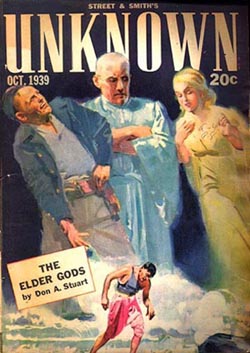
Who Gods There?: “The Elder Gods” by Don A. Stuart
 I’m guest-blogging this week at Babel Clash, along with fellow Pyr author Matt Sturges, and for the past couple days we’ve been kicking around the topic of our influences and anti-influences. It’s not always the biggest books or the best that are influences, though. For instance…
Don A. Stuart‘s “The Elder Gods” is a fantasy novella from the late 1930s that reads a lot like the science fiction being written around the same time. That’s no accident: the author behind the pseudonym is John W. Campbell, once a leading light in the “super science” stories of the 1930s, later a pioneer of a more sophisticated form of speculative fiction, and (by the time the work under review appeared) he was well into his third and longest career as the influential editor of Astounding Science Fiction–and the new fantasy magazine Unknown, in which “The Elder Gods” first appeared. (I reread it in a rather battered copy of the 1970s Ace reprint of The Moon is Hell; but there’s a NESFA edition of Campbell’s Stuart stories, including “The Elder Gods”. That’s what I’d recommend seeking out, if you’re interested, as there are some typographical glitches in the Ace edition; plus, it may be harder to find; plus, I’ve always thought “The Moon Is Hell” was a stupid title.)
In Unknown, Campbell didn’t want to create yet another knockoff of Weird Tales; the tagline for the paper-covered anthology From Unknown Worlds was “Fantasy Stories for Grown Ups”–by which he seems to have meant the serious grownups who were reading Astounding. Lots of his Astounding writers crossed over to write for Unknown, and “The Elder Gods” was apparently his how-to-do-it example, applying the Astounding method of speculative fiction to fantasy.
[ Spectacular Stories of Scientific Theology beyond the jump.]
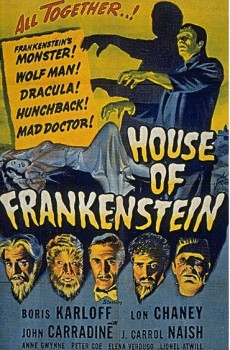 House of Frankenstein (1944)
 Fans of Tom Waits are often divided into two camps: those who favor the early boozy Kerouac, be-bop inspired crooner of life’s derelicts and losers up until he transmogrified beginning with the “Heartattack and Vine” album and “crossed over” into Kurt Weill cacaphonous orator of the absurd; fans of the later period sometimes disdain the earlier, and vice versa, despite the obvious connections. Me, I’m in the third camp as a huge admirer of both milieus. (I suppose there’s a further quarter of people who can’t stand Waits at all, but, much like the folks who still tiresomely maintain Dylan hasn’t done anything since his protest days, aren’t worth serious attention.)
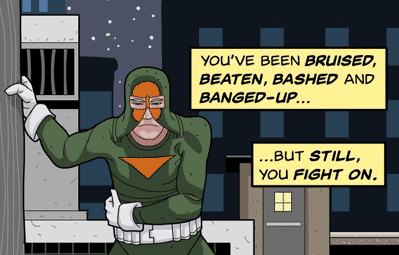 Before he became a regular artist for Black Gate, Bernie Mireault was already something of a Renaissance man in the comics industry. He’s been a writer, artist, letterer, and highly acclaimed colorist, and worked with Matt Wagner (Grendel), Joe Matt, Mike Allred, and many others. His comics include Dr. Robot, Bug-eyed Monster, The Blair Witch Chronicles, and his masterpiece, The Jam.
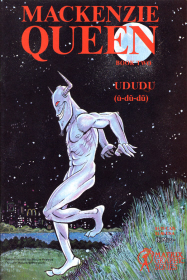 I say “first meeting that we know of” because Bernie and I were born in the exact same (and very small) place — a Canadian Air Force base in Marville, France — only a few years apart in the early 60s. Did we pass briefly as toddlers in the officer’s mess, and maybe compare our love for cartoons and comics while our fathers saluted each other over trays of french bread and beans? Probably not. But hey, man. It’s possible.

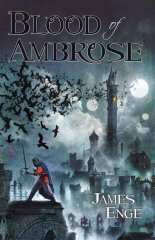 I was commenting the other day on the surplus number of wonderful S&S anthologies I’ve stumbled on since a friend and I began a collaborative shared world writing project a few weeks ago, both writing stories set in a fantasy/medieval city with a history and a river and neighborhoods and taverns and all the usual trappings. His background in world building (via D&D or whatever) is less than mine, and mine is quite scant, so our efforts have grown in odd bits and pieces: first the tavern, then the name of the city, then a mountain backed up against it, and so on.
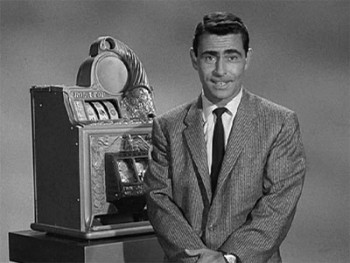 The place is here, the time is now, and the journey into the shadows that we’re about to watch could be our journey.
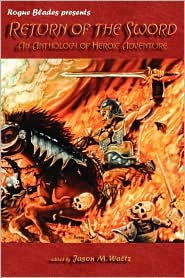 I read an interesting post the other day by a thoughtful blogster whose name I cannot now remember and whose post I cannot locate again, who professed his surprise at all the fans of Conan (and Sword & Sorcery in general) who were returning to the fold now, after falling away in the 1980s, after the last Big S&S Boom.