You’ve probably heard the recentreports about William Shatner’s possible return in the upcoming Star Trek 3, where he and Leonard Nimoy would appear together as Kirk and Spock one more time.
Pretty exciting stuff for an old-time Star Trek fan like me. Although the big event has just been scooped by a German Volkswagen ad released this week, which features both Leonard Nimoy and William Shatner (not to mention the Star Trek theme music, which probably wasn’t cheap to license for a car ad) in a charming 45-second spot. Yes, the ad is in German, but you’ll have no trouble following the dialog (Hint: The German phrase for “Captain Kirk” is “Captain Kirk.”)
The complete spot is below. Enjoy.
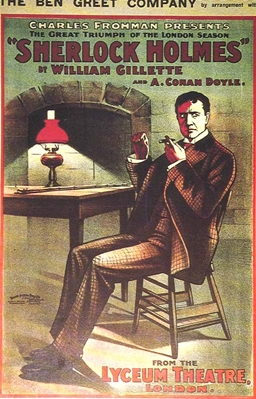
The Public Life of Sherlock Holmes: The First Great Holmes (Gillette)
In 1897 or 1898, Arthur Conan Doyle decided to “revive” Sherlock Holmes, who had gone over the ledge at the Reichenbach Falls in 1893. He wrote the first draft of a play starring the detective.
Since he already had scored a hit with his non-Holmes play, A Tale of Waterloo, Doyle must have figured that the public would ring up the cash register in seeing their favorite detective again: this time on the stage.
Doyle lost interest in the project, but his agent sent the five-act play off to noted Broadway producer and agent Charles Frohman. Frohman, who died aboard the ill-fated Lusitania, felt that the play was not commercial enough as it was and told Doyle that popular American actor William Gillette should revise and then star in it.
The uninterested Doyle gave his permission and Gillette transformed Holmes into more of a melodrama star and less of a stodgy British detective.
Gillette read all of Doyle’s original stories, took four weeks off from his current tour for the popular Secret Service and rewrote the play. That November, a fire in San Francisco’s Baldwin Hotel destroyed all of the scenery and sets of Secret Service; and also the only script of Sherlock Holmes!
It’s Elementary – Gillette asked Doyle if he could marry Holmes for the play. Doyle’s reply via telegram has become famous: “You may marry him, murder him or do anything you like to him.”
I’ve watched cartoons most of my life. It started with Spider-Man, Underdog and Star Trek: The Animated Series in the 1970s. In the 90s, it was Ren and Stimpy, Pinky and the Brain, and the brilliant The Tick. When my kids came along, we’d watch Gargoyles, Samurai Jack, Static Shock, and especially the great Batman Beyond together. For most of my first four decades, Saturday mornings meant curling up on the couch to share the adventures of my favorite funny animals and cartoon superheroes.
Over the last ten years, more stations have abandoned Saturday morning animated programming. Now The Washington Post is reporting that the CW, the last broadcast station with a full slate of animated shows on Saturday morning, has just done away with them.
This past Saturday, the CW became the last broadcast television network to cut Saturday morning cartoons. The CW is replacing its Saturday cartoon programming, called “The Vortexx,” with “One Magnificent Morning,” a five-hour bloc of non-animated TV geared towards teens and their families.
From the 1960s through the 1980s, Saturday morning time slots were synonymous with cartoons. Broadcast networks and advertisers battled for underage viewers. But that started to change in the 1990s. In 1992, NBC was the first broadcast network to swap Saturday morning cartoons for teen comedies such as “Saved by the Bell” and a weekend edition of the “Today” show. Soon, CBS and ABC followed suit. In 2008, Fox finally replaced Saturday morning cartoons with infomercials.
In the 1970s and 1980s, a Saturday morning cartoon viewership could grab more than 20 million viewers. In 2003, some top performers got a mere 2 million, according to Animation World Network.
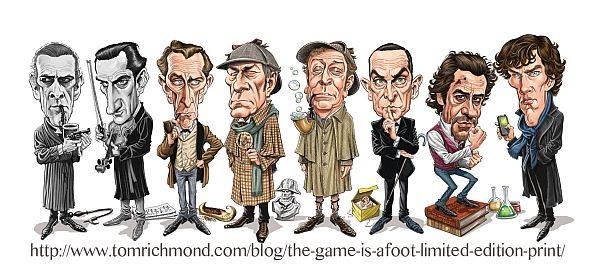
An awesome print by Tom Richmond of Holmes on screen over the years. I own print #7 of 450
Surprisingly, The Public Life of Sherlock Holmes has now made it to thirty posts. While I’m sure the dedicated reader types ‘Public Life of Sherlock Holmes’ in the search field to call up all the posts in the series, I said to myself (I talk to myself a lot), “Bob, there’s got to be an easier way for someone to bask in the entirety of your writings so far.”
And there is! Below is an index with links to all the posts, followed by some topics likely to come.
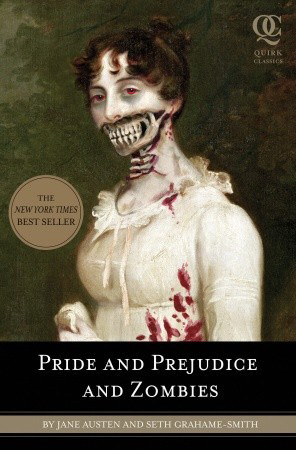
Just in time for the start of the Halloween season, we hear that Pride And Prejudice And Zombies has truly risen from the grave.
Based on the 2009 novel by Seth Grahame-Smith (and Jane Austin of course) P&P&Z tells the tale of “manners, morals and brain-eating mayhem” and has been sitting in movie development hell ever since before the book hit store shelves.
Back then, the British Sunday Times reported that Hollywood was all over Grahame-Smith, which he confirmed at a book-signing just after P&P&Z’s release, saying the novel had officially been purchased by an undisclosed major film company to be produced as a feature film.
Lionsgate turned out to be the film company and Natalie Portman was in to star as Elizabeth, but she later reconsidered and decided instead to serve as a producer. Shortly thereafter, director O. Russell left production due to scheduling conflicts (or Portman’s involvement if you believe gossip, which of course we never do…) and Mike White stepped in to direct the adaptation.
But nearly a year later, in January 2011, White also left the project due to “scheduling conflicts” as did his successor Craig Gillespie who signed on in April, 2011 but bailed in October.
In 1929, Clive Brook’s The Return of Sherlock Holmes ushered in the era of ‘talkies’ featuring the great detective. Although it was also released as a silent film, likely because many theaters had not yet converted to sound system projectors.
The movies went crazy over Holmes, with three big screen efforts in 1931:The Speckled Band (Raymond Massey), The Sleeping Cardinal (Arthur Wontner), and The Hound of the Baskervilles (Robert Rendel).
Cardinal was released in the US as Sherlock Holmes’ Fatal Hour. Rendel’s film was thought lost for years, with a print but no soundtrack. However, one was found and the two were merged. I’ve yet to see (and hear) that one.
Three more movies followed in 1932: The Missing Rembrandt and The Sign of Four (both with Arthur Wontner) and Sherlock Holmes(Clive Brook again). In Brook’s second turn as Holmes, his Watson was Reginald Owen, who would achieve success as Ebenezer Scrooge.
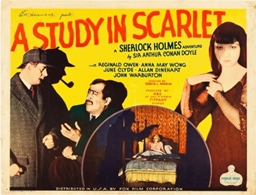
1933 saw only one Holmes movie, and it was Owen moving up to the starring role in a version of A Study in Scarlet. Well, sort of.
Last week, I talked about the Spanish master of silent film, Segundo de Chomón. This week, I’d like to talk about another early genre filmmaker who has also been all but forgotten.
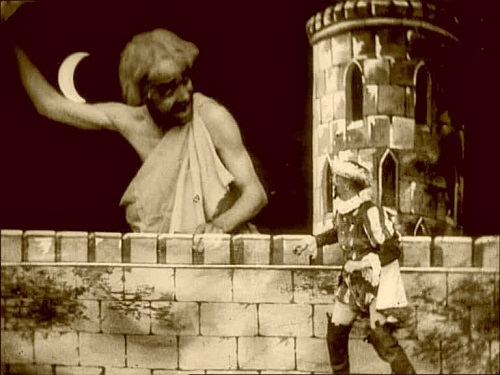
Walter R. Booth was an English stage magician who teamed up with film pioneer Robert W. Paul, who was making and screening films as early as 1896 at London’s Egyptian Hall, where Booth did his magic act. In 1899, Booth and Paul co-founded Paul’s Animatograph Works, a production house that specialized in trick films using Paul’s technical know-how and Booth’s skill at magic and illusion. These short films wowed audiences with special effects such as animation, split screen, jump cuts, superimposition, multiple exposures, and stop motion animation.
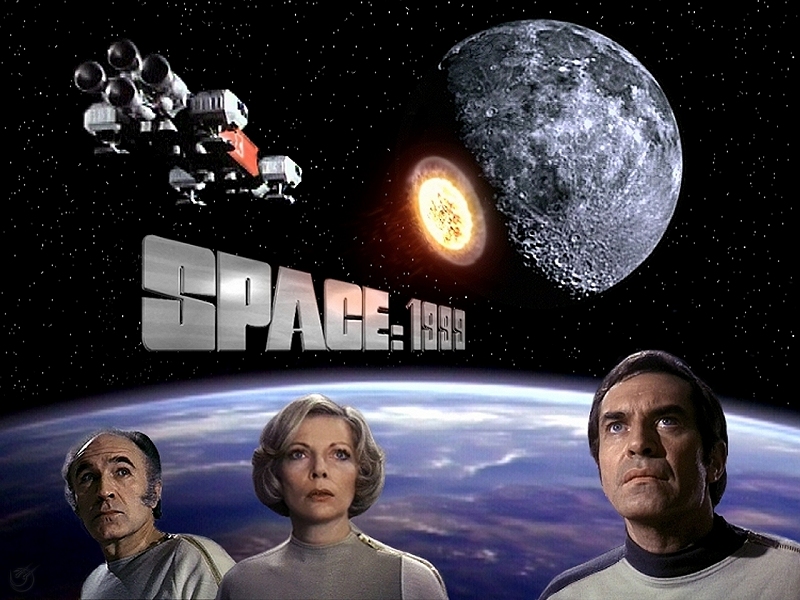
Over at SF Signal, Jeff Patterson recalls the tragic accident that hurled the brave men and women of Moonbase Alpha out of our solar system and into the cold reaches of space fifteen years ago.
Space: 1999 still gets a lot of flak for being cheesy SF TV, but one cannot understate the profound impact the show had on fans in the 1970s. It was the only new effects-heavy space-based show at the time, and a syndicated show at that. It had a fairlydiverse cast, at least by 70s TV standards. It featured the distinct Gerry Anderson vibe that had made Thunderbirds and Captain Scarlet such eye candy, mostly due to the astounding effects work of Brian Johnson and Martin Bower.
As a child of the 70s, I remember racing home after school to catch the show in re-runs. The rockin’ theme music in the opening credits still gets me.
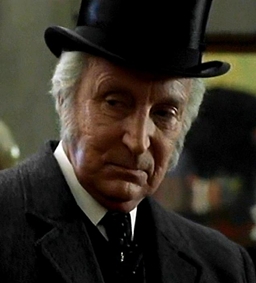
One of my favorite Holmes’ also played Joseph Bell
Apologies for this post running a bit long. While I’m a devoted Sherlockian, I’m not particularly a great fan of Conan Doyle himself. However, I find this tidbit from his life to be pretty interesting. So…
Biographers and devotees of Sherlock Holmes have written much regarding who the detective was modeled after. Joseph Bell is widely regarded as the primary inspiration, a belief bolstered by Sir Arthur Conan Doyle’s own words more than once.
In his autobiography, Memories and Adventures, Doyle said, “I thought of my old teacher Joe Bell, of his eagle face, of his curious ways, of his eerie trick of spotting details. If he were a detective he would surely reduce this fascinating but unorganized business to something nearer to an exact science.”
Add another comment, “Sherlock Holmes is the literary embodiment… of my memory of a professor of medicine at Edinburgh University.”
Now, it has been asserted that one can find bits of Doyle himself in the great detective. His second wife said that her husband had the Sherlock Holmes brain, solving mysteries that puzzled the police.
Son Adrian Conan Doyle vehemently (even militantly) argued that his father was Holmes. Seemingly more likely is that the stolid, patriotic Doctor Watson drew in great part from his creator.
But can we examine one of the sixty Holmes tales and discover biographical pieces of Conan Doyle? As a matter of fact, we need look no further than “The Adventure of the Resident Patient”and Dr. Percy Trevelyan.
Where Star Wars is concerned, even a goth chick can go fan-girl.
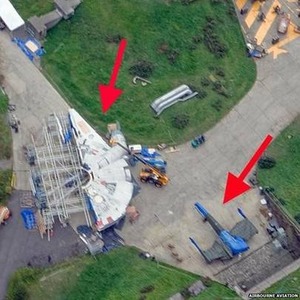
Just in from the UK today: A pilot taking publicity photos for a flying school accidentally buzzed one of the sets of the new Star Warsmovie with pretty impressive, if unintentional, results.
Matthew Myatt originally thought his pictures were of experiment aircraft at the Greenham Common airfield in Berkshire, England. Greenham Common is a former RAF airbase. Myatt was photographing one plane from another and it wasn’t until he got back and started reviewing his images that he realized what he had captured: none other than a partially built Millennium Falcon and an X-Wing fighter.
It appears that, at least in part, director J.J. Abrams will use models for filming rather than pure CGI. As one excited fan wrote on www.theforce.net, “Who’d’ve guessed filmmakers still build physical models?” and “Looks like the Falcon got a paint job!”