Browsed by
Category: Pulp

A (Black) Gat in the Hand: Will Murray on Lester Dent’s Lost Detective

A (Black) Gat in the Hand: Will Murray on Lester Dent’s Lost Detective

I’m always happy when my Pulp buddy Will Murray writes an A (Black) Gat in the  Hand essay. He tackles cool stuff that never even occurs to me. And often which I knew nothing about. Will is the leading authority on Lester Dent’s Travis McGee predecessor (and you KNOW I love me some John D. MacDonald), Oscar Sail. But I had never even heard of the the maritime PI who follwed Sail: Cyrus Peace. So I’m thrilled to give you Will’s essay on another Dent PI: who, unfortunately, never made it to print. Read on, MacDuff. 

An interesting sub-genre of modern detective fiction is the private detective who lives on and operates from a boat anchored somewhere along the Florida coast.

John D. McDonalds Travis McGee is considered the most successful in this peculiar sub-genre. His houseboat, The Busted Flush, was moored off Fort Lauderdale.

(Editor’s Note – Click here for Black Gate’s John D. MacDonald coverage)

Others include the trio of troubleshooters who operated out of a Miami Beach houseboat in the 1960-62 Warner Bros. television show, Surfside 6––Dave Thorne, Sandy Winfield II, and attorney-turned PI Ken Madison.
Read More Read More

Into the Weird: Weird Times 1 — Architecture and Housing

Into the Weird: Weird Times 1 — Architecture and Housing

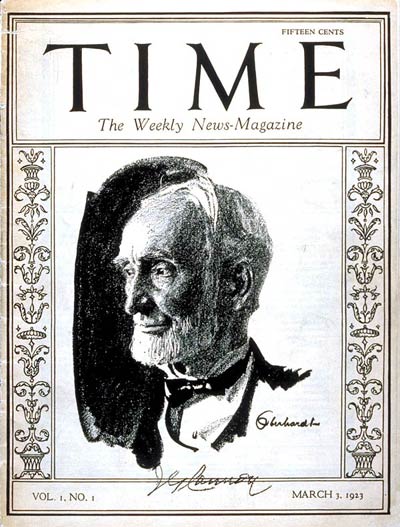
The first issue of Weird Tales went on sale in late February of 1923. It was cover-dated March, but that was a sell-by date. The issue would have arrived in stores on or about February 18, roughly a week before the first issue of Time magazine. In writing about early Weird Tales, I found it useful to think about that kind of context, and to look into that moment in history.

Partly that was because some aspect of a story would occasionally become clear once I understood specific terms or references or background. Mostly, though, I found an immersion in the time helped themes become clearer and habits of thought more obvious. In the hope that exercise might be useful for anyone else reading early Weird Tales or other fiction of the 1920s, I’ll be putting up a series of posts looking at different aspects of the era, reflecting on things I’ve learned or think I’ve learned. I hope these posts will also be useful as references I can link to in my reviews, rather than having to take the time to explain some 1920s-specific detail in a story.

Read More Read More

David C. Smith & Robert E. Howard, Part One

David C. Smith & Robert E. Howard, Part One


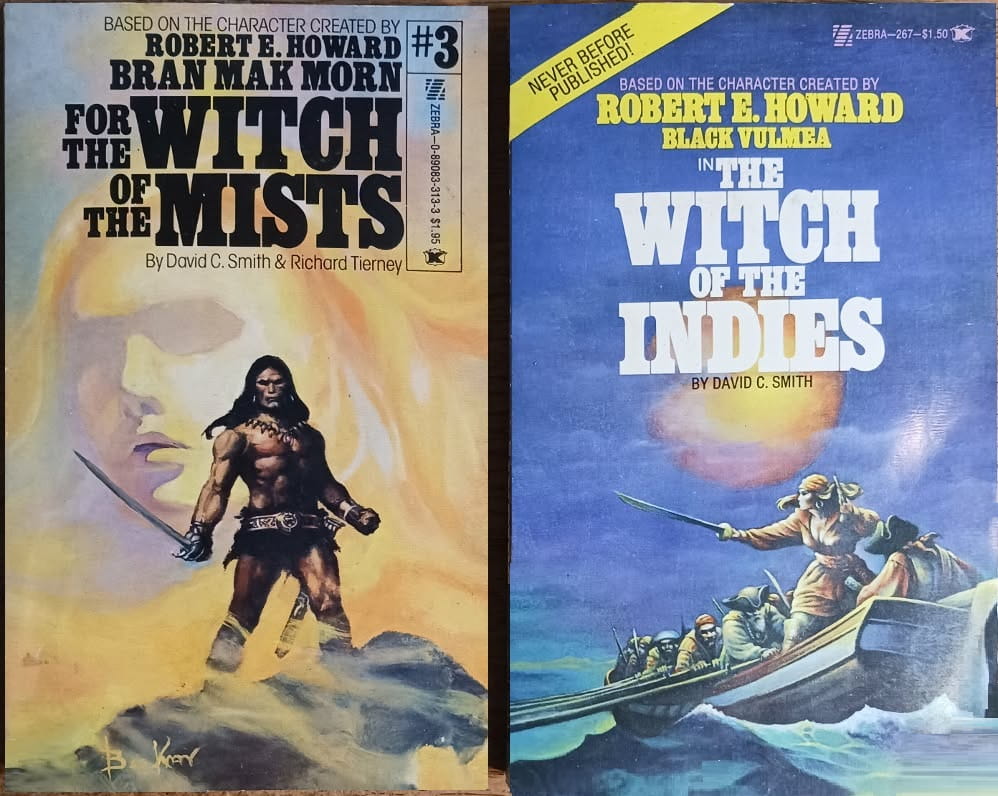
For the Witch of the Mists by David C. Smith & Richard Tierney (Zebra, January 1978) and The Witch of the Indies by David C. Smith (Zebra, June 1977). Covers by Doug Beekman and Stephen Fabian

I consider David C. Smith (1952) a friend. We’ve never met face to face but we’ve corresponded and have spoken on the phone. As with writers such as Karl Edward Wagner and Andy Offutt, I first became aware of David as an author through a connection to Robert E. Howard.

While in REHupa, the Robert E. Howard United Press Association, I routinely did reviews of Howard pastiches. And so I came upon The Witch of the Indies (Zebra, 1977, cover by Stephen Fabian). Shortly after I picked up For the Witch of the Mists by Smith & Richard Tierney (Zebra, 1978, Cover by Doug Beekman).

Read More Read More

Richard Stark’s Parker, Part 3: Why Can’t Anyone (Except Darwyn Cooke) Get Him Right?

Richard Stark’s Parker, Part 3: Why Can’t Anyone (Except Darwyn Cooke) Get Him Right?

Payback (Paramount Pictures, February 5, 1999

In the first two installments of this series, we looked at the master criminal known as Parker, and at his creator, Richard Stark, the pseudonym Donald E. Westlake used when writing spare and stark but hard-hitting prose.

Now let’s look at some of the many attempts to bring Parker to a wider audience.

The novels are extremely popular with a segment of the population, and so studios and directors have come calling from time to time, with attempts to adapt the character and his stories to film.

But they never quite get Parker right.

Read More Read More

Into the Weird: Weird Tales, March 1923 (Volume 1, Number 1) Part 1

Into the Weird: Weird Tales, March 1923 (Volume 1, Number 1) Part 1

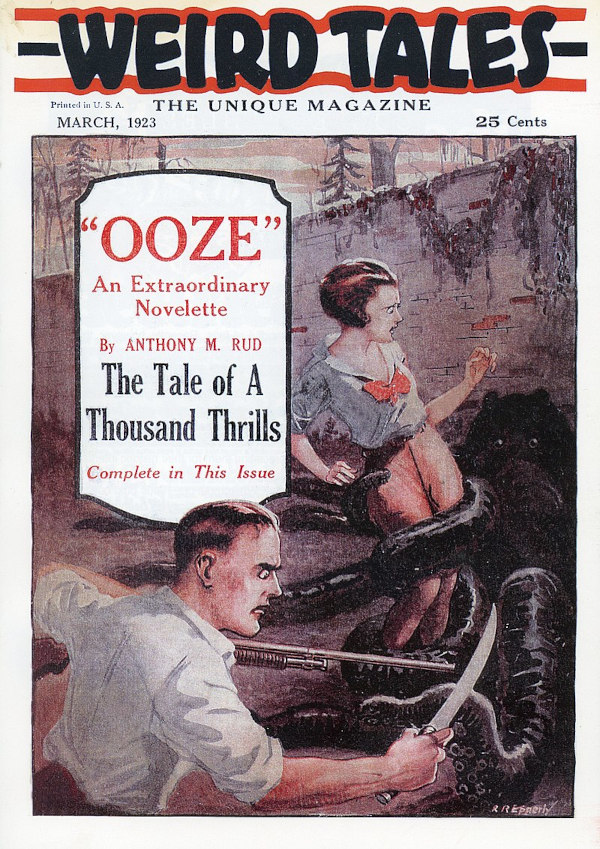
Weird Tales March 1923. Cover by R. R. Epperly

The first issue of Weird Tales landed on newsstands in late February of 1923. 192 pages long, it measured about 6 inches by 9, a standard size for a pulp fiction magazine. There were two different versions of the cover, perhaps due to a printing error; the illustration’s the same, a man with knife and gun fighting a shadowy tentacled monster which has grabbed a nearby young lady, but the colouring’s different. Either way, the cover advertised “‘OOZE’ / An Extraordinary / Novelette / by Anthony M. Rud / The Tale of A / Thousand Thrills.” Perhaps most intriguing, though, was the subhead below the logo: “The Unique Magazine.”

Thanks to modern technology it’s possible for anyone with an internet connection to flip through issue 1 of Weird Tales, if in a virtual format. In a later post I’ll write about the fiction the issue holds, but today I want to consider the magazine as an object (to the extent that’s possible working from a PDF). What do we see as we page through it? What signs of its times stand out? And what can be deduced about the editorial team’s vision?

Read More Read More

Into the Weird: An Introduction

Into the Weird: An Introduction


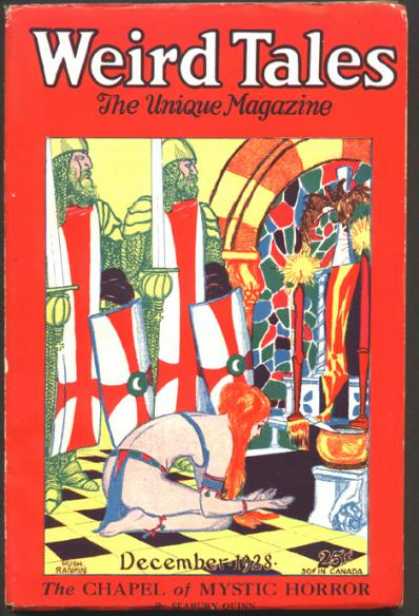
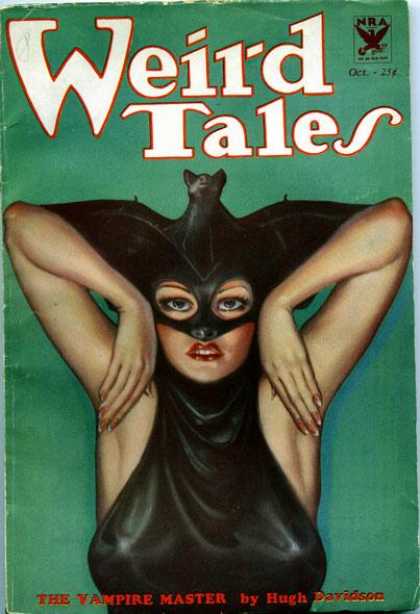
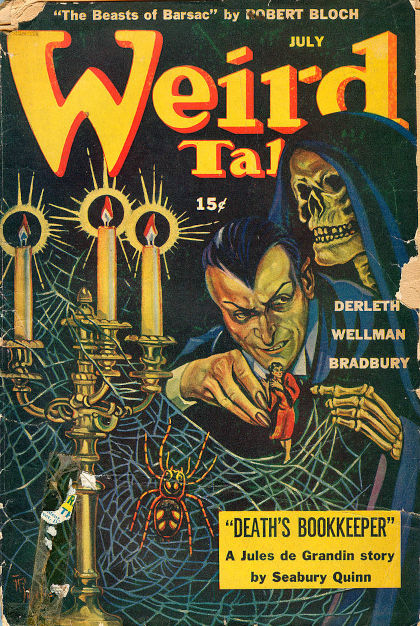
Weird Tales
, December 1928, October 1933, and July 1944. Cover
art by Hugh Rankin, Margaret Brundage, and A. R. Tilburne

A bit more than 103 years ago, the first issue of Weird Tales reached newsstands across North America. The magazine would be published consistently for over three decades, with the title revived sporadically ever since. The original Weird Tales would become a significant influence on the development of the fantasy and horror genres, and would lend its name to a subgenre of fantasy and a certain tone in fiction: the weird tale.

That entire first run of Weird Tales, ‘the unique magazine,’ is available at the Internet Archive. I thought it’d be an interesting project to look at it issue by issue, reading the magazine as it was published and discussing each issue as a whole. It was the venue for much of the fiction of H.P. Lovecraft and Clark Ashton Smith and Robert E. Howard, as well as a home for work by Robert Bloch, C.L. Moore, and Ray Bradbury, among many others. I wondered what it would be like to read those stories in the context of the other tales in the magazine by lesser-known writers; and to consider each issue as a package, a collection, with its cover and editorials and letters. And its ads; to look at the magazine holistically is to consider the many irruptions of its era into the experience of the fiction.

Read More Read More

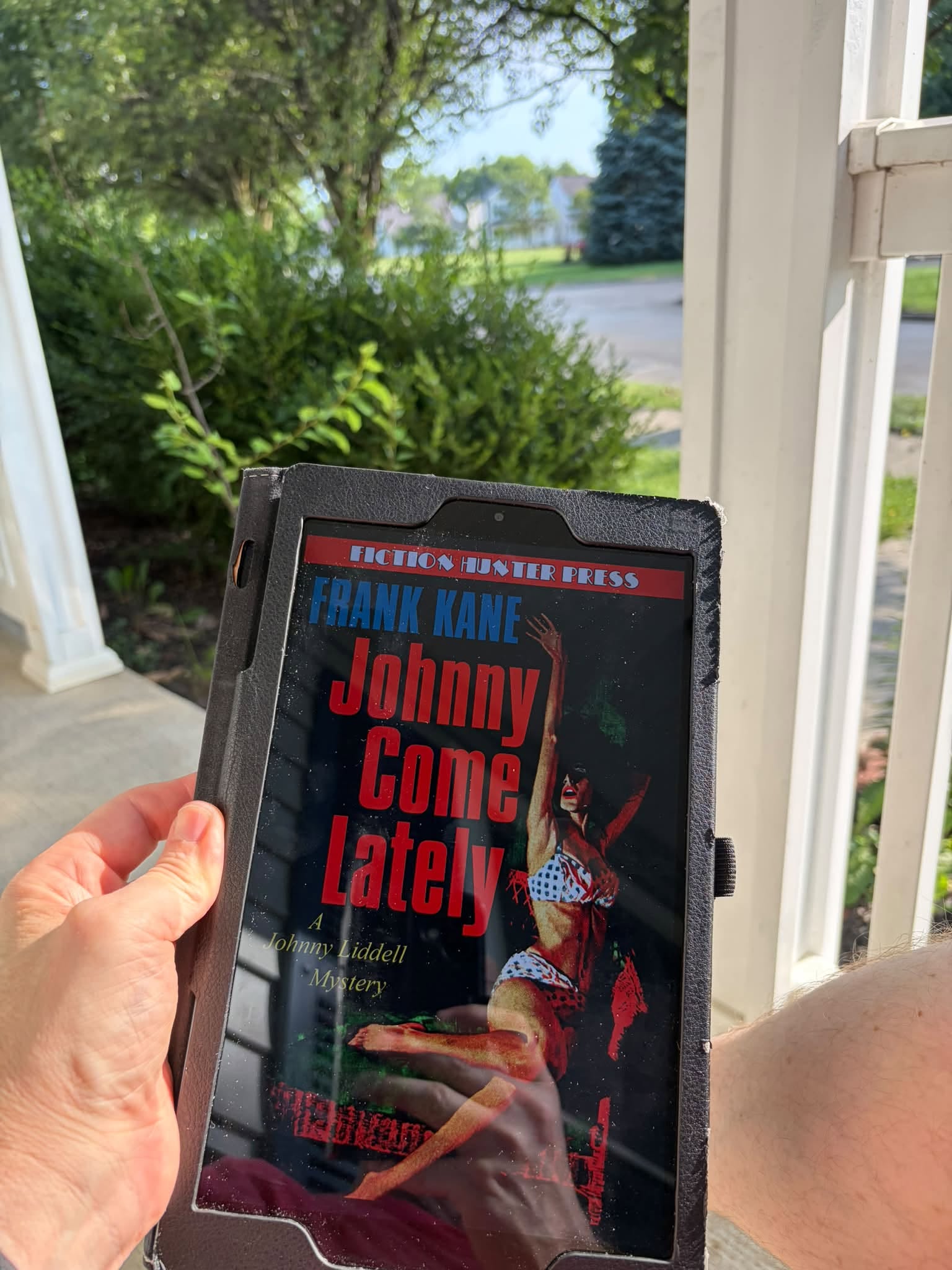
A (Black) Gat in the Hand: Front Porch Pulp & Frank Kane

A (Black) Gat in the Hand: Front Porch Pulp & Frank Kane

“You’re the second guy I’ve met within hours who seems to think a gat in the hand means a world by the tail.” – Phillip Marlowe in Raymond Chandler’s The Big Sleep

(Gat — Prohibition Era term for a gun. Shortened version of Gatling Gun)

So, as I type this, I am 99% moved from my apartment of the past six years, into the small house I bought a couple weeks ago (well, along with the bank…), which I happily call my writer’s bungalow. It has a small loft. I put in my desk (a cafeteria table) and as many bookshelves as I could fit in it. This is truly my happy place.

I started packing up my books in May. I’ve been crazy stressed between house hunting, house closing, and work. And packing. And I have felt oddly bereft, with my books in boxes. Unanchored. For someone who went through a divorce and moved out of his house in 2020 (like that wasn’t a hard enough year by itself!), this was unsettling. I couldn’t look over and see shelves of books. I couldn’t grab one for a Black Gate post.

I have over 2,000 physical books, and I moved all of them with my car, in about 55-60 boxes – yeah, that took a LOT of trips! I’m filling up my  bookcases, gradually. Things like installing a washer and dryer, finding my socket set (I swear, that thing vanished), and an inconveniently timed out-of-town work trip, have taken precedence.

But my new house is slowly filling with my fiction and non-fiction collections. And THAT is helping me feel settled again. But in addition to the loft, there’s another terrific writing aspect to my bungalow. A (Black) Gat in the Hand fans (and long-time FB followers) may remember my former house had a terrific back deck, which led to Back Deck Pulp.

My apartment had a nice little concrete slab, facing a lot of trees, and thus was born the infrequent Back Porch Pulp.

Read More Read More

Forgotten Authors: Leah Bodine Drake

Forgotten Authors: Leah Bodine Drake

Leah Bodine Drake

Leah Bodine Drake was born on December 22, 1904 in Chanute, Kansas to Thomas and Cornelia (née Bodine) Drake. Her father worked in the oil industry. Drake was sent to the Oakhurst School for Girls in Cincinnati and later attended Hamilton College, a junior college operated by Transylvania University, in Lexington, Kentucky as well as Sayre College in the same city.

Drake began publishing poetry in 1935 and is primarily known as a poet, although she also published some short fiction. From 1936-1937, She appeared as a Billy Rose dancer in the Fort Worth Centennial Exposition. Drake’s first published poem was “In the Shadows,” which appeared in the October 1935 issue of Weird Tales. The same issue of Weird Tales included the first of eight letters she had published in the magazine. Her letters indicated that she haunted used book stores searching for old back-issues of Weird Tales, which she said were rare and more expensive than other magazines. She would go on to publish nearly three dozen poems in the magazine.

Read More Read More

Dark Muse News: Blue Fire: A Jirel of Joiry Novella

Dark Muse News: Blue Fire: A Jirel of Joiry Novella

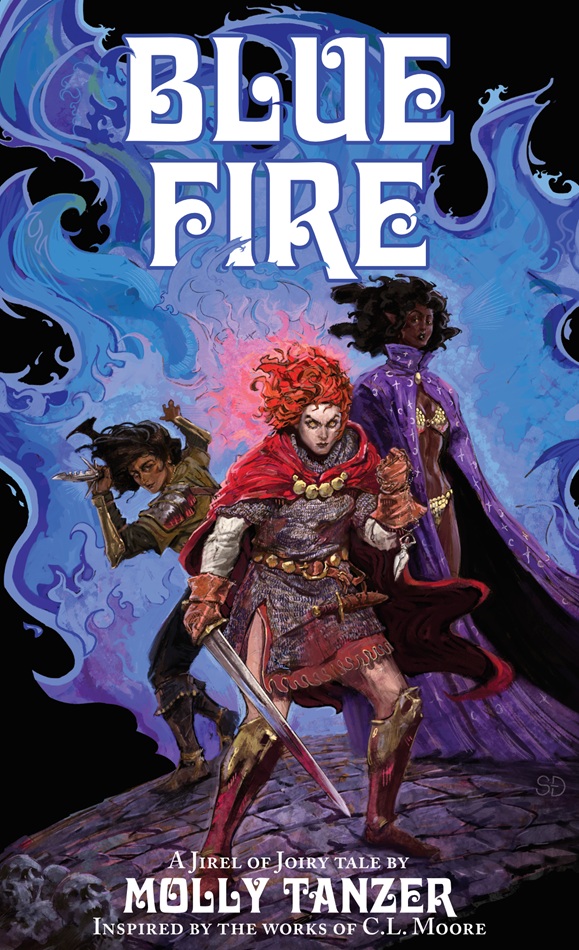
Blue Fire, a Jirel of Jory tale by Molly Tanzer (Brackenbury Books, 2026). Cover art by Saša Đurđević

In February 2025, Black Gate covered Molly Tanzer’s release of “Jirel Meets Death” (published with permission from Moore’s estate); and in March 2026 Black Gate’s Dark Muse News covered Tanzer’s next story, “Jirel in the Forest of Night.” These were brought to us by Brackenbury Books, the same outfit that champions New Edge Sword & Sorcery magazine.

And now, Dark Muse News (your biweekly Black Gate blog) has coverage of Brackenbury Books’ current campaign, bringing the first-ever Jirel of Joiry book-length adventure to life (crowdfunding launched June 11th, and is still ongoing).

Blue Fire begins with Jirel fighting a foe her sword cannot smite: a terrible illness nobody can explain, let alone heal. Her search for a cure takes her many miles across many worlds, encountering friends and foes familiar and frightening!

Like Alice in Wonderland with a big f***ing sword, Jirel has compelling adventures in bizarre dream-logic realms, balancing a rich emotional life with terrifying struggles against dark forces!  — boasts Brackenbury Books

Here ye, here ye. Read on to see:

  • A tour guide of the Jirel of Jory writings
  • Excerpts from Blue Fire
  • Special Perspectives from author Molly Tanzer, artist Saša Đurđević, and editor Oliver Brackenbury
  • Status updates on the campaign

Read More Read More

The Heroes of Fantasy Quiz

The Heroes of Fantasy Quiz

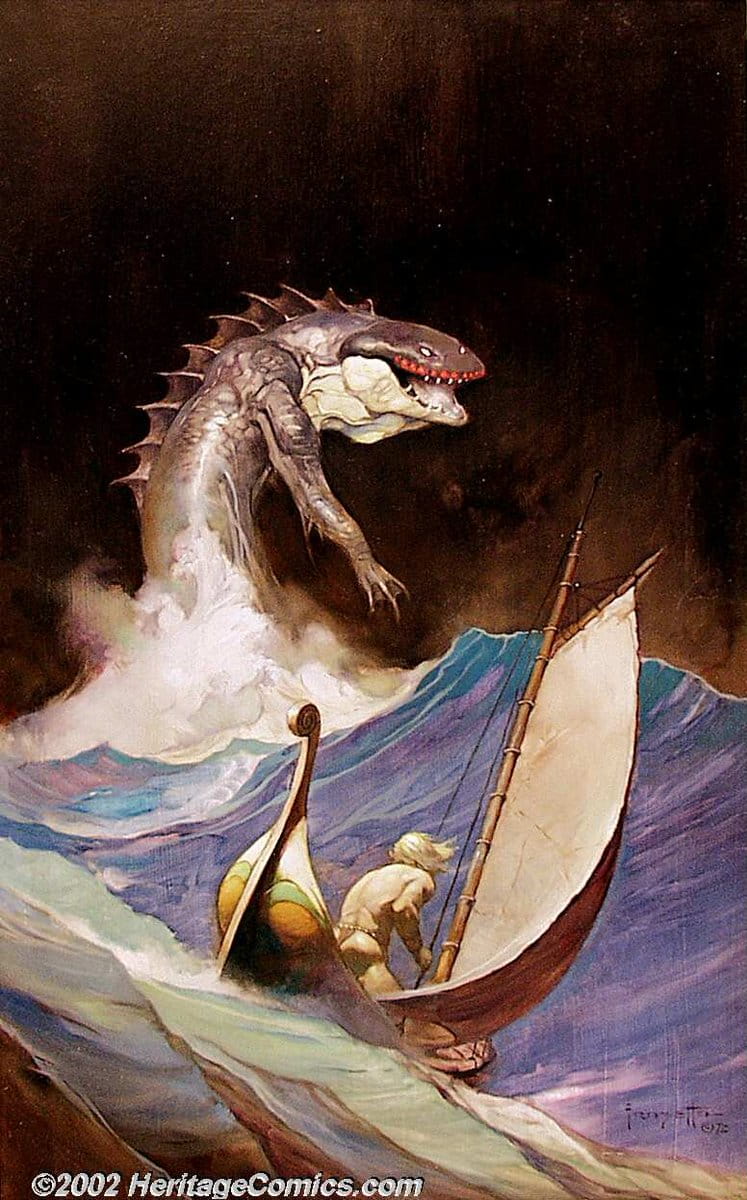
Art for Carson of Venus by Frank Frazetta

They slice. They dice. They bash their way through hordes of foes. They are the heroes of fantasy and just below is a list of some of the greatest. Can you pick out the hero on the right who goes with the author on the left?

Twelve to fifteen correct means you know your bloodthirsty authors like Conan knows ale. Eight to eleven correct is pretty good but you’re not as bloodthirsty as you might like others to believe. Four to seven correct definitely means you’re squeamish at the sight of crimson gore. Below four correct? I’m afraid you’re just not an “army of one.”

Read More Read More