Heroic Fantasy Quarterly #53 broke its bonds in August, and it runs amok, featuring three stories, three sort poems, with art and audio.
We’ve got two prequal tales: “The Path of Two Entwined” returns to Gregory Mele’s fantasy Meso-American world of Azaltlán, delving into one of the pre–piracy adventures of Sarrumos Koródu. “The Crown of Azt’nyr” returns us to Mike Adamson’s ringed world of Malovar with the story of how Derros and Princess Therolynn met before their hard-fought return to the city of Tymass.
Our third story, “The Waking Gods,” by D. H. Rowe introduces a new hero, Hekili, an adventurer who sails the mysterious islands of a fantasy south seas.
Because I’ve been asked about the process by which I’ve been selecting stories for the Random Review series, I thought I’d take a moment to explain how the stories are selected.
I have a database of approximately 42,000 short stories that I own sorted by story title. When it comes time for me to select a story to review as part of this series, I role several dice (mostly ten sided) to determine which story should be read. I cross reference the numbers that come up on the die with the database to see what story I’ll be reviewing. This week, I rolled 14,780 which turned out to be Terry Pratchett’s short story “The Hades Business.”
One of the things I’m hoping to get out of this series, from a person point of view, is to discover authors and short stories that I’ve owned and have never read. Of course, I’m also hoping to share those discoveries, good or bad, with the readers of Black Gate.
One of the great mysteries of life, or rather death, is what happens after we die. It has proven a constant fodder for authors to explore in short stories and novels. Often this exploration takes the form of some aspect of mundane life in order to provide a relatable experience to something that is completely unknowable.
In Thomas Seay’s “Blink,” which appeared in the April 2003 issue of Realms of Fantasy, the afterlife is a trainride through a dreamlike nightmare populated by various aspects of a person’s younger life. In this case, Gary finds himself aboard the train, wanting only to be reunited with his wife and daughter. Instead, he finds the clique he belonged to in college, who clearly viewed him as more of a hanger-on than a member of their group.
Gary’s ride includes brief encounters with a shape changing being who may well be God, who provides cryptic answers to Gary’s questions, but at the same time appears to be helping him to acclimatize to his afterlife.
While there are some versions of the afterlife which are appealing and others which are not, Seay’s afterlife seems like an unpleasant purgatory: an interminable train ride in which the illusions Gary built up to help him cope with the reality of life are carefully stripped away. Even as the truth is revealed to him, Gary retreats into a different fantasy world, denying the occurrence of his death and focusing on seeing his wife and daughter again.
The Magazine of Fantasy and Science Fiction, March 1954. Cover by Mel Hunter
I’ve spent the last few days putting my book collection in order, and yesterday I came across this, the first sf magazine I ever purchased: the March 1964 issue of F&SF, from a little shop in the town of Port Credit, Ontario.
J.G. Ballard, Kit Reed, Oscar Wilde, Avram Davidson’s haunting little story “Sacheverell” — pretty heady stuff for a precocious ten-year-old. But what had the greatest impact, looking backward from 2022, was Robert Bloch’s article “The Conventional Approach” — a pocket history of science fiction fandom. I was already nursing an ambition to write, specifically to write sf, and here was what looked like an invitation to a subculture of like-minded enthusiasts and maybe even a roadmap to a career.
Sometimes the roll of the dice produces a story that isn’t really all that easy to discuss. This week’s story, “The Birth of A.I,” is a (very) short humorous story about the birth of artificial intelligence by Cynthia Ward. The story originally appeared in the third issue of Xoddity in 1998.
Ward’s story is quite short, taking up about a page, and it mostly a set up for a punch line, although it doesn’t quite qualify as a shaggy dog story. The story also suffers from the fact that, written in 1998, computing power and the advance of artificial intelligence evolved in a very different manner than the enormous mainframes Ward discusses in her story.
The scientists in Ward’s story have been attempting to create a machine that can pass the Turing test, although the story doesn’t present it in those terms. Essentially they want to make a computer that has the same level of intelligence and sentience as a human being. When the story opens, they are on the verge of succeeding and Dr. Maria Denhurst is pondering what the artificial intelligence will be like and how it will react.
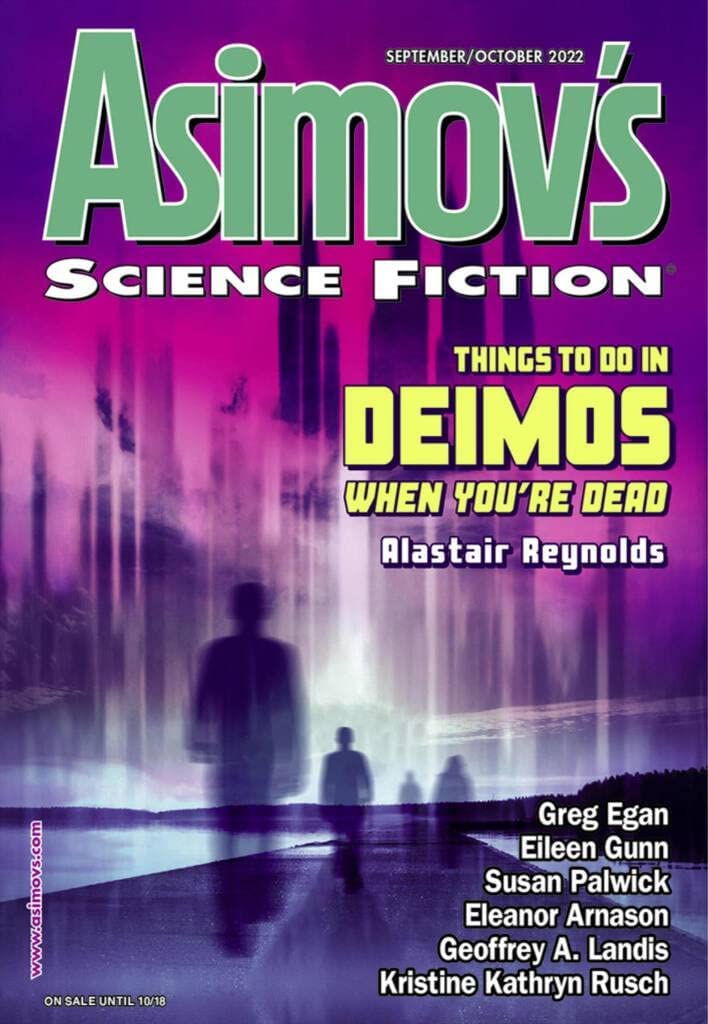
July/August 2022 issues of Analog Science Fiction & Fact, Asimov’s Science Fiction, and The Magazine of Fantasy & Science Fiction. Cover art by Donato Giancola, Eldar Zakirov, and Alan M. Clark
It’s marvelous to see a cover by the great Donato Giancola on Analog, of all places. Donato did one cover for Black Gate, our famous Red Sonja cover for Black Gate 15, our special Warrior Women issue. Analog‘s last cover was by NASA, the inside of a satellite or reactor or Easy Bake oven or something. This one is much cooler.
Shipping problems have delayed the arrival of this month’s F&SF, so I don’t have a copy in my hot little hands in time to do this article (again), but Tangent Online has the Table of Contents, so I can fake it. There’s lots of good reading in this month’s print SF mags, including stories by Jerry Oltion, Sean Monaghan, Bruce McAllister, Alvaro Zinos-Amaro, Rick Wilber, Will McIntosh, Michael Swanwick, Octavia Cade, Jack McDevitt, Paul Melko, Nick Wolven, James L. Sutter, Nina Kiriki Hoffman, and many others. Let’s dive in.
“You’re the second guy I’ve met within hours who seems to think a gat in the hand means a world by the tail.” – Phillip Marlowe in Raymond Chandler’s The Big Sleep
(Gat — Prohibition Era term for a gun. Shortened version of Gatling Gun)
I did six Back Deck Pulp installments. If you don’t know what that was – I had a great back deck at my former house. I would sit out there and read a lot. Mostly pulp stuff, but other things too. And I would take a pic of the book/or rarely, on my Kindle); trying to include some of my yard, or deck, and my leg or knee (hey – it was just a thing). And I’d talk about what I was reading. Usually sharing info about the author.
They were fun little things to share what I liked reading. And often it was a plug for an upcoming A (Black) Gat in the Hand post. I’m in an apartment now, with a small concrete slab back porch. With winter, and then the brutal heat of June, now behind us, I’m getting out there to read a little more. So, Back Porch Pulp makes its debut as Back Deck Pulp’s successor. Enjoy!
JACK HIGGINS
Back Deck Pulp has been re-branded. Back Porch Pulp. I read a $1.99 Jack Higgins ebook, “Comes the Dark Stranger.”
I have 49 Higgins books on the shelves: I’m a fan. That one was ‘meh.’ Predictable and not that exciting.
I’m a big fan of his WW II historical fiction stuff. And the first dozen Sean Dillon books.
I have always loved stories that offer a glimpse of the future. Speculative fiction is a literature of ideas, and stories set in the future can explore an enormous range of possibilities — from dark chilling futures that serve as cautionary tales to bright futures that offer us much-needed glimmers of hope.
We here at Uncanny Magazine are in the middle of the Uncanny Magazine, Year 9: To Fifty… and Beyond! The upcoming year will bring our 50th issue, and while we are planning ahead for the future of the magazine… here’s a look at futures past! Uncanny stories, essays, poems, and cover art depicting the world of tomorrow… and beyond!
Big changes are afoot for Interzone, the leading British SF magazine.
Long time publisher TTA Press has announced that the latest issue, Interzone 292/293, will be its last. The magazine has been sold to MYY Press. The new editor is Gareth Jelley.
The TTA era of Interzone ends with a bang — a big 192-page full color double issue, with new fiction from Rich Larson, Jeff Noon, Alexander Glass, Charles Wilkinson, and many more — plus artwork from Richard Wagner, Vince Haig, Vincent Sammy, and many others, the usual columns and goodies, and a Guest Editorial by Gareth Jelley, in which he outlines his plans and vision for the magazine.
“JackBack,” was the “Newcomer’s Corner” featured short story in the Fall/Winter 1997 issue of Absolute Magnitude. It appears it may not only have been newcomer J. Scott Crawford’s debut short story, but also, apparently, his last short story.
Set in a future Atlanta, Tyler Underwood is a security specialist who has been called to install a system for a celebrity who had chosen to live in Cummings, Georgia, which Underwood considers to be the most dangerous suburb in Atlanta, outside the Perimeter, the area of Atlanta in which he felt safe. The story of his drive home is juxtaposed with the description of a sales call for JackBack, a car security system that ensures people are able to recover their stolen vehicles, which Crawford portrays as a major issue in his Atlanta.
Underwood’s story is about his attempt to get home from this installation. Driving a Jaguar, he knows that his car is a target for every carjacker on the road. When his on-line communications system shut down, his concern, possibly paranoia, kicks in as he tries to make it to an area he considers safe. As he drives, he focuses his attention on a Camaro that seems to be trailing him, making his drive home a race to safety, at least in his own mind.
Against this, the details of the JackBack story line provides support for the danger that Underwood perceives, at least so far as the maker of the JackBack device want to promote the need for drivers to make use of their services. While Underwood’s story focuses on his drive home, the JackBack story includes sections dealing with a sales spiel to a new car owner, a flashback to a previously retrieved car, and, eventually, a tie in to Underwood’s drive home.