Browsed by
Category: Essays

Climbing Aboard the Dragon: 10 Tips to Better Productivity

Climbing Aboard the Dragon: 10 Tips to Better Productivity

Every writer I know has trouble writing.
— Joseph Heller

Previously in this series about writing, we’ve talked about ways to get story ideas as well as different approaches you can take to writing your story, novel, comic script, screenplay, or other related screed, tome, or pamphlet.

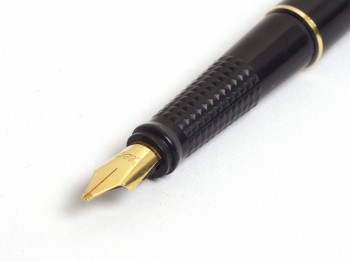
Pen image by Michael ConnorsBut what about the single most important aspect of the writing process? Yes, I’m talking about butt-in-chair time. How do you get yourself into a good schedule and motivated to write?

Very good question.

My answer? Below I’ve listed my top-ten list of tricks and techniques I’ve used that help me get more productive (and less annoyed with myself for not having gotten and writing done):

Read More Read More

Robert Silverberg on “Are the days of the full-time novelist numbered?”

Robert Silverberg on “Are the days of the full-time novelist numbered?”

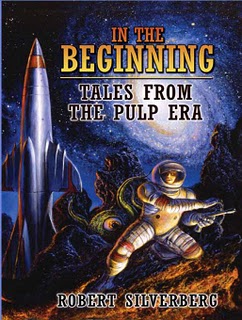
silverbergIn a post on his blog last week, Canadian science fiction author Robert Sawyer asked “Are the days of the full-time novelist numbered?

When I broke into the business 55 years ago you could count the number of full-time science fiction writers who could pay the rent and eat regular meals on the fingers of one oddly proportioned hand. Poul Anderson, Gordy Dickson, Robert A. Heinlein, Arthur Clarke, Robert Sheckley, maybe Jack Vance, and….well, who else? Jack Williamson? Perhaps he had begun teaching by then. Asimov was still a college professor who wrote s-f on the side. Ted Cogswell was a professor also. So was James Gunn. Phil Dick was a full-timer, but lived at the poverty level. Sturgeon didn’t do much better. Del Rey dabbled in editing and occasional agenting. Harry Harrison did editing work, wrote comics, whatnot. Leiber was an editor for Science Digest. Jim Blish wrote p-r stuff for the tobacco institute. Cyril Kornbluth worked for a wire service. Fred Pohl edited and agented. Alfred Bester wrote for the slicks and TV. I’m not sure what Phil Klass did for a living — he wasn’t teaching yet — but he couldn’t have lived on the proceeds of what he wrote. Kuttner and Moore — I don’t know; they did venture somewhat into television and mystery novels.Leigh Brackett was a part-time Hollywood writer and her husband Edmond Hamilton earned most of his living writing comic books. Mack Reynolds and Fred Brown had fled to Mexico, where a dime went as far as a dollar did here.

It just wasn’t a field for full-timers. I didn’t really know that, so I plunged right in and made a good living, but I did it by dint of writing and selling a couple of short stories a week, and even then the field vanished from under me by 1958 and I had to turn to all sorts of non-sf writing until things began to revive in the mid-1960s. The same happened to Harlan, and then he got drafted, and when he came out he went to Chicago to edit and on from there to Hollywood.

Now we are back to the same situation that obtained in the golden era of the Fifties — s-f is mainly a field for hobbyist writers, with just a few able to earn a living writing just the real stuff and nothing but. (It is different, of course, for those who write pseudo-Tolkien trilogies, vampire novels, zombie books, and other sorts of highly commercial fantasy.) For a while, in the late 70s and early 80s, the money flowed freely and all sorts of people set up in business as s-f writers full time. I remember Greg Bear, president of SFWA somewhere back in the mid-80s, warning the writers at the SFWA business session not to quit their day jobs, because the good times were just about over; and was he ever right!

Climbing Aboard the Dragon: Three Paths To a Story

Climbing Aboard the Dragon: Three Paths To a Story

“There are nine and sixty ways of constructing tribal lays, and every single one of them is right.”
— Rudyard Kipling

Get out the map...Okay, writers. Let’s say you have a short story idea or two, but you don’t know the best way to write it. Some sage writers with some sales under their belts tell you that you Must Outline. Other wisened authors tell you to just, “Go where the story takes you,” that you shouldn’t outline at all.

So what’s a new writer to do? Who’s right?

Well, they all are, of course. They’re right about what works for them.

You have to figure out what works best for you.

Read More Read More

Climbing Aboard the Dragon: Homework Every Day

Climbing Aboard the Dragon: Homework Every Day

doorways

Being a writer is like having homework every day for the rest of your life.
— Lawrence Kasdan

When John from Black Gate suggested I do a guest blog about writing for short fiction markets, I had to check to make sure he hadn’t intended his email for someone else. Surely he meant to send that email to my co-writer for the story “Devil on the Wind,” from Black Gate 14. That would be Jay Lake, who has over 200 story publications and counting.

But nope, the email was correct.

And a quick look at my list of stories over on my website seems to confirm the fact that I may indeed have figured how to sell a short story — fifty story publications thus far. And I have thirty more stories out to various publishers (fingers crosssed!).

Here’s the thing, though. You never figure out the trick to this writing gig. Soon as you think you’ve got it understood, you’re sunk.

Because you can’t rest on your laurels. Trust me on this — even though I’ve sold stories to great places like Asimov’s, Strange Horizons, Interzone, and to this fine magazine as well, I still get rejections aplenty. And while my focus has moved from short stories to novels, with the occasional comic script, I always have fun writing stories.

But I still have more to learn. Much more. And I’d like to share some of what I’ve learned along the way.

Read More Read More

Somebody Has to Talk about Frederick Faust

Somebody Has to Talk about Frederick Faust

and I guess it’s going to be me.

When I first started blogging officially here at Black Gate, I wondered what would constitute “on topic.” Obviously, writing about new crop developments in Iowa would be “off topic” (and I don’t know anything about that anyway) but would writing about Godzilla (about which I know far too much for my own good) be considered “on topic” because I could count on at least half the site’s readership thinking it was interesting? I still wrestle with these questions, and perhaps that’s why I don’t sleep as well at night as other people.

One thing that I’m certain now is “on topic” is anything that has to do with pulp magazines. I’ve written about Norvell Page’s Spider novels (and will do so again soon) and mystery and suspense author Cornell Woolrich, and nobody’s taken me to task for either. So now I throw caution to the four winds and write about Frederick Faust because somebody has got to do it. If I’m going to write about pulp magazines, I have an obligation to write a post about Frederick Faust. You have no obligation to read it, but I strongly urge you to look below the cut because  this fellow is seriously interesting and you should give him a glance some time.

Read More Read More

A New Copy of Dhalgren: Caution, BookCrossing

A New Copy of Dhalgren: Caution, BookCrossing

dhalgrenI bought my first copy of Dhalgren in the late 70s. If memory serves, I accidently dropped it in the sink shortly thereafter.  It swelled up and got sorta lumpy, even after it dried.

A few years ago I decided it was time to get a replacement. Now, I received a review copy of the imposing new trade paperback edition from Vintage Press a while back, with a big blurry red skyscraper on the cover, but what I wanted was the original 1975  Bantam edition (at left), which captured my imagination 35 years ago. Before it sank beneath the suds in our kitchen sink while I was supposed to be washing dishes, anyway.

It takes a while to find a pristine, unread copy of a 35-year old paperback, even on eBay. But before too long I had one, tucked snugly away with my other Samuel R. Delany, and I packed the old one away in the basement.

Except, now I want to read it. No point looking for the one I’d buried in the basement months ago (you’d understand if you saw my basement) — and anyway, who wants to read a book that’s all lumpy? I could read the new one… but man, I paid handsomely to have a pristine copy. Dhalgren is 890 pages — not exactly easy to read when you’re trying not to bend the spine.

So I did what any rational person would do. Back to eBay to find another copy.

This is the kinda thing that drives Alice crazy (Miss “Explain to me why you need a fourth copy??”), but I was very happy when it arrived today. And then I found this hand-written note on the inside cover:

BCID: 361-4144887

Dear Stranger,

If you read this book, please visit bookcrossing.com and say so. This book is traveling from hand to hand – better to be read by many people than to gather dust on a shelf. BookCrossing tracks it so that we readers know where it goes and what others think of it. Just go to the website, enter the BCID above, and leave a brief journal entry (anonymous, if you prefer). Then leave it somewhere to be read again.

Thank you!

Apparently, this thing is legit. The website checks out and everything. I entered my BCID and discovered my new copy of Dhalgren had been read by someone named Vasha and then “released into the wild” in a cafe in Ithaca, New York on August 2, 2006.

It’s hard to describe the delight in Alice’s eyes when she saw this. “You should pass it along!” she exclaimed. “Put it on a park bench or something.”  Get it out of her house, she means. My wife’s sanity depends on defending as much square footage as she can from the encroaching book madness. In her fondest dreams, this process involves a flamethrower.

Read More Read More

Howard and his truths

Howard and his truths

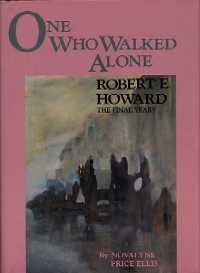
one_who_walked_aloneIt’s hard to add much about RE Howard to what’s been said here, but I’ll try.

Howard is easy to compliment on his prose style, his ringing battles so evocative that the blood almost sticks to your hands as you turn the pages. His characters were primal archetypes, quick to take to and want more from. His worldbuilding allowed you to smell the exotic spices in the market street air and hear the shadowy footpads in the alleys — his masterwork Hyborea teemed with life and detail. His sense of rhythm in the telling of Conan’s latest exploit or explosive westerns leavened with physical humor prove him a master yarn-spinner.

But there’s more to him than just technique.

I get writing from amateurs every now and then that about lives up to Howard, even if it’s just aping his style. The stories just seem strangely lifeless for all the careful detail, cacophonous action, and pulpish word-choice. I usually tell these writers to “tell me one of your truths.”

Howard put what he knew to be true in his stories. He was an opinionated man, read Novalyne Price Ellis’s memoir One Who Walked Alone for plenty of examples. He knew the power of entropy, he’d seen it growing up in Texas as the oil men came and went. Cross Plains experienced it in the bust of the Great Depression. Howard’s stories are filled with the frailty of civilization, yet even when all that is dross falls away and the hollow gongs go silent there’s still the rough code of someone like Conan to protect a defenseless woman or Solomon Kane’s relentless resolve to avenge a murder even unto the lawless coasts of the New World. The whole world may have fallen or been left behind, but these characters will still see justice prevail.

Howard was a great reader of history and spoke endlessly of corruption. The rotten old order gives way to the new, not always easily, then the new eventually goes sclerotic and itself is preyed on by another generation of barbarians. The same truth applied to Rome applied to Howard’s Aquilonia and fallen Stygia.

Yes, by all means give R.E. Howard his hard-earned props as a technical master. But he also wrote from his brain, his heart, and his guts about what was important about life, as he saw it. Conan’s broadsword spoke many of Howard’s truths.

Encountering Howard

Encountering Howard

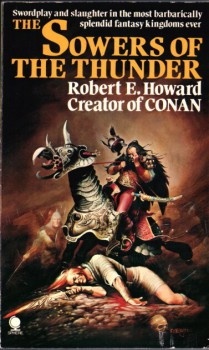
sowers-thunderTo write something on the occasion of Robert E. Howard’s birthday is a bit, well, intimidating. As imposing a presence as the Texan was in life, his reputation a century on has approached the status of myth. Not only that, but his work is the subject of formidable scholarship of the sort seen over at The Cimmerian and at the Robert E. Howard forums — and I’ll admit that the breadth of knowledge and insight displayed in even the most casual thread or post at either of those sites leaves me in the dust. Then too there are my fellow BGers who plan to post something today, many of whom have a deep and abiding passion for Howard and a long familiarity with his work. But in my case, on the subject of Howard, I’m a rank amateur.

But I’m an enthusiastic amateur, and if I can’t write from a position of deep learning, than I can at least offer my own personal appreciation for his work, which I was a long time in coming to. I met him first through Conan, naturally, a character more famous than his creator. It was as a wee lad sitting in front of the television and watching a behind-the-scenes special on an R-rated movie that I was not yet allowed to watch that I first encountered the iron-thewed Cimmerian . . . and a future governor of California. When I finally did get to see Conan the Barbarian, it immediately became one of my favorite films, cementing nicely with the melange of fantasy loves such as Dragonslayer and the old Robin Hood BBC series,  The Lord of the Rings, The Chronicles of Thomas Covenant, and Dragonlance, and, of course, Dungeons & Dragons.

Read More Read More

“The Fire of Asshurbanipal”: The First Time I Met Robert E. Howard

“The Fire of Asshurbanipal”: The First Time I Met Robert E. Howard

Today’s is Robert E. Howard’s birthday—I’ve always felt pleased that it lies so close to mine, as January is a lonely month in which to have your birthday—and for my gesture to commemorate the Great Lord of Blood, Thunder, and Thick Mountain Accents, I’m going to take a short glance back at my first encounter with him, in the story “The Fire of Asshurbanipal.”

Okay, I lied. It’s not short . . .

Read More Read More

Bloody Brilliance: Why I Love Robert E. Howard

Bloody Brilliance: Why I Love Robert E. Howard

Why do I love the works of Robert E. Howard?kull
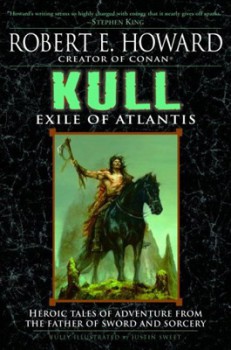
Emerald jungles filled with scalp-hungry picts. The primordial perfection of axe and spear. The clang of steel on steel beneath tattered banners, and the dying howls of winged terrors. Lost temples and fantastic jewels, mounds of gold steeped in the glow of eldritch flames…

The thunderous cadence of tribal drums and clouds rushing grey as death. Ruby-eyed witches and bloody claws trailing torn flesh. The primal rush of muscle and bone…battle cries like phantom bats above the field of honor. The stench of Stygian darkness where serpents gleam and glide, as terrible gods demand red sacrifices…

 The sorcerer who peers beyond and calls up fiends from Hell…the clash of iron and the defiance of tyranny. The triumph of the noble savage against the cruelty of opulent empires. Colossal spiders and spitting vipers. The turn of a supple leg, the heaving of breasts and swirling of gossamer veils. The crushing embrace of bronze arms, the blazing passion of life against the black gloom of death…

The galloping hosts of antique nations, the cry of a night-beast wailing at the moon. The precarious dance of flesh and metal, the arcs of flying crimson. Spilling viscera. The brutal grace of prehistoric combat, the strength of arm and gnashing of teeth. The sparkling visions of a misted age, the mysteries of old worlds heavy as dreams…

The Cimmerian snow and glaciers, the breath of northern myth…the sweltering desert where vultures stalk parched prey…the rise of Slave to King…the simplicity of might making right in a world tossed on seas of blood. The damsels in distress and the avenging hero…the lantern jaws and sapphire eyes. The glittering towers collapsing in shards…
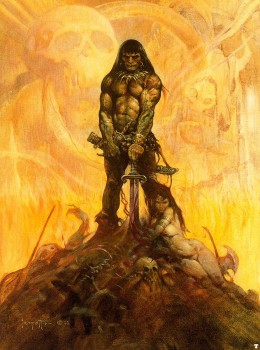
fraz501

The ancient world transmogrified, embroidered with the brilliants of legend, steeped in the wine of epic storms. The blood and thunder. The broad-shouldered lug and the skull-faced horror…the sting of a whisper in darkness. The dripping dagger and the broken blade…

Crumbling continents and rushing seas, the cataclysm of evolution…Atlantis and the descendents of Valusia. Tiger totems. Solemn kings brooding on golden thrones…the serpents that walk on two legs…the wizards haunting graveyards and the bones that rattle and walk in moonlight…the Valley of the Worm.

The mystic spell of language…the well-turned phrase and the phantasm of imagery. The tales of obsession, the obsession with tales. The poetry of doom and the marching specters…the man, the legend, the visionary…

The spectacular stories, the gripping yarns, the wonderfully weird tales…

Immortality wrought in ink and parchment.

All this and more…that’s why I love REH.

Happy Birthday, Bob.

— John R. Fultz