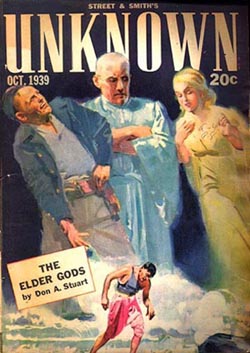
Who Gods There?: “The Elder Gods” by Don A. Stuart
 I’m guest-blogging this week at Babel Clash, along with fellow Pyr author Matt Sturges, and for the past couple days we’ve been kicking around the topic of our influences and anti-influences. It’s not always the biggest books or the best that are influences, though. For instance…
Don A. Stuart‘s “The Elder Gods” is a fantasy novella from the late 1930s that reads a lot like the science fiction being written around the same time. That’s no accident: the author behind the pseudonym is John W. Campbell, once a leading light in the “super science” stories of the 1930s, later a pioneer of a more sophisticated form of speculative fiction, and (by the time the work under review appeared) he was well into his third and longest career as the influential editor of Astounding Science Fiction–and the new fantasy magazine Unknown, in which “The Elder Gods” first appeared. (I reread it in a rather battered copy of the 1970s Ace reprint of The Moon is Hell; but there’s a NESFA edition of Campbell’s Stuart stories, including “The Elder Gods”. That’s what I’d recommend seeking out, if you’re interested, as there are some typographical glitches in the Ace edition; plus, it may be harder to find; plus, I’ve always thought “The Moon Is Hell” was a stupid title.)
In Unknown, Campbell didn’t want to create yet another knockoff of Weird Tales; the tagline for the paper-covered anthology From Unknown Worlds was “Fantasy Stories for Grown Ups”–by which he seems to have meant the serious grownups who were reading Astounding. Lots of his Astounding writers crossed over to write for Unknown, and “The Elder Gods” was apparently his how-to-do-it example, applying the Astounding method of speculative fiction to fantasy.
[ Spectacular Stories of Scientific Theology beyond the jump.]
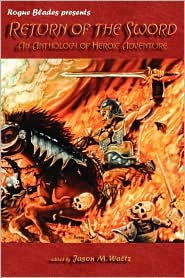 I read an interesting post the other day by a thoughtful blogster whose name I cannot now remember and whose post I cannot locate again, who professed his surprise at all the fans of Conan (and Sword & Sorcery in general) who were returning to the fold now, after falling away in the 1980s, after the last Big S&S Boom.
 I’m a sucker for retrospective anthologies. And F&SF is one of my favorite magazines — and has been since I first discovered tattered copies in the tiny library of Rockcliffe Air Force base in Ottawa, Canada, in the late 70s. Editor Gordon van Gelder has assembled an imposing, 470-page collection spanning more than five decades, starting with Alfred Bester’s “Of Time and Third Avenue” (1951) and ending with Ted Chiang’s “The Merchant and the Alchemist’s Gate” (2007).
 Regarding two earlier posts:
 When an unabashed work of fantasy gets shortlisted for a National Book Award, Black Gate‘s Rich Horton sits up and takes notice. The volume in question is titled Skin Hunger, Book One of a series called A Resurrection of Magic. Penned by talented writer Kathleen Duey, it’s filled with witches, magic, ove and loss. Horton judges it an intriguing page-turner that acts as a promising introduction to Duey’s fictional world.