Browsed by
Category: Blog Entry

Because One Frederick Faust Post Isn’t Enough: The Sacking of El Dorado

Because One Frederick Faust Post Isn’t Enough: The Sacking of El Dorado

frederick-faust-in-brentwood“So it will be when we are dead that perhaps our lives will stand for something.”

“A typewriter is almost like a human being to me.”

“Have recently sent thirty-eight poems to our leading magazines and received thirty-eight poems back from our leading magazines.”

“All that can save fiction is enormous verve, a real sweep, plus richness of character, blood that can be seen shining through.”

“Why is my verse so difficult, so dead, so dull to other people?”

—Frederick Faust, from various letters

I was surprised but pleased to see the positive reaction that my post about Frederick Faust, a.k.a. Max Brand, received last week. It was enough for me to want to spend an extra week on the author, specifically to take a closer look at an individual volume of his work. Faust has rarely received this sort of attention, as John C. Hocking pointed out in the comments last week, and so I’ll spend another Tuesday of your time talking about a man who was not only the most prolific of the pulpsters, but one of the most skilled and literary.

Read More Read More

Black Gate 14 Sneak Peek: “On a Pale Horse” by Sylvia Volk

Black Gate 14 Sneak Peek: “On a Pale Horse” by Sylvia Volk

on-a-pale-horse-277Once a Bedouin girl tamed a crooked stallion — and the Arabian breed was born. A tale of legend and desert war.

     Behind her, Salsabil heard the drumming of hooves. At the awning of the family tent, with her pursuer thundering after her, she whirled. Sand sprayed under her heels. She stood tall, flinging up her arms.
      The mare came charging downhill at full speed, head tucked close against her chest and hooves crashing through the loose scree. Straight at her. Salsabil stood like a rock. Her sight grew dim. Her outstretched fingers trembled. But she did not move.
     At the last instant, with her nose barely an inch from the girl’s breast, the war-mare stopped. She flung her elegant head high, danced before Salsabil upon hooves smaller than the feet of a girl-child. And Salsabil gazed up and up at the rider on the mare’s back.
      She looked into his bearded face, and fear struck her in the heart — for it was the face of a skeleton. But she could not allow him to pass.

Sylvia Volk was born in western Canada. This is her first published story.

 “On a Pale Horse” appears in Black Gate 14. You can read a more complete excerpt here. The complete Black Gate 14 Sneak Peek is available here.

Art by Aaron Starr.

On Reviewing

On Reviewing

sh_headJustina Robson’s review of Greer Gilman’s Cloud & Ashes in Strange Horizons struck a number of resonating chords for me. For one, her ambiguous feelings about reviewing echo my own. It’s not only wondering if you’re getting it right, it’s how one offhand sentence can be taken to mean something entirely more than what you intended. I, too, had my problems with Bold as Love (which you can read about here and here and here).

I also share with Robson that Gilman is undoubtedly an interesting and possibly profound writer, but it’s much too much work to appreciate it (“This brings us to the real doorstop of the collection, both in terms of page count and prose density. “A Crowd of Bone” by Greer Gillman invokes Celtic myth concerning…this is the longest story here; it is also the hardest to read… English majors who’ve ploughed through Beowulf in the original Old English may find the language fascinating. This English major found it tedious, and at one point just stopped reading it and went on to the next story. I did eventually go back to finish it, but still considered it rough going”).

Finally, I too struggle with balancing mixed feelings about books I actually like, or should like more, at certain levels, as, for instance, my review of Robson’s latest novel.

The Evil Genius of ORC STAIN

The Evil Genius of ORC STAIN

The Newest Must-Read Fantasy Comic…


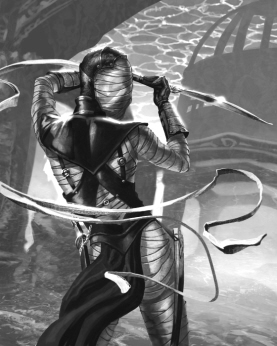
os1“And the Orcs took the fortress on the west slopes of Mount Rerir, and ravaged all Thargelion, the land of Caranthir; and they defiled Lake Helevorn.”
 –J.R.R. Tolkien, The Silmarillion

“Violator! Desecrator! Turn around and meet the hater!”
 –Rob Zombie, “Demonoid Phenomenon”


Orcs seem to be popping up everywhere these days. I’ve done my share of complaining about this. I’ve raved about how Orcs should be kept in Tolkien books…after all, he invented the beasties as a counterpart to his magnificent Elves. (Nevermind that that actual word “orc” existed before in reference to a water-monster.) Today there are even entire novels dedicated to Orcs.

And, to my great delight, at least one spectacular comic book.

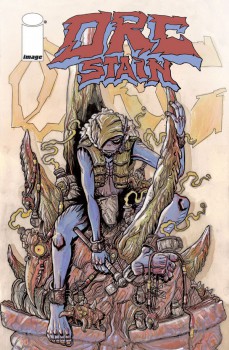
ORC STAIN is the creation of writer/artist James Stokoe, and is published by Image Comics. This series “For Mature Readers” is a brand-new offering, with only two issues on the stands so far. However, it grabbed my attention on both a story and art level (a seemless blend) and quickly rose to the top of my must-read list. In fact, any fan of fantasy adventure fiction, sword-and-sorcery, dark fantasy, monster comics, or simply Those Who Dig Orcs owes it to himself to read this amazing experiment in non-corporate comics.

Read More Read More

Somebody Has to Talk about Frederick Faust

Somebody Has to Talk about Frederick Faust

and I guess it’s going to be me.

When I first started blogging officially here at Black Gate, I wondered what would constitute “on topic.” Obviously, writing about new crop developments in Iowa would be “off topic” (and I don’t know anything about that anyway) but would writing about Godzilla (about which I know far too much for my own good) be considered “on topic” because I could count on at least half the site’s readership thinking it was interesting? I still wrestle with these questions, and perhaps that’s why I don’t sleep as well at night as other people.

One thing that I’m certain now is “on topic” is anything that has to do with pulp magazines. I’ve written about Norvell Page’s Spider novels (and will do so again soon) and mystery and suspense author Cornell Woolrich, and nobody’s taken me to task for either. So now I throw caution to the four winds and write about Frederick Faust because somebody has got to do it. If I’m going to write about pulp magazines, I have an obligation to write a post about Frederick Faust. You have no obligation to read it, but I strongly urge you to look below the cut because  this fellow is seriously interesting and you should give him a glance some time.

Read More Read More

Black Gate 14 Sneak Peek: “The Wine-Dark Sea” by Isabel Pelech

Black Gate 14 Sneak Peek: “The Wine-Dark Sea” by Isabel Pelech

wine_dark_seaThe crumbling passage led to an underwater city, filled with marvels, wild magic… and secrets.

The village witch rowed Newyn to the tainted place, the ocean cove the locals called ya sangra liu — the bloody harbor. No one knew what had happened there, except that once it had not been filled by the sea.
     “There.” It was a toothlike stone structure that stuck out of the water to roughly waist-height, in the middle of the miniature bay. “Everyone knows, you walk down that way, you can breathe.”
      Newyn studied the protrusion. It was manmade, circular, perhaps the ruined top of a tower. “Do you breathe water, like a fish, or is there air?”
     “You’re not floating, if that’s what you mean. You can walk, run, speak if you find anyone to speak to. Near enough to air, even if the fish swim in it.”
     “And others have gone down, and come back.”
     The witch half nodded, half shrugged. “Come back, yes. But not always whole.”
    “Why did they go?”
     “Some folks come back ranting about gold… I’d think you might like gold.”
     “Oh, I do,” Newyn said, so softly it was almost a hiss. “I do.”

Isabel Pelech has been published in Talebones, Tickled by Thunder and Dreams & Nightmares. She lives in Tennessee with two gray cats.

“The Wine-Dark Sea” appears in Black Gate 14. You can read a more complete excerpt here.

The complete Black Gate 14 Sneak Peek is available here.

Art by Mark Evans.

The Best Sword & Sorcery Stories

The Best Sword & Sorcery Stories

second-landhkmarOver at SF Signal, editor John DeNardo asked ten science fiction and fantasy writers and editors to pick the best sword and sorcery stories, and explain what makes them so good.

The writers include Black Gate authors James Enge and Martha Wells, as well as Steven Brust, Mercedes Lackey, Mary Robinette Kowal, Mark Chadbourn, P.C. Hodgell, Gail Z. Martin, Brandon Sanderson, and Lou Anders.

Here’s what James Enge had to say, in part:

There’s no doubt in my mind that Fritz Leiber’s series about Fafhrd and the Gray Mouser are the uneven apex of the disreputable S&S mountain…. Leiber was a gifted storyteller and stylist who used the stories to explore what the world is, how it’s made, what the people there are like. Every story takes you someplace different and extends your knowledge — whether the heroes are fighting gods on Rime Isle, ghosts in the unnamed west, or rats or the Thieves’ Guild or advertisers in Lankhmar city, Leiber doesn’t do retreads. And Leiber understands, as few writers do, how horror and humor are two sides of the same coin; likewise love and grief.

It’s a fascinating list, and well worth reading. And you’re sure to find more than a few good recommendations, whether you’re new to S&S or an old sword-brother.

The complete article is here.

Goth Chick News: These Are A Few of My Favorite Things

Goth Chick News: These Are A Few of My Favorite Things

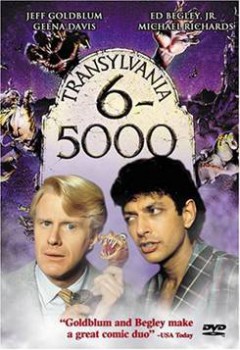
6-5000This is the second of two installments which I pre-wrote for the Goth Chick Intern to gratefully post on my behalf.
In a strange fit of wanton generosity I found myself also agreeing to allow the little minion to come up with a title for this entry, so in the event it is lame (heaven help him if he used a Sound of Music reference) please accept my apology in absentia, and rest assured my response will be swift and merciless upon my return.

Rather than enjoying the wee bit of freedom he has recently been allowed, he will once again be banished to the windowless broom closet in the bowels of Black Gate headquarters. I should know better than to succumb to a flush of good will brought on by an impending foray into the paranormal.

But more on that later.

When last we discussed the mutual enjoyment we get from insinuating movie quotes into situations at wickedly appropriate (or inappropriate) times, it got me to thinking about the sources of those quotes – be they movie, book or music. It also occurred to me that everyone has a “Top Ten” list which represents their own mental comfort food; i.e. the entertainment you go to when you’ve had a bad day, or a good day, or just a bored-to-sobs-rainy-afternoon day, and are assured you’ll be welcome. These sources have seeped into our daily lives in the form of quotes or lyrics, and therefore permeated the lives of our friends and families as well.

So, it is to our own personal Top Ten lists that I wish to pay homage this week, and I invite you to share yours. If you love it, the rest of us just might love it too.

And as I have multiple top ten lists, I’ll stick to the one that pertains to my favorite genre (bet you can guess).

So here it is, in no particular order. 

Read More Read More

Writers, Readers, and Glorious Fools

Writers, Readers, and Glorious Fools

Novels vs. Short Stories, and Why We Write

fool-11
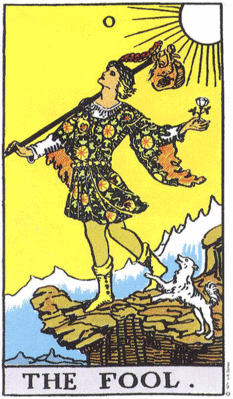
The Fool -- a leap of faith.

“What fools these mortals be…”
–Puck, A Midsummer Night’s Dream

 “But the fool on the hill
Sees the sun going down
And the eyes in his head
See the world spinning around…”
–The Beatles, “Fool On the Hill”


A colleague of mine recently asked the question: “Why do we write short stories?” Good question. It set me to thinking: “Why do people READ short stories?”

Which set off a whole line of thought involving the reasons why writers write, and conversely, why readers choose to read what they read.

Readers: Which do you like best, novels or short stories? I may be a writer but I’ve been a reader a lot longer and my answer has to be “It depends on the novel or story.”

I’ve read novels that touched my soul and changed my life…and I’ve read short stories that did the same thing. In most of those instances, the novels seem to stay with me longer…maybe because of their greater size and time commitment. Yet I could never discount the power of marvelous short stories like Harlan Ellison’s “I Have No Mouth and I Must Scream,” Robert Silverberg’s “The Reality Trip,” or Clark Ashton Smith’s “Xeethra.” (To name only three of hundreds.)

Read More Read More

Who Fears the Devil?

Who Fears the Devil?

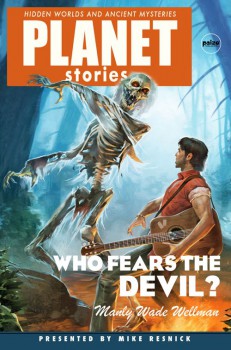
who-fears-the-devil-coverWho Fears the Devil?
Manly Wade Wellman (Paizo Publishing, 2010)

Paizo Publication’s Planet Stories has brought forth another collection of the kind of grand and weird fantasy that the chain bookstores want to keep hidden from you. Who Fears the Devil?, the complete tales of Manly Wade Wellman’s “John the Balladeer” character, is one of the Planet Stories volumes I’ve most anticipated; there’s no other fantasy character quite like John, and no one else but Wellman could have created him. He’s a contemporary fantasy hero who uses folk songs instead of swords, and faces wonders from the mountain legendry of Appalachia. He’s part Weird Tales, a touch of Unknown, plus Pete Seeger and Johnny Cash.

Also called “Silver John” in promotional material because he strings his guitar with silver, but always simply referred to as “John” within the stories, Wellman’s hero is a variant on the bard of the Middle Ages who wanders the contemporary Appalachians. Or semi-contemporary; the setting is really a fantasy land based on Wellman’s love of Appalachian folklore and the spirit of its musical tradition. In the stories readers will occasionally encounter cars, trucks, air travel, and mention of John’s Korean War service, but most of the time they will find it easy to imagine that this is an Appalachia frozen in the nineteenth century, when stories and songs at the hearthside were thinly veiled truths about wizards, witch-folk, and strange beasts.

John’s songs help combat evil, as do the silver strings on his guitar. (One of the few problems I have with the stories is that the “silver against supernatural” concept turns up a few times too many.) John not only sings the ballads, he’s a collector, and in some of the stories (“The Little Black Train,” “Vandy, Vandy”) his search for old ballads brings him into the action. “Call me a truth seeker,” he tells one curious inquirer, “somebody who wonders himself about riddles and life.” When then asked if he’s a “conjure man,” he answers: “Not me…  I’ve met up with that sort in my time, helped put two-three of them out of mischief. Call that part of what I follow.”

Read More Read More