Browsed by
Category: Blog Entry

Vintage Treasures: Echoes of Valor II, edited by Karl Edward Wagner

Vintage Treasures: Echoes of Valor II, edited by Karl Edward Wagner

Echoes of Valor II-smallKarl Edward Wagner continued his sword-and-sorcery anthology series with Echoes of Valor II, published in hardcover by Tor Books in August 1989, two years after the release of Echoes of Valor.

Wagner settled into an established pattern with this volume. The first one had been unusual for a couple of reasons. For one thing, it contained only novellas — three big stories by Robert E. Howard, Fritz Leiber, and Henry Kuttner. Not that you can go wrong with Howard, Leiber, and Kuttner, but the next two books in the series offered a more varied table of contents.

Echoes of Valor had also been bare bones from an editorial standpoint. Not even an introduction, let alone commentary on the stories. Wagner rectified that with Echoes of Valor II, which included new and reprinted story intros and author retrospectives by C. L. Moore, Sam Moskowitz, Forrest J. Ackerman, and Wagner himself. This seems more what Wagner had in mind for EoV, which he clearly intended to be a definitive S&S anthology series.

In fact, it’s probable that the first volume was put together much more hurriedly than the last two. Not only was it missing the editorial content that would be the hallmark of the series, but it went straight to paperback. Echoes of Valor II appeared first in a handsome hardcover edition, and was reprinted in paperback in February 1991.

This one contains a rich assortment of classic S&S and heroic fantasy, including a Conan tale by Robert E. Howard, a Jirel of Joiry story and two Northwest Smith tales from C. L. Moore, a Venus novella by Leigh Brackett and Ray Bradbury, and a Hok the Mighty novella by Manly Wade Wellman… along with fascinating articles on how some of the stories came together.

Read More Read More

Shimmer 23 Now on Sale

Shimmer 23 Now on Sale

Shimmer 23-smallI’m someone who believes that the core of the fantasy genre is still its short fiction magazines.

This used to be a lot more true, of course. When fantasy and science fiction were still fresh and new as distinct literary genres in the early 20th Century, the only place they regularly appeared was pulp magazines. For fantasy, that meant Weird Tales, the shot-lived Unknown, and later Famous Fantastic Mysteries and the like. Mass market paperback fantasy didn’t take shape until the 1950s, and didn’t really become popular until The Lord of the Rings appeared in paperback in the 60s. Nowadays when people think of fantasy, they tend to think of paperback bestsellers like George R.R. Martin, Stephen King, and Brandon Sanderson.

Where did all three of those writers get their start? In magazines, of course.

Magazines are where the next generation of breakout fantasy writers are already at work today. And if you’re interested in trying a magazine that has a fabulous rep for discovering and promoting stellar writers long before they’re well know — authors like Amal El-Mohtar, Genevieve Valentine, Lou Anders, Chris Roberson, Aliette de Bodard, and many others — then I highly recommend Shimmer.

Shimmer is published bi-monthly, and edited by E. Catherine Tobler. It’s available in both print and your choice of DRM-free electronic formats (indeed, a wide range of formats, not just PDF and Kindle.) It has shown a talent for rooting out great fiction across a wide range of fantasy and SF, and takes pride in publishing “Speculative fiction for a miscreant world.”

Read More Read More

Introducing BlackGateDate.com: Examining the Dating Profiles of the Men of the Fantasy World

Introducing BlackGateDate.com: Examining the Dating Profiles of the Men of the Fantasy World

Science fiction writer Amy Sundberg recently wrote an excellent post about dating on her blog. This inspired me to think a little more about dating too. Dating is not something I have a lot of time to do, but I have been on a dating site or two and this set me wondering about how to approach dating from the angle of the fantasy genre. It isn’t pretty, but it’s perhaps more honest than what is shown on dating websites.

Username: ImTooSexyForTheMaiar,TooSexyForTheMaiar
Summary: I am the all-seeing eye and I have spread my shadow across the world and crushed the races of Middle Earth. I also make jewelry.
Body type: I am a burning eye. I looked really good when I was an angel. Now that I’ve conquered Middle Earth I’m getting back into shape. Work out partner?
I’d Fit Well With: I’m All-Dominating, in the bedroom and out. I fit well with someone into that.
Six Things I Could Never Do Without: The One Ring.
Deepest Secret: I sometimes I wonder what it would be like to submit to a lover or get a spanking. I’ve been a bad boy. Also, I haven’t told any of my friends, but I make kick-ass balloon animals.

Read More Read More

Historical Cthulhu: That Is Not Dead, edited by Darrell Schweitzer

Historical Cthulhu: That Is Not Dead, edited by Darrell Schweitzer

That Is  Not Dead-smallAccording to H.P. Lovecraft’s legendary canon of cosmic horror tales, the Great Old Ones such as Cthulhu, Nyarlathotep, Yog Sothoth, and all-mighty Azathoth have lurked in the dim places of the cosmos since the beginning of time.

“That is not dead,” wrote the mad poet Abdul Alhazred, “which can eternal lie, and with strange aeons even death may die.” One of Lovecraft’s most famous lines is the inspiration for a new hardcover volume of historical Cthulhu Mythos fiction from PS Publishing.

That is Not Dead features all-new tales of cosmic horror set in various periods of history. Here’s what editor/contributor Darrell Schweitzer had to say about the book:

That is Not Dead is a collection of Mythos stories, based on the premise that if the Old Ones have been around since elder aeons, someone should have noticed before Lovecraft’s characters did about 1900. The theme then is lurking presences. Inasmuch as the stories deal with history, it is secret history, i.e. “what really happened…”

Here’s the complete Table of Contents (by historical era).

Read More Read More

Smart Guy, Huh?

Smart Guy, Huh?

ScorpionIt used to be okay to be the smartest person in the room – at least on paper, real life isn’t my area of expertise. Sherlock Holmes was definitely a loner, and eccentric, no question. But when he left Baker Street, he was appropriately dressed, even, or perhaps especially, when in disguise. He knew, understood and used all the social conventions, and could converse easily with everyone and anyone, from any walk of life. He may not have been interested in women romantically, but he had no trouble interacting with them.

This facility used to be part of being the smartest person in the room. Now, we see more examples of this extremity of genius than ever before, including two versions of Holmes. It might have been CSI that started this off – what was Grissom but the smartest guy in the room? – and since then we’ve had House MD bringing in the medical side, and The Mentalist for the con artist in all of us, and this season alone we’ve got Forever, and Scorpion, plus, I believe, a couple more coming along soon.

And let’s not forget, that for as long as most of us have been alive, we’ve had Dr. Who.

Read More Read More

Writerly New Year’s Resolutions and How to Make Them Work: Part 2

Writerly New Year’s Resolutions and How to Make Them Work: Part 2

Writing Space
It all comes down to time and space to write.

How are the New Year’s Resolutions working out?

Are you being a more productive writer?

If not, then you probably need to set things up so you can be more productive, which is what I promised to talk about this week.

It all comes down to time and space to write.

You can squeeze more into your existing writing time by having an effective writing process — we had that rant already in Part 1 — and by learning to touch type.

Touch typing rocks. The words appear on the screen by telepathy. No distractions, no fiddling fingers. You think better, write faster.

However, what you really want is more writing time, with less interruption, which in turn means establishing a better physical space within which to do it. The time and space then need defending.

Read More Read More

The Shade of Klarkash-Ton

The Shade of Klarkash-Ton

None strikes the note of cosmic horror as well as Clark Ashton Smith. In sheer daemonic strangeness and fertility of conception, Smith is perhaps unexcelled by any other writer, living or dead.

casSo wrote another great writer of cosmic horror, H.P. Lovecraft. Even given the Old Gent’s tendency toward hyperbole when extolling the virtues of his colleagues, I find it hard to disagree, particularly on this, the 122nd anniversary of Smith’s birth in Long Valley, California.

Of the “Big Three” – Lovecraft, Howard, and Smith – who wrote for Weird Tales during the 1920s and 1930s, CAS is the only one to have lived long enough to have died of old age and yet he’s also probably the least understood and celebrated. That’s a great pity, not just because he’s probably my favorite of that glorious triumvirate, but also because his works are quite unlike any other fantasy or science fiction writer before or since. Jack Vance probably comes the closest to conjuring up the shade of Smith, but there are lots of subtle differences between the two authors that make such a comparison facile.

For one, Smith considered himself primarily a poet rather than a writer of fiction. Even his most straightforward prose pieces possess a poetic character to them that transcends his florid vocabulary and indulgence in archaisms. There’s an incantatory rhythm to his writing that demands it be read aloud; I frequently find myself doing just that when I read a Smith story. It’s a very strange and powerful thing. Rarely have I encountered a writer whose written words so cried out to be spoken (intoned?). When you do so, the experience is like few others in literature. Smith’s writing is luxurious and appeals to all his reader’s senses, including the mind’s eye – that part of the imagination that doesn’t just conceive of people and things and places that have never existed but that strains at the edges of infinity. I find myself at a loss to describe precisely what I mean, but then that’s part of my point. Smith’s work often gives voice to the ineffable in ways that are both exhilarating and terrifying. Few others writers I have encountered can do that.

I make no secret of the fact CAS is my personal favorite of the Big Three of Weird Tales and the one whose works I most wish I could emulate. Though I strive mightily against it, I fear that my own writings evince a style more in keeping with the antiquarian Lovecraft than with the otherworldly poetry of the Bard of Auburn, though not for lack of trying. Smith’s genius is elusive and not easily reproduced.

Read More Read More

A Most-Enjoyable Crisis

A Most-Enjoyable Crisis

dc_comics_crisis_3d_600x600_0If you’ve read DC comics for any length of time since the mid-1960’s, the term “crisis” probably triggers memories of monumental, universe-shattering storylines. It began as the name for several of the major DC cross-over events, ultimately culminating in the classic 1986 Crisis on Infinite Earths storyline, which was one of the most effective efforts to fix continuity errors in comics with a comprehensive universal reboot. (It has since been followed up by DC universal reboots of varying degrees in their crossovers Zero Hour, Infinite Crisis, and Flashpoint.)

So the title of this game-changing expansion to the DC Deck-Building Game (Amazon) should be no surprise. The Crisis expansion (Amazon) introduces significant new elements of gameplay. I’ve played a number of games and expansions, but it’s been a while since I saw an expansion which gave an existing game such a phenomenal revamp as this one.

I first reviewed the DC Deck-Building Game a year ago, in a face-off against the Marvel: Legendary deck-building game. At the time, my 9-year-old son considered the DC game as his favorite, though I came down in favor of the Marvel game, mostly for the following reasons:

  • Marvel: Legendary felt more like narratively being inside a comic book, in comparison to the DC game. Marvel is built around a Scheme Card implemented by specific Mastermind supervillains, meaning that each game has a unique storyline and game objectives. The DC game, on the other hand, involves beating up a pile of villain cards to win.
  • Marvel: Legendary was at least partially cooperative, while the DC game was entirely competitive. Since I mostly play with my son, I prefer cooperative games. Also, from a storytelling standpoint, I felt like a game where I’m supposed to be Batgirl and my son is supposed to be Nightwing should be more cooperative.

Read More Read More

December Short Story Roundup

December Short Story Roundup

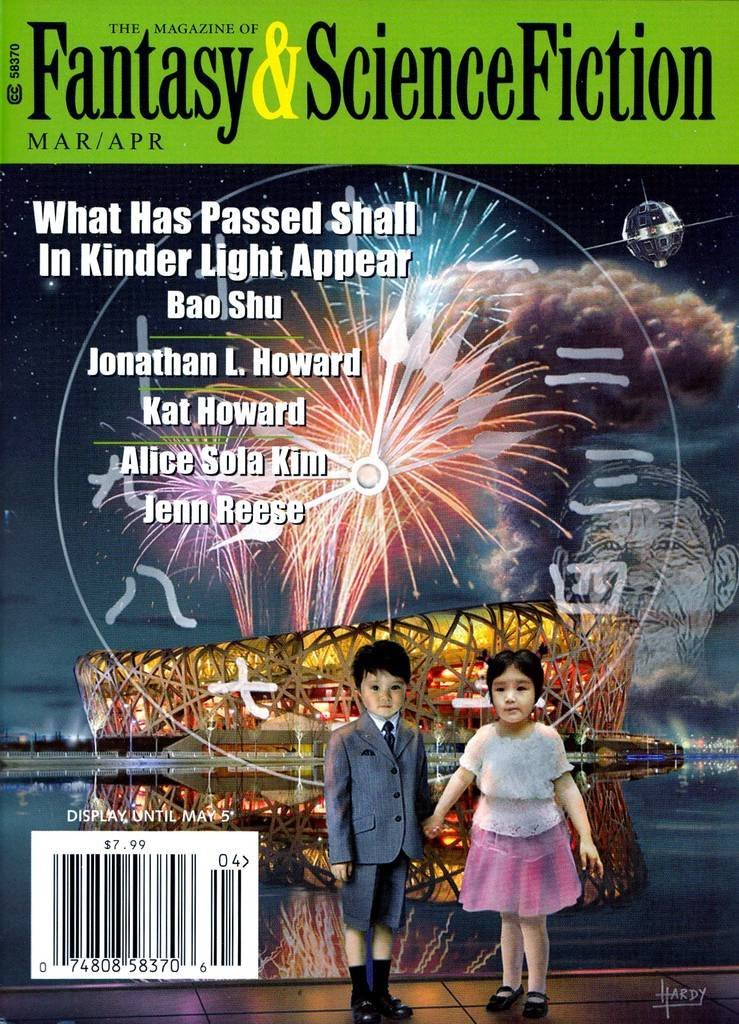
Magazine of Fantasy and Science Fiction Jan-Feb 2015-smallNot every month brings me a great big stack of stories to review. Which is fine. I mean, it’s not like we all don’t have a ton of things to do during December. Still, I did find three stories to tell you about, one them quite good.

Let’s start with the highlight of the December stories, “Prisoner of Pandarius,” by Matthew Hughes in The Magazine of Fantasy & Science Fiction (January/February 2015). It’s a tale of revenge, thievery, and guild politics starring Raffalon, a thief with a ready wit, an overriding sense of self-preservation, and a name more than a little reminiscent of E A Hornung’s famous gentleman thief, Raffles.

Hughes makes no bones about being a fan of, and inspired by, Jack Vance’s Dying Earth. On his site he refers to Raffalon as “my archetypal Dying-Earthish thief.” There’s certainly a Vancian sensibility to the story’s trappings, e.g. a spell with the name “Izzizitz’s Matchless Latch” and the thieves’ organization’s official name of “The Ancient and Honorable Guild of Purloiners and Purveyors.” I’m a sucker for Jack Vance-inspired stories, provided they’re done well. I’m quite happy to write that “Prisoner of Pandarius” is one of those.

My first encounter with Hughes’s fiction was just this past September, also on the pages of F&SF (Sept/Oct 2014). “Avianca’s Bezel,” which I like very much, also features Raffalon. Therein, he learns the hard way the problems attendant with working for wizards.

In the new story, his decision to never again work for a wizard is put to the test when he is defrauded by the Purveyors — i.e. fences — of his guild. An old associate, the sorcerer Cascor, approaches him with a job offer and he reconsiders the hard line he’d previously taken.

Read More Read More

The Barbarism of Bullfighting and Archaic Diction in L. Sprague de Camp’s “The Rug and the Bull”

The Barbarism of Bullfighting and Archaic Diction in L. Sprague de Camp’s “The Rug and the Bull”

1974 Paperback edition. Cover art by Frank Frazetta.

One of the many freedoms of Sword and Sorcery, it seems to me, is that it enables the adoption of a world that allows the writer to comment on just about anything on which one would want. One of Robert E. Howard’s purposes in the construction of his own Hyboria was to create a conglomerate of cultures, no matter how anachronistic their juxtapositions, so that his hero Conan might have any kind of adventure that Howard might think up. Whereas for previous tales, Howard perhaps had to construct different heroes for different historical epochs (Bran Mak Morn for the Celtic Picts, Solomon Kane for the sixteenth century, Kull for Atlantis), in the Hyborian Age Conan might be a thief, a soldier, a pirate, and ultimately a king, his adventures all the while providing Howard with powerful commentary on “civilization.”

So, too, writers after Howard have utilized this purpose. Dave Sim, through his creation of Cerebus the Aardvark, begins by commenting on the Sword and Sorcery genre itself (as well as the mainstream comic books of Sim’s time) and then goes on to explore High Society, Church & State, marriage – and this last, in Jaka’s Story, is as far as my reading has taken me, but I understand that Sim is so far reaching in his exploration of topics that in a much later volume he even explores the life and works of Ernest Hemingway through Cerebus taking on the position of Hemingway’s personal secretary!

Terry Pratchett uses the Sword and Sorcery milieu to ingenious satirical effect, cribbing directly (I believe) from Fritz Leiber in order to forecast to his readers, in the very first pages of the very first Discworld novel, just what tone and material his readers may expect. Pratchett’s initial perspective characters, soon abandoned, are Bravd and the Weasel (Fafhrd and the Gray Mouser, obviously). I quote the following description in order to give an example of Pratchett’s satirical treatment of Sword and Sorcery and to underscore, specifically, Pratchett’s debt to Leiber. For more humor, one might want to pick up this book and enjoy the way that these characters talk to each other – it’s impressively Leiberesque.

Read More Read More