Browsed by
Category: Art

In Pursuit Of the Dragons Of Britain

In Pursuit Of the Dragons Of Britain

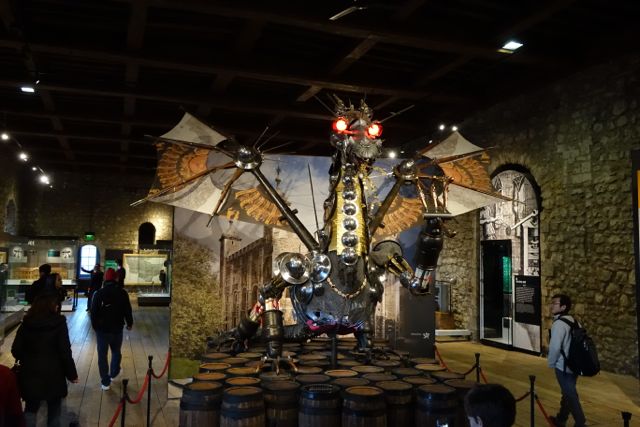
The "Munitions Dragon" at the Tower of London.
The “Munitions Dragon” at the Tower of London.

As some few of you may know, I recently abandoned my luxurious offices in Black Gate’s sprawling Indiana Compound and have set my course by a wandering star. My prime objective (if not my Prime Directive) is to find a real, live dragon.

So far, no go. On the plus side, I have found definite signs of dragons in all quarters of my British hunting grounds. In fact, if carvings and statuary are any guide, dragons remain downright popular and have been so for centuries. Surely their real life counterparts cannot be far afield? Lurking just over the next moor, I should think, spitting flame and devouring maidens.

The most remarkable thing about dragons is how they induce credulity. Dragon fans become, with time, less like a fine aged wine and instead rather like my old friend Fox Mulder: against all reason, we want to believe. Maybe firedrakes and so on don’t exist –– maybe I’m off on a wild goose chase, and I should scarper back to the Indiana Compound forthwith –– but having grown up on Smaug, Quok, and the Reluctant Dragon, I find that I run along on fumes of faith. Dragons are simply too magical to track them with anything less than full-bore belief.

Read More Read More

OMG! Immortal Immodesty (Deities and Demigods, Part 3)

OMG! Immortal Immodesty (Deities and Demigods, Part 3)

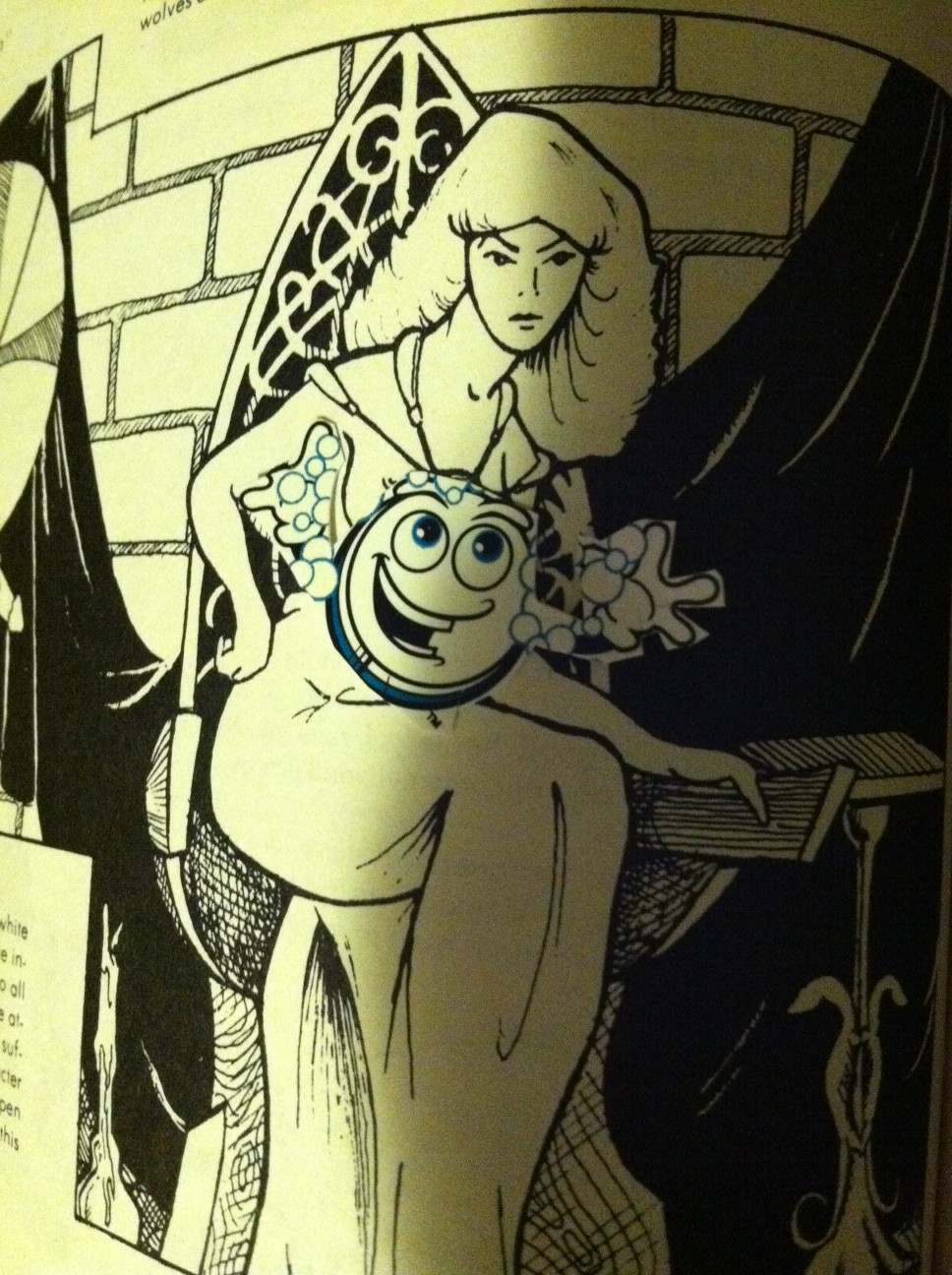
Whoops! The Goddess of Pain has had a wardrobe malfunction!
Whoops! The Maiden of Pain has had a wardrobe malfunction!

In my ongoing exploration of TSR’s first edition Deities and Demigods (1980), I must now confront the mammary in the room.

Did you ever notice there’s a fair amount of nudity in those first generation ADD books? I’m just, um, wondering if you guys did. I mean, I didn’t. I just noticed. Someone pointed it out to me — yeah! That’s the ticket! When I was twelve years old, I was much too pious to have had any impure thoughts toward Loviatar, aka Goddess of Hurt aka “Maiden of Pain.”

Okay, I may have noticed in passing that there was less modesty in those ‘70s and early ‘80s realms of fantasy, whereas with second edition on there is nary a nipple to be noticed. The cleaning up happened before the Wizards of the Coast buy-out and seems to track pretty closely with the culture in general (note many PG movies from the same era — say, the original Clash of the Titans — that couldn’t be shown on basic cable these days without heavy editing to assure that preteens aren’t sullied by viewing bare human breasts and buttocks, which they have never seen because who ever heard of the Internet?).

The interior illustrations are gorgeous. This is old-school RPG, so it’s all black-and-white line art by the likes of Erol Otus, David S. LaForce, Jim Roslof, and David C. Sutherland III.

To undress, er, address the tempestuous topic of topless deities in the temples, I must confess that, as an adolescent, I did appreciate the fact that goddesses by and large disdained mortal-kind’s prudery when it came to attire. It’s stunning, really, how many goddesses not only do not cover up their breastesses, but wear outfits that positively accentuate them.

Read More Read More

Total Pulp Victory: A Triumphant Return from Windy City Pulp & Paper

Total Pulp Victory: A Triumphant Return from Windy City Pulp & Paper

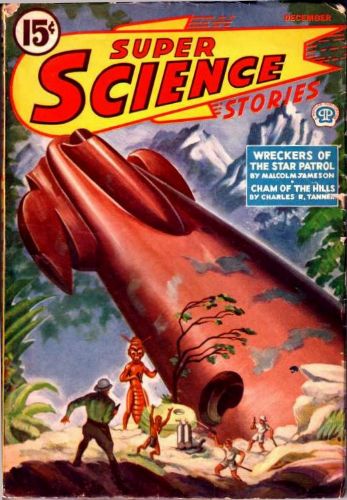
Super Science Stories Canada December 1942-small Super Science Stories Canada February 1945-small Super Science Stories Canada August 1945-small

Doug Ellis’s Windy City Pulp and Paperback Convention has wrapped up for another year (see my report from last year here). I got to see many old friends, meet some new ones, and also connect in person with a few for the first time — including Barbara Barrett, who traveled many hundreds of miles to make it to Chicago. Barbara has been blogging for Black Gate for many years and her early article “Robert E. Howard: The Sword Collector and His Poetry” is one of the most popular pieces we’ve ever published… but we’ve never met in person, and it was an absolute delight to finally join her for dinner — and give her a big hug.

In between all the meetings, reunions, and forging of new friendships, I also picked up a treasure or two. I’ll be reporting on some of the most interesting here over the next few weeks (the most common comment I heard as I put away my purchases was, “Something new for you to blog about!”), but I can’t resist telling you about one now.

Read More Read More

Tales From Windy City Pulp and Paper

Tales From Windy City Pulp and Paper

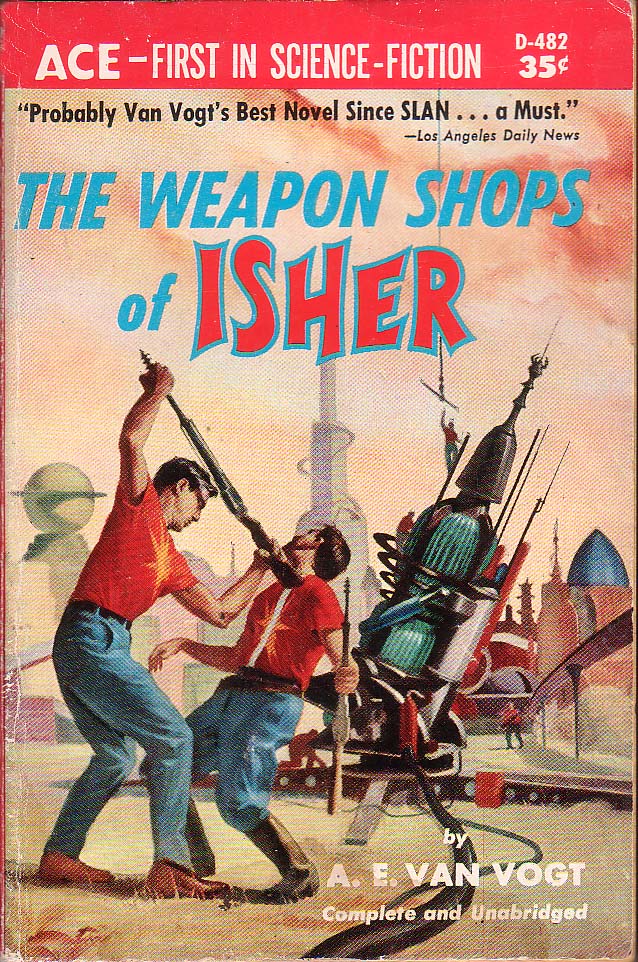
The Weapon Shops of IsherThis coming weekend, Friday April 25th through Sunday April 27th, is Doug Ellis’s magnificent celebration of all things pulp, the Windy City Pulp and Paperback Convention here in Chicago, in nearby Lombard, Illinois.

Windy City is one of my favorite local cons. I’ve written about it before, and in fact I’ve been attending the show for around 10 years. 2012 was perhaps the most successful show in some years, considering I returned with a fabulous assortment of mint-condition fantasy and science fiction paperbacks from the collection of Martin H. Greenberg. See the article and photos from that show in my 2012 post, “Thank You, Martin H. Greenberg (and Doug Ellis).”

The show has been growing steadily over the years. Doug and his cohorts have added a film program, an Art Show, panels, an auction, readings, and more programming, but the real draw continues to be the massive Dealer’s Room, a wall-to-wall market crammed with pulps, paperbacks, rare DVDs, posters, artwork, comics, and much more.

I jotted down a few notes last year, and promised myself I’d write them up before the 2014 convention, to let folks who may be on the fence about attending (or those sad and lonely souls who, like me, just enjoy reading far-off convention reports), know what they’re missing.

In 2013, the list of Dealers was the longest I’ve ever seen, boasting some 80 vendors. They had to add more space, and it took even longer to walk the floor. Doug reported that he sold more tables than at any previous convention, and in record time.

If there’s a drawback to the show, it’s that the Dealer’s room closes at 5:00 pm. That made it impossible for me to make it there after work on Friday. My weekly D&D game with my kids kept me tied up until after 3:00 pm Saturday, which meant that by the time I made the show on Saturday, I had less than half an hour to walk the floor before it closed.

I put the time to good use. After a few years, you tend to find a few favorite sellers and I searched them out immediately.

Read More Read More

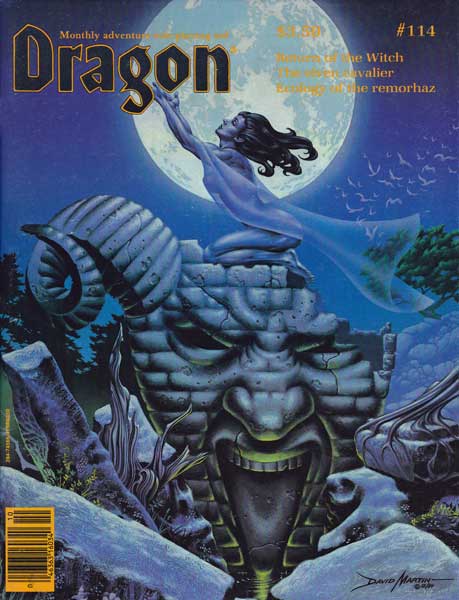
Art of the Genre: An Interview with David Martin

Art of the Genre: An Interview with David Martin

tumblr_mwxucxtvi61ro2bqto1_500So it’s April, which is a lovely time of year here in L.A., with moderate temperatures in the mid-60s and 70s most days as the city gets ready for June Gloom to set in and cast a shadowy marine layer over everything for a month.

I was hoping to relax in the splendor of Ryan Harvey’s satisfied silence at the success of Captain America: The Winter Soldier, as well as Kandi’s casting as innocent bystander #3 for the next Michael Bay film (you know, the beautiful young woman who gets filmed in slow motion from a gratuitous boob angle as some huge vehicle flies over her head), when my phone decided to ring.

Now there is only one person that calls me when I really, really don’t want to get a call, and that is always our editor John O’Neill.  To make things worse, this time not only was he intent on sending me out for an interview to the New Mexico desert (temps already climbing in to the 90s), but I was to take Goth Chick with me.

Why?  I have no idea, as her mission was coded ‘top secret’, although my money is on a clandestine meeting with UFO witnesses around Roswell.  Whatever the case, I soon found myself boarding a plane (yes, out of Long Beach again) with Chick.  I was pleased, however, that she was searched by the TSA four times before she made it through security, but that joy quickly evaporated when I had to sustain the brunt of her dark mood for the two-hour flight into Albuquerque.

Still, Chick is always fun to have around, and after a few miniature bottles of vodka, followed by a solicitation to join her in the ‘Mile High Club’, she was back to her caustically lovely self.  Now I know what you’re thinking, but a gentleman never kisses and tells, and besides, what happens above Vegas, stays above Vegas.

Read More Read More

The Best One-Sentence Reviews of Edmond Hamilton: The Winner of The Collected Edmond Hamilton, Volume Four

The Best One-Sentence Reviews of Edmond Hamilton: The Winner of The Collected Edmond Hamilton, Volume Four

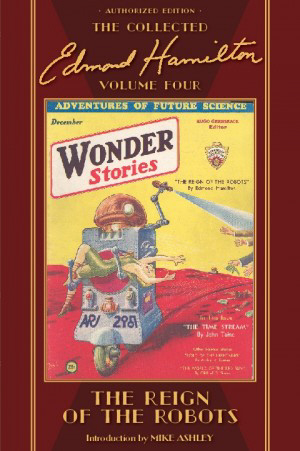
The Collected Edmond Hamilton Volume Four-smallLast month, we invited Black Gate readers to send us a one-sentence review of their favorite Edmond Hamilton novel or short story.

In return, we offered to award a copy of the long-awaited fourth volume of The Collected Edmond Hamilton from Haffner Press to one lucky winner. The winner was randomly drawn from the list of all qualified entrants.

Before we announce the winner, let’s have a look at some of the entries. We can’t reprint all of them, but we can hit the highlights. (But fret not — all qualifying entries received before April 20 were included in the drawing.)

We left the choice of what novel or story to review up to you and we weren’t too surprised to find the most popular topic was Edmond Hamilton’s The Star Kings series. Robert James Parker kicked things off with this review:

John Gordon, suffering from an existential crisis, agrees to travel through time and space to the far future where he gets caught up in a sweeping space opera full of cosmic space battles, beautiful princesses, and bizarre monsters.

Andy Sheets gets bonus points for a completely à propos Alan Rickman reference.

How can you not be enticed by a story about an out of step WWII veteran getting mind-swapped into the body of a prince 200,000 years in the future, hooking up with a foxy future princess, and battling The League of Dark Worlds, lead by a guy who should totally be played by Alan Rickman in the movie, with a super-weapon called the Disruptor, all tightly packed into a fast-moving novel not even 200 pages long?!

Read More Read More

Vintage Treasures: Men, Martians, and Machines by Eric Frank Russell

Vintage Treasures: Men, Martians, and Machines by Eric Frank Russell

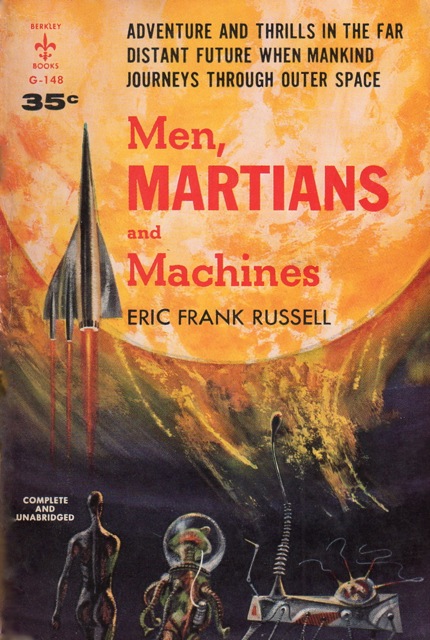
Men Martians and Machines-smallLast Sunday, I posted the latest article in my Ace Double series, this time focusing on Sentinels of Space by Eric Frank Russell and Don Wollheim’s The Ultimate Invader.

It made me realize that I’ve given precious little coverage to Eric Frank Russell over the years — really, a pretty serious oversight, considering what a fine writer he was. So I thought I’d remedy that here, starting with his 1955 volume Men, Martians, and Machines.

Men, Martians, and Machines is something of a problem child for catalogers. Wikipedia lists it as a novel, but it’s really not — it’s a collection of four linked stories, three published in Astounding during World War II, and one original. The Internet Speculative Fiction Database entry for Russell lists it as neither a collection nor a novel, creating a separate category for it.

In some ways the book is an early precursor to Star Trek. The stories follow the exploits of the rough-and-tumble crew of the solar freighter Upskadaska City, known more commonly as the Upsydaisy, who follow their Captain as he takes charge of one of the first faster-than-light starships, the Marathon. Captain McNulty leads his mixed crew of humans, jovial tentacled Martians, and one robot on voyages of discovery to far stars and strange alien planets.

Star Trek fans will certainly enjoy these proto-Trek stories and see how they influenced that seminal series two decades later. For me, these tales represent something even more primal. When I think of Golden Age robot stories, I think of Asimov; when I think of military science fiction, I think Heinlein. When I think of tales of brave exploration and camaraderie in the face of the vast mystery and terror of deep space, I think of Eric Frank Russell.

It’s his unique voice, I think, and the poetry and humanity of his prose, mixed with all the marvelous ray-gun trappings of pulp science fiction, that makes him such a joy to read. Here’s a snippet from the first story, “Jay Score,” as our unnamed narrator meets with the imposing new emergency pilot shortly after blast off.

Read More Read More

Art of the Genre: The Dreaming Work of Travis Hanson

Art of the Genre: The Dreaming Work of Travis Hanson

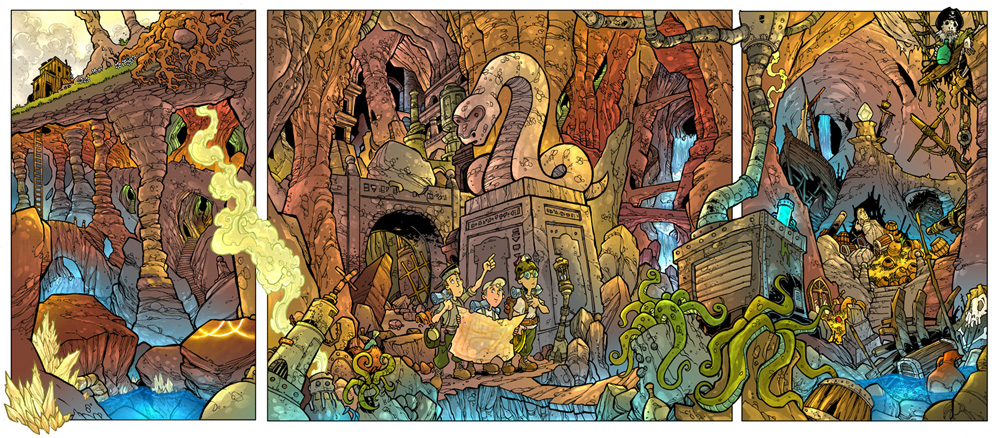
poster2final2My suggestion, assuming my AotG followers ever listen to me, is to go here and do what you must.  Seriously, find some change in your pocket and put it somewhere that is worthy.  I find I can’t help but support incredible artists, especially those willing to tell a beautiful story for children and adults alike.  So hurry and add this to your ‘what I did in 2014 that was worth something’ list.

Ok, now that you’ve made the world a better place, I’ll do the same by talking a bit about the art of Travis Hanson.

Trav, as he’s known to me, decided he wanted to do a comic, but he didn’t have any place to put it.  Luckily for him, and so many creative people, the Internet gave him the opportunity to share his talent and vision, for free, with people across the globe.  Thus, a few years back, The Bean was born.  Fast forward to now and you’ve got Fifteen Chapters and 579 comic pages of incredible fantasy adventure all at your fingertips for ZERO dollars and ZERO cents!

Read More Read More

Vintage Treasures: Sentinels of Space by Eric Frank Russell / The Ultimate Invader edited by Donald Wollheim

Vintage Treasures: Sentinels of Space by Eric Frank Russell / The Ultimate Invader edited by Donald Wollheim

Sentinels of Space-smallWe’re back  with our journey through the Ace Double line, this time with one of the earliest volumes in the series: Eric Frank Russell’s SF novel Sentinels of Space, coupled with a Donald Wollheim anthology The Ultimate Invader. It was published in paperback in 1954.

Eric Frank Russell is one of those writers I’m not nearly as well-versed in as I should be. I read his brilliant short story “Dear Devil” in Terry Carr’s YA anthology Creatures From Beyond in the mid-seventies, when I was in Junior High, and that’s all it took for his name to stick with me.

“Dear Devil” — rejected by all the major magazines until Bea Mahaffey pulled it from the slush in 1950, while filling in for the hospitalized Ray Palmer at Other Worlds — established Russell as a major name and it also cemented the 26-year-old Mahaffey’s rep as an editor. She remained as co-editor of Other Worlds when Palmer returned and also edited his magazines Science Stories and Universe Science Fiction in the late 50s.

Russell wasn’t terribly prolific. He wrote only eight novels between 1939 and 1965, plus a posthumous collaboration with Alan Dean Foster, Design for Great-Day (1995), published 17 years after his death. I’m sure there’s a fascinating story behind that — I’ll have to ask Alan next time I run into him at a convention.

His two most famous works are probably his first novel Sinister Barrier, which so impressed John W. Campbell that he reportedly founded Unknown magazine just to get it into print, and “Allamagoosa’ (Astounding, May 1955), the first short story to win the Hugo Award.

My favorite Eric Frank Russell anecdote occurred while I was selling vintage paperbacks in the Dealer’s room at the 2012 Worldcon here in Chicago (Howard’s detailed report is here.) Jo Walton — who won a Hugo the next day for her novel Among Others — was browsing my books when she suddenly let out a shout of glee.

She explained why in a funny and delightful post a few months later at Tor.com., titled “The Book You Don’t Know You’re Looking For.”

Read More Read More

Art of the Genre: I.C.E.’s Middle-Earth Roleplaying Part Four: The Maps

Art of the Genre: I.C.E.’s Middle-Earth Roleplaying Part Four: The Maps

MIddle-EarthHave you ever designed a campaign and thought to yourself, ‘Damn, this is so good, I should build a company on it?’ Well, certainly you aren’t the only one, and dozens of game companies have been born from folk’s home brew campaigns, but it wasn’t until very recently that I realized that I.C.E.’s Middle-Earth Role-Playing was born of the same ilk.

Now before you all go running off to Twitter about Tolkien being a RPG nerd, you have to have the full understanding of what I’m talking about. First and foremost, Tolkien WAS NOT a gamer, but that didn’t mean that his world wasn’t ripe for table-top role-players to want to explore in the mid to late 1970s.

One case in particular came out of the University of Virginia in 1977, when then student Pete Fenlon decided he wanted to create a role-playing game around Tolkien’s world for some friends on campus.

My first question upon finding this out was, ‘Why didn’t you just play D&D?’ and Pete’s answer was simple: D&D simply wasn’t Tolkien. As an avid camper and backpacker, as well as a member of the SCA, Fenlon understood way too much about Tolkien to throw a campaign into a world of negative integer armor classes and D20 to-hit charts.

Read More Read More