Fantasia 2016, Day 5: Bewitched and Bewailing (The Love Witch and The Wailing)
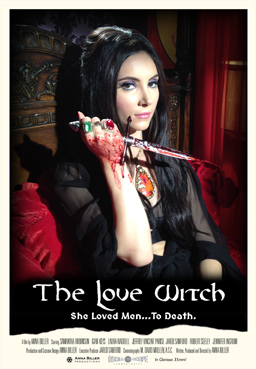 I had only one movie on my schedule for Monday, July 18, but thanks to the good offices of the people at the Fantasia Film Festival and at Oscilloscope Laboratories, I ended up able to catch another film first. The Love Witch was a movie that I’d been unable to watch in its theatrical showing at Fantasia due to a scheduling conflict. After seeing it Monday, I’d go on to the Hall Theatre for The Wailing (Goksung), a two-and-a-half hour Korean horror film. The movies made for an odd contrast. In both cases I greatly appreciated them but came away fairly sure I wasn’t part of their primary audience. But movies play to whoever sees them, and perhaps writing about these films will bring them to the attention of people with better perspectives than my own.
Directed and written by Anna Biller, The Love Witch is a mix of horror, satire, and melodrama which follows Elaine (Samantha Robinson), a witch and murderess, as she moves to a new home and seeks love. Unfortunately for the men she desires, she’s both unforgiving and possessed of high standards. Any sign of weakness or emotional neediness is a sign of her partner’s unfitness, which she puts to an end both swift and fatal. Will Elaine finally find the man of her dreams? Or will her interest in Richard (Robert Seeley), the husband of her friend Trish (Laura Waddell), bring about her downfall?
From the opening shots of a bright scarlet car driving along a California highway we know this is going to be a stylish treat for the eyes. Biller’s created a colour-drenched world out of a Hollywood melodrama, circa 1970. It isn’t set in that time — we get a few signs to the contrary, mostly in scenes involving policemen trying to figure out where all the dead male bodies are coming from — but it’s largely played that way, with sets and props evoking the period. More than that, there’s a mannered artificiality to the acting styles and dialogue that (I felt) mimics the specific artificiality of the late 60s.
 Sunday, July 17, began early for me. I went down to the Hall Theatre to watch Parasyte: Part 2 (I’ve written about it
 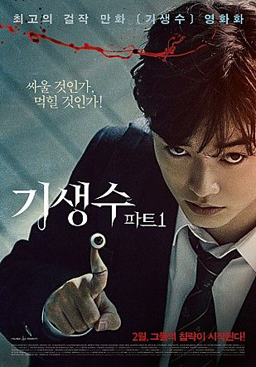 Saturday, July 16, began early for me. I headed downtown to the Hall Theatre for an 11:05 showing of Parasyte: Part 1 (Kiseiju), the first instalment of a Japanese science-fiction–horror duology. After that I planned to head to the festival screening room; I hoped to see La Rage du Démon (Fury of the Demon), a French horror mockumentary that mixes film pioneer Georges Méliès, occultism, and legends of mass hysteria into the story of a cursed silent movie. Then I’d head back to the Hall for a showing of For the Love of Spock, a documentary about Leonard Nimoy and his most famous role, hosted by the director, Nimoy’s son Adam. I’d wrap up the night with Terraformars, a science-fiction film directed by Takashi Miike about humans battling genetically-modified cockroaches on the surface of Mars. Miike would be present to host a question-and-answer session and receive Fantasia’s Lifetime Achievement Award.
 Friday, July 15, began early for me. I headed down to Fantasia’s De Sève Theatre to watch a 2 PM press conference with the winner of this year’s
 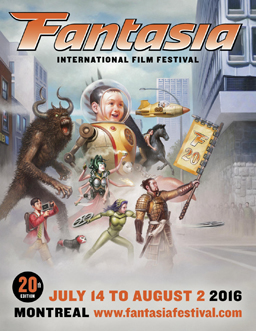 Thursday, June 14: as good a day as any to begin an adventure. I walked downtown that afternoon under looming clouds to Concordia University’s EV Building, where I picked up my accreditation for the 2016 edition of the Fantasia International Film Festival. I’d been looking forward to writing about this year’s festival for Black Gate virtually since last year’s had ended. Now things were finally about to begin. A laminated press pass, a festival schedule, a thick program book: the guide to the adventure unfolding over the next three weeks, to fantasy and horror and science fiction and a lot more.
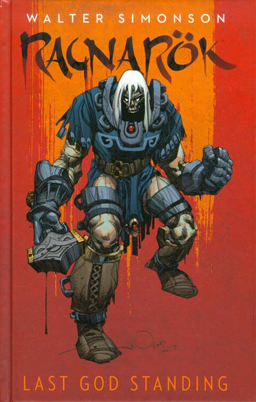 Walt Simonson’s published eight issues so far of his ongoing comics series Ragnarök, along with a trade paperback collecting issues 1 through 6. Simonson, a veteran master of the comics form, is joined for the book by colorist Laura Martin and letterer John Workman. Edited by Scott Dunbier, Ragnarök’s published through IDW, and Chris Mowry’s credited with “production” on the first seven issues while Neil Uyetake gets the production credit on the eighth. What is Ragnarök beyond that? A fast-paced, adventurous saga. A grim playing-about with Norse myth. A super-hero high fantasy that nods to the past while telling a new and distinctive tale. And: a comic as exuberant as it is well-crafted.
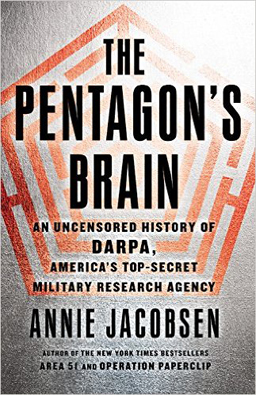 I sat down to read Annie Jacobsen’s 2015 book The Pentagon’s Brain — subtitled An Uncensored History of DARPA, America’s Top Secret Military Research Agency — thinking I’d get a new perspective on the development of the American military-industrial complex. And a new angle on the history of science in the 1950s and 1960s and beyond. Also that I’d learn a bit about the development of the internet, and who the people were who came up with it, and why they did, and what they were thinking. I got all of that. But I also found a new angle on science fiction, and the way SF shapes the world for better or for worse.
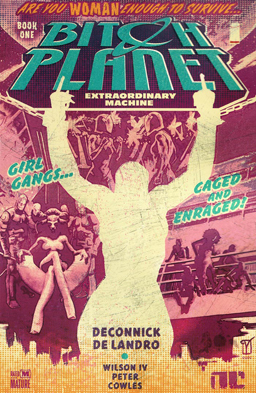 I can understand scepticism of consciously political art. But I feel it’s often misplaced. If an artist is choosing to create art about politics, it probably means that those politics have a deep power for them. Which in turn is probably because the politics are connected to their emotions, worldview, beliefs — all the things that give art power. A political theme doesn’t elevate a work of art, but good art can illuminate the political. An artist may create consciously political art because politics are their passion. A storyteller may find their politics are the lens through which to present human truth and artistic power.
 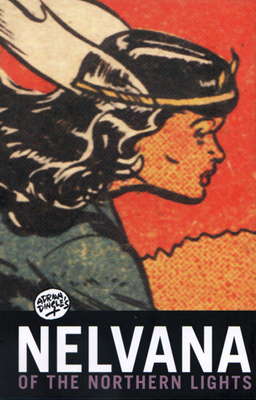 In 2014, following a successful Kickstarter campaign, Hope Nicholson and Rachel Richey published Nelvana of the Northern Lights, a trade paperback reprinting all the appearances of the eponymous Canadian super-heroine from the 1940s. IDW gave the book a wider release in hardcover and paperback later that year. It contains over 300 pages of comics written and drawn by Nelvana’s creator Adrian Dingle, mostly in black and white, along with forewords by the editors, an introduction by Dr. Benjamin Woo (Assistant Professor of Communication Studies at Carleton University), and an afterword by Michael Hirsh (an artist and animator who founded a well-known animation studio named for Nelvana). It’s a nice package, designed by Ramón Pérez, a past winner of the Eisner, Harvey, and Shuster Awards.