Browsed by
Author: Bob Byrne

The Public Life of Sherlock Holmes: Sherlock (Doctor) Who?

The Public Life of Sherlock Holmes: Sherlock (Doctor) Who?

Baker_PipeThe BBC recently held a ‘Best of Doctor Who 50th Anniversary Poll’ and Tom Baker came out number one. This is a bit surprising, as he roamed in the Tardis from 1974 to 1981, which was over three decades ago. And less relevant but still of note is that the Doctor never really broke big in America until David Tenant took on the role.

Baker_Moore
Roger Moore starred in the TV movie Sherlock Holmes in New York. It’s not quite as bad as it might appear, though John Huston was woefully miscast as Moriarty.

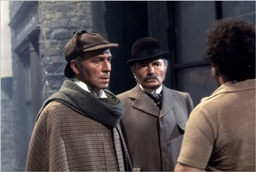
After Baker gave the Doctor up for regeneration, the BBC approached him and asked what project he would like to do next with his popularity still soaring. Baker immediately replied, “Sherlock Holmes,” and traded his scarf for a deerstalker.

With England’s most iconic actor (sorry, Roger Moore) to play England’s most iconic character (sorry, James Bond), only the biggest Holmes story would do. Though that’s not the smartest choice to showcase Holmes.

The BBC hadn’t tackled The Hound of the Baskervilles since Peter Cushing’s second attempt at it for his 1968 television series (a role he secured after failed attempts to land Robert Stephens and Eric Porter). There had been an American TV version in 1972 starring a dull Stewart Granger with Bernard Fox as yet another doofus Watson who mumbled his lines.

Read More Read More

The Public Life of Sherlock Holmes: Eille Norwood: the Silent Detective

The Public Life of Sherlock Holmes: Eille Norwood: the Silent Detective

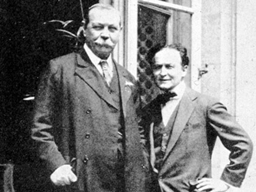
Norwood_Doyel
Norwood and Sir Arthur Conan Doyle at the Stoll Pictures Annual Dinner

This may shock you, but there were on-screen Sherlock Holmes before Benedict Cumberbatch! And for you old-time fans, even before Robert Downey Jr. Really! The first great movie Holmes comes from the silent film era. And he shared a last name with another actor who would give arguably the greatest portrayal of the world’s first private consulting detective.

William Gillette had come to personify Sherlock Holmes through repeated performances of his stage play in the U.S. and Europe. His 1916 film version certainly helped as well, but was not a critical part of his success. Anthony Edward Brett would become the first great movie Holmes, though he would achieve it as Eille Norwood.

Born in 1861, Norwood was primarily a stage actor in England when he landed the role that would make him famous throughout the U.K..

In 1921, a British film company named Stoll decided to film a series of shorts based on Doyle’s stories. For the next two years, they would produce forty-five of the twenty-minute films, along with two longer ones. Doyle’s short stories fit the twenty-minute length quite well and Stoll wasn’t forced to add inauthentic filler to them.

The first fifteen, chosen randomly from among Doyle’s stories, were called The Adventures of Sherlock Holmes. That same year, the first version of what would be the most famous film title in the Canon was made, The Hound of the Baskervilles. Maurice Elvey directed all sixteen films. That same year, Elvey made a romantic drama called The Fruitful Vine. The lead was played by a young man named Basil Rathbone. How about that?

Read More Read More

The Public Life of Sherlock Holmes: A Man Called Spade

The Public Life of Sherlock Holmes: A Man Called Spade

Spade_FalconbookIn last week’s column, I mentioned The Maltese Falcon, starring Humphrey Bogart. (Did you follow instructions and watch it for the first time?) Over eighty years after its publication, Dashiell Hammett’s The Maltese Falcon stands supreme today as the finest private eye novel ever written. Bogie’s 1941 film proved that the third time is a charm, prior attempts in 1931 and 1936 having failed.

Sam Spade, the quintessential tough guy shamus, appeared in a five-part serial of The Maltese Falcon in Black Mask in 1929. Hammett carefully reworked the pieces into novel form for publication by Alfred E. Knopf in 1930 and detective fiction would have a benchmark that has yet to be surpassed.

Hammett, who wrote over two dozen stories featuring a detective known as The Continental Op (well worth reading), never intended to write more about Samuel Spade, saying he was “done with him” after completing the book-length tale.

But the public wanted more and his agent cajoled him into cranking out three more short stories featuring Spade. The first two appeared in American Magazine and the third in Collier’s in 1932 and they were collected into book form later that year as The Adventures of Sam Spade and Other Stories. In 1999, Vintage Crime published Nightmare Town, a compilation of twenty Hammett stories, including all three Spade short stories.

Read More Read More

Writers – Don’t Start at the Start…

Writers – Don’t Start at the Start…

Block_TellingLiesChapter 25 of Lawrence Block’s Telling Lies for Fun and Profit (which should be on EVERY writer’s bookshelf) is titled, ‘First Things Second.’ As he succinctly summarizes (nice but unneeded alliteration there), “Don’t begin at the beginning.”

It’s a popular screenwriting maxim to enter the scene as late as you can. In other words, don’t begin at the beginning. I seem to recall William Goldman espousing this.

Block tells of being advised to switch the first two chapters of a detective novel he had written. Basically, this put the reader in the thick of the action from the outset, with some explanation following. Tension can be created at the outset and carried forward by not beginning at the beginning.

Sitting here at the keyboard, I can’t think offhand of a Sherlock Holmes or Solar Pons story that uses this technique. There’s a reason we’ve all got the image of Holmes and Watson sitting in their rooms at 221B Baker Street when a client or Inspector Lestrade comes to visit and we’re off on a case.

As I read this chapter, I thought of Will Thomas’s Barker and Llewlyn books (love them, but what’s with the two “L”s at the beginning of that name?). Barker has more than a passing resemblance to Sherlock Holmes (I suspect that Robert Downey Jr’s portrayal owes a debt to these books) and Llewellyn is his Watson (or Boswell). Mind you, they are excellent books and not simply Holmes copies.

Read More Read More

The Public Life of Sherlock Holmes: The Science Fictional Humphrey Bogart

The Public Life of Sherlock Holmes: The Science Fictional Humphrey Bogart

ReturnX_PosterInto the nineteen fifties, Hollywood operated under the studio system. A few major movie studios owned both the production and distribution channels and dominated the industry.

They cranked out “B” pictures to provide product to support the “A” films and keep the theaters they owned filled.

Actors, especially non-stars, made several films a year, either appearing higher in the credits on B films or as supporting actors in A movies. Those actors had very little power in the system as well.

In 1936, Humphrey Bogart (who had already twice failed to stick in Hollywood) received his first critical acclaim for The Petrified Forest, in which he recreated his Broadway role as gangster Duke Mantee.

He would really strike it big in 1941, first with  High Sierra, and then The Maltese Falcon  (if you haven’t seen this one,  rent it tonight and then leave an apology comment on this post for waiting so long). In the five years between Forest and Sierra, he appeared in twenty-nine films: most not as the star.

Bogart famously said, “I made more lousy pictures than any actor in history.” This was because Warner Brothers tossed him into every low budget B movie they could.

Sometimes it was so bad that he refused the part, which then got him suspended without pay. That’s why you see Dennis Morgan and not Bogie in the awful western, Bad Men of Missouri (with Wayne Morris starring – see below).

Bogie, in a career with over eighty credits and possibly the greatest star in film history, made only one horror/science fiction movie. And he considered it one of his worst. He’s got a point.

Read More Read More

The Public Life of Sherlock Holmes: Playing the Game With the Master Blackmailer

The Public Life of Sherlock Holmes: Playing the Game With the Master Blackmailer

Milverton_SP1Far more than with any other character, Sherlock Holmes has been treated as if he had really lived. It’s not just that people believe in the character as they read the story. That’s usually the case in good fiction.

But there are hundreds of books that treat Holmes and Watson as if they were alive. Speculation about Holmes abounds. No other character’s life is explored in such detail, expounded upon and speculated about.

This treating Holmes (and Watson) as if he were a real person is called, ‘Playing the Game.’ And there’s no shortage of Holmes fans that have done it in new stories and scholarly writings about the great detective. An example of my own follows.

SPOILERS SPOILERS SPOILERS. The Adventure of Charles Augustus Milverton is one of my favorites stories of the sixty that Sir Arthur Conan Doyle wrote about Holmes.

If you haven’t read it before, I strongly suggest you do so before reading the rest of this post. It won’t take you very long. The fifty-six short stories are quick reads.

Milverton is a master blackmailer. No one is better at it. Sherlock Holmes tells Watson that Milverton is the worst man in London. For someone who seemingly knew about every type of depravity and ruffian in the city, that is quite a statement.

Read More Read More

The Public Life of Sherlock Holmes: All The World’s A Stage

The Public Life of Sherlock Holmes: All The World’s A Stage

Speck_PagetSnake
Sidney Paget’s well-known drawing from The Speckled Band

There are two Holmes stories by Sir Arthur Conan Doyle that have a gothic feel to them. The Hound of the Baskervilles is one of four novels featuring Holmes and the best-known story of the sixty which Doyle wrote. The other, the ninth short story to feature Holmes, is “The Speckled Band.”

A creepy mansion; exotic animals roaming loose, gypsies, an imposing stepfather, eerie whistles in the night and the mysterious death of a daughter some years before: it has all the trappings. Doyle himself listed it as his favorite story and I’m not going to ruin it here. If you haven’t read “The Speckled Band,” you should go do it right now. Well, after you finish this post.

Doyle wrote several plays, two of which featured Sherlock Holmes. The Crown Diamond was and remains a poor one (as does “The Mazarin Stone,” the Holmes short story it mirrors).

But the other, born of financial necessity, was a big hit.

Read More Read More

House of Cards Kicked the Cat

House of Cards Kicked the Cat

Houseofcards_RichardsonI mentioned Netflix’s wildly successful House of Cards in a recent Public Life of Sherlock Holmes posting. I’ve written a couple of screenplays that will be made into movies shortly before the Earth plunges into the sun.

Or more likely, sometime after that event. Just as I enjoy reading books on writing, I’ve also found lots to learn from books on screenwriting (which is a very different proposition).

A brief aside: Amazon (which should give me stock with the number of purchases I’ve made from them) includes screenwriting as a subcategory of “Humor & Entertainment.”

Not every screenwriting book is funny. In fact, the most useful ones generally aren’t! That said, we resume our normal programming.

Read More Read More

The Public Life of Sherlock Holmes: Dirk Gently, Holistic Detective

The Public Life of Sherlock Holmes: Dirk Gently, Holistic Detective

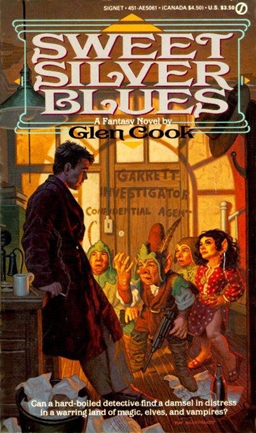
Gently_HolisticThe plan is to go non-Holmes every fourth post or so, just to mix it up a bit.  So, today, we move over to the mystery field. Well, sort of…

Race Williams, Sam Spade, Philip Marlowe, Peter Kane, Max Thursday, Lew Archer, Travis McGee, Dave Robicheaux: the list of accomplished private eyes is a long one. And of course, Sherlock Holmes was the first professional consulting detective. But there has only been one holistic detective. Dirk Gently.

It’s hard to imagine a better science fiction parody than Douglas Adams’s marvelous Hitchhiker’s Guide to the Galaxy series. Five books (plus one short story and an authorized sequel), they are the standard.

Adams’s brilliance was equally on display when he tackled the private eye genre with Dirk Gently’s Holistic Detective Agency.

If you’ve read any of the Hitchhiker’s books, you know that Adams was not your typical writer. Gently, though mentioned earlier, does not appear until page 114. In fact, the main character is really Richard MacDuff, though Gently is certainly at the center of things.

Read More Read More

The Public Life of Sherlock Holmes: Holmes – Creation to Death and Back

The Public Life of Sherlock Holmes: Holmes – Creation to Death and Back

Ormond1In 1882, Arthur Conan Doyle (not yet “Sir”) opened up his own shop as a doctor in Southsea (England). Business was slow and his most notable triumph was marrying the sister of a patient who died of meningitis.

With some spare time on his hands, Doyle wrote fiction. Somewhere around 1886, he came to the conclusion that he could write detective stories better than the ones he was reading. He would create, “a scientific detective, who solved cases on his own merits and not through the folly of the criminal.”

Putting the pen to the paper, he completed A Study in Scarlet (working title, The Tangled Skein) that year. Originally starring Sherrinford Holmes and Ormond Sacker, the names had settled into the now familiar Sherlock Holmes and John Watson.

Doyle’s stories of Holmes owe a debt to Edgar Allen Poe that has been discussed by far better minds than mine. The now mostly forgotten Emile Gaboriau was also acknowledged by Doyle as an influence.

Mystery maven and Doyle biographer John Dickinson Carr stated that Holmes was clearly based on Doyle himself, which seems overly flattering.

Read More Read More