Browsed by
Author: Bob Byrne

A (Black) Gat in the Hand: Norbert Davis’ Ben Shaley

A (Black) Gat in the Hand: Norbert Davis’ Ben Shaley

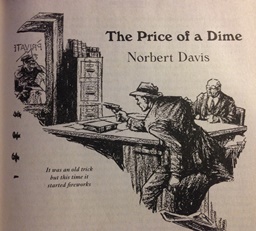
Gat_DavisDime

“You’re the second guy I’ve met within hours who seems to think a gat in the hand means a world by the tail.” – Phillip Marlowe in Raymond Chandlers’ The Big Sleep

(Gat — Prohibition Era term for a gun. Shortened version of Gatling Gun)

Like many pulpsters, Norbert Davis wrote for several different markets, such as westerns, romance and war stories. But he was at his best in the private eye and mystery field. Davis could write standard hardboiled fare, but he excelled at mixing humor into the genre, and many argue he did it better than anyone else.

Joe ‘Cap’ Shaw, legendary editor of Black Mask, didn’t feel that Davis’ hardboiled humor fit in to the magazine and the writer only managed to break into Black Mask five times between 1932 and 1937.  Davis had success in other markets, however, with eighteen stories seeing print in 1936, for example. And several stories appeared in Black Mask after Shaw departed.

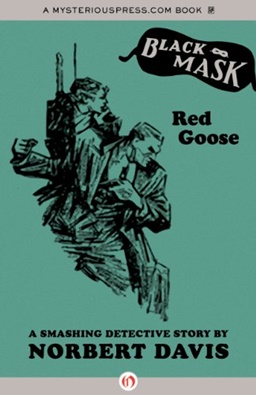
Ben Shaley appeared in the February and April, 1934 issues of Black Mask and represent two of the five Davis stories that Shaw chose to print.

Shaley was a Los Angeles PI introduced in “Red Goose.” I like Davis’ description: ‘Shaley was bonily tall. He had a thin, tanned face with bitterly heavy lines in it. He looked calm; but he looked like he was being calm on purpose – as though he was consciously holding himself in. He had an air of hardboiled confidence.’

The humor that Davis is best known for is pretty much absent from this story, but that proves he could hold his own writing ‘straight’ hardboiled. Though Shaley’s exasperation with the nerdy museum curator, as the detective tries to lay the groundwork for the case is amusing.

Read More Read More

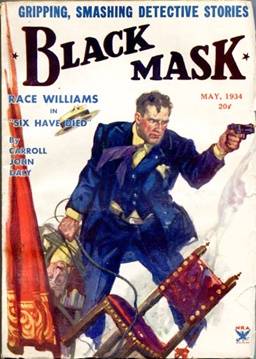
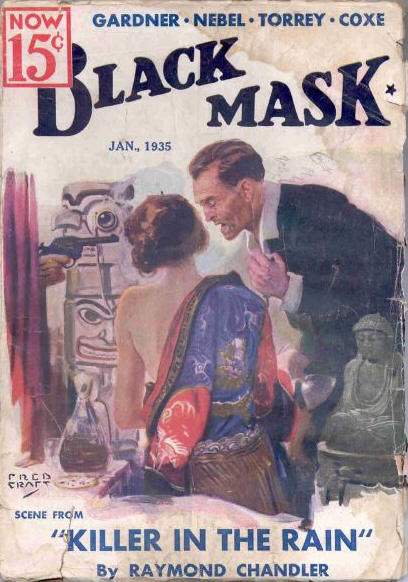
A (Black) Gat in the Hand: Black Mask — January, 1935

A (Black) Gat in the Hand: Black Mask — January, 1935

BlackMask_January1935

“You’re the second guy I’ve met within hours who seems to think a gat in the hand means a world by the tail.” – Phillip Marlowe in Raymond Chandlers’ The Big Sleep

(Gat — Prohibition Era term for a gun. Shortened version of Gatling Gun)

Joseph ‘Cap’ Shaw was still at the helm of Black Mask in January of 1935, when Raymond Chandler’s “Killer in the Rain” scored the cover. But this issue also included stories by Frederick Nebel, Erle Stanley Gardner, George Harmon Coxe and Roger Torrey. All that for fifteen cents!

“Killer in the Rain” featured Carmady. I’m in the camp that feels all of Chandler’s PIs: Carmady, Ted Carmady, Ted Malvern and John Dalmas were all essentially Philip Marlowe with slight differences. Carmady appeared in six stories – all in Black Mask.

The story was heavily cannibalized for Chandler’s first novel, The Big Sleep. Carmen Dravec became Carmen Sternwood, played memorably by Martha Vickers in the HumphreyBogart film. Two other Carmady stories, “The Curtain” and “Finger Man,” were also used. I think that “Killer in the Rain” is a strong story on its own and is definitely worth reading. I’m tinkering with ideas for a separate post on this story.

Frederick Nebel, whose Tough Dick Donahue (subject of an earlier post in the series) would replace The Continental Op when Dashiell Hammett left the pulps, provided Black Mask readers with the twenty-eighth adventure featuring Captain Steve MacBride of the Richmond City Police and newsman Kennedy of the Free Press. MacBride is a tough, by-the-book cop, while Kennedy is a hard-drinking smart aleck reporter. However, both are committed to justice and cleaning up corrupt Richmond City.

Except for one story (“Hell on Wheels” – Dime Detective), the entire series appeared in Black Mask. The collection has been reprinted in a three-volume series from Altus Press.

Read More Read More

A (Black) Gat in the Hand: Thomas Walsh

A (Black) Gat in the Hand: Thomas Walsh

Gat_WalshDiamonds“You’re the second guy I’ve met within hours who seems to think a gat in the hand means a world by the tail.” – Phillip Marlowe in Raymond Chandlers’ The Big Sleep

(Gat — Prohibition Era term for a gun. Shortened version of Gatling Gun)

Eighteen years after writing his first story, Thomas Walsh’s 1951 debut novel, Nightmare in Manhattan, won an Edgar Award. Twenty-seven years later in 1978, he picked up another Edgar for the short story “Chance After Chance.” That is impressive! Walsh wrote a half-dozen stories for Black Mask in the thirties and his “Best Man” was included by Joseph Shaw in his prestigious Hard-Boiled Omnibus.

“Double Check” appeared in the July, 1933 issue of Black Mask, which also included stories by Raoul Whitfield (Jo Gar), Erle Stanley Gardner (Ken Corning), Frederick Nebel (Tough Dick Donahue) and Carroll John Daly (Race Williams). How’s that for less than a quarter?!

It’s a buddy cop story – except the two men aren’t buddies. Flaherty is well-dressed, small and the smart detective. Mike Martin is big, rough, not the quickest thinker and looks rumpled. It’s brains and brawn.

A banker named Conrad Devine is being threatened, presumably with death, if he doesn’t pay out.

Flaherty constantly pokes at Martin, annoying the bigger man. More than once, Martin’s exasperation with his temporary partner is expressed as “I’m gonna lay you like a rug.”

Read More Read More

With a (Black) Gat: Frederick Nebel’s Donahue

With a (Black) Gat: Frederick Nebel’s Donahue

BlackMask_August1931(Gat — Prohibition Era term for a gun. Shortened version of Gatling Gun)

Carroll John Daly’s action-packed adventures of Race Williams sold more copies of Black Mask than any other author’s stories. But editor Joe ‘Cap’ Shaw, who was willing to hold his nose and put Williams on the cover, considered the far more literate Dashiell Hammett to be the magazine’s cornerstone.

In January of 1930, the final installment of The Maltese Falcon appeared in Black Mask. A Continental Op story followed in February, then the next three months saw the stories that would become The Glass Key. But at the peak of his pulp abilities, Hammett left the genre. He was interested in the easy money of Hollywood and the better paying ‘slick’ magazines. He bid adieu to Black Mask in November of 1930.

Shaw had lost his best writer. The irreplaceable Hammett had to be replaced. He turned to Frederick Nebel, whose MacBride and Kennedy stories had appeared over a dozen times. That November issue of Black Mask included the thirty-sixth and final Continental Op story, “Death and Company.” It also featured “Rough Justice,” the first tale of Donahue of the Inter-State agency.

After the phenomenal success of The Maltese Falcon, Shaw had urged Hammett to write more stories featuring Sam Spade. Dash wasn’t interested and not only refused, but he shortly thereafter left the magazine forever. Though, he did write three more Spade stories in 1932 for the slicks. Shaw tagged the reliable Nebel to provide Black Mask readers with a tough private eye to replace the immensely popular Continental Op. The writer most certainly did that.

In “Rough Justice,” the Irish New York City PI, a former cop bounced from the force for being too honest, finds himself in sweltering St. Louis. In August of 1931 Donahue would return to the Arch City in “Spare the Rod.” In between, Nebel wrote a three-story serial of connected adventures that appeared in consecutive issues.

Read More Read More

With a (Black) Gat: Some Harboiled Anthologies

With a (Black) Gat: Some Harboiled Anthologies

The Black Lizard Big Book of Pulps-small(Gat — Prohibition Era term for a gun. Shortened version of Gatling Gun)

There are a lot of anthologies out there that collect old pulp stories and I’m using several for the With a (Black) Gat series. While my hard-boiled collection doesn’t remotely rival my Sherlock Holmes library (or even my Nixon/Watergate, Civil War and Constitutional Convention of 1787 libraries), I’ve managed to amass quite a bit of good reading.

Of course, I have novels and individual short story collections from Black Lizard, Mysterious Press, Hard Case Crime and other imprints, as well as anthologies of stories from just one author. But for this post, I thought I’d talk about a few of the multi-author anthologies I’m drawing on. I’ll do a similar post with a few of the reference books I’m tapping.

The Black Lizard Big Book of Pulps

I got the idea for the new column from this book. It’s one of a series of ‘Big Books’ edited by Otto Penzler. We talked about The Big Book of Sherlock Holmes Stories (which, of course, I own) here at Black Gate earlier. It’s a great series for collecting a wide variety of stories in a particular genre. This bad boy has more than 50 stories covering over 1,100 pages, including multiple tales from such pulpsters as Dashiell Hammett, Raymond Chandler, Paul Cain and Roger Torrey.

I like the interior artwork, which includes original illustrations from Black Mask, Dime Detective and Detective Fiction Weekly. I try to include at least one piece in each With a (Black) Gat post.

You can go to the book’s Amazon page and ‘Look Inside’ to see the Table of Contents. Quite frankly, I can’t imagine any pulp fan not finding this anthology to be an excellent buy. And if you were just starting out, this is probably my very first recommendation. It’s a fantastic collection and I’ll be talking about quite a few of the stories in With a (Black) Gat.

Read More Read More

With a (Black) Gat: Raoul Whitfield

With a (Black) Gat: Raoul Whitfield

Gat_Whitfield1(Gat — Prohibition Era term for a gun. Shortened version of Gatling Gun)

Welcome back to our second post in With a (Black) Gat!

I don’t think that you can argue with the assertion that the Joe ‘Cap’ Shaw era was the highwater mark of Black Mask Magazine (and detective pulps in whole). Some good writers, like Steve Fisher, Cornell Woolrich and John D. MacDonald, made their marks on the Mask with Shaw’s editorial successors, but let’s be real.

Dashiell Hammett and Raymond Chandler are recognized as the two greatest Black Maskers, though Chandler only wrote eleven stories over three years. It was his novels (the first two drawing heavily on his Black Mask short stories) that launched him to legendary status. Carroll John Daly, creator of Race Williams, was the most popular writer in the stable, though Shaw disliked his work.

Erle Stanley Gardner (better remembered for Perry Mason, though his Cool and Lam stories are great) was one of the favored sons. Frederic Nebel, Shaw’s handpicked successor to replace Dash when he left the pulp field, belongs in the upper echelon. As does the less-well remembered Raoul Whitfield. And today’s gat is in Whitfield’s hand. Boy, did he like to use one!

“About Kid Deth” appeared in the February, 1931 issue of Black Mask. Raymond Chandler famously said, “When in doubt, have a man come through a door with a gun in his hand.” Chandler may very well have developed this axiom by reading Whitfield’s story. I’m kidding!

Read More Read More

With a (Black) Gat: George Harmon Coxe

With a (Black) Gat: George Harmon Coxe

Coxe_MurderPicture(Gat — Prohibition Era term for a gun. Shortened version of Gatling Gun)

Working from Otto Penzler’s massive The Black Lizard Big Book of Pulps, we’re going to be exploring some pulp era writers and stories from the twenties through the forties. There will also be many references to its companion book, The Black Lizard Big Book of Black Mask Stories. I really received my education in the hardboiled genre from the Black Lizard/Vintage line. I discovered Chester Himes, Steve Fisher, Paul Cain, Thompson and more.

With first, the advent of small press imprints, then the explosion of digital publishing, pulp-era fiction has undergone a renaissance. Authors from Frederick Nebel to Raoul Whitfield; from Carroll John Daly to Paul Cain (that’s 27 letters – we went all the way back around the alphabet – get it?) are accessible again. Out of print and difficult-to-find stories and novels have made their way back to avid readers.

Strangely, George Harmon Coxe, one of the Black Mask boys, has been elusive in this pulp rebirth. He had a half-dozen recurring characters and wrote over sixty novels and his stories were also adapted for movies, television and radio. But it’s tough to find even a handful of his works these days, though a few novels have found their way to ebook format.

From 1935 to 1973, Coxe wrote twenty-three novels featuring Kent Murdock. Murdock, a Boston-area crime photographer, is really an evolved (make it, more refined and mature) version of an earlier Coxe creation, (Jack) Flashgun Casey. It’s a Casey story that’s in The Big Book and our focus today.

The photographer appeared two dozen times in Black Mask from 1934 through 1943. And there were six novels (one of which was previously serialized in Black Mask). But Casey fell by the wayside for the ‘cleaned up version’ that was Murdock. The Casey story, “Murder Mixup” was included in Joseph ‘Cap’ Shaw’s legendary Hard Boiled Omnibus — though it was one of three stories dropped when the paperback from Pocket Books came out.

Read More Read More

By Crom: Arthurian Elements in the Conan Canon

By Crom: Arthurian Elements in the Conan Canon

ConanArthurian_GuideCoverJohn Teehan, in The Complete Guide to Writing Fantasy: Volume One, challenges the reader to think of their favorite contemporary fantasy novels. And we’re talking Tolkien-onwards here, not just the past few years. Then he gives a list and says it would be difficult to think of a book that didn’t have any of the five themes on the list. He is making the point that the Arthurian legend, largely brought to popular culture by Thomas Malory, was an interweaving of those five themes. High fantasy epics like David Eddings’ Belgariad still follow this path.

I immediately thought about Robert E. Howard’s Conan tales and how they didn’t really emulate this pattern. Or so it seemed to me. My friend Deuce Richardson immediately pointed out two stories that did significantly incorporate these elements. So, I decided to go back to the very beginning and take a good look at “The Phoenix on the Sword”: then, do a less detailed survey of the following stories.

So, here we go!

Characteristic One – Commoner who is Really a King

Well…we’re definitely 0 for 1 right out of the gate. I think of Shea Ohmsford, who is a descendant of Jerle Shannara (Terry Brook’s Sword of Shannara) or Belgarion in Eddings’ previously mentioned Belgariad). They have the lineage of kings (or great sorcerers) in their blood. And they rise up to perform great deeds or rule kingdoms.

Read More Read More

Tolkien’s Magic Sword: Anglachel

Tolkien’s Magic Sword: Anglachel

Turin_HurinI wrote a post here at Black Gate about Nauglamir, the necklace of the dwarves. Personally, I would love to see that tale as a separate novella (note to self: I’ve written Doyle and Stout – do not take on Tolkien…).

Today’s essay is about another item: a magic sword named Anglachel. It is really a minor element of the book, but the story of it weaves in and out of many other parts. That’s one of the true wonders of The Silmarillion. It’s a vibrant, interconnected history of Tolkien’s world. There are just SO many characters and stories throughout it.

I’m in that weird, small group which cites The Silmarillion as their favorite Middle Earth book. It is essentially a mythology and history of Tolkien’s world. While I love Robert E. Howard’s Hyboria, Tolkien set the fantasy standard for world building. The Silmarillion is really several long stories combined into one book.

John Ronald Ruel Tolkien, creator of Middle Earth, was a master storyteller. The Hobbit, with its tale of plucky hobbits and dwarves, a wizard, a magic ring and a dragon made what has been termed high fantasy appealing to a large audience. And The Lord of the Rings is an epic saga of good versus evil and of never giving up on what is right, no matter how daunting the odds.

Both The Hobbit and The Lord of the Rings included bits of Middle Earth history. Gimli sang ‘The Song of Durin’ as the fellowship travelled through Moria and Aragorn sang a song of Beren and Luthien early in his travels with the hobbits. It was the history of Middle Earth and events of the First Age that were always dear to Tolkien’s heart. He tried for decades to get The Silmarillion published and he constantly revised and added to his creation.

Of course, magic swords are one of the most popular tropes in fantasy (and role playing games). The appeal can probably trace its roots back to King Arthur’s legendary blade, Excalibur. Bilbo was given the elven dagger named Sting in The Hobbit. Aragorn’s Anduril (the reforged Narsil) is an important symbol in The Lord of the Rings, while Gandalf bore Glamdring (Hey Gary Gygax, who says wizards can’t use swords?), a sword that traced its lineage back to Turgon of Gondolin. As does its ‘mate,’ Orcrist, which found its way to Thorin as he sought to reclaim Erebor for Durin’s folk.

Read More Read More

Black Gate on the list for the 2018 REH Foundation Awards

Black Gate on the list for the 2018 REH Foundation Awards

REHaward_ShanksIf you were to take a poll at Black Gate World Headquarters, asking for the staff’s favorite author, I’d put my money on Robert E. Howard coming in at the top spot. ‘Conan’ appeared in a Black Gate headline over a decade ago (thank you, Charles Rutledge!). Ryan Harvey, John Fultz, Bill Ward, William Patrick Maynard, Brian Murphy, Howard Andrew Jones, Barbra Barrett and more have written about Howard and his works under the Black Gate banner.

And the respect and love of Howard’s work has only increased over the past few years. All with the standard Black Gate quality. For the third year in a row, there is a solid Black Gate presence on the Robert E. Howard Foundation Preliminary Awards List. Our nominees for 2018:

The Cimmerian—Outstanding Achievement, Essay (Online)

(Essays must have made their first public published appearance in the previous calendar year and be substantive scholarly essays on the life and/or work of REH. Short blog posts, speeches, reviews, trip reports, and other minor works do not count.)

BOB BYRNE – “Robert E. Howard Wrote a Police Procedural? With Conan?? Crom!!!”

JAMES McGLOTHLIN – “A Tale of Two Robert E. Howard Biographies”

M. HAROLD PAGE – “Why Isn’t Conan a Mary Sue?”

Read More Read More