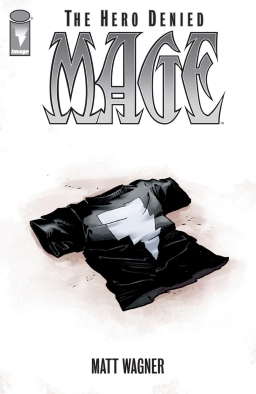
 At the Emerald City Comicon in early March, Image Comics announced that starting in August they’d be publishing writer/artist Matt Wagner’s Mage: The Hero Denied, a 15-issue series with a half-length 0 issue and a double-sized conclusion. Hero Denied will be the final part of a trilogy Wagner began over thirty years ago, and I want to prepare for that last installment by looking back here at the first parts of the saga. The Mage books are two of the finest works of a great comics talent, urban fantasies mixing excellent action storytelling, a mastery of plot beats, and a sense of the mythic into gripping stories — and stories with a semi-autobiographical slant, no less.
Mage: The Hero Discovered was published by Comico from May 1984 to December 1986 (I read it in the three-volume 1987 Starblaze trade paperback collections). Wagner wrote, drew, and coloured the series, with letters by Bob Pinaha, and Sam Kieth inking from issue 6 through 15. The story follows Kevin Matchstick, inhabitant of the modern-day world, as he encounters a mysterious figure named Mirth who turns out to be a mage; Mirth introduces Matchstick to a grander and more terrifying world, one of wizardry and horrors, and leads him to the hidden truth of his nature and his link to a hero out of legend. Mage: The Hero Defined came out from Image from July 1997 through October 1999, again written and drawn by Wagner, this time with colours by Jeromy Cox and letters by Sean Konot. The series follows an older Matchstick through a stranger world of greater magics and other heroes; Matchstick meets another mage, faces consequences of his earlier actions, and discovers deeper truths about the archetypes behind him.
Always intended as a trilogy from the beginning of the story back in the 80s, the second and third chapters have necessarily been slow to follow because the story is in part an autobiography. Kevin Matchstick is the alter-ego of Matt Wagner: he’s drawn to resemble his creator, aspects of his story are fictionalisations (fantastifications?) of Wagner’s life, and other characters are analogues of people Wagner knows — and since Wagner’s a professional in comics, a number of the characters in the second series are thinly-disguised versions of other comics artists. The Hero Defined is therefore also an odd document of 1990s comics culture. If you don’t know the background, you don’t need to know it. If you do, you see another level to the story: artists become mythic heroes and villains. That works with the central concern of the tale — the transmutation of everyday life into archetypal struggle.
…
Read More Read More
 How is Conan not a Mary Sue?