A review of the Cortex System Role Playing Game
Cortex System Role Playing Game
By Jamie Chambers
Margaret Weis Productions ( 160 pp, $29.99, April 2009)
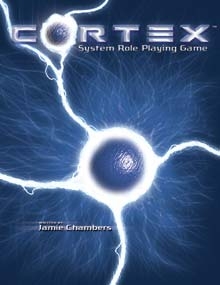 There are a lot of things to commend this book to an experienced gamer. The rules are fairly simple yet cover a lot of ground. I like how the abilities are not really tied into specific stats that are sometimes hard to justify - this system is much more fluid. It also is not conducive to rules lawyering and if there is one thing I hate, it is rules-lawyering, so this is a positive for me. I can see where the OCD crowd who wants a rule for everything could be irritated with it, but I game by the principle that story precedes rules, and this rule set is made for that mindset.
Basically, after two or three hours of reading, a game master will feel comfortable enough to run the system. Layout is simple but functional black-and-white and an easy to read font. It’s fairly thin for being the core rules of a game system, but I liked that. It made the book less intimidating than a lot of other systems I have looked at.
 Conan the Defender
 What’s interesting about a collection of “interfictions,” aka “interstitial fictions,” is that this isn’t just another descriptor (e.g., new wave fabulism, new weird, slipstream, paraspheres, fill-in-the-blank) made up by an editor or a marketing department or critic that subsequently becomes blogosphere fodder about how inaccurate and/or stupid it is. Rather, interfictions is the self-proclaimed terminology of an actual
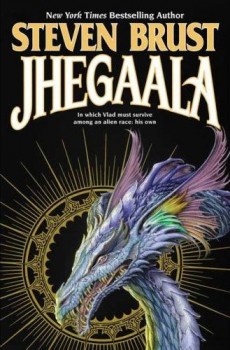 Jhegaala
 I am going to semi-repeat myself in my next two Black Gate posts, going over graphic novel versions of material that I’ve discussed over the past few months.
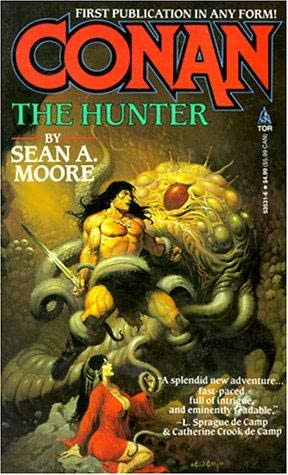 Conan the Hunter
 If there is a watch, then there must be a watchmaker. That’s the crux of the argument for intelligent design, that existence, and specifically you and me, are the result of some conscious creator. My main problem with this is the adjective “intelligent.” If I was designing existence, there’s a lot I’d leave out, like cancer or maggots or flatulence or Glenn Beck. Or that for certain kinds of life to continue and thrive, other life forms must suffer. Besides, this all begs the question of, if there is a designer (intelligent or otherwise), who created the designer?
 While her work sometimes hints at the fantastic, Lydia Millet isn’t strictly speaking a fantasy writer, certainly not in the sense of questing elves or weird alternate universes, and certainly not as evidenced in her new short story collection, Love in Infant Monkeys. Yet Millet’s work is frequently mentioned in genre venues; indeed, one of the stories collected here, “Thomas Edison and Vasil Golakov,” (in which the famed inventor of light bulbs and power generation attains metaphysical illumination by continually re-running a film of a circus elephant’s seemingly Christ-like electrocution)previously appeared in
 For this edition of my irregular review of the latest (more or less) short fiction, I thought I’d try something a little different. Usually I try to focus on the stories that worked the most for me, with maybe some attention on those that didn’t and why; at the same time, I also try to convey a flavor of everything else, if only just to alert you that an author is in the publication without, for any number of reasons, wanting to get into discussing the story to any great length. Note the use of the word “try.” One of the challenges here is to provide some substantive, possibly even useful, discussion to an audience that I’m assuming hasn’t already read the material. As