Pastiches ‘R’ Us: Conan the Defender
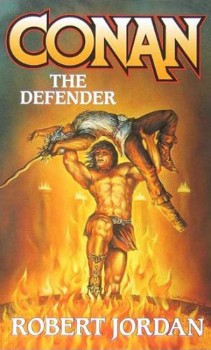 Conan the Defender
Robert Jordan (Tor, 1982)
I’ve had some requests on the site and in emails to my own blog from people who have enjoyed previous installments of “Pastiches ‘R’ Us” to look at Robert Jordan’s novels. I’m here to serve. This week and next I’ll feature two of the famous fantasy author’s Conan novels.
Robert Jordan, the pen name of James Oliver Rigney Jr., is the best-known of the stable of writer on Tor’s long-running and now defunct Conan pastiche series. After writing six consecutive books (and the novelization of Conan the Destroyer), Jordan turned into one of the most popular authors of epic fantasy with his “Wheel of Time” series. Unfortunately, Jordan’s career ended early with his death in 2007 from cardiac amyloidosis, only a month before his fifty-ninth birthday.
How does Jordan’s work on Conan stack up? He’s not consistently the strongest of the Tor group—I think John Maddox Roberts deserves that title—but when Jordan first started writing Conan, he created some fresh and energetic material. His first Conan novel, Conan the Invincible (also the first of the Tor series), is pulpily exciting and one of the few pastiches from the Tor books that I recommend to people who normally avoid non-Howard Conan.
 What’s interesting about a collection of “interfictions,” aka “interstitial fictions,” is that this isn’t just another descriptor (e.g., new wave fabulism, new weird, slipstream, paraspheres, fill-in-the-blank) made up by an editor or a marketing department or critic that subsequently becomes blogosphere fodder about how inaccurate and/or stupid it is. Rather, interfictions is the self-proclaimed terminology of an actual
  Jhegaala
 I am going to semi-repeat myself in my next two Black Gate posts, going over graphic novel versions of material that I’ve discussed over the past few months.
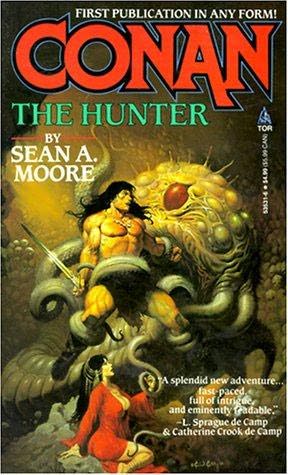 Conan the Hunter
 If there is a watch, then there must be a watchmaker. That’s the crux of the argument for intelligent design, that existence, and specifically you and me, are the result of some conscious creator. My main problem with this is the adjective “intelligent.” If I was designing existence, there’s a lot I’d leave out, like cancer or maggots or flatulence or Glenn Beck. Or that for certain kinds of life to continue and thrive, other life forms must suffer. Besides, this all begs the question of, if there is a designer (intelligent or otherwise), who created the designer?
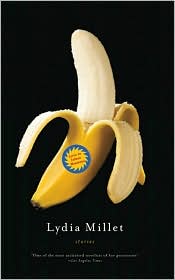 While her work sometimes hints at the fantastic, Lydia Millet isn’t strictly speaking a fantasy writer, certainly not in the sense of questing elves or weird alternate universes, and certainly not as evidenced in her new short story collection, Love in Infant Monkeys. Yet Millet’s work is frequently mentioned in genre venues; indeed, one of the stories collected here, “Thomas Edison and Vasil Golakov,” (in which the famed inventor of light bulbs and power generation attains metaphysical illumination by continually re-running a film of a circus elephant’s seemingly Christ-like electrocution)previously appeared in
  For this edition of my irregular review of the latest (more or less) short fiction, I thought I’d try something a little different. Usually I try to focus on the stories that worked the most for me, with maybe some attention on those that didn’t and why; at the same time, I also try to convey a flavor of everything else, if only just to alert you that an author is in the publication without, for any number of reasons, wanting to get into discussing the story to any great length. Note the use of the word “try.” One of the challenges here is to provide some substantive, possibly even useful, discussion to an audience that I’m assuming hasn’t already read the material. As