Browsed by
Category: Movies and TV

The Public Life of Sherlock Holmes: Sherlock (Doctor) Who?
The Public Life of Sherlock Holmes: Sherlock (Doctor) Who?

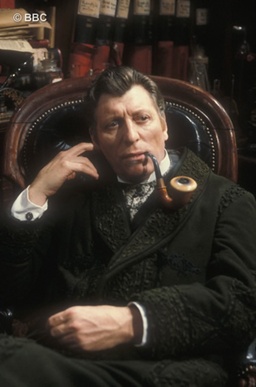
Baker_PipeThe BBC recently held a ‘Best of Doctor Who 50th Anniversary Poll’ and Tom Baker came out number one. This is a bit surprising, as he roamed in the Tardis from 1974 to 1981, which was over three decades ago. And less relevant but still of note is that the Doctor never really broke big in America until David Tenant took on the role.
Baker_Moore
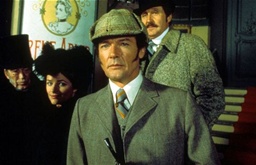
Roger Moore starred in the TV movie Sherlock Holmes in New York. It’s not quite as bad as it might appear, though John Huston was woefully miscast as Moriarty.

After Baker gave the Doctor up for regeneration, the BBC approached him and asked what project he would like to do next with his popularity still soaring. Baker immediately replied, “Sherlock Holmes,” and traded his scarf for a deerstalker.

With England’s most iconic actor (sorry, Roger Moore) to play England’s most iconic character (sorry, James Bond), only the biggest Holmes story would do. Though that’s not the smartest choice to showcase Holmes.

The BBC hadn’t tackled The Hound of the Baskervilles since Peter Cushing’s second attempt at it for his 1968 television series (a role he secured after failed attempts to land Robert Stephens and Eric Porter). There had been an American TV version in 1972 starring a dull Stewart Granger with Bernard Fox as yet another doofus Watson who mumbled his lines.


Read More Read More

King Conan Gets a Movie Poster

King Conan Gets a Movie Poster

King Conan poster-smallSo here’s a fun thing. The King Conan movie poster at right, featuring Arnold Schwarzenegger as everyone’s favorite barbarian monarch, was spotted at the Cannes Film Festival this weekend, and is now making the rounds on the Internet.

Before you get too excited, the existence of the poster does not actually imply the existence of a movie… or even a soon-to-be-movie. Apparently, this is a thing at Cannes: using promotional posters to generate excitement among possible investors.

Still, it warms my heart. And it sent me on a hunt for the latest news of the next Conan film, which everyone seems certain will be announced Real Soon Now. Last summer, producer Fredrick Malmberg provided some details on the plot, clarifying that “this takes place AFTER Conan has been king… if we do this right, we can do two more Conan movies right after.” Andrea Berloff  took over script duties from Chris Morgan last October.

Schwarzenegger has expressed clear interest and has been tied to the film since word first leaked. In an interview last year, he shared his thoughts on the project:

The important thing with Conan is to make it into an A-movie, to treat it like a 300, or any of those great movies, rather than a B-action movie… The audience today, and the fans, are very sophisticated… They’ve seen it all. They demand something — when they see a Conan movie — that isn’t just a spectacle.

Opinion is divided on whether the final version will be called King Conan or The Legend of Conan. Whatever the case, we’ll keep you posted as things develop.

The Resurrection of Dr. Mabuse, Part Two

The Resurrection of Dr. Mabuse, Part Two

etipomarMabuseLess than six months ago, I reviewed indie wunderkind Ansel Faraj’s 21st Century update of Dr. Mabuse. The Rondo-nominated film garnered more attention from genre fans for Faraj’s stunt casting of veterans of the 1960s Gothic soap opera Dark Shadows than it did for his faithful recreation of Expressionism in the digital age of indie filmmaking.

I won’t claim Faraj is the equal of Fritz Lang or that his Hollinsworth Productions offers the resources of UFA at its peak, but this is a young man who impresses in spite of the limitations of budget and time. There is a dreamlike quality to his work which is helped rather than hindered by the Spartan production values. One wonders just what he would be capable of rendering given studio backing.

Faraj’s latest production, Etiopomar, is the second half of his Dr. Mabuse reboot and deftly blends elements of Norbert Jacques’s original novel that Fritz Lang and his screenwriter wife Thea Von Harbou jettisoned from their 5-hour two-part adaptation of the book in 1922, while incorporating characters from Lang and Von Harbou’s Metropolis (1927). When one considers Lang’s silent masterpieces, the visionary Metropolis easily supersedes his Mabuse pictures. Metropolis is a stunning sci-fi epic that is still influential nearly 90 years on.

Read More Read More

A History of Godzilla on Film, Part 5: The Travesty and the Millennium Era (1996–2004)

A History of Godzilla on Film, Part 5: The Travesty and the Millennium Era (1996–2004)

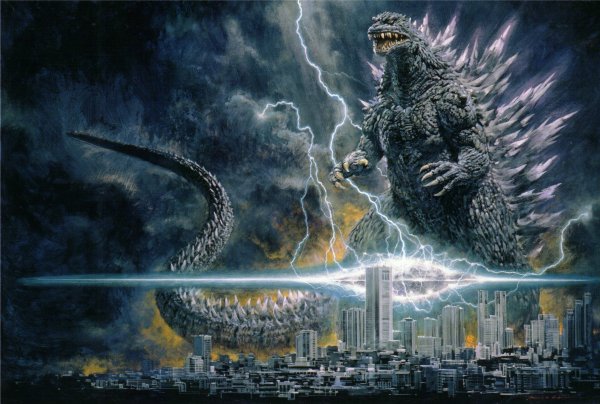
GodzillaMillenniumHey, kids: guess what comes out in theaters this Friday? Oh, wait … I have something I need to finish up here. (Sorry about the delay. It’s a boring story.)

Other Installments

Part 1: Origins (1954–1962)
Part 2: The Golden Age (1963–1968)
Part 3: Down and Out in Osaka (1969–1983)
Part 4: The Heisei Era (1984–1996)
Addendum: The 2014 Godzilla

Godzilla ‘98: An American Tragedy

Oh, I wish Theodore Dreiser wrote this.

All right, let’s get this mother*&!%ing thing over with as much speed as possible: Godzilla ’98 stinks like rotten Limburger. We can all agree on this. It isn’t the worst film in the Godzilla series, but that’s because it doesn’t belong in the series and has no business associated with anything with the name “Godzilla” on it. It has zero connection to any version of Godzilla, nor does it make any attempt to interpret the monster whose name it crassly exploits — which is probably the most insulting thing about this massive heap of industrial Hollywood sewage.

Read More Read More

The Public Life of Sherlock Holmes: Eille Norwood: the Silent Detective

The Public Life of Sherlock Holmes: Eille Norwood: the Silent Detective

Norwood_Doyel
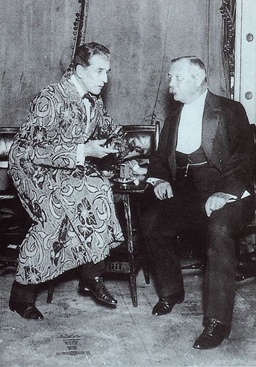
Norwood and Sir Arthur Conan Doyle at the Stoll Pictures Annual Dinner

This may shock you, but there were on-screen Sherlock Holmes before Benedict Cumberbatch! And for you old-time fans, even before Robert Downey Jr. Really! The first great movie Holmes comes from the silent film era. And he shared a last name with another actor who would give arguably the greatest portrayal of the world’s first private consulting detective.

William Gillette had come to personify Sherlock Holmes through repeated performances of his stage play in the U.S. and Europe. His 1916 film version certainly helped as well, but was not a critical part of his success. Anthony Edward Brett would become the first great movie Holmes, though he would achieve it as Eille Norwood.

Born in 1861, Norwood was primarily a stage actor in England when he landed the role that would make him famous throughout the U.K..

In 1921, a British film company named Stoll decided to film a series of shorts based on Doyle’s stories. For the next two years, they would produce forty-five of the twenty-minute films, along with two longer ones. Doyle’s short stories fit the twenty-minute length quite well and Stoll wasn’t forced to add inauthentic filler to them.

The first fifteen, chosen randomly from among Doyle’s stories, were called The Adventures of Sherlock Holmes. That same year, the first version of what would be the most famous film title in the Canon was made, The Hound of the Baskervilles. Maurice Elvey directed all sixteen films. That same year, Elvey made a romantic drama called The Fruitful Vine. The lead was played by a young man named Basil Rathbone. How about that?

Read More Read More

The Public Life of Sherlock Holmes: A Man Called Spade

The Public Life of Sherlock Holmes: A Man Called Spade

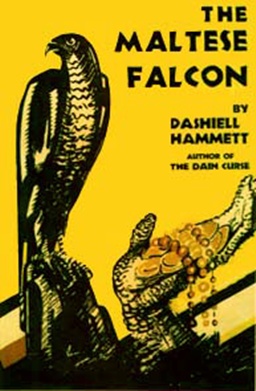
Spade_FalconbookIn last week’s column, I mentioned The Maltese Falcon, starring Humphrey Bogart. (Did you follow instructions and watch it for the first time?) Over eighty years after its publication, Dashiell Hammett’s The Maltese Falcon stands supreme today as the finest private eye novel ever written. Bogie’s 1941 film proved that the third time is a charm, prior attempts in 1931 and 1936 having failed.

Sam Spade, the quintessential tough guy shamus, appeared in a five-part serial of The Maltese Falcon in Black Mask in 1929. Hammett carefully reworked the pieces into novel form for publication by Alfred E. Knopf in 1930 and detective fiction would have a benchmark that has yet to be surpassed.

Hammett, who wrote over two dozen stories featuring a detective known as The Continental Op (well worth reading), never intended to write more about Samuel Spade, saying he was “done with him” after completing the book-length tale.

But the public wanted more and his agent cajoled him into cranking out three more short stories featuring Spade. The first two appeared in American Magazine and the third in Collier’s in 1932 and they were collected into book form later that year as The Adventures of Sam Spade and Other Stories. In 1999, Vintage Crime published Nightmare Town, a compilation of twenty Hammett stories, including all three Spade short stories.

Read More Read More

Something Unspeakable Has Come Home: 1972’s Deathdream Revisited

Something Unspeakable Has Come Home: 1972’s Deathdream Revisited

Andy_at_the_Drive-In-smallOne of the most enduring tales in all horror literature is W.W. Jacobs’s classic 1902 shocker, “The Monkey’s Paw,” in which a father acquires a magic talisman (the paw) from a soldier home from service in India. The paw supposedly grants three wishes — wishes that of course come at a price. Not really believing that it will work, the father wishes for two hundred pounds to pay off his house. The next day, his son is killed (“caught in the machinery”) at the factory where he works and in compensation, the company presents the family with…two hundred pounds.

Some days later, after her boy has been buried, the grief-blinded mother realizes that they’ve only used one wish, and compels the appalled father to use the paw to wish their son alive again. A short time later, they hear a soft knocking at the door, knocking that quickly grows into a deafening fusillade as whatever it is that waits outside the bolted door furiously tries to gain entry. While the ecstatic mother fumbles with the bolt, the terrified father, imagining the mangled horror outside, uses the paw for one last wish. When the door finally swings open, there is nothing there — “The street lamp flickering opposite shone on a quiet and deserted road.”

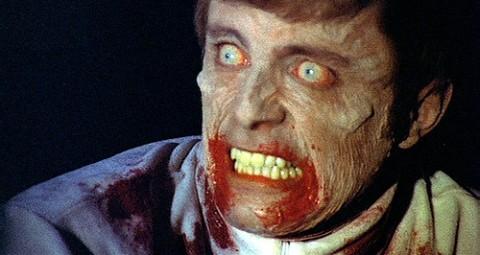
This powerful tale has been adapted many times over the decades, for stage and radio, for television and movies, and for comics, and it has additionally inspired many stories and films that are not direct adaptations; of these Stephen King’s 1983 novel Pet Semetary may be the most well known. Another example, not nearly as well known as it deserves, is the 1972 low-budget horror film, Deathdream.

Read More Read More

The Public Life of Sherlock Holmes: The Science Fictional Humphrey Bogart

The Public Life of Sherlock Holmes: The Science Fictional Humphrey Bogart

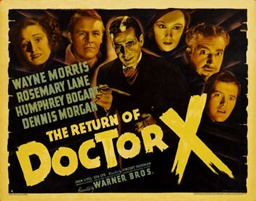
ReturnX_PosterInto the nineteen fifties, Hollywood operated under the studio system. A few major movie studios owned both the production and distribution channels and dominated the industry.

They cranked out “B” pictures to provide product to support the “A” films and keep the theaters they owned filled.

Actors, especially non-stars, made several films a year, either appearing higher in the credits on B films or as supporting actors in A movies. Those actors had very little power in the system as well.

In 1936, Humphrey Bogart (who had already twice failed to stick in Hollywood) received his first critical acclaim for The Petrified Forest, in which he recreated his Broadway role as gangster Duke Mantee.

He would really strike it big in 1941, first with  High Sierra, and then The Maltese Falcon  (if you haven’t seen this one,  rent it tonight and then leave an apology comment on this post for waiting so long). In the five years between Forest and Sierra, he appeared in twenty-nine films: most not as the star.

Bogart famously said, “I made more lousy pictures than any actor in history.” This was because Warner Brothers tossed him into every low budget B movie they could.

Sometimes it was so bad that he refused the part, which then got him suspended without pay. That’s why you see Dennis Morgan and not Bogie in the awful western, Bad Men of Missouri (with Wayne Morris starring – see below).

Bogie, in a career with over eighty credits and possibly the greatest star in film history, made only one horror/science fiction movie. And he considered it one of his worst. He’s got a point.

Read More Read More

Mashed Up

Mashed Up

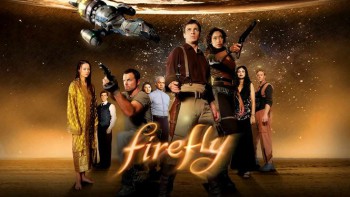
FireflyAs might be expected from the guy who wrote Sword Noir: a Role-Playing Game of Hardboiled Sword & Sorcery and is now Kickstarting Nefertiti Overdrive: Ancient Egyptian Wuxia, I love a good mash-up. I use the term mash-up to refer to a creative work that blends two or more apparently dissimilar genres. The mash-up most genre fans would know would be Firefly, mashing-up space opera and westerns.
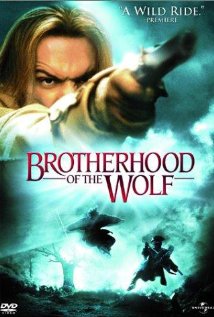
Brotherhood of the WolfNow space opera and western are not terribly dissimilar, but Firefly included many of the trappings as well as the tropes of the western. The characters carried six-shooters and lever action rifles, they had costumes that appeared quite close of 19th century American frontier clothing, and pseudo-frontier language dotted their speech – along with Mandarin. While I often hear Firefly referred to as sci-fi with some western aspects, I think it is more fitting to call it a western in space.
That’s kind of splitting hairs.

Firefly melded two genres, but there is a wonderful French movie that mixes at least four – period drama, martial arts, horror, and romance. The Brotherhood of the Wolf is one of my favourite movies and an inexhaustible source of inspiration. It might not be the finest movie of its age, but it was my favorite movie of 2002.

Read More Read More

Goth Chick News: An Anniversary Edition of the Ultimate Novelization

Goth Chick News: An Anniversary Edition of the Ultimate Novelization

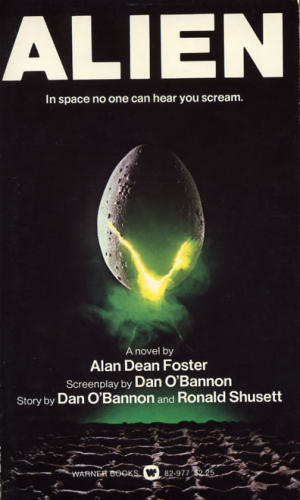
Alien Alan Dean Foster-smallI’ll never forget my first time.

I was a very young Goth Chick, spending a typical Saturday combing the used paperbacks for sale at my local library. It’s hard to feed a literary addiction on a six-grader’s salary, as I know every last one of you understand.

And there it was.

Dog-eared and minus its back cover, but with that impossible-to-miss front cover art. It was based on the movie I wasn’t allowed to watch, the one with the R-rating, which obviously meant it was the best movie ever committed to film. Or at least the scariest.

My parents clearly had not considered the library a place to land contraband of this magnitude.

I bolted for the front desk, threw my two quarters at the librarian, waved the yellowed, pulpy tome in her general direction, and exited the library to the adjacent park where I sat planted for the remainder of the afternoon – transfixed.

That was where I fell in twisted, grossed-out love with the movie Alien — and the man who told me the story (which is better than seeing it anyway), Mr. Alan Dean Foster.  It was the beginning of a long and intense relationship, at least by sixth-grade standards.

Back then, a used-book seller would have been the most likely place to have found a copy of Alien, a book which has been out of print since 1992. A pity, since it is widely considered the defining testament to how a novelization can complement an already-great film.

But this week, all that changed.

On Tuesday, April 15th, in honor of its 35th anniversary, Titan Books released a new printing of Alien: The Official Movie Novelization.

Read More Read More