Public domain is a tricky issue. We all know the horror stories of a certain bloodsucking literary estate who clings to the last remaining copyrights of their Victorian property and frequently demand exorbitant fees for usage in new works. There are also tales of a well-known property where a dubious claimant to the literary rights regularly files nuisance lawsuits and is often paid off by the big conglomerates just to avoid the hassle of dealing with the allegedly loopy individual in question. Both have generated their share of sympathy for the public domain cause.
Greedy bastards only interested in money and wealthy loons fighting to prove they own something they don’t are certainly unlikable characters. I know a good number of publishers and writers who thrive upon reviving properties that have slipped into public domain. So long as too many cooks aren’t in the kitchen churning out new soups with the same basic ingredients, it should be a harmonious situation that serves to keep the originals in print and grows fan interest in otherwise forgotten characters.
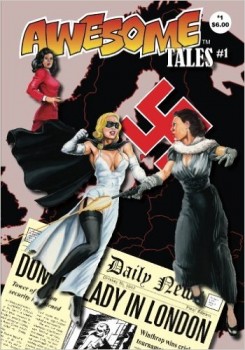
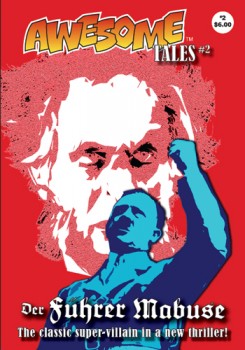
Bold Venture Press and Black Cat Media recently unveiled a new pulp anthology title, Awesome Tales. Largely the brainchild of editor/lead writer R. Allen Leider, three issues have been published thus far. Leider’s featured stories in each have successfully revived vintage pulp characters and placed them in World War II settings.
The first issue featured The Domino Lady, a racy adventuress from the “spicies” who has found popularity with “new pulp” specialty publishers such as Moonstone Books and Airship 27. Leider, who operates Black Cat Media, collaborated with Rich Harvey, who operates Bold Venture Press with Audrey Parente, in penning this new adventure that advances the character from her 1930s origins to the Second World War. Interestingly, the entire Domino Lady revival began when Bold Venture Press collected the character’s original 1930s adventures in 2004 and set the stage for new adventures to follow.
Howard Andrew Jones and Bill Ward have completed their epic re-read of every complete story of Conan the Cimmerian written by Robert E. Howard. They’ve been blogging about the project at howardandrewjones.com, and we’ve been following along with the viewers at home. In their wrap-up, Howard and Bill look over the vast catalog of Conan pastiches.
Howard: Such a fantastic character practically begs to have more adventures told about him, which is probably why the regrettable Conan pastiche industry popped up. Well, maybe not entirely regrettable, because I’ve read some I’ve really enjoyed…
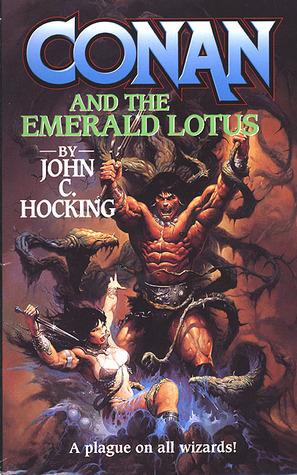
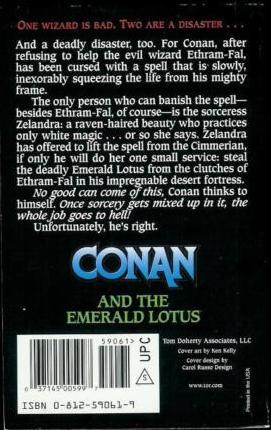
Bill: I’m actually looking forward at this point to checking out the many pastiches I’ve never read — I’ve got a stack of Ace Conans that I’d started reading before we came up with the plans for this epic reread… I’ve never read the deCamp and Carter pastiches, or the other stories by REH that de Camp Frankensteined into Conan tales. It’ll be a while before I jump into that series, though, as [I’ll] be rereading all the REH tales again as well. As for other pastiches, I’ve only read a few — Wagner’s Road of Kings was good, and, of course, Hocking’s [Conan and the] Emerald Lotus is terrific.
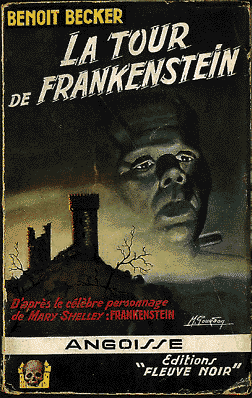
Jean-Claude Carriere is best remembered as the acclaimed screenwriter of Hotel Paradiso (1966), Belle de Jour (1967), The Discreet Charm Of The Bourgeoisie (1972), The Return Of Martin Guerre (1982), and The Unbearable Lightness of Being (1988). Less well known is the fact that he also authored (under the house name of Benoit Becker) six very bloody sequels to Mary Shelley’s classic Frankenstein; or, The Modern Prometheus (1818) in 1957 and 1958 for a French horror-specialty imprint. Carriere’s books chronicle the exploits of Gouroull, as he christened the Monster, as he moves across Europe from 1875 to 1939.
Gouroull is portrayed very much in the mold of Mary Shelley’s literary original. He is a terrifying amoral creation possessed of superhuman strength and cunning. Truly the only one of his kind, he is a creation who has outlived his creator and knows not love or restraint. Gouroull is the ultimate sociopath. This Frankenstein monster is quite foreign to our pop cultural mindset. Gouroull uses his razor sharp teeth to slash his victims’ throats. He does not breathe. His skin is naturally flame-resistant. Ichor runs in his veins in place of blood. He is a monster like no other.
NOTE: The following article was first published on May 30, 2010. Thank you to John O’Neill for agreeing to reprint these early articles, so they are archived at Black Gate which has been my home for over 5 years and 250 articles now. Thank you to Deuce Richardson without whom I never would have found my way. Minor editorial changes have been made in some cases to the original text.
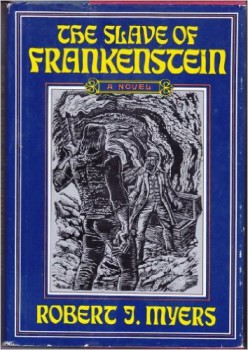
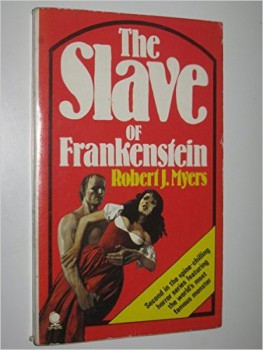
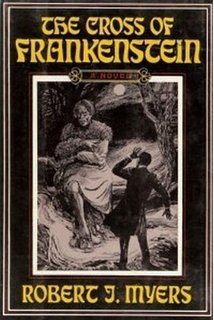
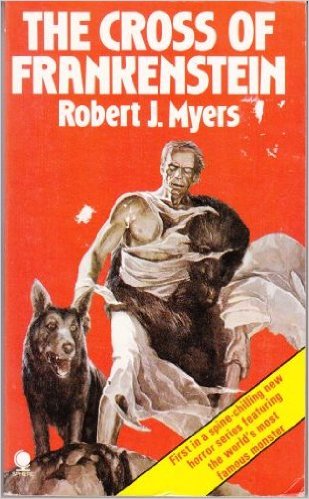
A couple weeks ago I reviewed R. J. Myers’ The Cross of Frankenstein. It was the respected political commentator’s first foray into fiction. He followed it with a sequel, 1976’s The Slave of Frankenstein and despite the promise of a third book, his only other genre efforts were a late seventies soft-core vampire title and a privately-published guide to blood-drinking as an alternative lifestyle.
I always feel a pang of guilt when I come down hard on a fellow pastiche writer. I’ve been on the receiving end of disappointed Sax Rohmer and Conan Doyle fans who felt I had no business continuing the adventures of characters they love. At the same time, I believe I have been fair and honest in my assessments when reviewing pastiches. I have the utmost respect for Joe Gores, Michael Hardwick, Cay Van Ash, and Freda Warrington as writers who tried hard to stay true to the original author in terms of style and spirit. I can still enjoy Peter Tremayne and Basil Copper who, despite falling short of the mark, can still spin an entertaining yarn. Consequently, I feel justified when I confine Myers to the lowest pit of literary Hell alongside Ian Holt and Richard Jaccoma for The Slave of Frankenstein, while a very different beast than Myers’ first effort, is equally contemptible.
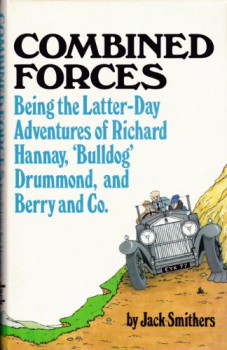
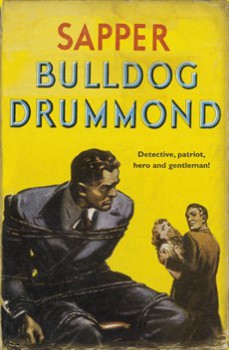
A. J. Smithers is a respected author of fiction and non-fiction titles with a special dedication to the Clubland fiction of Dornford Yates, John Buchan, and H. C. “Sapper” McNeile. His 1983 novel, Combined Forces was subtitled Being the Latter-Day Adventures of Richard Hannay, “Bulldog” Drummond, and Berry and Co. Clubland literary scholar Richard Usborne praised the book and Smithers’ willingness to expose the dark sides of its characters’ lives. Wold Newtonians sometimes seek out this rare work because of the literary crossover within its pages. I approached the book first as a Bulldog Drummond completist and secondly as a fan of Richard Hannay.
While most people know of The Thirty-Nine Steps thanks to Alfred Hitchcock’s celebrated film version, they are unaware of how different the character of Richard Hannay is in John Buchan’s fiction. Most are unaware that Hannay appeared in a total of seven spy thriller novels by Buchan published between 1915 and 1940. Unlike many long-running series, Buchan chose to have Hannay age in real time and grow as a person as he marries and settles down and even retires. Buchan’s approach appears to have influenced some of Gerald Fairlie’s modifications to Hugh Drummond’s character and life as he continued the series after Sapper’s death.
Sure, I’m all about Sherlock Holmes and Solar Pons, which you are certainly aware of if you read The Public Life of Sherlock Holmes every Monday here at Black Gate (blatant self-plug). But of all the mystery (and swords and sorcery, for that matter) series that I read and love, Rex Stout’s Nero Wolfe tales hold the top spot for me.
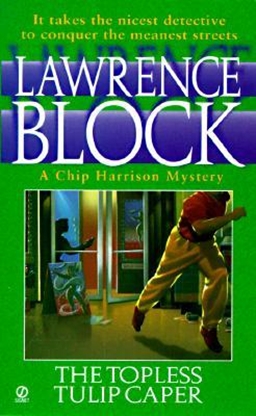
You can a get a primer on Wolfe from this post I wrote in the summer of 2014. And of course, you can buy a book and check him out first hand. I mentioned here that there are definitely Wolfean characteristics in Glen Cook’s Garret, PI series. Mystery grand master Lawrence Block (Matthew Scudder, Keller, Bernie Rhodenbarr series’ and more) tinkered with an R-rated version of Wolfe in two novels and two short stories featuring Leo Haig (Wolfe) and Chip Harrison (Archie Goodwin).
The stories don’t just emulate Wolfe and Goodwin. They specifically talk about them! As Harrison tells us in Make Out With Murder:
I don’t have any idea how to salvage this train wreck of a show. Do you?
So, for the first post of 2016, I think the most important thing to recognize is that I made it to the end of my second calendar year at Black Gate without getting axed (it helps that I work cheap. As in, ‘free.”). By my reckoning, The Public Life of Sherlock Holmes has appeared here every single Monday morning for the past 96 weeks. As I had serious doubts that John O’Neill would even approve a Holmes-themed column (I mean, it’s a fantasy website!), I’m pretty pleased it’s still around.
During 2015, I helped with Black Gate’s outstanding “Discovering Robert E. Howard” series, which featured guest columns from a slew of very knowledgeable folks; and there are still a couple fine posts remaining in the series. Personally, I thoroughly enjoyed putting together Part One of my history of Necromancer and Frog God Games, Dungeons and Dragons and Pathfinder RPG publishers extraordinaire. Part Two is pretty much written, but still needs some serious editing.
The three-part piece on Granada’s Adventures of Sherlock Holmes, starring Jeremy Brett, was a favorite and there will certainly be another in the series: likely a few more. And I even managed to have the most viewed post in a month with a look at what went wrong in season three of BBC Sherlock (sadly, my hopes that the January 1 special episode would get the franchise back on track were horribly dashed).
With a couple of extras that I wrote outside of PLoSH included, I’ve linked 54 posts from 2015 below. It’s no surprise, with the name of this column, 27 were about Sherlock Holmes or Arthur Conan Doyle. With another 5 about the best of the Holmes pastiches, Solar Pons.
Next up were 8 posts related to fantasy and 1 for science fiction. Then we’ve got 5 Hard Boiled/mystery posts and 8 miscellaneous ones.
If you’re at least a semi-regular reader of the column, I try not to write “here’s my opinion” posts. I like to share information about things I like, be it the Richard Diamond radio series or a different way to look at a Holmes story. Hopefully in 2015 you came across a topic that you either wanted to go explore a bit or that you learned a little more about. There’s lots more I plan on writing about in 2016 (can’t believe I didn’t write a single Nero Wolfe post last year!), so grab a cup of coffee and check in on Monday mornings. And thanks for reading The Public Life of Sherlock Holmes!
NOTE: The following article was first published on May 16, 2010. Thank you to John O’Neill for agreeing to reprint these early articles, so they are archived at Black Gate which has been my home for over 5 years and 250 articles now. Thank you to Deuce Richardson without whom I never would have found my way. Minor editorial changes have been made in some cases to the original text.
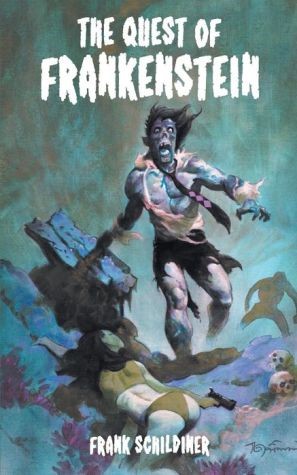
Robert J. Myers is a study in contradictions. A veteran CIA operative, he became the publisher of The New Republic. In the mid-1970s, Myers authored two sequels to Mary Shelley’s classic, Frankenstein or: The Modern Prometheus (1818). Having a longstanding interest in literary pastiches, I tracked down these two long out-of-print titles and read the first, The Cross of Frankenstein (1975). The prolific nature of the Universal and Hammer Frankenstein movies was understandable, but the original novel has always seemed more challenging to extend – even more so than Bram Stoker’s Dracula (1897). Neither story demands literary sequels, nor did their authors choose to pursue them – a fact that makes the ambitions of prospective continuation authors all the more difficult to realize with any degree of success.
Mary Shelley’s original reads like a modern fable. The scientist who transgresses nature’s laws is destroyed by the abomination he brought into existence with his own hand. It is the same fable Michael Crichton fashioned nearly 200 years later into Jurassic Park. Shelley’s alternate title for the book, The Modern Prometheus is frequently forgotten, but it is critical to an understanding of how the novel differs from the 1931 Universal horror classic that imbued itself in the public consciousness. The monster of Shelley’s novel may be lacking a flat head and neck bolts, but he makes up for it in spades with his philosophical yearning for his own place in the universe and with the father/creator who abandoned him.
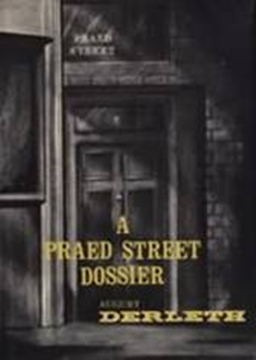
August Derleth created Solar Pons as a successor to Sherlock Holmes. You know that, of course, because I’ve written about Pons several times and I mention him at the bottom of every post. A Praed Street Dossier was a collection of Pons odds and ends written by Derleth, related to the ‘Sherlock Holmes of Praed Street.’
Included were some “Notebook” entries, attributed to Dr. Parker. Derleth would write two more “Notebook” installments for The Pontine Dossier, the newsletter of the Praed Street Irregulars.
The “Notebooks” are among my favorite Pons writings by Derleth. They provide additional insights into Pons and even add a case or two to the Pontine Canon. In fact, I like them so much I have continued on with the series, including ‘Notebook’ entries in several issues of my Solar Pons Gazette. I plan on adding more.
Tongue a bit in cheek with the names, here is a case from one of my ‘Notebooks’ entries in the Gazette. While Dr. Parker included this case, he never saw fit to fully write it up and publish it, so you are likely not familiar with it.
20 April, 1921
“Did you see this letter in the Herald, Pons?” I asked, handing him the item of discussion. He briefly glanced at it and then tossed it aside without a word. “You don’t think much of the suggestion, then?”
Solar Pons looked at me with the trace of a smile. “I believe that you are intentionally baiting me, Parker. So be it. No, I do not believe that ‘optograms’ will aid in finding the killer of Andrew Treacher.”
 Public domain is a tricky issue. We all know the horror stories of a certain bloodsucking literary estate who clings to the last remaining copyrights of their Victorian property and frequently demand exorbitant fees for usage in new works. There are also tales of a well-known property where a dubious claimant to the literary rights regularly files nuisance lawsuits and is often paid off by the big conglomerates just to avoid the hassle of dealing with the allegedly loopy individual in question. Both have generated their share of sympathy for the public domain cause.