Browsed by
Category: Essays

A Look at the Blackwyrm Novella Series

A Look at the Blackwyrm Novella Series

blackwyrmIn the age of fat fantasy series, doorstop thrillers, and historical epics it’s often impossible to find a short, satisfying read. Gone are the days of the 60,000 word science fiction novel, or even the novella doubles series Ace once put out. Long a standard of genre fiction — both the worlds of SF and of fantasy having a host of renowned novellas and short novels considered classics in their respective fields — these short, sharp stories are increasingly ignored for multi-book works of massive length. But, sometimes, it’s nice to get a book done in a day or two, it’s nice to explore an idea, premise, or setting without committing to dozens or hundreds of hours with it.

Which is  why I was very interested to see indie game company Blackwyrm’s new fiction line of novellas and short novel chapbooks. With an ambitious schedule of a book a month last year, Blackwyrm produced books ranging up and down the genre spectrum — from military fantasy to psychic thriller, from slipstream SF to  crossgenre mashup. In fact, all of the Blackwyrm titles I’ve seen do something a little bit different with genre tropes, and indeed they’ve billed their line as ‘Experimental Fiction.’

Read More Read More

Specialist and Generalist Readers

Specialist and Generalist Readers

stack-of-booksWhen people ask me what I like to read I usually answer with a simple ‘everything,’ but of course that’s not strictly true. I don’t read trigonometry textbooks or Romance novels, celebrity memoirs or cookbooks, monographs on the evolution of sheep shearing or anything by Dan Brown (in fact, just give me that thing on sheep first). But when I say ‘everything’ I’m being figuratively if not literally honest, because my tastes — especially when compared to the average reader — are very broad. I don’t read only one kind of thing. I’m a generalist.
There are plenty of people — possibly even the majority of people — that have a wholly different approach to reading. They are the specialists, and they only like one kind of thing and that is what they read to the exclusion of all else. It is tempting for me to regard this alien species as outside the category of ‘reader’ as I understand it — you know, the sort of person that, as a kid, spent all his lunch money on books, who’s tempted to get rid of his furniture to make room for his library, and who would rather read than watch TV, play jai-alai, or attend model home open house events in the hopes of a buffet spread. To me, a real reader is a voracious omnivore; metaphorically a gaunt, hollow-eyed ghoul with ink-stained fingers and sharpened teeth who knows an insatiable hunger so keenly painful it has in fact become a pleasure of sublime proportions. Our ghoul/reader will eat and eat and eat to the point of dieing, and ask for more with his last breath. Real readers are all a little bit insane — and they hope that no one ever finds the cure for their condition.

Read More Read More

Win a Copy of This Crooked Way!

Win a Copy of This Crooked Way!

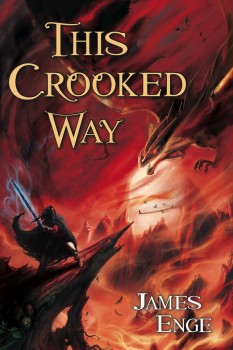
thiscrookedway_mechJames Enge’s Morlock stories have been some of the most popular fiction we’ve published in Black Gate.  His first Morlock novel, Blood of Ambrose, published by Pyr in April, was very warmly received, and described as “A future classic… this novel succeeds beautifully” (The Great Geek Manual) and “Like Conan as written by Raymond Chandler” (Paul Cornell).
The second volume, This Crooked Way, went on sale October 6th.  More than just a collection of previously published Morlock fiction, This Crooked Way has 15 chapters, only 5 of which have previously appeared.  We’ve received a small number of advance copies, and we want to give them to you.

We’ve asked James Enge to compile a list of questions, the answers to which lie in the five Morlock stories that have appeared in Black Gate.  The first five readers to fill out and submit the quiz below with the correct answers will receive a copy of This Crooked Way, compliments of Black Gate, James Enge, and Pyr.

The usual legal disclaimers apply: Offer void where prohibited.  No purchase necessary.  Must be 18 to enter.  Judges decisions are final.  Postage costs outside the US are the responsibility of the winner.  Additional disclaimers apply as we think of them.  Eat your vegetables.

Read More Read More

Fifty Years in the Zone: The Twilight Zone’s 50th Anniversary

Fifty Years in the Zone: The Twilight Zone’s 50th Anniversary

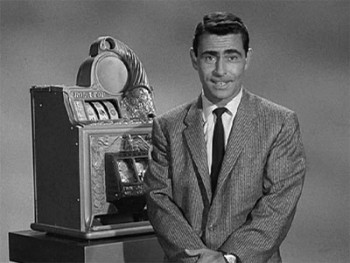
tz-title-card2serlingThe place is here, the time is now, and the journey into the shadows that we’re about to watch could be our journey.
With those words, spoken exactly fifty years ago by a respected television dramatist over an image of a man walking down a lonesome dirt road toward an empty town, started a journey into the imagination that continues to this day.

Last Friday was the fiftieth anniversary of The Twilight Zone. The speculative-fiction show created by Rod Serling broadcast its first episode, “Where Is Everybody?”, on 2 October 1959 on CBS. The world has never been the same since we crossed over into another dimension, not of sight or sound, but of mind. Brilliant writing, endless imagination, and the inspiration for countless authors, filmmakers, and other assorted dreamers resulted from this landmark along the roadway to the metaphorical Zone.

Read More Read More

The Real d’Artagnan

The Real d’Artagnan

The portrait Dumas paints of d’Artagnan in The Three Musketeers is iconic: a penniless young Gascon who sets off for Paris on a horse that has seen better days, armed with his father’s sword, an ointment his mother made that “miraculously heals any wound that doesn’t reach the heart”, and a letter of recommendation to M. de Trèville, captain of the King’s Musketeers.  From such humble beginnings are heroes made.  But, how accurate a portrait is it?

For The Three Musketeers (1843-44) and its sequels, Dumas drew upon the work – some call it scurrilous – of Gatien de Courtilz de Sandras (1644-c.1712), a pamphleteer and man of letters who may have personally known the historical d’Artagnan, Charles de Batz-Castelmore.  Courtilz’s Mèmoires de Monsieur d’Artagnan first saw publication in Cologne, in about 1700; it was a bestseller in its day, running into three editions.  Amid its rumor and gossip, under its skin of story-teller’s tricks, was a skeleton of fact – much of which one can easily verify through the records of the day, and by letters and dispatches archived in places such as the Bibliothèque Nationale.

Read More Read More

Thoughts Concerning Scurvy (De Scorbuto)

Thoughts Concerning Scurvy (De Scorbuto)

I come from a medical family. Of the five members of my immediate nuclear family, I’m the only one who lacks a background or job in medicine or health care. As a writer and historian growing up in a family that now consists of a pathologist, a nurse and lactation expert, a medical student on the cusp of graduation, and an occupational therapist, it was probably inevitable that I developed an interest in disease both in history and fiction. I would never get near the profession of medicine (the general public ought to thank me for this—I’d make a horrible doctor), but the dramatic role of disease in writing has always entranced me.

Among writers, bubonic plague is the leading favorite pestilence. It’s hard to resist the power of an illness that wiped out a third of Europe during the late Middle Ages and has a death toll exceeding two hundred million. The very title “The Black Death” instantly conjures up Hieronymous Bosch grotesques in most people’s minds. It’s a disease with an outstanding pedigree for fantasy and historical writers.

However, I’d like to shine an operating room light on another disease that I think is one of the most useful for a writer. At a cursory glance, it seems like it shouldn’t have any dramatic potential at all: not only is it easily preventable, it’s also easily cured. It isn’t even communicable. But a second glance reveals that this disease is a superb tool for fiction.

The disease is scurvy.

Read More Read More

Books Best Appreciated In Their Natural Habitat

Books Best Appreciated In Their Natural Habitat

bookstoreRecently I received a bit of a surprise when I went to a local library that has long been one of my ambush zones for the acquisition of unsuspecting books. All those lovely 25 cent mass market paperbacks with the stickers on the spine, all those nicely broken-in trades, all those hardbacks with the covers mylared over and glued down, were gone. Vanished. Whisked away on an electron breeze to inhabit the alternate world of the internet.
That’s a world I’ve hunted in a lot; in fact, the internet may indeed be my own Happy Hunting Grounds, the place where all those impossible to find treasures I’d only ever heard about as a kid grew like ripe fruit within easy reach. Not only was it simple and cheap, but it’s a world where anything is possible.

Of course, it’s also online cheapskates like me that are killing book stores.

I’ve blogged about my library shock in full over at my site, and talked about how important library sales were to me as a kid. How owning books, having a collection, taught a different sort of relationship and fostered a deeper respect for the world of books, fiction, and education than did borrowing them. I truly do think having these books available for purchase furthered the library’s mission of instilling a respect for the written word in the populace — especially in us kids who could buy a handful of SF novels with our lunch money after school — but, I suppose, it may have also reinforced other less desirable traits in me.

Read More Read More

Arab Fantasy

Arab Fantasy

This, alas, is not going to be one of those highly informative posts by a knowledgeable person possessing vast information on the subject. Instead, it’s a partial response to several different topics that have crossed my consciousness lately. One is an ongoing issue–the role of the Other (exotic, evil, dangerous, wild, etc.) in our culture and our storytelling, and what it is like living in a country of one of our current primary Others (Arabs) for the last year. Another is an article I read recently on the current state of Arab cinema (burdened by censorship, unwieldy bureaucracy, and funding problems–see also here and here). Finally there was a conversation last night on the future of the Arab world in which the subject turned to education. As in the US, discussions about the role of education tend to focus on job readiness and the economy, but it’s art and storytelling that are crucial for cultural health, and growth.

“Arab Fantasy” could mean fantasy by outsiders using elements of Arab tradition, or fantasy by Arabs using traditional or other source materials. The best-known source in the west is, of course, One Thousand and One Nights in its numerous versions, although (quoting from wikipedia, that utterly reliable source), “Some of the best-known stories of The Nights, particularly “Aladdin’s Wonderful Lamp”, “Ali Baba and the Forty Thieves” and “The Seven Voyages of Sinbad the Sailor”, while most likely genuine Arabic folk tales, were not part of the The Nights in its Arabic versions, but were interpolated into the collection by its early European translators.” Actually the article is a pretty interesting overview, and I learned a bunch of stuff. Genre works influenced by Nights are many; titles I’ve read recently enough that they float to the surface include Tim Powers’ World War II espionage-with-djinns novel Declare, Diana Wynne-Jones’ Aladdin sendup, Castle in the Air, and P.B. Kerr’s Children of the Lamp series, aimed primarily at middle-grade readers, but entertaining enough for undemanding adults, and, it seems, forthcoming as a movie from Dreamworks.

Read More Read More

The Future Is Now

The Future Is Now

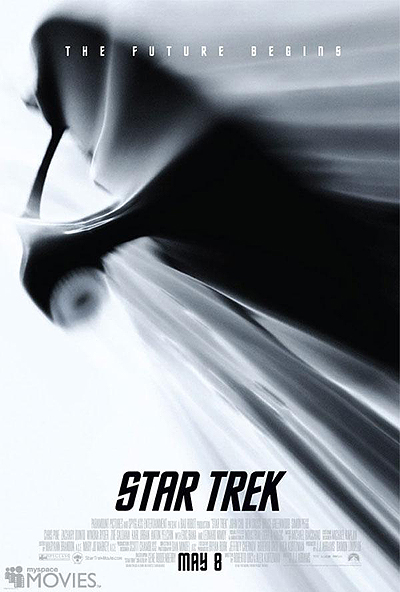
trekfinal2Star Trek (2009)
Directed by J. J. Abrams. Starring Chris Pine, Zachary Quinto, Leonard Nimoy, Eric Bana, Bruce Greenwood, Karl Urban, Zoe Saldana, Simon Pegg, John Cho, Anton Yelchin, Ben Cross, Winona Ryder.

I wrote a review of the new movie Star Trek for my own blog within a few hours of seeing the film on Friday morning. I have nothing against that review, but it’s definitely the sort of free-form exercise I do on my personal blog, and it goes deep into the story and specific details for general readers. I never intended to put such a review on my Black Gate blog.

But Star Trek deserves it’s own take on Black Gate, one geared toward the specific audience. This isn’t truly a review, but an essay analysis of a cultural phenomenon that takes into account the many other reviews I’ve now read of the movie since I saw it (I purposely avoided reading others reviews before seeing the film) and the reaction of people I know who have seen it so I can paint a canvas of the sort of zeitgeist we’re experiencing.

Although Black Gate takes heroic fantasy as its theme, while the Star Trek franchise is science fiction, the people who read this magazine and its website belong to a genre community of which Star Trek forms one of the cornerstones. It doesn’t matter if you like Star Trek or not… if you count yourself a fan of anything that is “genre,” Star Trek has a place in your universe. Star Trek is the personification of “fandom.”

A few days before the new movie hit theaters, I wrote a short essay examining my own relation to Trek fandom. You can read that if you want to know where on the “Trekker” scale I stand, if that’s of interest to you regarding reading the rest of this essay.

Read More Read More