Browsed by
Category: Books

No Adaptations?

No Adaptations?

bondLately I’ve been looking at adaptations, both novel-to-movie, and novel or movie to TV series. I been talking about them in terms of what I thought was successfully done, and occasionally pointed at my favourites. In their comments people observed that while they agreed, for the most part, with my suggestions, they had suggestions of their own. All of us had to admit, however, that we were sometimes unfamiliar with either the source work, or the adaptation, or even both.

Have a look for yourself, here, and here.

One of the things I didn’t look at was movies or TV series adapted from story cycles, or from book series. The most successful of the latter has to be the Bond franchise, from the novels by Ian Fleming. How many movies have been made? 26? 27? Edgar Rice Burroughs’ character Tarzan has appeared in both movies and TV series. It seems there’s a new Tarzan film every 20 years or so, but none have been as successful as the Johnny Weismuller/Margaret O’Sullivan films of the 1930’s and 40’s. Do we need to mention Perry Mason?

Read More Read More
Edgar Rice Burroughs’s Pellucidar Saga: At the Earth’s Core

Edgar Rice Burroughs’s Pellucidar Saga: At the Earth’s Core

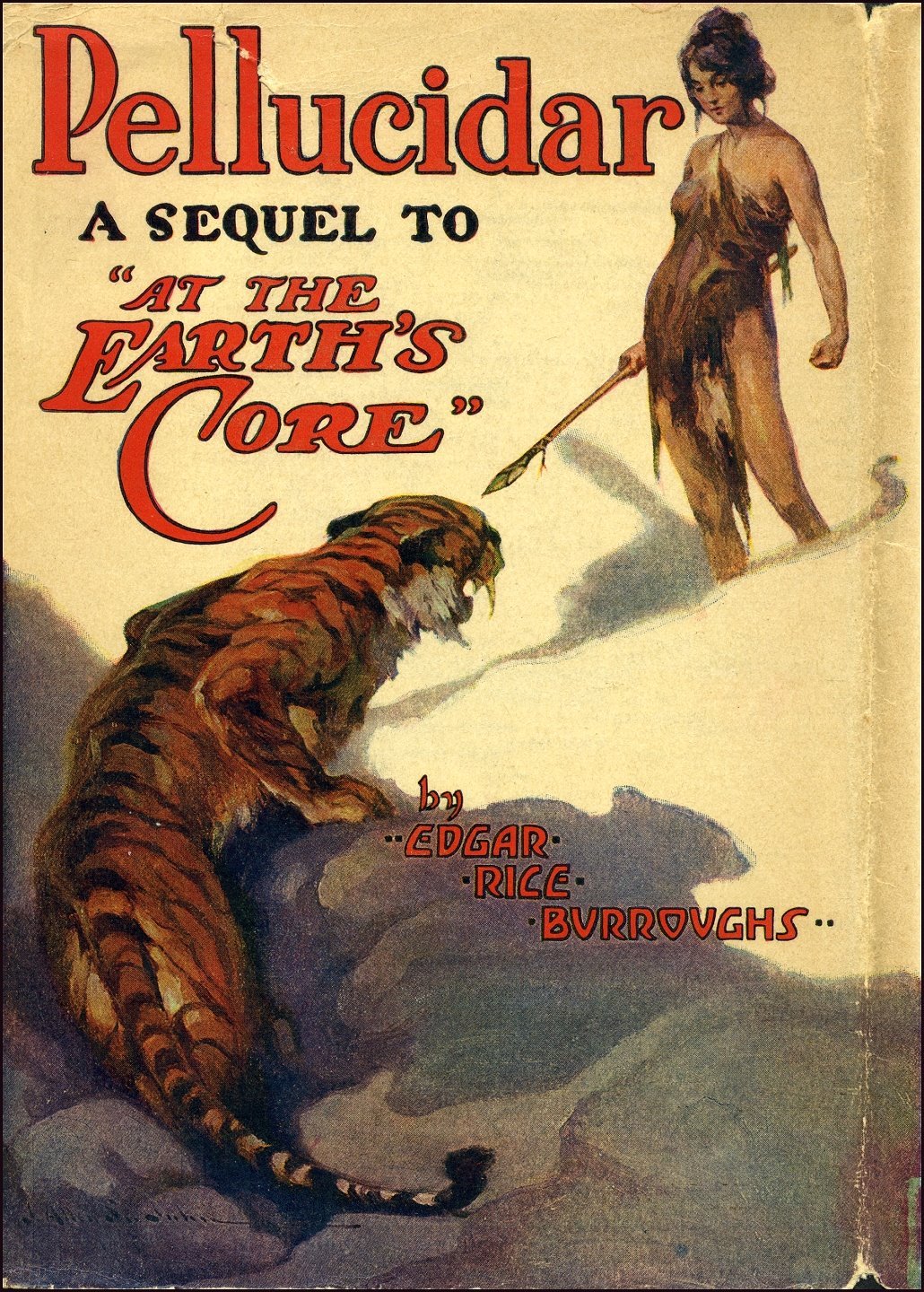
at-the-earths-core-first-edition-j-allen-st-johnOnce upon a time, I shouldered the enjoyable burden of analyzing all of Edgar Rice Burroughs’s Venus (Amtor) novels. Then, to celebrate the hundredth anniversary of the publication of A Princess of Mars, I took on the same task for the Mars (Barsoom) novels. It was inevitable that I would one day bring the same survey methods to the Pellucidar novels at the center of the earth. (Sorry, a Tarzan series just won’t happen. There are far too many Tarzan novels for the sanity of even the most hardcore ERB fan to take in concentrated doses.)

Our Saga: Beneath our feet lies a realm beyond the most vivid daydreams of the fantastic… Pellucidar. A subterranean world formed along the concave curve inside the earth’s crust, surrounding an eternally stationary sun that eliminates the concept of time. A land of savage humanoids, fierce beasts, and reptilian overlords, Pellucidar is the weird stage for adventurers from the topside layer — including a certain Lord Greystoke. The series consists of six novels, one which crosses over with the Tarzan series, plus a volume of linked novellas, published between 1914 and 1963.

Today’s Installment: At the Earth’s Core (1914)

The Backstory

Subterranean realms of the fantastic have a history reaching back to antiquity. But it was the nineteenth-century speculative theories of Captain John Cleves Symmes about the hollow earth that ignited a wave of fictional explorations of What Lies Within: “I declare the earth is hollow, and habitable within; containing a number of solid concentrick [sic] spheres.”

Read More Read More

Win a copy of The Watcher at the Door: The Early Kuttner, Volume Two, from Haffner Press!

Win a copy of The Watcher at the Door: The Early Kuttner, Volume Two, from Haffner Press!

The Watcher at the Door-smallContests! We love contests. It’s because we love to give you things, just like Santa Claus.

In this case, it’s something you really, really want: the latest archival quality hardcover from Haffner Press, The Watcher at the Door: The Early Kuttner, Volume Two, a massive collection of 30 early weird fantasy tales by Henry Kuttner. Here in the Black Gate offices we’ve been awaiting this gorgeous book for a long, long time. We first gave you a sneak peek back in April 2015.

The Watcher at the Door is the second volume in a three-volume “Early Kuttner” set collecting many of Kuttner’s earliest stories, most of which have never been reprinted. The first volume, Terror in the House, was released way back in 2010.

We have two copies of this beautiful hardcover to gave away. How do you win one? Now pay attention, this is the fun part. You must submit the title of an imaginary weird fantasy story. The most compelling titles — as selected by a crack team of Black Gate judges — will be entered into the drawing. We’ll draw two names from that list, and the two winners will receive a free copy of The Watcher at the Door, complements of Haffner Press and Black Gate magazine. Here are the titles of some of the stories in this book, to give you a little inspiration:

“We Are the Dead,” Weird Tales, Apr ’37
“The Curse of the Crocodile,” Strange Stories, Aug ’39
“Corpse Castle,” Thrilling Mystery, Nov ’39
“When New York Vanished,” Startling Stories, Mar ’40
“The Room of Souls,” Strange Stories, Jun ’40

How hard is that? One submission per person, please. Winners will be contacted by e-mail, so use a real e-mail address maybe. All submissions must be sent to john@blackgate.com, with the subject line The Watcher at the Door, or something obvious like that so I don’t randomly delete it.

Read More Read More

New Treasures: Invisible Planets, edited by Ken Liu

New Treasures: Invisible Planets, edited by Ken Liu

invisible-planets-back-small invisible-planets-small

Ken Liu’s been having a heck of a year. His English language translation of Liu Cixin’s The Three-Body Problem helped the book win the Hugo Award for Best Novel in 2015, and his first collection, The Paper Menagerie and Other Stories, appeared in hardcover from Saga Press in March. And the second volume in his new fantasy epic, The Dandelion Dynasty, arrived in October (read the first chapter right here at Black Gate).

That should be enough for anyone… but not for him, apparently. Last month Liu released his first anthology, a groundbreaking collection of SF stories from China that is getting a lot of attention. Invisible Planets is available now in hardcover. Don’t look for a review here any time soon… I didn’t mail our advance copy out to our reviewers, because I refused to part with it.

Award-winning translator and author Ken Liu presents a collection of short speculative fiction from China. Some stories have won awards (including Hao Jingfang’s Hugo-winning novella, Folding Beijing); some have been included in various ‘Year’s Best’ anthologies; some have been well reviewed by critics and readers; and some are simply Ken’s personal favorites. Many of the authors collected here (with the obvious exception of New York Times bestseller Liu Cixin’s two stories) belong to the younger generation of ‘rising stars’. In addition, three essays at the end of the book explore Chinese science fiction. Liu Cixin’s essay, The Worst of All Possible Universes and The Best of All Possible Earths, gives a historical overview of SF in China and situates his own rise to prominence as the premier Chinese author within that context. Chen Qiufan’s The Torn Generation gives the view of a younger generation of authors trying to come to terms with the tumultuous transformations around them. Finally, Xia Jia, who holds the first Ph.D. issued for the study of Chinese SF, asks What Makes Chinese Science Fiction Chinese?

Invisible Planets was published by Tor Books on November 1, 2016. It is 384 pages, priced at $24.99 in hardcover and $11.99 for the digital edition.

Truth in Historical Fiction

Truth in Historical Fiction

800px-Boys_King_Arthur_-_N._C._Wyeth_-_p38
Writerly boots on the ground in 12th century France (this illustration is a test, by the way).

Anet, Northern France, AD 1176
The summer breeze rustled the oaks where the tournament company of King Henry the Younger waited in ambush. It carried with it the sound of hooves, jingling harness and men chatting.
Sir William Marshal suppressed a grin. “Here they come, messers.” (*)

I was frankly terrified when I first put my writerly boots on the ground in 12th century France and perched on the shoulder of a 30-something William the Marshal as he lay in ambush with his lord, the bratty Henry the Younger.

In a sense, everything in my life had prepared me for this moment. I’d always been obsessed by Medieval History, spent my childhood dragging family around castles, read Malory at 11, Froissart at 12, and could recite the deeds of the Marshal when I was younger than that. I studied the subject to postgraduate level. I even have a sword scar and can teach you how to use a longsword.

Despite all this, writing that first line was terrifying.

Read More Read More

A Tale of Two Covers: Shadows and Tall Trees 7 edited by Michael Kelly

A Tale of Two Covers: Shadows and Tall Trees 7 edited by Michael Kelly

shadows-and-tall-trees-7-trade-small shadows-and-tall-trees-7-small

Michael Kelly’s Shadows and Tall Trees may be the most acclaimed original horror anthology series on the market. It’s been growing in stature and popularity every year, and anticipation is high for volume 7, due in March from Undertow Publications.

Michael had revealed the striking covers for both the trade paperback (at left) and hardcover (right) editions of the upcomnig volume at the Undertow website. About the trade edition he writes:

Very pleased to reveal the cover design for the Trade edition of Shadows & Tall Trees 7 coming March 2017. Art by Yaroslav Gerzhedovich. Design by Vince Haig. The hardcover will have a completely different cover.

And for the hardcover:

Very happy to reveal the cover for the hardback version of Shadows and Tall Trees, Vol. 7. Artwork and design is by the talented Vince Haig. Vince created that font specifically for this project. Kudos to him.

Read More Read More

Future Treasures: The Heart of What Was Lost by Tad Williams

Future Treasures: The Heart of What Was Lost by Tad Williams

the-heart-of-what-was-lost-tad-williams-smallTad Williams’ massive Memory, Sorrow, and Thorn trilogy (The Dragonbone Chair, Stone of Farewell, and the 1,100-page To Green Angel Tower) was one of the biggest fantasy series of the late 80s and early 90s. Set in the world of Osten Ard, the books were enormously influential on an entire generation of fantasy writers. Patrick Rothfuss called it “Groundbreaking… changed how people thought of the genre, and paved the way for so much modern fantasy. Including mine,” and George R. R. Martin said it “Inspired me to write my own seven-book trilogy…. It’s one of my favorite fantasy series.”

Tad Williams returns to Osten Ard for the first time in over two decades with The Heart of What Was Lost. It arrives in hardcover next month from DAW, and will be followed by The Witchwood Crown (the opening novel in a brand new series, Last King of Osten Ard) in April 4, 2017.

At the end of Memory, Sorrow, and Thorn, Ineluki the Storm King, an undead spirit of horrifying, demonic power, came within moments of stopping Time itself and obliterating humankind. He was defeated by a coalition of mortal men and women joined by his own deathless descendants, the Sithi.

In the wake of the Storm King’s fall, Ineluki’s loyal minions, the Norns, dark cousins to the Sithi, choose to flee the lands of men and retreat north to Nakkiga, their ancient citadel within the hollow heart of the mountain called Stormspike. But as the defeated Norns make their way to this last haven, the mortal Rimmersman Duke Isgrimnur leads an army in pursuit, determined to end the Norns’ attacks and defeat their ageless Queen Utuk’ku for all time.

Two southern soldiers, Porto and Endri, joined the mortal army to help achieve this ambitious goal — though as they venture farther and farther into the frozen north, braving the fierce resistance and deadly magics of the retreating Norns, they cannot help but wonder what they are doing so very far from home. Meanwhile, the Norns must now confront the prospect of extinction at the hands of Isgrimnur and his mortal army.

Read More Read More

A Neglected Master: The Best of Henry Kuttner

A Neglected Master: The Best of Henry Kuttner

the-best-of-henry-kuttner-del-rey-small the-best-of-henry-kuttner-del-rey-back-small

In Henry Kuttner’s short story “The Voice of the Lobster,” a character who is trying to escape some enemies muses to himself that he wishes he were a Cerean. In a footnote Kuttner includes the following: “The inhabitants of Ceres were long supposed to be invisible. Lately it has been discovered that Ceres has no inhabitants.” (p. 135).

Such is the typical humor of The Best of Henry Kuttner (1975), the fourth installment in Del Rey’s Classic Science Fiction Series. The previous volumes in this series all had insightful afterwords by the featured author, but Kuttner’s book does not contain one. Primarily, I take it, because Henry Kuttner (1915-1958) had already been dead for over a decade and a half by the time of publication. A shame though, given how the previous author afterwords in this series shed much light upon the subtext of their stories.

The introduction for this volume was done by the late and legendary Ray Bradbury (1920-2012). As with the previous three volumes, the cover art was by the amazing Dean Ellis (1920-2009).

Read More Read More

Why Swords & Sorcery?

Why Swords & Sorcery?

oie_521202xl2lgoypAbout twenty years ago, I bought John Clute and John Grant’s The Encylopedia of Fantasy. I wasn’t reading much standard fantasy at the time, having abandoned it for science fiction and crime stories. As I pored over the Encyclopedia’s entries, several authors I’d never read caught my attention, enough so that I went out and bought books by them. That was I how I came to read Guy Gavriel Kay’s Fionavar Tapestry and Tad Williams’ Memory, Sorrow, and Thorn trilogy. While I liked parts of them, they struck me as long-winded and overwrought for much of their length. I also realized I was done with stories of willowy elfs, doughty dwarfs, and emo heroes — the seemingly standard players in most of what I was reading. If that was the current state of fantasy, I was all right without it.

I was drawn back to the genre a few years later, though, when I became aware of Night Shade Books publishing hardcover omnibuses of Karl Edward Wagner’s Kane stories and novels. As a monster fan of Wagner, I jumped at the chance to replace my battered paperbacks. As soon as I got them I found myself compelled to read them. I hadn’t read Wagner’s fantasy in several years, and had almost forgotten how visceral a punch it packs (click for my reviews of Death Angel’s Shadow and Night Winds). His stories grabbed me and shook me in a way none of the writers like Kay or Williams had. Battle scenes in epic novels seemed bloated in the light of Wagner’s taut action sequences. The Kane stories were both darker and more vivid than most of the epics I had read. And whatever else about the character of Kane, he never mopes or whines, as I found too many modern epic heroes prone to doing.

When I finished rereading all the Kane stories, I practically ran to my shelves looking for anything else that might affect me the same way. The obvious choices were Robert E. Howard and Michael Moorcock. I had read both authors’ works several times previously, but not for nearly twenty years in both cases.

Howard met my needs, Moorcock less so. Howard remained the ur-swords & sorcery writer, a teller of ripping yarns of the first caliber. This time around Moorcock struck me as too intent on holding the material at a distance, as if part of him was slumming, or maybe just putting on a show to make some shopworn points about heroism, politics, and religion.

Read More Read More

New Treasures: The Hidden People by Alison Littlewood

New Treasures: The Hidden People by Alison Littlewood

the-hidden-people-alison-littlewood-smallI admit the recent mini-boom in “pioneer fantasy,” which drops readers into a world of dark superstition, has a lot of appeal to me. Much of it is set on the American pioneer, but not exclusively.

The latest entrant is Alison’s Littlewood’s (A Cold Season, The Unquiet House) newest fantasy The Hidden People, which is set in rural Britain in the 1850s, and which Booklist calls “The perfect book to curl up with on a chilly fall day… will make the hairs on the back of your neck stand up.”

In 1851, within the grand glass arches of London’s Crystal Palace, Albie Mirralls meets his cousin Lizzie for the first — and, as it turns out, last — time. His cousin is from a backward rural village, and Albie expects she will be a simple country girl, but instead he is struck by her inner beauty and by her lovely singing voice, which is beautiful beyond all reckoning. When next he hears of her, many years later, it is to hear news of her death at the hands of her husband, the village shoemaker.

Unable to countenance the rumors that surround his younger cousin’s murder–apparently, her husband thought she had been replaced by one of the “fair folk” and so burned her alive — Albie becomes obsessed with bringing his young cousin’s murderer to justice. With his father’s blessing, as well as that of his young wife, Albie heads to the village of Halfoak to investigate his cousin’s murder. When he arrives, he finds a community in the grip of superstition, nearly every member of which believes Lizzie’s husband acted with the best of intentions and in the service of the village.

There, Albie begins to look into Lizzie’s death and to search for her murderous husband, who has disappeared. But in a village where the rationalism and rule of science of the Industrial Revolution seem to have found little purchase, the answers to the question of what happened to Lizzie and why prove elusive. And the more he learns, the less sure he is that there aren’t mysterious powers at work.

The Hidden People was published by Jo Fletcher Books on November 1, 2016. It is 368 pages, priced at $26.99 in hardcover and $12.99 for the digital edition.