Text & Countertext
One of the best books I’ve read about writing (and, full disclosure, I don’t read many) is Samuel Delany’s About Writing: Seven Essays, Four Letters & Five Interviews (Wesleyan). When I say “best,” I don’t mean I was nodding my head the whole way through going, “Right! Exactly!” Although in many places I was. Overall, I was in constant dialogue, sometimes offering additional examples or counterexamples, sometimes arguing vociferously, sometimes muttering, “WTF are you talking about?” Almost every page was good for a long train of thought.
The subject of one chapter is illustrated by its title, “After No Time at All the String on Which He Had Been Pulling and Pulling Came Apart into Two Separate Pieces So Quickly He Hardly Realized It Had Snapped….” Writing, Delany argues, has at least two technical levels. The sentences of a story describe a progression of events and occurrences, and this is what he calls the “text.” These sentences, though, are simultaneously “gesturing, miming, and generally carrying on about a supportive countertext that gives the story we’re reading all its resonance, highlighting, and intensity.” …
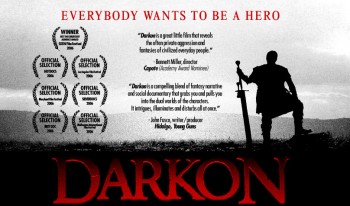 As a follow-up to
 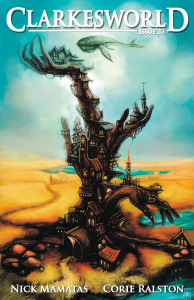 Issue 33 of Clarkesworld Magazine features a
  I’m looking forward to China Miéville’s new novel, The City and the City. In the meantime, here’s an
  I’ve only ever heard the terms ‘escapism’ and ‘escapist’ used as pejoratives and, quite often, used to describe things that I enjoy. We all know what these terms mean, and especially what they are implicitly communicating: the notion that escapist entertainment is a crutch, a way of running away from reality. But also, and I think that this is more important, that it has no redeeming value as art or as educational material.

 Risus: The Anything RPG