Browsed by
Author: Matthew David Surridge

Into the Weird: Weird Tales, April 1923 (Volume 1, Number 2) Part 1
Into the Weird: Weird Tales, April 1923 (Volume 1, Number 2) Part 1

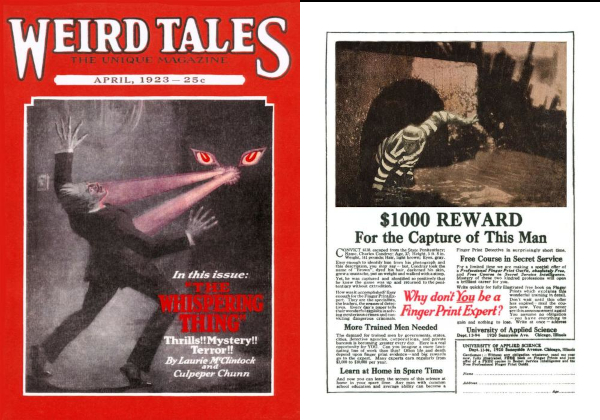
Weird Tales, April 1923, front and back covers

The second issue of Weird Tales, on sale from March of 1923 through to April, looked much like the first: a pulp magazine roughly 6 and a half inches by 9 and a half, with 192 pages. The April issue was .75 of an inch shorter and half an inch narrower. The black-white-and-red cover was more striking than the previous issue’s, with the main image contained in a thick red frame, and the date and price more easily visible under the title. There was a new and smoother-looking logo. Unlike the first issue, this cover didn’t share a format with that month’s issue of Weird Tales’ older sister publication Detective Tales. Although to phrase it that way may be misleading; John Locke, in The Thing’s Incredible! The Secret Origins of Weird Tales, argues that what is referred to as the April/May 1923 issue of Detective Tales was actually an issue that came out in May which the publisher retroactively dated as a bimonthly issue, and if that’s so then there was no Detective Tales issue in April for the second issue of Weird Tales to parallel.

Either way, the cover’s about all you might hope for from a magazine called Weird Tales. Mysterious gigantic eyes stare out of darkness, while from just below them pink rays shoot out to strike a man who screams and throws out his hands. It’s not terribly sophisticated — background details are nonexistent or lost in the ink wash, and you can’t help but wonder if the mysterious creature in shadows is firing rays from its nostrils. But it is an image that tells you things supernatural and horrific lurk within these pages.

This post will take a look at the physical and editorial package of the second issue of Weird Tales, with an eye to tracking the magazine’s evolution. It’ll run long, because I’ve included numerous extracts from pulp magazine editorials — mostly for the sake of making an argument about how Weird Tales was positioning itself in its marketplace, but partly, I have to admit, for historical interest and potential amusement value.

Read More Read More

Into the Weird: Weird Times 2 — Cars, Roads, and Travel

Into the Weird: Weird Times 2 — Cars, Roads, and Travel

A 1923 Ford Model T

This post is the second in a series reflecting on the world of 1923 as a background to early issues of Weird Tales. Imagine that you’re an American in February of 1923, and you’re taking a walk to the newsstand to buy the first issue of a new pulp fiction magazine. What sort of things will you see?

Probably the first thing you’ll notice as you set out into the street is the street itself, and its contents. The motor car has begun to change urban life. Since Ford introduced the Model T fifteen years ago the price has steadily dropped; there were almost 11 million registered passenger automobiles in the United States by the end of 1922, and will be just shy of 13.5 million by the end of 1923. Cars are registered, incidentally, and license plates have been required since 1918, but most states do not issue driver’s licenses; half the states will require licenses by 1930, and as late as 1935 only 39 states will mandate licenses and not many of those will require passing a test. In 1923 Model Ts are still the most common make of car, though competing models are about to cut into its sales. Famously, you can get a Model T in any colour, so long as it’s black; Ford used to offer a range of colours, but in 1914 streamlined production by cutting back to a particular type of black paint that was cheap and fast-drying. Model Ts do not at this time have shock absorbers, windshield wipers, rear view mirrors, bumpers, or an instrument panel for a speedometer (not a standard feature) or gas gauge.

Read More Read More

Into the Weird: Weird Tales, March 1923 (Volume 1, Number 1) Part 2

Into the Weird: Weird Tales, March 1923 (Volume 1, Number 1) Part 2

Weird Tales volume 1 number 1 boasts 26 separate pieces of fiction, one of which is continued in the next issue. As you’d expect from an anthology, some stories are better than others. None reach the heights of the fiction the magazine would publish later. But a few are at least interesting in their own right.

I’m going to look here at each story, which means this post is going to run long. After I’m done going piece-by-piece, I’ll write about the collective effect of the issue, and how it reads as a whole. But there are over 100,000 words of fiction to discuss before I get there.

Three of the longest pieces lead off the issue. The second story is the cover feature, and the third story’s the first part of the serial. The opener, though, is “The Dead Man’s Tale,” by Willard E. Hawkins. So the first story of the first issue of Weird Tales lets us know right in its title to expect the unexpected: here dead men do tell tales.

Read More Read More

Into the Weird: Weird Times 1 — Architecture and Housing

Into the Weird: Weird Times 1 — Architecture and Housing

The first issue of Weird Tales went on sale in late February of 1923. It was cover-dated March, but that was a sell-by date. The issue would have arrived in stores on or about February 18, roughly a week before the first issue of Time magazine. In writing about early Weird Tales, I found it useful to think about that kind of context, and to look into that moment in history.

Partly that was because some aspect of a story would occasionally become clear once I understood specific terms or references or background. Mostly, though, I found an immersion in the time helped themes become clearer and habits of thought more obvious. In the hope that exercise might be useful for anyone else reading early Weird Tales or other fiction of the 1920s, I’ll be putting up a series of posts looking at different aspects of the era, reflecting on things I’ve learned or think I’ve learned. I hope these posts will also be useful as references I can link to in my reviews, rather than having to take the time to explain some 1920s-specific detail in a story.

Read More Read More

Into the Weird: Weird Tales, March 1923 (Volume 1, Number 1) Part 1

Into the Weird: Weird Tales, March 1923 (Volume 1, Number 1) Part 1

Weird Tales March 1923. Cover by R. R. Epperly

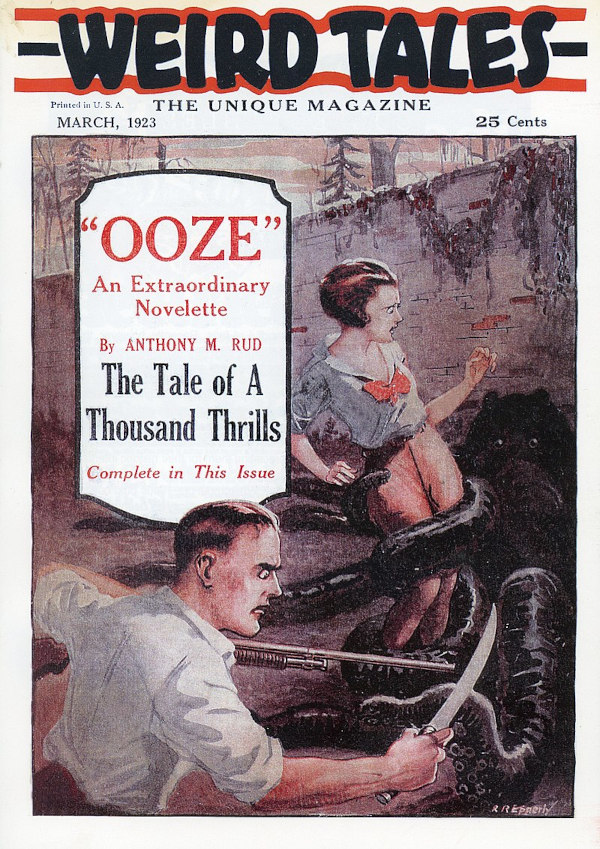
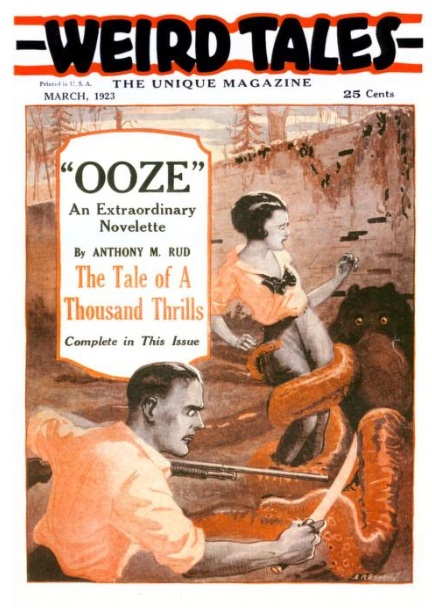
The first issue of Weird Tales landed on newsstands in late February of 1923. 192 pages long, it measured about 6 inches by 9, a standard size for a pulp fiction magazine. There were two different versions of the cover, perhaps due to a printing error; the illustration’s the same, a man with knife and gun fighting a shadowy tentacled monster which has grabbed a nearby young lady, but the colouring’s different. Either way, the cover advertised “‘OOZE’ / An Extraordinary / Novelette / by Anthony M. Rud / The Tale of A / Thousand Thrills.” Perhaps most intriguing, though, was the subhead below the logo: “The Unique Magazine.”

Thanks to modern technology it’s possible for anyone with an internet connection to flip through issue 1 of Weird Tales, if in a virtual format. In a later post I’ll write about the fiction the issue holds, but today I want to consider the magazine as an object (to the extent that’s possible working from a PDF). What do we see as we page through it? What signs of its times stand out? And what can be deduced about the editorial team’s vision?

Read More Read More

Into the Weird: An Introduction

Into the Weird: An Introduction


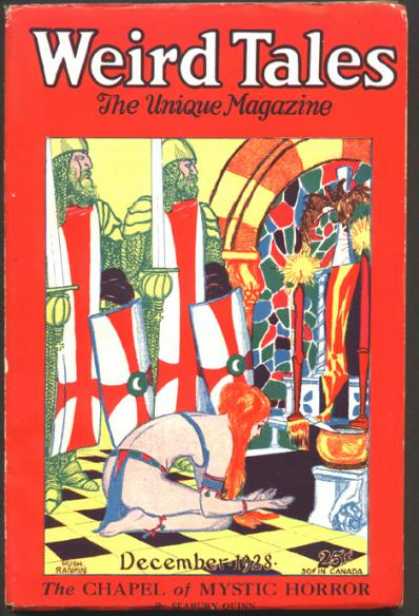
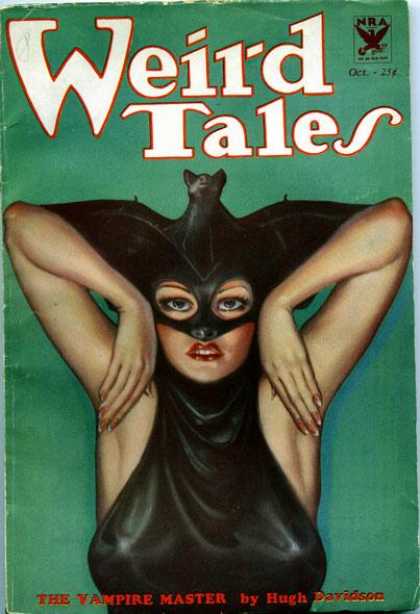
Weird Tales
, December 1928, October 1933, and July 1944. Cover
art by Hugh Rankin, Margaret Brundage, and A. R. Tilburne

A bit more than 103 years ago, the first issue of Weird Tales reached newsstands across North America. The magazine would be published consistently for over three decades, with the title revived sporadically ever since. The original Weird Tales would become a significant influence on the development of the fantasy and horror genres, and would lend its name to a subgenre of fantasy and a certain tone in fiction: the weird tale.

That entire first run of Weird Tales, ‘the unique magazine,’ is available at the Internet Archive. I thought it’d be an interesting project to look at it issue by issue, reading the magazine as it was published and discussing each issue as a whole. It was the venue for much of the fiction of H.P. Lovecraft and Clark Ashton Smith and Robert E. Howard, as well as a home for work by Robert Bloch, C.L. Moore, and Ray Bradbury, among many others. I wondered what it would be like to read those stories in the context of the other tales in the magazine by lesser-known writers; and to consider each issue as a package, a collection, with its cover and editorials and letters. And its ads; to look at the magazine holistically is to consider the many irruptions of its era into the experience of the fiction.

Read More Read More

Fantasia 2021, Part LXXII: Final Thoughts

Fantasia 2021, Part LXXII: Final Thoughts

I saw more movies at Fantasia 2021 than at any previous iteration of the festival. By my count, I watched 96 short films from 25 countries and 69 features from 19 countries, with a total of 32 different countries represented in my viewing this year. The quality was there, too. I don’t have any metric to track these things, but it felt like both the number of exceptional films and the overall quality of the movies in 2021 was higher than in the past.

Before going on with a look back at this year’s Fantasia experience, I want to thank, as every year, Fantasia’s organisers and programmers and volunteers, and generally everyone involved with the festival. It is always in many ways the highlight of my year. I also want to thank John O’Neill for hosting these reviews here, and for keeping Black Gate up and running. And I want to thank everyone who takes the time to read and comment. Fatigue issues have tended to keep me from replying here as much as I’d like, but every comment is noted and valued.

The Fantasia experience this year was similar to last year’s; there was just more of it. There was a notable improvement in the way scheduled movies played — last year you had to start watching within five or ten minutes of the scheduled start time, while this year the films were available for a three-hour window beginning at a given time. That made things a lot easier, and the fact that almost all of them were also available for 24 hours two days after their first showing helped a lot as well.

Read More Read More

Fantasia 2021, Part LXXI: Woodlands Dark And Days Bewitched: A History Of Folk Horror

Fantasia 2021, Part LXXI: Woodlands Dark And Days Bewitched: A History Of Folk Horror

When I first saw the schedule for Fantasia 2021, none of the films playing the final night of the festival struck me as something I wanted to review here. I therefore decided I’d pick one of the movies available on-demand throughout Fantasia as my personal closing film. Which then raised the question of which of those movies felt like enough of an event to mark the end of a three-week revel in the weirdness of genre cinema. And the answer to this question was clear at once. My big finish for Fantasia 2021 would be the three-hour-plus documentary Woodlands Dark and Days Bewitched: A History of Folk Horror.

Right beforehand I watched the short bundled with it. “Saudade” is a 20-minute film from Singapore written and directed by Russell Morton, presenting stories and rituals of the Kristang people, a community of mixed Eurasian ancestry that arose in the area of Malacca four or five hundred years ago. The film, in the Kristang language, is structured around three sequences. The first is a folk dance, the second’s a conversation between a fisherman and his wife about stories and the shrimp that have vanished from the seas, and the third is a meeting with a mythic entity called the Oily Man — a human who sold his soul to the Devil. The film’s very concerned with ghosts and the survival of stories; the title’s a Portuguese word that refers to a kind of melancholic nostalgia for a desired thing that will not come again, and there seems a connection there with the film’s interest in history and culture. The movie’s photographed well, with a colourful shot at the end reminiscent of a dance of death, and it’s evocative, though the connections are elliptical to me. That may be deliberate, as I’m not sure whether the movie’s meant to present the Kristang culture to others, to speak to the Kristang people, or to record some pieces of Kristang culture. Or all of the foregoing. Either way, there’s a tone of longing and distance here that, so far as I can tell, bears out the promise of the title.

Woodlands Dark and Days Bewitched: A History of Folk Horror is directed by Kier-la Janisse, the founder of The Miskatonic Institute of Horror Studies. Janisse has written several books on horror, and her micropress Spectacular Optical has published several more (including Lost Girls: The Phantasmagorical Cinema of Jean Rollin). Woodlands Dark is her first feature, and it has more than 50 interviewees discussing folk horror films from around the world. It’s coming on blu-ray from Severin Films on December 7, available on its own or as part of a 15-disc collection called ‘All the Haunts Be Ours’ which includes 20 of the movies mentioned in the documentary.

Read More Read More

Fantasia 2021, Part LXX: The Unknown Man of Shandigor

Fantasia 2021, Part LXX: The Unknown Man of Shandigor

In the waning hours of the 2021 Fantasia Film Festival I sat down to watch The Unknown Man of Shandigor (L’inconnu de Shandigor), a 1967 Swiss spy film directed by Jean-Louis Roy, who collaborated on the script with Gabriel Arout and Pierre Koralnik. The film’s got a new 4K restoration by the Cinematheque Suisse; I’d never heard of the movie, but the description was intriguing, a black-and-white mod odyssey through the weirdness of the 1960s, with nods to Dr. Strangelove and Alphaville, and including Serge Gainsbourg as the leader of a group of bald turtleneck-clad assassins. Was this a lost classic, or an eccentric curiosity? Or both?

The plot of the film concerns one Doctor Von Krantz (Daniel Emilfork, who would go on to feature in The City of Lost Children), an admirer of Dracula prone to observations such as: “I don’t like humanity. Or, I do, but in a jar of arsenic.” The good doctor has invented the Canceler (or Annulator), which can nullify a nuclear explosion. As this is the height of the Cold War, his fortified home has now become the target for spies from multiple different nations. American agent Bobby Gun (Howard Vernon) races with the dastardly Russian Shostakovich (Jacques Dufilho) to get their hands on the device — but the key may lie with Von Krantz’s young and idealistic daughter Sylvaine (Marie-France Boyer), who dreams of a man she once knew (Ben Carruthers), a mysterious man in the city of Shandigor.

Read More Read More

Fantasia 2021, Part LXIX: Dear Hacker

Fantasia 2021, Part LXIX: Dear Hacker

I wrote a little while ago about watching three documentary films bundled together at the 2021 Fantasia Film Festival, centred around the short feature You Can’t Kill Meme. There was another set of three documentaries at Fantasia this year, and as the festival drew to a close, I sat down to watch them as well. These two shorts and the short feature Dear Hacker were a bit more diverse in subject matter, but shared themes of technology and power.

First was writer-director Aleix Pitarch’s “Orders,” a disturbing animated short based on a true story. The movie re-creates a horrific phone call that was made to a fast-food restaurant by a man claiming to be a police officer, using actors and an edited transcript of the call (I am not sure where the transcript is supposed to have come from, but the events are clearly based on a deeply disturbing reality). Without going into detail, the story’s a dark working-out of something like Stanley Milgram’s experiments about authority and what ordinary people can be ordered to do. As we hear bits of the phone call, and hear things getting worse and worse, we see everyday images of the day’s work at a fast-food restaurant.

Read More Read More