The Real Superheroes of the Comics
If I say “comic book superhero” who do you think of? Superman? Iron Man? Batman? Wonder Woman? Spider-Man? Captain Marvel? (The real one please, and don’t give me any of this “Shazam” crap.) Those and many others are all perfectly legitimate choices, of course, only they’re not really heroes — super or otherwise — are they? They’re adolescent daydreams, and no matter how dark or gritty they have gotten in the years since their shiny Golden or Silver Age peaks, they’re still characters with “secret identities” running around in silly costumes doing things that no actual person could ever do — or probably would even want to. (In the words of the immortal Will Eisner, “I never understood why the hell anyone would run around fighting crime.”)
That’s not a knock on the members of the Justice League or the Avengers, and when I was a kid, I loved superhero comics; in fact, I still do, but then I love all kinds of comic books — science fiction, humor, horror, romance (Patsy Walker, anyone?) — back in the day, I read them all.
One of my favorite genres was war. Now, with all due apologies to Sergeant Fury and his Howling Commandoes, I was a DC guy, which meant that during my Silver and Bronze Age heyday, I was reading stories that were somewhat more realistic than what Marvel was offering at that time, even taking the Haunted Tank and Dinosaur Island into account. (“Comic book realism” is a tricky term, as we all know.)
In the pages of my favorite war title, Our Army at War, Sergeant Rock and the dogfaces of Easy Company (you remember these guys — Bulldozer, Ice Cream Soldier, Little Sure Shot, Wildman, Jackie Johnson and the rest) battled a grittier, more grounded Wehrmacht than was usually found in the pages of Marvel magazines, and while some boys may have had pin-ups of Farrah or Lynda Carter hidden under their beds (or even right up on their walls, but they didn’t have my mom), I was salivating over double-page spreads of Russ Heath’s gorgeous drawings of German tanks, planes, and machine-guns.
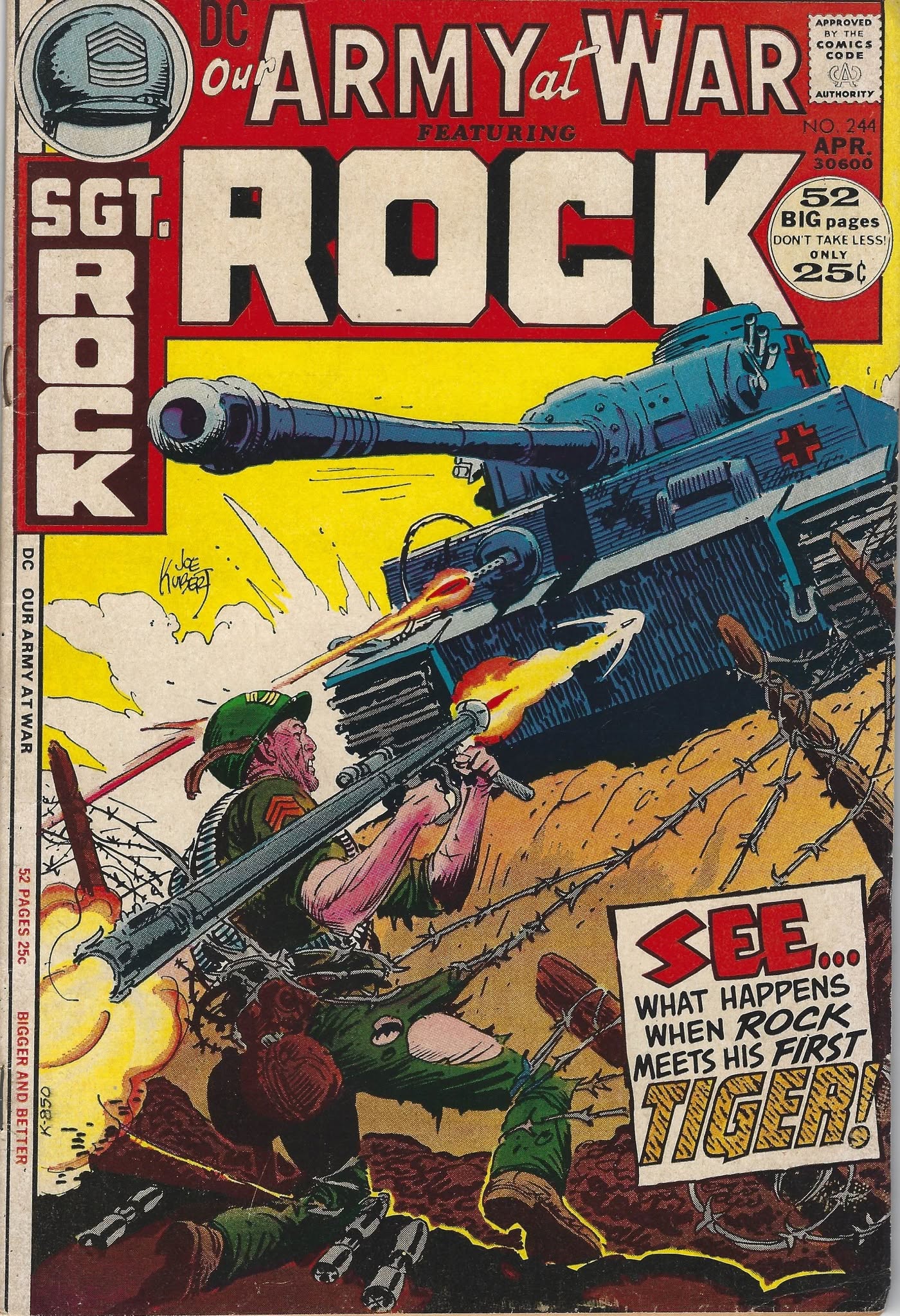
One of the issues I remember most fondly was Our Army at War #244, April 1972. It was one of my most read and reread single comic books, with its awesome Sergeant Rock story — “Easy’s First Tiger.” I mean, c’mon!
It’s a great story, drawn with Heath’s usual obsessive attention to detail (he wrote it, too) but what has stuck with me most is a little four-page piece at the back of the book, part of a series that often appeared at the tail end of DC’s Bronze Age war comics. You might think that they were there because the editor just needed a little filler, but I think these particular stories were serving a very different purpose.
After letting us read about a haunted Stuart tank that could best German Panthers with the help of an ectoplasmic Jeb Stuart (a 37 mm gun and 51 mm armor ain’t beating a 75 mm gun and 150 mm armor, ghost or no ghost; I may have been a kid, but I wasn’t stupid) or cheer as Easy Co. suckers the “Krauts” out of their tanks by climbing on top and banging on the hatches (“Vas ist?” the German commander would say as he poked his nose — and a luger — out of the hatch, prior to our guys tossing in a grenade; why would anyone fall for that, I wondered), I think the grownups at DC decided to set aside four pages to show us kids what war was really like, and they had just the man for the job — Sam Glanzman.
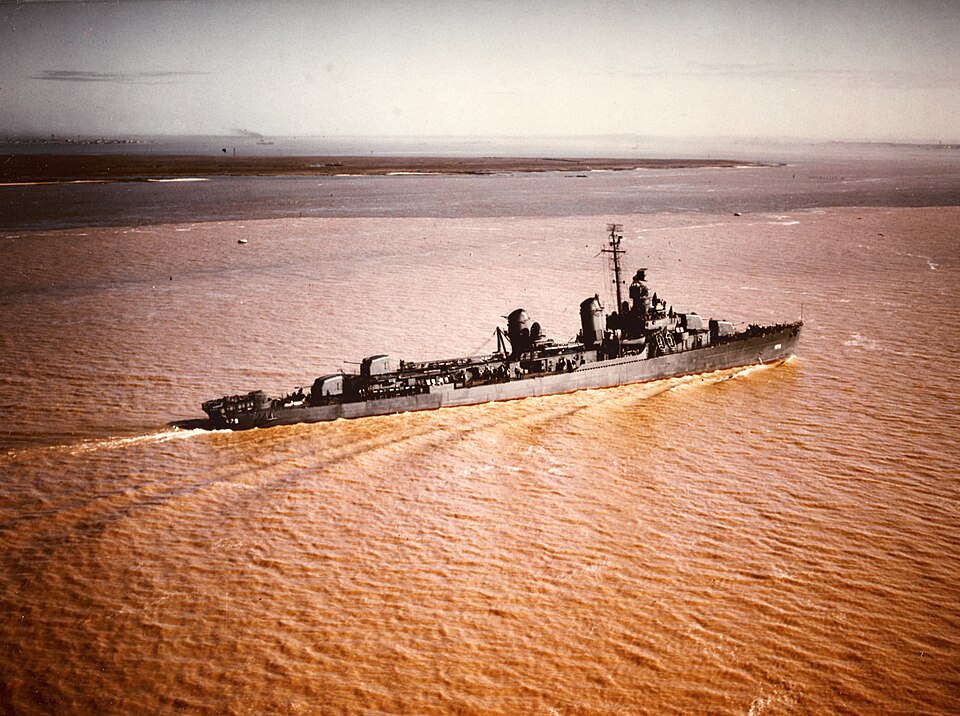
Sam Glanzman worked in the comic book industry for fifty years, from the late 30’s to the late 90’s (he died in 2017 at the age of ninety-two), doing stories in all genres for Charlton, Marvel, Dell, DC and other publishers. Beginning in the early 40’s he took a temporary vacation from comic book work, because of a little thing called World War Two. As a member of the U.S. Navy, Glanzman served on the Fletcher-class destroyer USS Stevens. From 1943 until the end of the war, the Stevens participated in the great naval campaigns in the Central and South Pacific that tightened the noose around the Empire of Japan. Tarawa, Kwajalein, Tulagi, Rabaul, Hollandia, Guam, the Philippines — the Stevens saw them all, and so did the twenty-year old Sam Glanzman. During that time, the ship and her crew ferried troops, conducted bombardments, battled submarines, and carried out escort and minesweeping missions, did virtually everything that a warship can do, in fact.
Naturally enough, when Sam Glanzman returned to civilian life in 1946, he was not the same man who went to war, and when he returned to comics in the late 50’s (he had stayed away because the pay was so bad, working instead as a manual laborer) he began to gravitate toward war titles, and his most highly regarded war stories are the four-page USS Stevens tales that he did for DC throughout the 70’s.
After reading the two-fisted, action-packed cover story (in which Sergeant Rock never got more than a flesh wound and the Unknown Soldier always outwitted Nazis who were more dull-witted than they probably were in real life), you would get to the back of Our Army at War, G.I. Combat, Our Fighting Forces, or Star Spangled War Stories and there find a four-page USS Stevens story that simply told you the truth. I have no idea how Glanzman got away with it.
The story that follows “Easy’s First Tiger,” “What Do They Know about War?” is one of his best. Waiting at an island to join a convoy, the Stevens is approached by a native family in a small dugout canoe. As the father tries to trade with the sailors, one of the crew crudely propositions the man’s teenage daughter. She rebukes him, more in hopeless exhaustion than anger, contrasting his full stomach with their hunger and poverty. As the family paddles away from the shamed sailors, the father, a helpless victim of the conflict who will get no glory or medals, bitterly exclaims, “Warriors! What do they know… about war?”
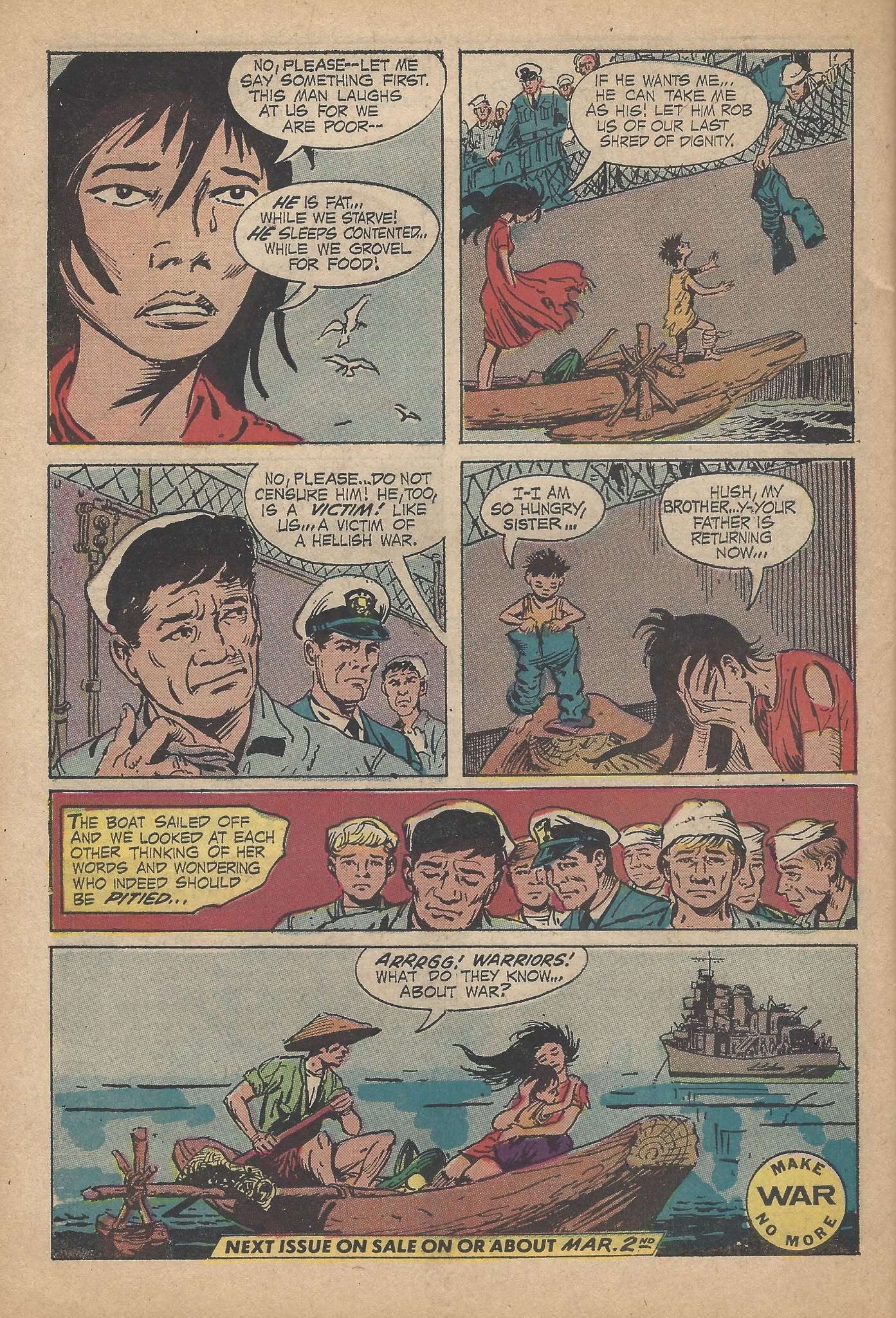
No shooting, no heroics (quite the opposite, in fact), just four pages (a mere eighteen panels!) of reality, a cold shower for all the action-loving, fantasy-devouring adolescents out there, including this one. Never were my twenty-five cents better spent.
Glanzman always comes through with insight and compassion. In “Accident,” a USS Stevens story from Our Army at War #259, August 1973, a peaceful Chinese junk is misidentified as an enemy vessel and instantly blown to fragments by a naval barrage, and all the fishermen aboard are killed. In Glanzman’s words, innocent lives were destroyed “by accident! The sort of accident that occurs in all wars… to all sides! A senseless act… within a senseless act!”
In “The Sea Is Calm… the Sky Is Bright…” from Our Army at War #257, June 1973, a young off-duty sailor sits down to write a letter to his mother. Faced with the question, “What can I write about?” he thinks back to the events of the day before — a kamikaze obliterating a nearby ship, a gun crew shredded by the machine gun bullets of an attacking plane, the flag-draped bodies of young men dropped into the indifferent ocean, his own helpless, fear-stricken prayers to be spared the sudden, violent death that has capriciously taken so many others… and then, having remembered all this and knowing that these experiences cannot be communicated to those waiting back home, he writes, “Dear Mom; I’m fine. The sea is calm… the sky is bright…”
In Glanzman’s war, paradox and absurdity are never far away. In “King of the Hill”, which appeared in Star Spangled War Stories #174, October 1973, a work detail is sent from the Stevens to an island to bring some crates of supplies onto the ship. While there, they discover that an ape from the nearby jungle is lurking among the piles of boxes, and one of the marines stationed on the island, thinking to have some fun, begins clowning around with the animal, provoking gales of laughter from the onlookers… and then a burst of savage rage from the ape, who kills the marine before anyone can intervene. “The small knot of men were shocked beyond belief… a fun-loving, foolish marine who had survived the real horrors of Guadalcanal did not survive a make-believe-game of king of the hill!”
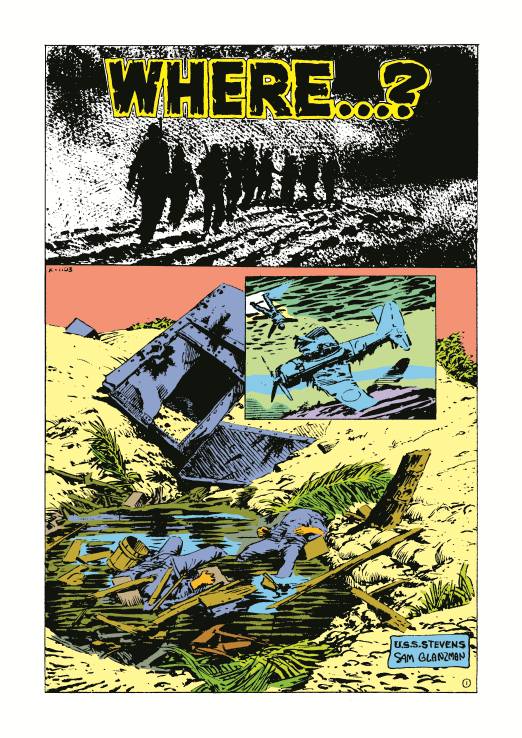
Sometimes Glanzman abandons words altogether, as he does in “Where…?” published in Our Army at War #262, November 1973. It is simply four pages of death: soldiers, civilians, in Europe, in Asia, on land, at sea, faceless, silent and still, the ultimate products of the industry of war.
There is combat in these stories, and it is depicted with an almost hallucinatory intensity, but in most of them Glanzman’s characters are doing what sailors, soldiers, airmen and marines are always doing — gambling, joking, loafing, drinking, arguing, telling lies, performing their common, boring tasks (or finding ways to evade those common, boring tasks — we called it shamming when I was in the Army), finding any way they can to escape from the routine, to break the monotony, even for a minute. Mostly the stories are about how a group of men who are essentially imprisoned together find ways to do their intermittently dangerous but more commonly dull and stultifying job without going nuts. (The work that most reminds me of the Stevens stories is also set on a ship in the Pacific during World War Two, Thomas Heggen’s once-famous novel Mister Roberts. Like many of the Stevens stories, Heggen’s book is largely about the personal dynamics of a diverse and volatile group of men who have been thrown together more or less at random and have to find a way to live together.)
The superheroes of my youth have long since escaped from the pages where I first encountered them and have gone on to conquer the entire culture. Every summer we’re offered a new slate of hundred-million-dollar movies about people in spandex battling outlandish intergalactic menaces, and the original comic book stories that introduced these characters are getting reprinted in deluxe editions with introductions by movers and shakers, Pulitzer-winning novelists and PHD’s.
I think that’s great, especially because it means that the people who toiled for years creating and writing and drawing are finally getting some recognition (and even some remuneration — those who are still alive). But comics have always been more than just superheroes and these “little” stories of Sam Glanzman’s are some of the greatest achievements of the Bronze Age, and he was one of the era’s finest creators. In our era of bloated story arcs that run for months over multiple titles (and that vanish from the memory without a trace as soon as you’ve finished them), what Sam Glanzman could do with four pages is a lesson to everyone who wants to make memorable statements about the things that really matter.
In 1987 Marvel published Glanzman’s A Sailor’s Story as one of its Marvel Graphic Novel series. (A neglected group of books, by the way, much in need of rediscovery.) It presents his experiences in the Navy in a more unified narrative than was possible with the USS Stevens four pagers that he did for DC. Like all of Glanzman’s war work, it’s terrific and deserves to be remembered and celebrated, not forgotten.
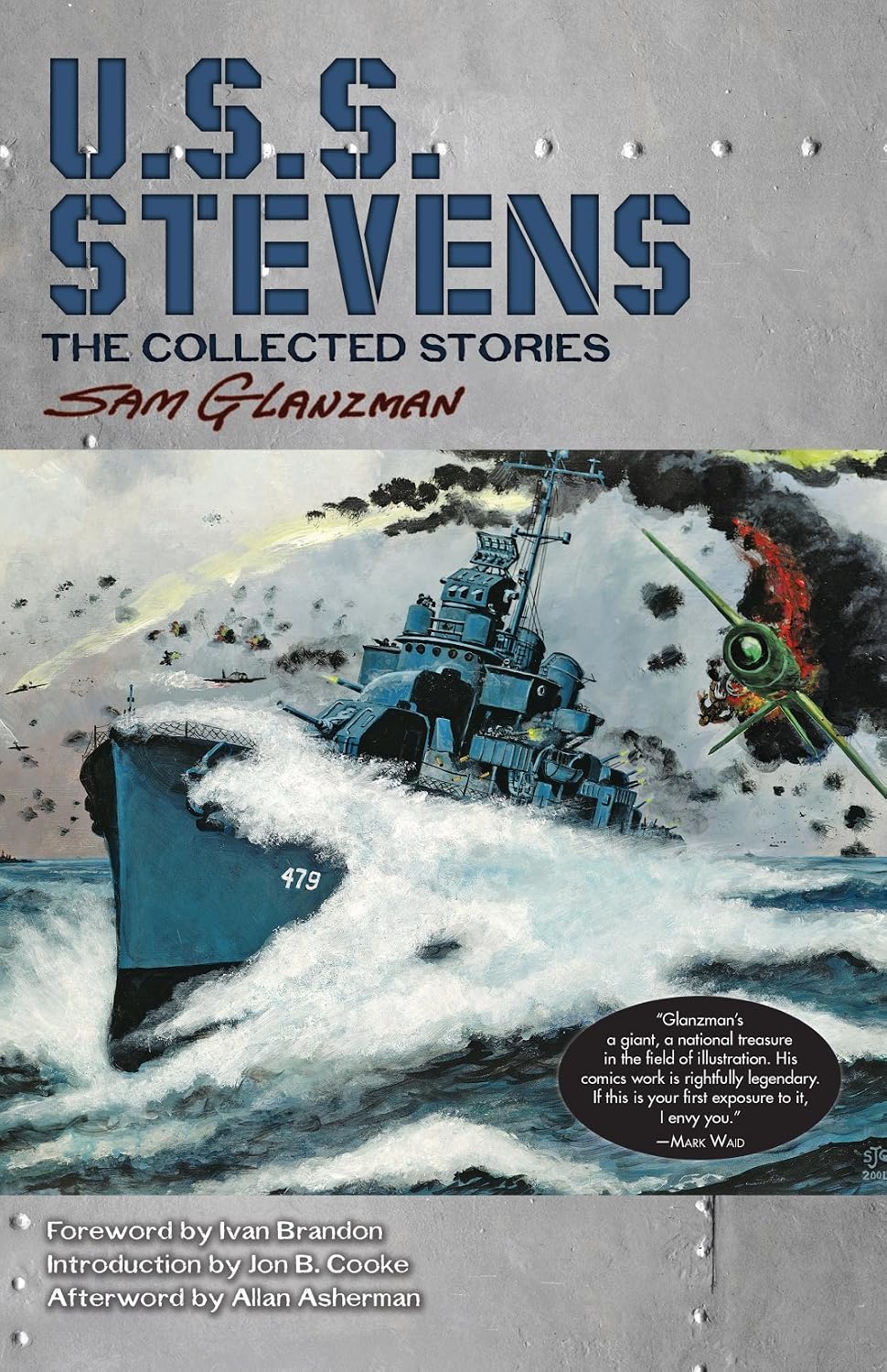
Even better, in 2016, just before his death, Dover gathered all of the USS Stevens stories (more than sixty of them) that Sam Glanzman had done forty years before and published them in one three hundred-eighty-four-page volume, U.S.S. Stevens: The Collected Stories. It’s not just an essential book for anyone interested in comics; it is, without qualification, one of the great books about World War Two.
We know that Thor and the Flash and Black Widow and Doctor Strange aren’t really heroes; they’re not really anything. They’re not real. The real heroes are the young men who left their lives behind (left their factories, farms, offices and shops) when their country needed them, all those years ago. Sam Glanzman did honor to them through the medium he knew and loved, as he took up his pen after the war was over and let a generation of naïve, impressionable young readers get a taste of how it really was.
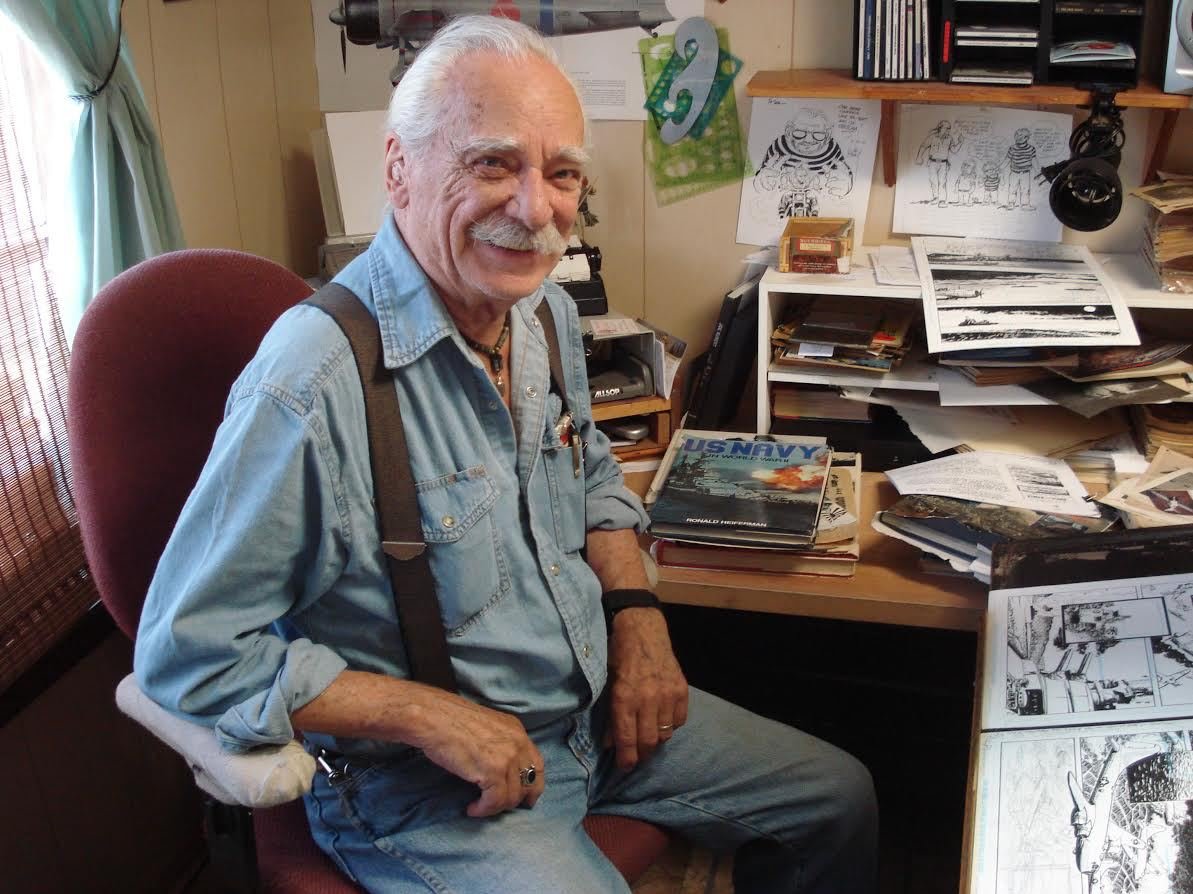
Some men didn’t leave ordinary clerical or agricultural or manufacturing jobs when the call came — some men left their drawing boards, men like Jack Kirby and Nick Cardy and Dick Ayers and Will Eisner… and Sam Glanzman.
They are the real superheroes of the comics.
Thomas Parker is a native Southern Californian and a lifelong science fiction, fantasy, and mystery fan. When not corrupting the next generation as a fourth grade teacher, he collects Roger Corman movies, Silver Age comic books, Ace doubles, and despairing looks from his wife. His last article for us was The Limits of Vision: Arthur C. Clarke’s Imperial Earth
A lot of comic creators had been in war. Jack Kirby was in the infantry and saw combat. Bob Haney, known as zany Haney for the weirdness of his plots, was on a ship at the Battle of Okinawa. Horror comic writer Jack Oleck was in the infantry during WWII and that influenced his long run on Weird War stories. Later, Mike Grell was in ‘Nam (though as a clerk who I am pretty sure wasn’t in shoot outs.) This is what they have in common with SF/Fantasy writers who also produce a lot of combat vets. (Tolkien, Kornbluth, Wolfe, Drake, Haldeman.)
War comics is a really undervalued genre. I’ve read a lot from the seventies and eighties. While a lot of these were over the top action stories some really dealt with the tragedy of war. In the 70s they were usually better written than the superhero titles. (As were the War and Western ones.)
I know I gave the back of my hand to Sergeant Fury and his Howling Commandoes, but Marvel produced an outstanding war title in The ‘Nam, during the late 80’s. Issues are well worth seeking out. (I don’t know if any trade paperback collections were ever done.)
Actually, there’s an omnibus out. I have it but haven’t gotten to it. Heard a lot of good things about it though.
I remember someone had a Machine Gun Kelly Marvel war comic, but I only remember running across that one single comic.
“Make War No More”, indeed.
What about The Losers? They were one of my favorites.
I grew up in the 70’s and 80’s and read comics throughout both decades, and continue to do so, more or less right up to today. I too loved the superhero comics, but I loved all the genre’s they worked in, especially sword-and-sorcery. But I miss these old War comics, along with the Westerns.
Didn’t read The Losers much, but what about DC’s Weird War? That was one of my favorites.
War comics tend to hit me in the heart anyway, and Mr. Glanzman’s work… breathtaking in the most painful of ways. Thank you for writing this record/tribute.
Nothing is ever easy in Easy Company!
I really appreciate this essay. I was never a comic book kid but went through a brief phase in the early seventies. I never cared for super heroes and was generally turned off by Marvel in particular because the art was usually less polished and the writing ridiculous (and way too soapy).
I gravitated toward Sgt. Rock and the DC war comics because I’d already seen a lot of WW II movies and television growing up and those stories were the mythology of my youth. What really drew me in was the high quality of writing, cinematic graphic style and most importantly the anti-war overtones that had a profound influence on me at the time.
It’s tragic how overlooked these titles are by the comic book crowd but given how immature many of them are, not surprising.