The Public Life of Sherlock Holmes: Dr. Watson for Comic Relief?
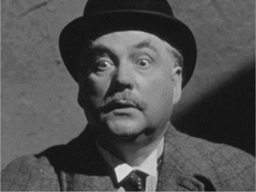 For many (especially of a certain age), the image of Doctor Watson is that of a buffoon who provides little assistance and lots of laughs. And the “credit” for that perception can be laid at the feet of Nigel Bruce. Bruce appeared in fourteen popular movies opposite Basil Rathbone’s beloved Holmes, and he also played the good doctor in well over two hundred radio plays – most with Rathbone.
In the first two films, The Hound of the Baskervilles and The Adventures of Sherlock Holmes, he was a bit of a clown. But after the franchise shifted from Fox to Universal, that portrayal was understated compared to the next twelve movies he made with Rathbone. The scripts called for Bruce to play a dolt – his daughter said that the disappointed Bruce made up the term ‘Boobus Brittanicus’ to describe his un-Doyle like character.
The poem below appeared in Punch Magazine. Unfortunately, after digging through my shelves, I cannot find where I got this from (I thought that it was one of Peter Haining’s books, but that didn’t pan out). But it is from the nineteen forties, when Rathbone was the brilliant, active Holmes and Bruce provided comic relief.
I think it’s both an amusing and insightful commentary on the Bruce phenomenon:
The stately Holmes of England, how beautiful he stood
Long, long ago in Baker Street – and still in Hollywood
He keeps the ancient flair for clues, the firm incisive chin,
The deerstalker, the dressing gown, the shag, the violin.But Watson, Doctor Watson! How altered, how betrayed
The fleet of foot, the warrior once, the faster than Lestrade!
What imbecile production, what madness for the moon
Has screened my glorious Watson as well nigh a buffoon?
Is this the face that went with Holmes on half a hundred trips?
Through nights of rain, by gig, by train, are these the eyes, the lips?
These goggling eyes, these stammering lips, can these reveal the mind
How strong to tread, where duty led, his practice cast behind?His not to reason why nor doubt the great detective’s plan –
The butt, maybe, of repartee yet still the perfect man,
Brace as the British lion is brave, brave as the buffalo,
What to they know of England who do not Watson know?We have not many Sherlocks to sift the right from wrong
When evil stalks amongst us and craft and crime are strong,
Let not the Watsons fail us, the men of bull-dog mould,
Where still beneath the tight frock-coat beats on the heart of gold.Watson, who dared the Demon Hound nor asked for fame nor fee,
Thou should’st be living at this hour. England hath need of thee!
Thus did I muse and muse aloud while wondering at the flick
Till people near me turned and said, ‘Shut up, you make us sick!’
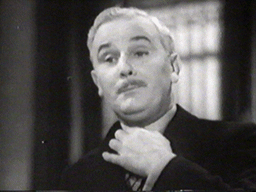
Bruce wasn’t the first less than Canonical Watson on film. Arthur Wontner, the first great ‘talkie’ Holmes, was aided by Ian Fleming in four films, with a switch to Ian Hunter for The Sign of Four. Both were preening, lightweight Watsons who conveyed nothing of Doyle’s stolid, loyal companion. Of course, you read all about Wontner in a prior Black Gate post, right? And Bruce’s scenes (try Sherlock Holmes Faces Death) cemented the image of a goofy Watson on the case.
H. Marion Crawford made some progress in the ‘Take Doctor Watson Seriously’ movement (which didn’t really exist…) when he appeared opposite Ronald Howard in Sheldon Reynolds’ 1955 made-in-France television series (which you surely read about here). Watson was a doofus in some episodes, but he was also intelligent and his physical abilities were useful. He even captured the villain in the first two episodes. Crawford provided a step or two away from Bruce towards Doyle.
In 1959, 50 year old Andre Morell played a somewhat dull but not comedic Watson in Peter Cushing’s The Hound of the Baskervilles (yep, I wrote about that one as well). While I find it a rather pedestrian performance, it was a significant change in how Watson could be portrayed on the big screen. He didn’t have to simply be the comic relief contrast to the dramatic Holmes.
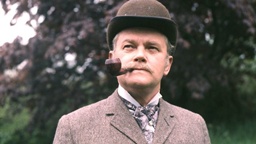
Donald Houston wasn’t too bad in A Study in Terror (Holmes takes on Jack the Ripper), and Nigel Stock seemed like a fawning puppy dog to Douglas Wilmer and then Peter Cushing’s Holmes’ on television.
I’m not going to go through all the Watsons – there would be good (Vitaly Solomon) and bad (Bernard Fox) ones. But that Nigel Bruce image would persist. Until Granada cast David Burke opposite Jeremy Brett for their excellent adaptation of the Canon. Psst… I wrote about Fox’s Hound of the Baskervilles.
In case you missed it, here’s the link to part three of my series on their The Adventures of Sherlock Holmes: it’s got links to the first two parts at the beginning.
Granada wanted an intelligent (but not brilliant), loyal, capable Watson to assist Holmes on his adventures, but to also be his friend. To be fair, Nigel Stock emphasized the latter opposite Peter Cushing, but without emphasizing the usefulness factor enough. Burke was, FINALLY, Doyle’s Watson. I’ve wondered why Rathbone’s Holmes would bother keeping Bruce’s Watson around. Brett and Burke made perfect sense.
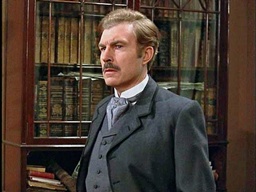
Burke left the show after that first season and was replaced by Edward Hardwicke, whom he suggested for the role. Hardwicke, a few years older, continued on with Burke’s revolutionary portrayal. The two men transformed the public image of Watson.
Jude Law played a capable but modern culture-ish, wise-cracking Watson opposite Robert Downey Jr. Some would say he was a good Watson opposite a terrible Holmes. I enjoy the movies, even though Holmes resembles Jason Bourne.
Today, Martin Freeman plays a Canonical Watson opposite Benedict Cumberbatch’s over-the-top Holmes in BBC’s Sherlock. Even though the show jumped the shark with season three, Freeman has remained steady.
And in America, Watson is a woman (Franklin D. Roosevelt had it right!). Lucy Liu is a former neurologist hired to help the drug addled Holmes (Johnny Lee Miller) get right. She’s smart, capable, and intuitive and while she has a sense of humor, she’s certainly not comic relief. We’re talking a brain surgeon here! Elementary is, of course, is miles away from the Canon (as is BBC Sherlock, which wasn’t always that way).
So, it took several decades, but the Nigel Bruce portrayal of Holmes is no longer the standard image of the good Doctor Watson. For me, while I very much like Hardwicke, David Burke is probably my favorite portrayal (check out The Solitary Cyclist episode). And I actually don’t mind watching Bruce in the Rathbone films: I understand the function he serves in the movies. But I certainly don’t see or hear Bruce when I’m writing about Watson.
It’s Elementary – I’m always interested in who authors see and hear when they write Holmes fiction. When I’m working on something a little lighter, I picture Ian Richardson as Holmes. But I always hear Clive Merrison in my head. And for that matter, I often hear Michael Williams’ voice when writing Watson.
You can read Bob Byrne’s ‘The Public Life of Sherlock Holmes’ column here at Black Gate every Monday morning.
He founded www.SolarPons.com, the only website dedicated to the ‘Sherlock Holmes of Praed Street’ and blogs about Holmes and other mystery matters at Almost Holmes.
His “The Adventure of the Parson’s Son” is included in the largest collection of new Sherlock Holmes stories ever published. Surprisingly, they even let him back in for Volume IV!
I know not everyone agrees, but for me, it’s Brett and Hardwicke. Period.
I can’ find fault with either man’s depiction.
Ouch! It says something for my powers of observation that I never noticed the switch in the Granada Series. I was going to cite ‘Shadowlands’ as an example of Burke’s acting chops, but Warnie (C.S. Lewis’s brother) was played by Hardwicke, not Burke. I read somewhere that casting Holmes is easy. It’s finding the right Watson that’s the tricky part….
Incidentally, I came across this little sketch while browsing the Interweb yesterday and thought it was pretty funny –
https://www.youtube.com/watch?v=eYosZDMIpY4
Aonghus – It took me awhile to be able to actually notice the difference between Burke and Hardwicke in early episodes: especially in some photos.
A bad Watson can destroy a Hound of the Baskervilles…
Never saw that sketch before. Thanks!
Your stereotype of Watson is not merely incomplete but a fundamental category error, and one worth correcting by returning to what the Canon actually shows rather than what a century of adaptation has calcified over it.
Watson is not the stolid, phlegmatic figure that you found it convenient to produce. He is NEITHER “a man of bull-dog mould” (actually Watson applies that phrase to Lestrade in a sarcastic tone, which means your Watson is simply a promoted Lestrade, not by any means Watson), NOR “the man brave as the British lion or the buffalo.” They are a systematic misreading, and the Canon refuses them on almost every page. A man of that mould does not write as Watson writes. He will not write on a day of October fog and compose a sentence like this: “the house is banked in with rolling clouds, which rise now and then to show the dreary curves of the moor, with thin, silver veins upon the sides of the hills, and the distant boulders gleaming where the light strikes upon their wet faces.” That is not observation in service of detection. That is a painter’s sentence, written because the light on wet stone mattered to the writer, because the silver veins running down the hillside moved him in some way that required language to hold. A stolid man would have written: foggy. Watson wrote what his imagination transfigured as he looked.
This governs everything. Watson’s imagination is porous to atmosphere in the way that belongs to the romantic temperament and to no other. When he sits alone in Baskerville Hall on his first evening, he records not the furniture but the weight of the place pressing down on him. When he walks out onto the moor in rain, “full of dark imaginings, the rain beating upon my face and the wind whistling about my ears,” he is not performing duty. He is surrendering to the sublime in the only vocabulary he has. The prehistoric hut-circles on the hillside do not read to him as landmarks or evidence. They are presences, the residue of forgotten peoples whose indifference to the present is precisely what unsettles him. A man of bull-dog mould does not feel that kind of unsettling.
Alone on Dartmoor, Watson is frightened. He says so plainly and without apology. “I am conscious myself of a weight at my heart and a feeling of impending danger, ever present danger, which is the more terrible because I am unable to define it.” He “wishes Holmes were there”, sincerely and repeatedly. The darkness and the vastness and the sense of something watching from the fog work on him, and he does not pretend otherwise in the diary he is keeping, which is a private document written into silence, with no audience to perform courage for. A man of bull-dog mould does not write that diary. The bull-dog is defined precisely by the quality of not registering atmosphere, not feeling the weight of old stones, not lying awake in a strange house listening to the moor. Watson registers all of it. The letters exists because he cannot not register it.
Watson is a romantic who romanticizes. He dramatizes the cases into what Holmes dismisses as “little fairy-tales,” and elevates Holmes in prose to something approaching legend defends himself against the charge as “the romance was there” because he has sensitivity while views the world with his rose-tinted spectacles. He is susceptible to women, susceptible to masterful men of commanding will, susceptible to atmosphere and strangeness, drawn to Holmes in a way he cannot fully explain and does not try very hard to. He is good-looking, possesses what the Canon calls “natural advantages,” and wears that knowledge with the unguarded ease of a man who has never had to argue the point.
The short period in Afghanistan (about a year) did not produce toughness. It produced someone who came back with a wound that migrated across the Canon because Doyle forgot it but Watson never did, and with a quiet, earned acquaintance with what violence actually costs. The buffalo does not become a doctor. Watson did. The misfortune and disaster of war never took from Watson what was most essentially his: that imagination, that curiosity, that sensibility, that openness to the world which were not qualities he had cultivated but the very substance he was made from.
“Cut out the poetry, Watson!” Holmes says at one point, and the instruction is revealing precisely because it wells up unbidden even when the case is urgent and Holmes needs facts. “the same blithe boy as ever” is another phrase that attaches to Watson. Watson is lightweight in the sense Fleming meant: not shallow, but buoyant, carried by emotions, alive and insightful to the world in a way that no amount of Strand Magazine caricature has managed to extinguish from the Canon.
The bull-dog/buffalo/lion is all resistance. Watson is all receptivity. That is what the Canon shows, on every page where he bothers to look at something and write down what he sees.
And it is worth noting that in one of Conan Doyle’s own plays, Watson is called “doe” by a man
Did you even read my post Or just go off on an unnecessary rant after you saw the title, nine years after it went up?
I made the point that Doyle’s Watson was not the Nigel Bruce depiction.
But I hope you feel better after getting all of that out. Feel free to read my posts before commenting, in the future.