Anathem update
Well, I’m now about halfway through Neal Stepehenson’s Anathem and, while I’m enjoying it, the going is slow. When I was in graduate school, my 18th century British Lit class had as required reading a 1500 page epistolary novel by Samuel Richardson called Clarissa which recounts the seduction, rape and subsequent suffering of said title character. Correctly suspecting that perhaps not everyone would read it thoroughly, the professor assigned the students sections that we would each summarize and present to the class as we worked through the reading. My section was some 500 pages into the story, and I remember starting my presentation by saying, “I was fortunate to be assigned the part of the book where something actually starts to happen.” Which is sort of how I feel about Anathem about now.
I’m not overly obsessive, let alone concerned, about world-building. I don’t look at the maps, or the etymology of a sword’s name, or get overly concerned about any of that stuff. I don’t get upset if there’s some inconsistency in the imagined world; hell, the real world is inconsistent enough for my taste. I’m more interested in metaphor, or even just whether it’s a good read. In Antathem, Stephenson is poking fun at the world-building fetish (I think) but, at the same time, is a practicing adherent. A dangerous thing for an author known to never hesitate to let the reader just how much he knows.
Certain sections of the book begin with definitions of the Earth-like society’s terms, sociological classifications, and historical events. Here’s Stephenson reading these definitions. If you like this sort of thing, you’ll love the book for this alone.
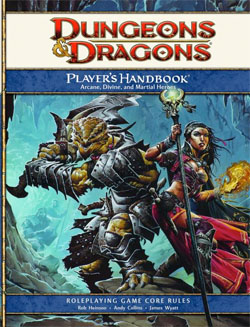 Fourth Edition Dungeons and Dragons has been with us for about a year now; long enough for the gaming community to get a pretty good taste of it. I’ve been hearing various reports from gamer friends about the system, and opinions of it have fallen across a roughly tripartite spectrum, from favorable to neutral to negative. Among these views, though, there is agreement that this isn’t the same old Dungeons and Dragons. Fans of Fourth Edition sometimes call it a “transformation,” or point out, “This time around they didn’t have any sacred cows. They were ready to change anything.” Critics have generally agreed that “It might be a game some people like, but it’s no longer D&D.”
 More snarking and snarling at the expense of the stories nominated for this year’s Nebula Awards, this time directed at those in the “novelette” category.
 Watchmen (2009)
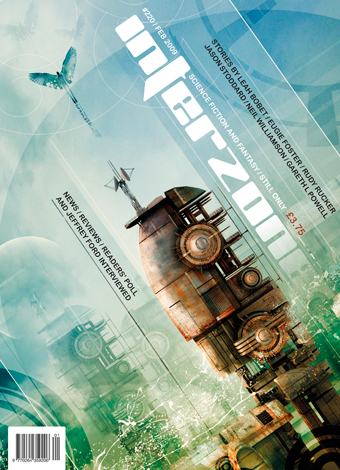
 When I became eligible to become a member of SFWA last year I thought about it long and hard and finally decided to join. I forget why, now. The experience hasn’t exactly been a bad one–it’s been oddly non-experiential, as a matter of fact. For instance, you may have noticed that the final ballot for this year’s Nebulas was recently announced,