The Greatest Harryhausen: The Golden Voyage of Sinbad
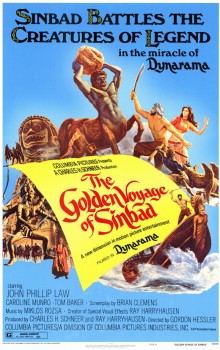 The Golden Voyage of Sinbad (1974)
Directed by Gordon Hessler. Starring John Philip Law, Tom Baker, Caroline Munro, Douglas Wilmer, Martin Shaw, Kurt Christian, Grégoire Aslan, Takis Emmanuel.
“Every voyage has its own flavor.”
Recently on this blog, I wrote about one of the more ignored of Ray Harryhausen’s films, The 3 Worlds of Gulliver. This inspired me to review two other films of his that don’t get enough attention—the underwhelming H. G. Wells adaptation The First Men in the Moon (1964), and the wonderful but financially unsuccessful The Valley of Gwangi (1969)—on my own blog. Now I think I owe the legendary effects animator and fantasy film producer some time with one of his most popular films.
The Golden Voyage of Sinbad is not only one of Harryhausen’s most financially successful movies, but is also, in my Harryhausen-loving fan-obsessed opinion, the greatest piece the special effects maven ever worked on. I think that it’s not only Harryhausen’s best movie, but also one of the finest heroic fantasy films ever made.
Morningside Productions, Harryhausen’s and his producing partner Charles H. Schneer’s company, had experienced a financial disappointment with 1969’s “cowboys ropin’ a dinosaur” adventure The Valley of Gwangi, and the gap between it and The Golden Voyage of Sinbad was the longest yet between their movies. The two men decided to turn the clock back and re-visit the figure who had brought them to prominence in the first place: Sinbad the sailor. The major success of 1958’s The 7th Voyage of Sinbad had allowed them to take the path of colorful fantasy and period science fiction, and the character was one who could have a variety adventures. Harryhausen had done some sketches in 1964 for a new Sinbad story, and now had the opportunity to realize the project. Both those early sketches reached the final film almost unchanged. …
 Intriguing premise — and something quite different from his previous work, which is always good to see in a favorite novelist — where two presumably East European cities somehow physically co-exist, with the inhabitants following strict protocols to avoid one another whenever their separate realities intersect. Grossman would be happy that it has compelling plotting; however, as a “police procedural,” Miéville doesn’t quite play fair. Part of the game in these kind of things is to at least give the reader a chance of figuring out the mystery of “whodunnit,” which I doubt anyone would be able to, although I’m guessing this isn’t Miéville’s concern here. I think he’s aiming at something more metaphorical along the lines of the existential spaces we all tread among the various realms of social interaction. Nonetheless, the unfolding of the mystery struck me as a little forced. Potentially, this could be the start of a series.
 Incredible Adventures
 Hey, have you heard? Archie Andrews is going to marry Veronica Lodge. Good for him; I always had this thing for Veronica. I hope Archie isn’t in this only for the Lodges’ money. In celebration of this momentous moments of moments, I’m going to write about the Hittites.
 I tend to go through my “to be read pile” looking for themes as an approach to wend my way through and choose what I want
 to attack next. These two are about the realities of war and the casualties of those who manage to survive. The first, Denis Johnson’s Tree of Smoke is a novel about the Vietnam war fiasco; the other is non-fiction, The Forever War
  What’s the point of toiling long hours in relative obscurity for Black Gate, if we don’t pimp your new books?