On Getting Current in Heroic Fantasy, Part II
 I was commenting the other day on the surplus number of wonderful S&S anthologies I’ve stumbled on since a friend and I began a collaborative shared world writing project a few weeks ago, both writing stories set in a fantasy/medieval city with a history and a river and neighborhoods and taverns and all the usual trappings. His background in world building (via D&D or whatever) is less than mine, and mine is quite scant, so our efforts have grown in odd bits and pieces: first the tavern, then the name of the city, then a mountain backed up against it, and so on.
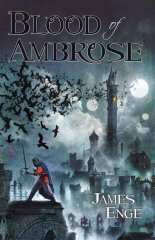
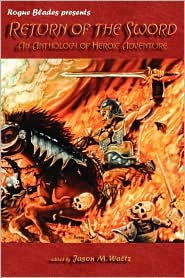
And while writing and inventing and noting what I was writing and inventing, I’ve kept reading new (to me) material, noting those books and writers people clamor about and ordering their books and waiting impatiently by the mailbox every afternoon to see what’s arrived – David Gemmell’s first novel, or George R. R. Martin’s A Game of Thrones, or Matthias Thulmann: Witch Hunter or, just yesterday, James Enge’s Blood of Ambrose – I read and very much enjoyed his “The Red Worm’s Way” in Return of the Sword and want to read further about his hero Morlock Ambrosius…

 The place is here, the time is now, and the journey into the shadows that we’re about to watch could be our journey.
 I read an interesting post the other day by a thoughtful blogster whose name I cannot now remember and whose post I cannot locate again, who professed his surprise at all the fans of Conan (and Sword & Sorcery in general) who were returning to the fold now, after falling away in the 1980s, after the last Big S&S Boom.
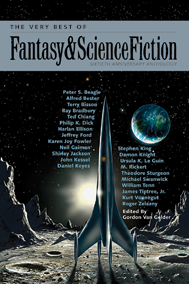 I’m a sucker for retrospective anthologies. And F&SF is one of my favorite magazines — and has been since I first discovered tattered copies in the tiny library of Rockcliffe Air Force base in Ottawa, Canada, in the late 70s. Editor Gordon van Gelder has assembled an imposing, 470-page collection spanning more than five decades, starting with Alfred Bester’s “Of Time and Third Avenue” (1951) and ending with Ted Chiang’s “The Merchant and the Alchemist’s Gate” (2007).
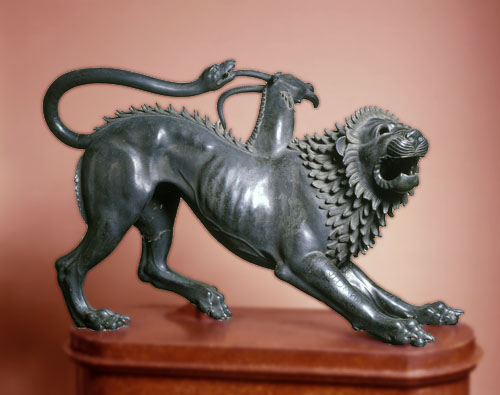 I don’t often get the opportunity to encounter true works of ancient artwork, those anonymous pieces of bronze and stone and gold that appear reproduced in textbooks, volumes of history, and museum brochures. Living on the western edge of the New World means I have a lack of local access to them, and when I’m in the Old World, I’m usually among the artworks of the early modern masters, who painted onto canvas their dreams of the ancients. Not that such art isn’t wonderful, but I’m a classicist deep down in my cerebellum, and I don’t get to engage with the genuinely ancient as often I would like.
 The much anticipated — and feared — “reimagining” of Patrick McGoohan’s classic cult TV series The Prisoner is scheduled for release on AMC in November. One good sign is that Ian McKellen is cast as Number Two (a role which, unlike the original series, will not revolve among multiple actors) and is (like the original) of fixed duration. James Caviezal is Number 6 and there are some interesting parallels here. Caviezal played Jesus in Mel Gibson’s (who was rumored to be a candidate for Number 6 in the various movie proposals over the year) The Passion of the Christ, controversial for its brutal, some would say sado-masochistic, portrayal of the Gospel stories. Like McGoohan, Caviezal is an observant Cathloic. Caviezal has made public stands on such issues as stem cell research and it is not inconceivable this might have affected his career in an industry that for the most part tilts left; McGoohan reportedly turned down the role of James Bond for moral reasons and insisted in his contract that he would not kiss women on-screen, particularly ironic given that The Prisoner was embraced by the sexual liberation advocates of the Sixties counter-culture for the program’s non-conformist ethos.