Browsed by
Category: Weird Tales

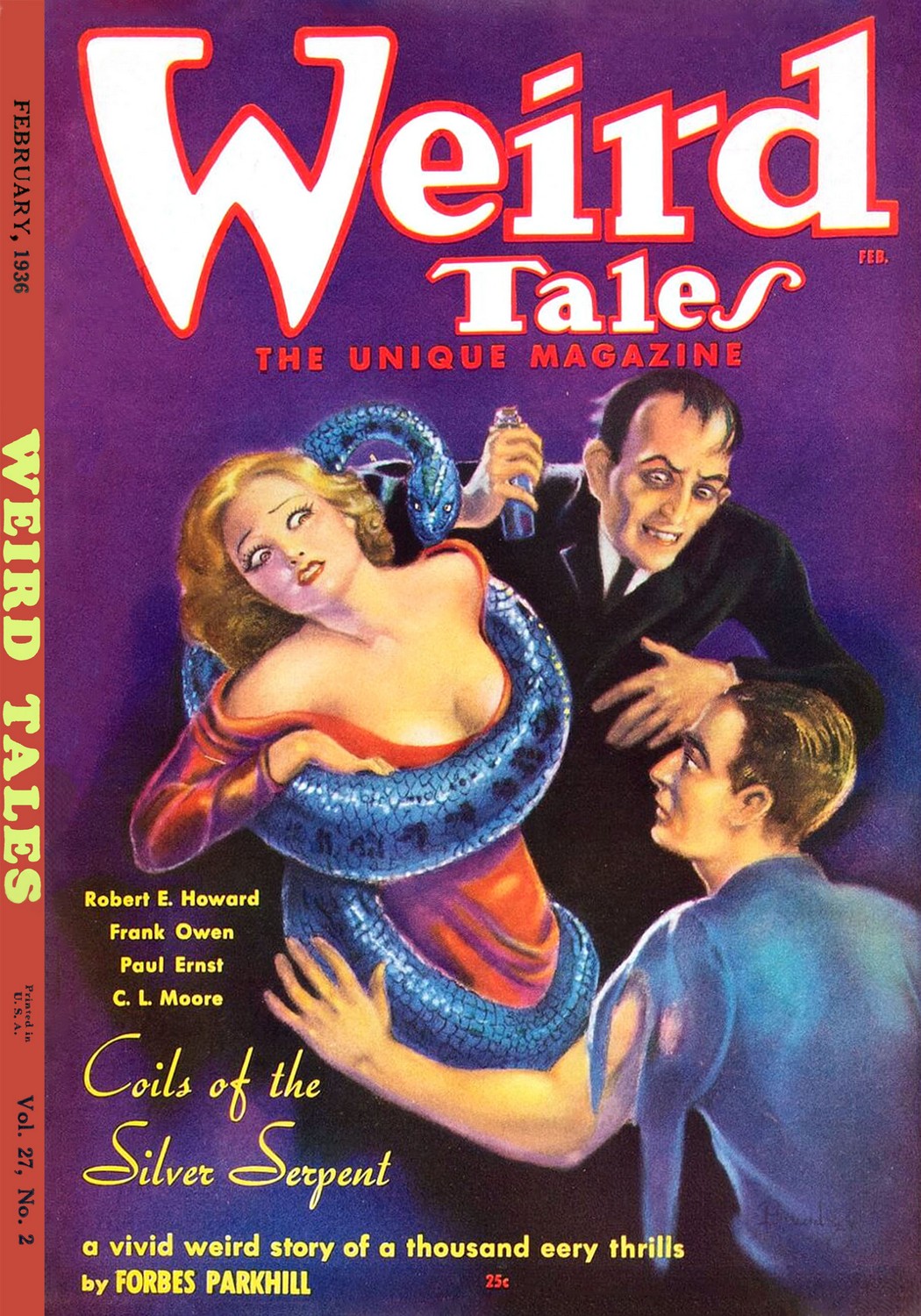
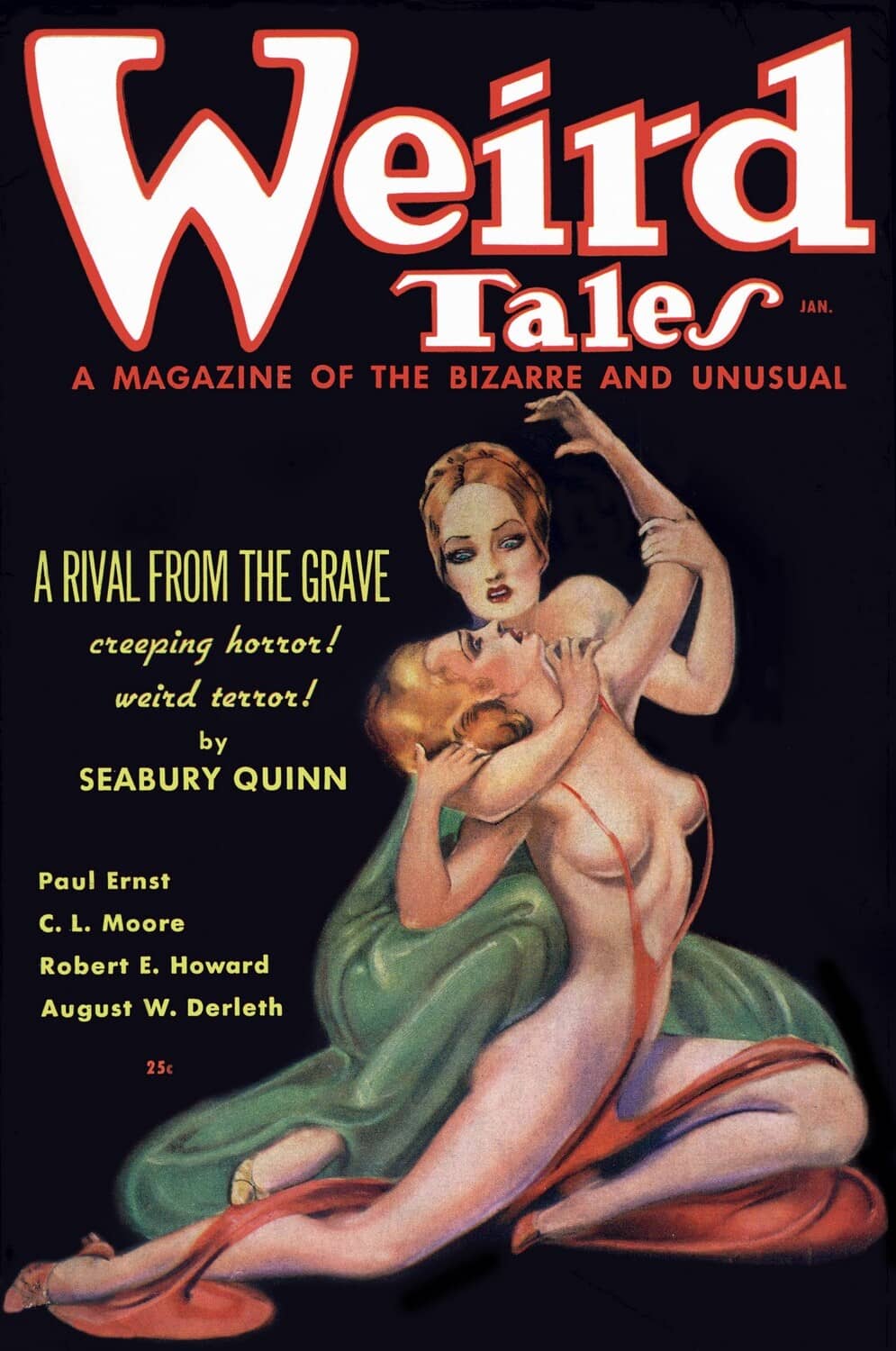
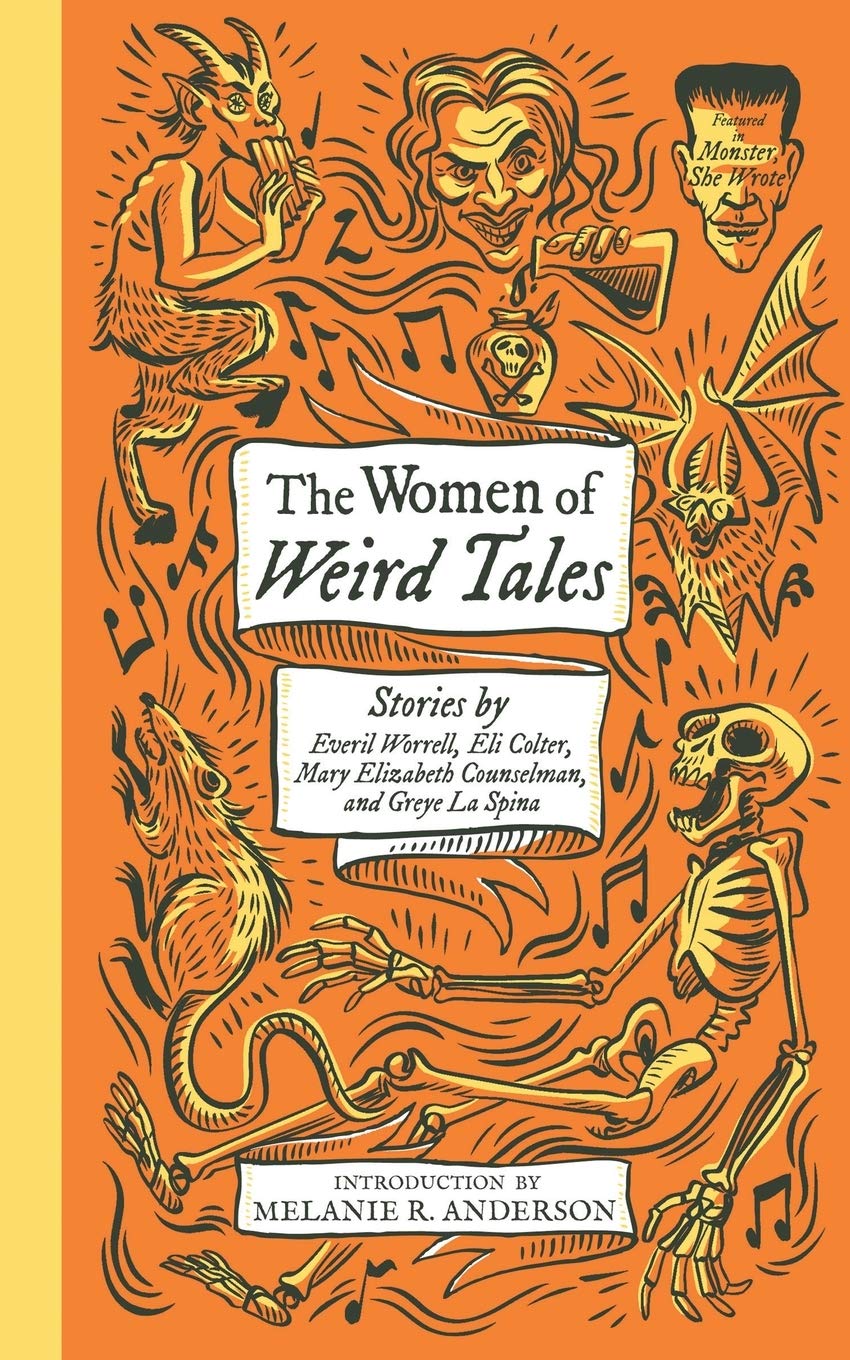
Women Do It Better? The Women of Weird Tales, from Valancourt Books

Women Do It Better? The Women of Weird Tales, from Valancourt Books

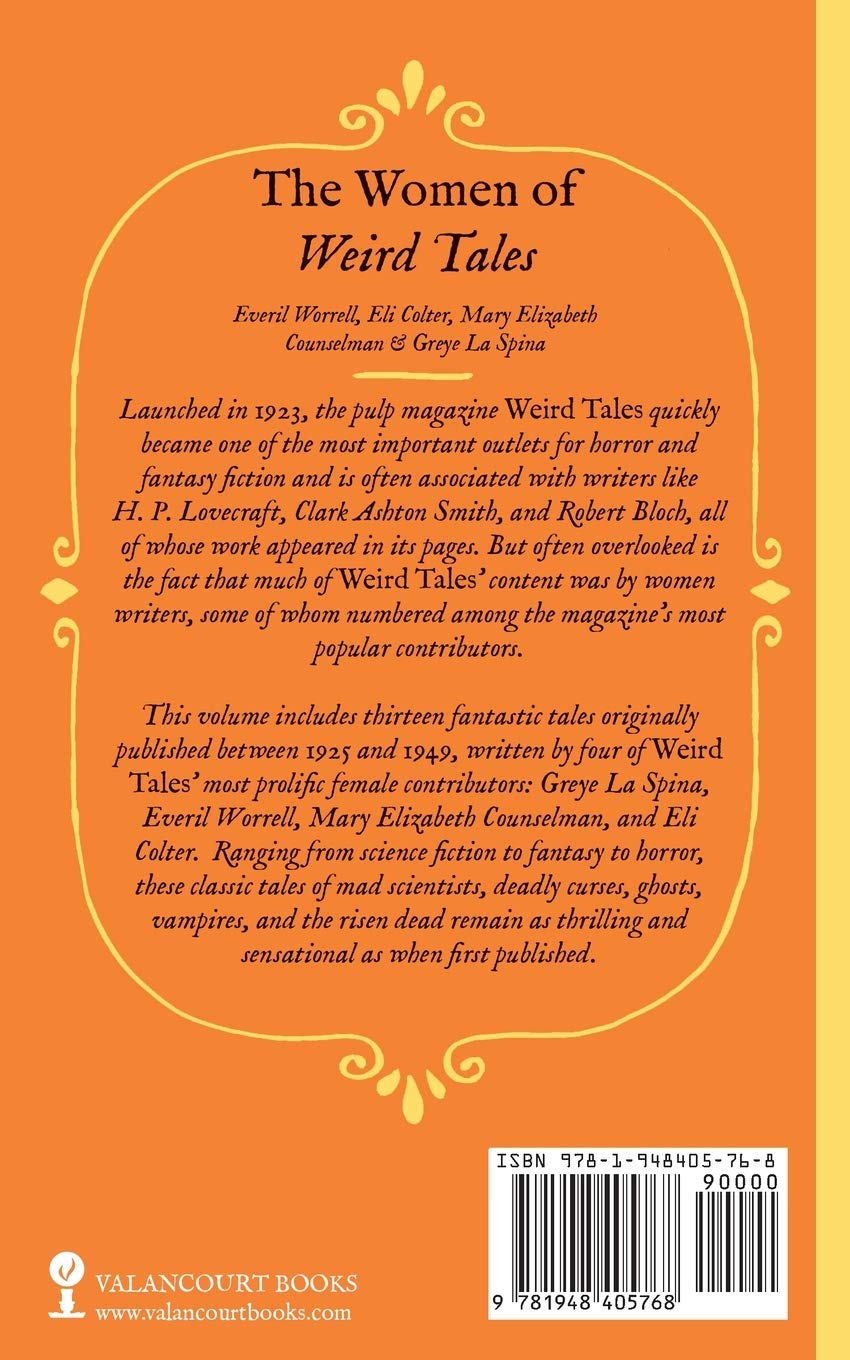
The Women of Weird Tales-small The Women of Weird Tales-back-small

The Women of Weird Tales
By Everil Worrell, Eli Colter, Mary Elizabeth Counselman and Greye La Spina
Introduction by Melanie Anderson
Valancourt Books (280 pages, $24.99 hardcover/$16.99 paperback/$9.99 digital, November 3, 2020)

It is well known by now that women had a pivotal role in the development of those literary genres called Gothic Fiction, Horror, Dark Fantasy, etc. If we look at the iconic Weird Tales, the golden era of which spanned the ‘20s to the ‘50s, female authors were constantly included, and they penned some of the magazine’s most popular stories. Not to mention that some of the most influential editors and cover artists of the era were women as well.

Valancourt Books has aptly published a new anthology showcasing stories from Weird Tales by female writers, Women of Weird Tales.

Greye La Spina is present with five stories. The most accomplished, to me, is “The Antimacassar,” an effective, well told tale portraying a case of vampirism, gradually disclosed throughout the yarn. Other good tales are the bizarre “The Remorse of Professor Panebianco,” in which a mad scientist designs a device to imprison the soul of dying people; “The Dead-Wagon,” a dark gothic tale about a family curse dating back to the times of the Black Death; and “ The Deadly Theory,” a disturbing piece showing how the power to bring back people from the dead leads to tragedy.

Read More Read More

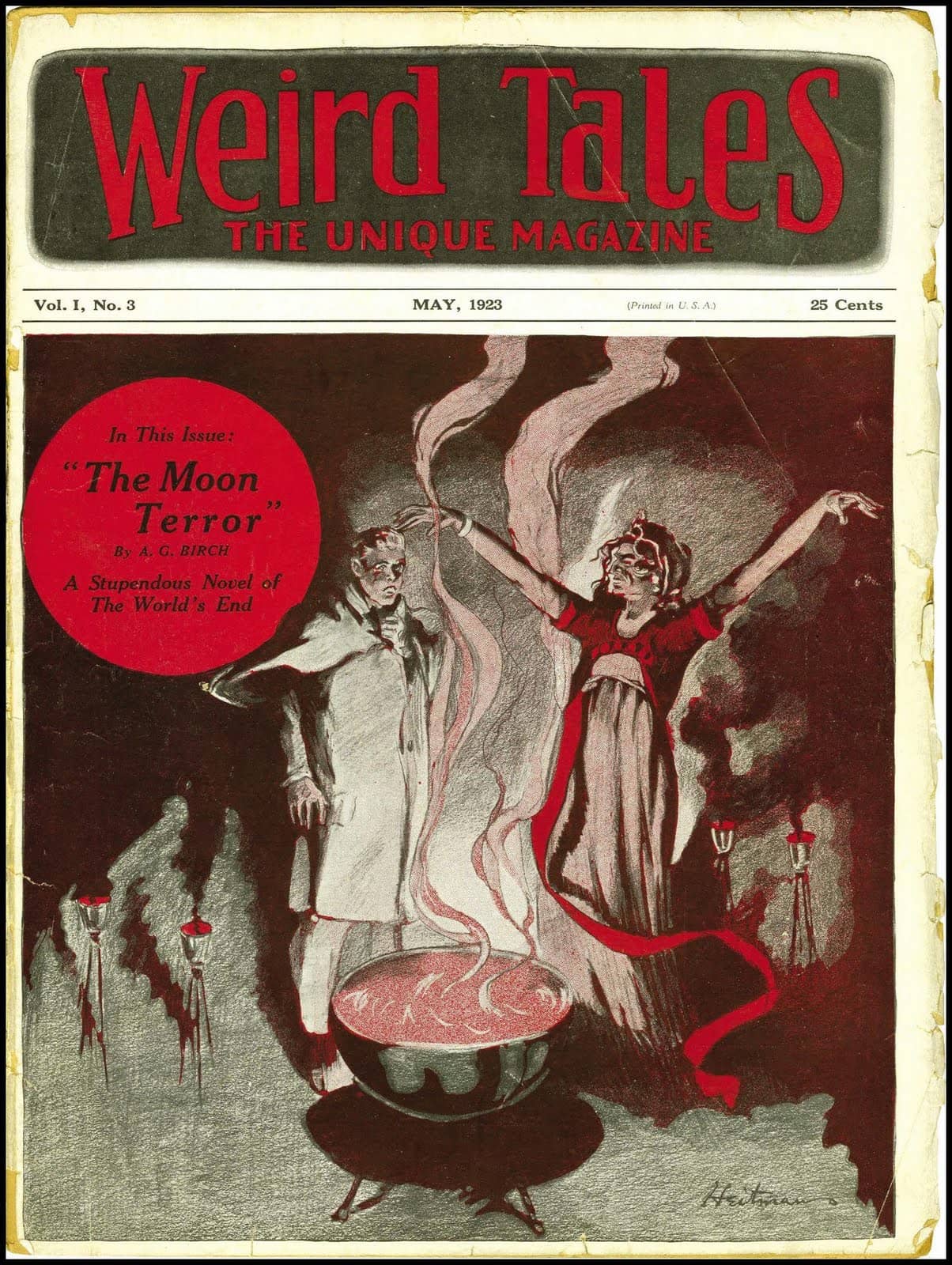
Weird Tales Deep Read: May 1923

Weird Tales Deep Read: May 1923

Weird Tales May 1923-small

Cover by William Heitman

This time we’re considering another early Weird Tales, the third issue, May 1923. This was one of the oversized bed-sheet sized issues and contained 21 stories by 22 authors. Astonishingly, fourteen of these authors were one and done, with no additional published stories in the sf/fan field. Another two have two stories listed at the Internet Speculative Fiction Database.

The two most significant authors in this issue are Vincent Starrett, a long-time newspaper man who produced several out of genre books and a single slim collection of fantasy stories published by Arkham House in 1965. The other is Edward Bulwar-Lytton (yes, of a “dark and stormy night” fame), represented by a reprint that is more of a curiosity than anything else.

The other author worth commenting is Culpeper Chunn (a byline that screams pseudonym), whose real name was Seymour Cunningham Chunn (1889-1927). His two stories in Weird Tales are his only listed genre works, but if you google his name you’ll find repeated offers for his book Plotting the Short Story (it’s in public domain, so naturally it’s currently available in countless editions, even on Amazon) so he must have some kind of track record, somewhere. But that’s not why he gets a mention here. The protagonist of “The Whispering Thing,” co-authored by Laurie McClintock (who otherwise has left no trace in the written record), is Jules Peret, a French-born ex-policeman and current consulting detective, “a small, effeminate man with delicate features, small hands and feet,” given to uttering extravagant oaths. Sound familiar? The first Jules de Granden story appeared in Weird Tales in 1925. I have no explanation for this extraordinary coincidence.

Read More Read More

Weird Tales Deep Read: November 1934

Weird Tales Deep Read: November 1934

Weird Tales November 1934-small Weird Tales November 1934-back-small

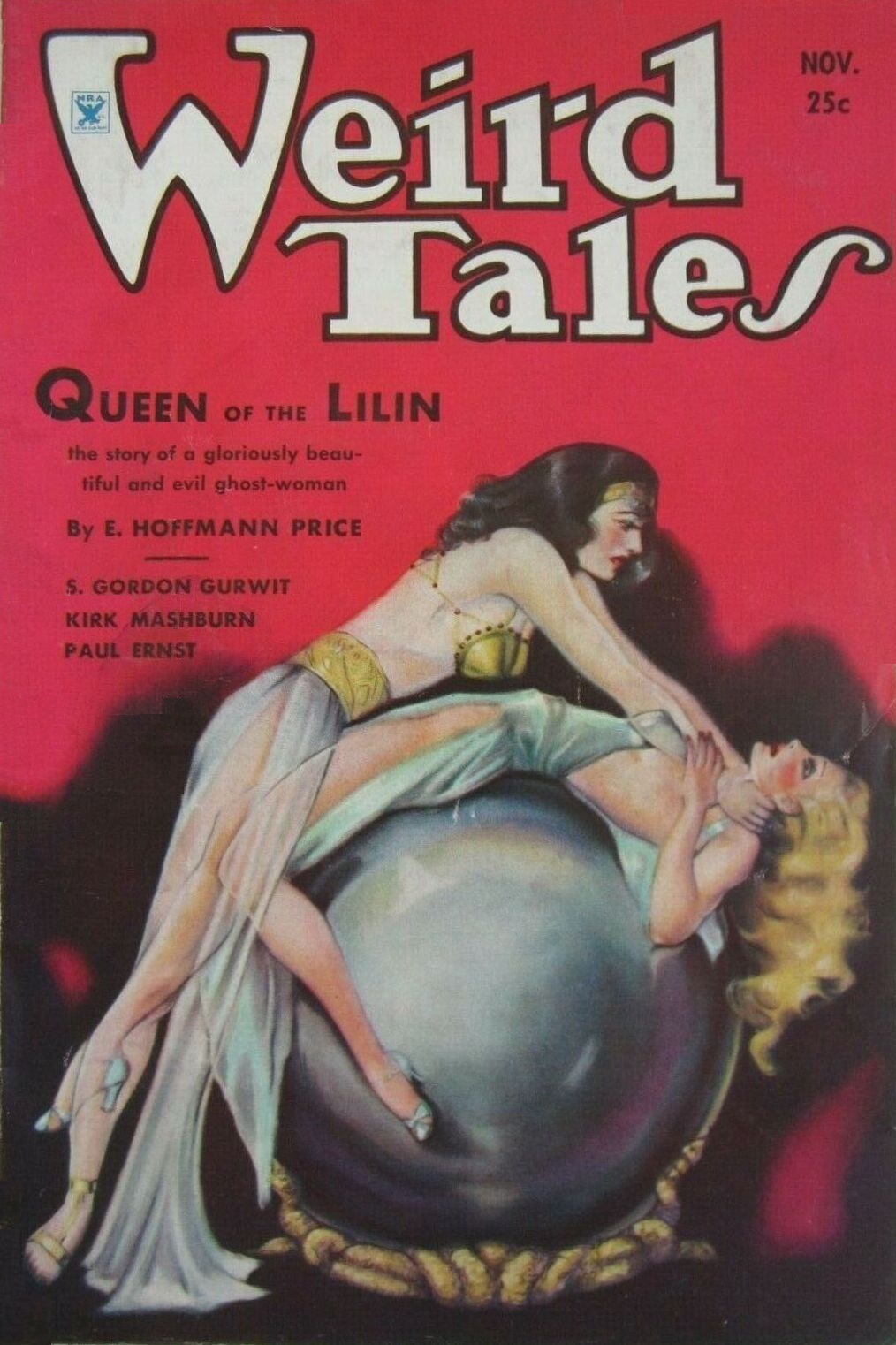
Weird Tales, November 1934. Cover by Margaret Brundage (for “Queen of the Lillin”)

We’re back on more familiar ground with this issue of Weird Tales from its classic period. More familiar authors are represented, and although not every story is a classic the editors at least avoided any real stumbles this. The issue grades out to a 2.1, which all in all is pretty decent.

Both Howard and Lovecraft appear, although the Lovecraft tale is a reprint and the Howard is the last installment of a serial. E. Hoffman Price, Paul Ernst, and August Derleth, seasoned pulp veterans all, also contributed stories. Price tale’s is part of his Pierre d’Atois stories; , d’Atois, like another Frenchman who appears in a series of WT stories, is an occult detective. The Ernst is one of his slighter efforts. The Derleth is somewhat more unusual, although, as is common, also rather slight. We have to cover already trodden ground with two serials this time around. I’ve included the information on those stories for those who haven’t read all the posts in this series.

Read More Read More

Weird Tales Deep Read: June, 1923

Weird Tales Deep Read: June, 1923

Weird Tales June 1923

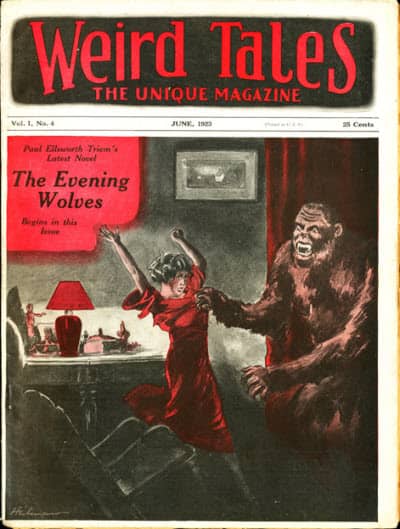
Cover by Heitman for “Murders in the Rue Morgue”

June 1923 was the magazine’s fourth issue, and it was still clearly a magazine in search of itself.

There are very few authors who had a major impact on the magazine appeared in this issue. The most notable name, of course, is Edgar Allen Poe with a reprint of one of his most famous tales (“The Murders in the Rue Morgue”) and, secondarily, Otis Adelbert Kline, with a story largely forgotten today, but which I found to be a cut above many of his others, though ultimately somewhat slight. That’s about it. Two of the best stories were by authors totally forgotten today, Paul Ellsworth Triem and Loual B. Sugarman, with only the later tale having fantastic elements. In fact, only seven of the 18 stories in this issue had fantastic elements (39%), all were set in contemporaneous times (of course, the Poe story was written in the 1840s), and most (13 or 72%) were set in the United States.

On the whole, many of the stories were no better than mediocre, but really poor efforts were largely avoided (four 4’s and one 5). Also largely avoided were the overtly racist tropes too readily present in many early WT’s, with the Birch effort going all in on the Yellow Peril theme.  Overall, this issue rated out to 3.00, which notably lags behind the classic early 1930s issues previously covered.

Read More Read More

Weird Tales Deep Read: August, 1934

Weird Tales Deep Read: August, 1934

Weird Tales August 1934-small

Yet another Brundage cover

We have another nine stories to consider this time around, but what is particularly noteworthy is that all nine of the authors are at least somewhat well known. The most obscure on the list is probably Anthony Rud (here writing under the name of R. Anthony, perhaps best known for his story “Oooze,” arguably the best offering in WT’s initial issue [3-23]), which is partially due to his passing in 1942 at the relatively young age of 49. Also unknown today is Arlton Eadie, who died even earlier (1935) also at 49, but everyone else had long writing careers, although some, of course, have fallen by the wayside due to the relentless march of time.

Of the nine stories, eight (89%) are either fantasy or science fiction, several actually in the gray area between the two genres. Seven stories (78%) have contemporary settings, one (11%) is set in the far past and one (11%) in the future. Four (44%) take place in the United States, and one each in a fictitious realm in the far past, on the planet Mars, in the South Seas (mostly), Great Britain, and a fictional Central European country. Three (33%) are part of a series.

Read More Read More

Weird Tales Deep Read: March, 1933

Weird Tales Deep Read: March, 1933

Weird Tales March 1933-small

Weird Tales, March 1933. Cover by Margaret Brundage

This installment of the deep read of the Unique Magazine examines the nine stories in the March, 1933 issue of Weird Tales. We see some familiar names from the previous column: Seabury Quinn, Robert E. Howard, Clark Ashton Smith, and Harold Ward, as well as a couple who might be familiar to fans of pulp fiction, Otis Aldebert Kline and Paul Ernst. Kline is probably best known for his imitation Edgar Rice Burroughs planetary adventure novels. He was also Robert E. Howard’s literary agent for awhile, which will no doubt come up for discussion at the appropriate time. Paul Ernst was a rather prolific pulpster, possibly remembered mostly today for writing the Avenger hero pulps, but he was also a frequent contributor to Weird Tales.

Some stats for this issue before we get to the individual stories, then a few comments on some of this issue’s offerings. Locations: US (4/9; 44%), fictional realms (2/9: 22%), Venus, UK, France, Tibet (all 1/9: 11%). Contemporary setting: 6/9; 67%). Past: (2/9; 22%), Future: (1/9; 11%). Four of these stories (44%) are part of a series: Quinn, Howard, Kline, and Smith.

Seabury Quinn [Jules de Grandin] (2) “Thing in the Fog, The” [US, PA, Harrisonville, fictional town; Contemporary] Occultist de Grandin and Dr. Trowbridge literally run into a man on the street being attacked by a werewolf. He’s only injured but his companion is killed by the creature. They soon learn that his future wife was once the werewolf’s fiancee and that he’d initiated into his clan. After the wedding, the bride is again transformed into a wolf by a potion given her anonymously by her werewolf ex, but she attacks him while both are in their canid forms, giving de Grandin the opportunity to deliver a fatal shot. De Grandin then releases her from her curse by using an incantation in the form of a prayer. [Medical doctor. Occultist. Occult being, werewolf. Death by occult being, werewolf. Love triangle. Magic potion. Werewolf transformation by magic potion. Magic incantation, prayer]

Read More Read More

Weird Tales Deep Read: July 1933

Weird Tales Deep Read: July 1933

weird_tales-July-1933-small

Somewhat fanciful Brundage cover for “Hand of Glory”

This is the first in a series of posts I’ve wanted to do for awhile now, a detailed look at a single issue of Weird Tales magazine where I do a short analysis of each story, the famous, the infamous, and the forgotten. Just to make things a little confusing, I rate these stories, unlike movies, on a 1-5 scale, with the lower the number, the better the story. You can look at these ratings as A-B-C-D-F, or Excellent – Good – Mediocre – Below Average – Poor.

I wanted to start with a memorable issue, so I chose the July 1933 entry, one of the best I’ve read so far. I’ll start with a short overview and then get into the specifics of each story.

This issue is at the beginning of the Unique Magazine’s (as it sometimes called itself) Golden Age (roughly the early to late 1930’s) with a total of four of the nine stories penned by what I like to think of as the Holy Trinity of Weird Tales writers, Robert E. Howard, H. P. Lovecraft, and Clark Ashton Smith. The ubiquitous Seabury Quinn is also present with one of his ninety-three Jules de Grandin stories, along with tales by early giants of science fiction Edmond Hamilton and Jack Williamson. Sheridan Le Fanu contributes a classic reprint. The final story is by Harold Ward, a fairly prolific pulp writer noted for complicated plots often bordering on the incoherent.

The Howard story is one of his slightest, but moderately effective. The Smith, set in what is probably the first shared-world universe in science fiction — the Cthulhu Mythos — is also rather slight, but vastly more imaginative. The Lovecraft story under his byline is one of his classic Cthulhu Mythos tales. His second story in this issue appears under the name of Hazel Heald, which requires a bit of explanation.

Read More Read More

Yes, Weird Tales is Back

Yes, Weird Tales is Back

Weird Tales 363-small

Cover by Abigail Larson

A few months ago I started to hear rumors that Weird Tales, the most storied and collectible American fantasy magazine of all time, had returned. Whispers, really. But I’d been hearing whispers for the last six years, ever since the last issue appeared from Nth Dimension Media, and especially since I published the article “Is Weird Tales Dead… Again?” in 2016. So I didn’t pay much attention.

But then I heard more reliable reports, and started to see listings online…. and then I ordered a copy, and right now I’m holding it in my hot little hands. And I can report that, in fact, Weird Tales is back.

It returns with a new publisher, Weird Tales Inc., but the same editor, Marvin Kaye, who took over the editorial reins from Ann VanderMeer in 2011, and managed only three issues in the last nine years. But the magazine looks terrific, with glossy paper and full color interiors, and an impressive Table of Contents, including stories by Victor LaValle, Jonathan Maberry, Sherrilyn Kenyon, and others. Not to mention an eye-catching cover by Abigail Larson, a tribute to perhaps the most iconic Weird Tales image of all time, the famous bat woman cover by Margaret Brundage.

Is Weird Tales back for good? Too early to tell — though to be fair Weird Tales has never exactly been a stable publication. (There’s a reason it’s called “The Magazine That Never Dies,” it keeps having to be resurrected.) There are the usual troubling signs already, including the fact that the website they proudly promote on the back page (weirdtales.com) is down already. But this looks like a quality package, and I’m hopeful. Let’s have a closer look at the contents.

Read More Read More

Vintage Treasures: The Weird Tales Anthologies

Vintage Treasures: The Weird Tales Anthologies

Weird Tales Peter Haining-small More Weird Tales Peter Haining-small

Weird Tales and More Weird Tales (Sphere, 1978). Covers by Les Edwards

Weird Tales is unquestionably the most storied and respected American fantasy magazine. It first appeared in March 1923, and published its last issue in Spring 2014 — a nearly 91-year run. That’s impressive by any standard.

Of course, Weird Tales isn’t measured purely by its longevity. The three greatest pulp fantasy writers — Robert E. Howard, H.P. Lovecraft, and Clark Ashton Smith — did their most important work in its pages, and it also published classic fiction by Edmond Hamilton, C.L. Moore, Henry Kuttner, Algernon Blackwood, E. Hoffmann Price, Robert Bloch, Manly Wade Wellman, Seabury Quinn, Ray Bradbury, Fritz Leiber, Eric Frank Russell, Fredric Brown, Mary Elizabeth Counselman, Theodore Sturgeon, and hundreds of others. It remains the most collectible and desirable fantasy pulp, and individual issues sell for hundreds (sometimes thousands) of dollars.

There have been numerous anthologies and collections gathering much of the best work from Weird Tales over the years. Most were produced by Arkham House, the publishing house founded in 1939 by August Derleth and Donald Wandrei to preserve the work of H.P. Lovecraft. Arkham mined Weird Tales for decades, issuing many hardcover volumes, and in the process preserved the work of many fine writers. Many of their reprints are now highly collectible on their own, which doesn’t help those of us looking for an inexpensive introduction to the glories of Weird Tales.

Fortunately for folks like you and me, there are a number of affordable and highly readable books out there that can do the job. Here’s a dozen to get you started.

Read More Read More

A Spooky Trip Back to the Golden Age of Weird: The Complete Tales of Jules de Grandin, by Seabury Quinn

A Spooky Trip Back to the Golden Age of Weird: The Complete Tales of Jules de Grandin, by Seabury Quinn

The Horror on the Links The Complete Tales of Jules de Grandin Volume One-small The Devil's Rosary The Complete Tales of Jules de Grandin Volume Two-small The Dark Angel The Complete Tales of Jules de Grandin Volume Three-small

Seabury Quinn’s occult detective Jules de Grandin first appeared in Weird Tales in 1925 and, in over 90 stories published over the next 26 years, he squared off against ghosts, werewolves, satanists, serial killers, and more sinister things. His adventures were among the most popular ever published in that venerable old pulp, surpassing even the legendary exploits of Robert E. Howard’s Conan and H.P. Lovecraft’s Cthulhu Mythos.

Publishers’s Weekly had this to say about the first installment of The Complete Tales of Jules de Grandin, The Horror on the Links, released by Night Shade Books in April 2017:

The first volume… is a fun, spooky trip back to the golden age of weird. Each story is narrated by de Grandin’s bemused and long-suffering friend Dr. Samuel Trowbridge, and most include de Grandin’s concluding explanation of the how and why of the events. Each story has its merits, but standouts include the shudder-worthy “The Isle of Missing Ships,” in which de Grandin and Trowbridge’s ship is overtaken by pirates; they end up stranded on an island where a strange man dwells in a lavish underwater cave and “long pork” is on the menu. “The Great God Pan” sees de Grandin and Trowbridge among a bevy of beauties in thrall to a strange guru. In other stories, the duo face werewolves, disembodied hands, and an evil scientist who keeps horrifying “pets” in his cellar. Seabury had a keen imagination and gift for atmosphere, and, even though modern readers may flinch a bit at some of the dated viewpoints and tropes, they’re likely to still have a grand time.

In the Jules de Grandin entry of The Nightmare Men, his long-running Black Gate series on occult detectives, Josh Reynolds offered his own thoughtful assessment of this great pulp hero. Here it is.

Read More Read More