Browsed by
Category: Movies and TV

The Ultimate Halloween Party Movie: House of Frankenstein
The Ultimate Halloween Party Movie: House of Frankenstein

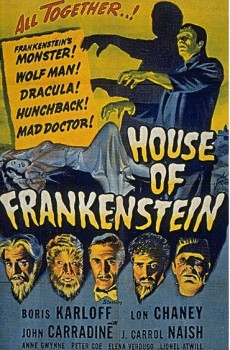
house_of_frankenstein_movie_poster1House of Frankenstein (1944)

Directed by Erle C. Kenton. Starring Boris Karloff, Lon Chaney Jr., John Carradine, J. Carrol Naish, Glenn Strange, Anne Gwynne, Elena Verdugo, George Zucco, Lionel Atwill.

I was working in the lab, late one night…

Ah, October. My favorite month. No other time is so ideal for exploring dark fantasy, the Gothic, the classic ghost story … and of course, Universal horror films. The monsters of Universal’s 1930s and ‘40s films have given the Halloween season its mascots, creatures as closely identified with the holiday as Santa Claus is with Christmas. So there’s no better Halloween party flick than the wall-to-wall monster epic that was the original “The Monster Mash”…

In seventy-one minutes, House of Frankenstein brings you:

  • Dracula
  • The Wolf Man
  • Frankenstein’s Monster
  • A mad scientist
  • A hunchback
  • A torch-wielding mob of angry villagers
  • A laboratory full of Kenneth Strickfaden-influenced sizzling equipment
  • Brain transplants!

All this, plus the hat trick of Boris Karloff, Lon Chaney Jr., and John Carradine in the same film; roles for classic supporting actors Lionel Atwill and George Zucco; and sexy Anne Gwynne. Now how much would you pay?

I paid $8.99 for my DVD, and I got Frankenstein Meets the Wolf Man on the same disc!
Read More Read More

The Greatest Harryhausen: The Golden Voyage of Sinbad

The Greatest Harryhausen: The Golden Voyage of Sinbad

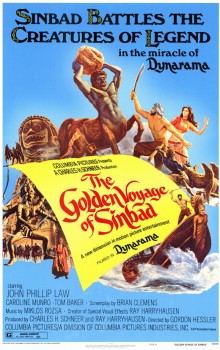
golden-voyage-posterThe Golden Voyage of Sinbad (1974)
Directed by Gordon Hessler. Starring John Philip Law, Tom Baker, Caroline Munro, Douglas Wilmer, Martin Shaw, Kurt Christian, Grégoire Aslan, Takis Emmanuel.

“Every voyage has its own flavor.”

Recently on this blog, I wrote about one of the more ignored of Ray Harryhausen’s films, The 3 Worlds of Gulliver. This inspired me to review two other films of his that don’t get enough attention—the underwhelming H. G. Wells adaptation The First Men in the Moon (1964), and the wonderful but financially unsuccessful The Valley of Gwangi (1969)—on my own blog. Now I think I owe the legendary effects animator and fantasy film producer some time with one of his most popular films.

The Golden Voyage of Sinbad is not only one of Harryhausen’s most financially successful movies, but is also, in my Harryhausen-loving fan-obsessed opinion, the greatest piece the special effects maven ever worked on. I think that it’s not only Harryhausen’s best movie, but also one of the finest heroic fantasy films ever made.

Morningside Productions, Harryhausen’s and his producing partner Charles H. Schneer’s company, had experienced a financial disappointment with 1969’s “cowboys ropin’ a dinosaur” adventure The Valley of Gwangi, and the gap between it and The Golden Voyage of Sinbad was the longest yet between their movies. The two men decided to turn the clock back and re-visit the figure who had brought them to prominence in the first place: Sinbad the sailor. The major success of 1958’s The 7th Voyage of Sinbad had allowed them to take the path of colorful fantasy and period science fiction, and the character was one who could have a variety adventures. Harryhausen had done some sketches in 1964 for a new Sinbad story, and now had the opportunity to realize the project. Both those early sketches reached the final film almost unchanged.

Read More Read More

The Call of Cthulhu Movie, 2005

The Call of Cthulhu Movie, 2005

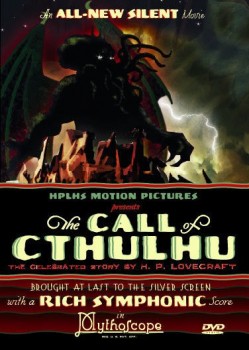
the_call_of_cthulhu_dvd_coverDirected by Andrew Leman; starring Matt Foyer, Chad Fifer, Noah Wagner, Ramon Allen Jr., and Ralph Lucas.
I cannot say I’ve ever been impressed with any film I’ve seen purporting to be based on a story by H.P. Lovecraft, as they have all tended to stray pretty far from what makes Lovecraft’s stories interesting in the first place. And they generally show the limits of their budget as well as being both poorly shot and acted. But then I heard about this little gem, distributed by the H.P. Lovecraft Historical Society, that adapts Lovecraft’s foundational short ‘The Call of Cthulhu’ in as loyal and accurate a way as possible. Not only that — and here’s the really interesting bit — the movie itself is a black and white silent film, as if it had been filmed at the time of the story’s publication in the 1920s.

The choice to make this a silent film was a smart one. Firstly, it does help evoke the period of Lovecraft in a way no film before it ever has (all of the ones I’ve ever seen where contemporary pieces, for a start), and also makes it feel like a world apart from our own. In leaving some things unseen and unsaid, and in creating an at times stylized environment, this film activates the viewer’s imagination to fill in the blanks — and speeches or effects which would seem silly or dreadful when laid bare in a modern film are instead left in the shadows. In surmounting the very limited budget for this project, the choice could not have been better.

Read More Read More

The “Other” Harryhausen: The 3 Worlds of Gulliver

The “Other” Harryhausen: The 3 Worlds of Gulliver

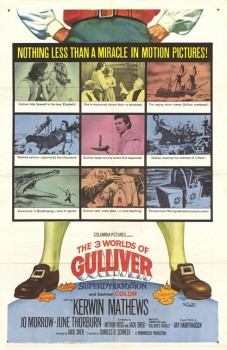
3_worlds_of_gulliver_posterThe 3 Worlds of Gulliver (1960)
Directed by Jack Sher. Starring Kerwin Mathews, June Thorburn, Grégoire Aslan, Basil Sydney, Jo Morrow, Sherri Alberoni, Peter Bull.

First there was the Dynamation spectacle of The 7th Voyage of Sinbad. Then there was Mysterious Island. Then the miracle of Jason and the Argonauts, and… wait, I seem to have skipped one. Oh yes, The 3 Worlds of Gulliver, made right after Sinbad. Now how did that one slip away?

Among the “Core Ten” Harryhausen films, the ten color fantasy and period science-fiction pictures he made between 1958 and his retirement in 1981 (all but one produced with Charles H. Schneer), The 3 Worlds of Gulliver gets the least amount of love now. For most of the 1980s, it was probably the unfortunate The Valley of Gwangi that suffered the most neglect, but that was because of its unavailability on video. (The weird name wasn’t helping it either; it certainly wasn’t the filmmakers’ first choice for the title.) Today, The 3 Worlds of Gulliver has turned into something of “the other movie” in the list of Harryhausen classics, even though it came out in 1960 fresh after the smash global success of The 7th Voyage Sinbad and featured that movie’s star, Kerwin Mathews, and its composer, Bernard Herrmann. In fact, Herrmann’s score is well-loved and appreciated among music fans through multiple re-recordings, but those same music lovers often haven’t watched the movie that inspired the music.

Read More Read More

Hercules vs. the Giant Robots

Hercules vs. the Giant Robots

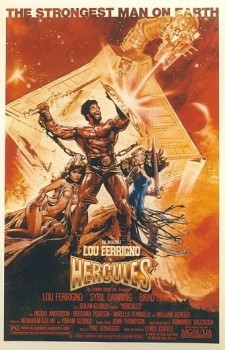
herculesposter1983Hercules (1983)Last week I reviewed a silly Conan pastiche novel. Today, I offer a sequel of sorts: a review of a very silly Hercules movie. The 1983 Hercules, sporting former mean, green, grunting machine Lou “Hulk” Ferrigno and the best special effects the Italian film industry can sort of buy, is one of the grandly awful pieces of entertaining oddness ever to come from a Roman studio. And Rome has given us some odd stuff. Aside from sanitation, medicine, education, wine, public order, irrigation, roads, the fresh water system, and public health, of course.

I encountered this Hercules when I was eleven years old. I adored Greek mythology since I was in second grade and was well-read in the topic, for which I can thank Clash of the Titans for the initial push. One Friday night, a friend and I watched Hercules when it premiered on cable. It sounded like a sure-winner for kids still not old enough to go out on weekend nights: Greek mythology, monsters, and that guy who played the Hulk. (Plus girls in skimpy outfits, but at eleven we weren’t willing to admit that was already a motivation.)

I’m not certain what I expected from Hercules back then, but it certainly wasn’t what I ended up getting. I had this strange illusion, which only an eleven-year-old can sustain, that a mystical law forced filmmakers to adhere to their source material as closely as they could. When I saw this oddball Hercules film on television, my young boy’s illusions died forever. Which is safer for my sanity, although I still feel the pains from the 1998 Roland Emmerich Godzilla and Jan de Bont’s 1999 demolishing of The Haunting [of Hill House]. The 1983 Hercules has only the most tenuous connection to Greek mythology, and appears like a mishmash of tiny bits and pieces of Hellenic legendary in a goopy stew of trendy science-fiction clichés from the SF-explosion of the late-‘70s. Welcome to Battlestar Hercules. Or perhaps Krull is the most appropriate comparison.

Read More Read More

Dragonlance: Dragons of Autumn Twilight

Dragonlance: Dragons of Autumn Twilight

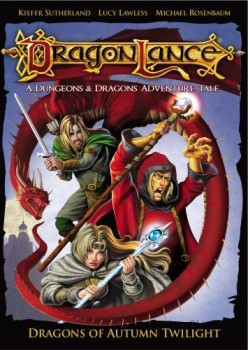
dragonlanceDragonlance: Dragons of Autumn Twilight
Directed by Will Meugniot. Featuring the Voices of Keifer Sutherland, Lucy Lawless, Michael Rosenbaum, Michelle Trachtenberg, Jason Marsden, Rino Romano.

During one of the classic episodes of Mystery Science Theater 3000, while Mike and the ‘Bots are watching the conclusion of the delightfully weird and wretched 1960’s Coleman Francis masterpiece The Skydivers, Mike abruptly remarks: “I don’t know guys. I still like this movie better than Top Gun. A lot better.”

So I will say this about the recent animated film adaptation of Dragons of Autumn Twilight: “I still like this movie better than the 2000 Dungeons & Dragons movie. A lot better.”

Be warned: these will be the last friendly words you are likely to hear in this review.

If Wizards of the Coast, the current owners of the Dungeons & Dragons media franchise, had serious intentions of starting a successful line of direct-to-video animated films based on the Dragonlance and Forgotten Realms novels, they couldn’t have done a finer job of slicing themselves off at the knees with a broadsword than this disaster of a movie. The DVD came out in January, and the reason you probably haven’t heard much about it until now is because so many people are trying to abide by “If you can’t say anything nice…” Or else the film immediately slipped their memory after seeing it. Both concepts make sense.

Read More Read More

Rome (2005)

Rome (2005)

I just watched about 25 hours of what I consider the best Sword and Sorcery I’ve seen in about the same number of years.

I’m speaking about HBO’s Rome, of course, the very expensive historical fiction epic that ran for two seasons 2005-2007. I’m sure many of you have seen it, but it was new to me (we don’t have cable). Apart from a few quibbles about some of the portrayals, specifically Cato the Younger and Octavian in the second season, I found it a fascinating peek into another age.

Read More Read More

Darkon

Darkon

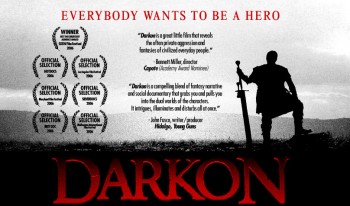
darkon_tstAs a follow-up to last week’s post on Escapism, I give you Darkon (2006), a low-budget documentary  by Andrew Neel and Luke Meyer that raises some of the same questions I did in my post as it looks at one particular group of LARPers (Live-Action Role-Players) involved in a game that has become its own little reality. Following the lives of a few key players in the drama, the documentary (which I watched free on Hulu after John Ottinger pointed it out, though it is also available from snag films) chronicles their in-game and out-of-game struggles, and how these facets of their lives intertwine.

If your initial reaction to adults pelting each other with foam swords is to roll your eyes, that’s probably even more reason to watch this documentary, which is a sympathetic and nuanced look at the lives of these players. Firstly, the film is presented as a real struggle for ‘in-game power’ between its two central characters, leaders of rival ‘countries.’ These competing factions of Darkon chart their progress in wars that allow them to expand across a map, and one faction, the nakedly imperialistic Mordom, has had more success at this than the rest. Feeling threatened, other countries lead by Laconia, band together to fight them.

Read More Read More

The People That Time Forgot: The Movie

The People That Time Forgot: The Movie

The People That Time Forgot (1977)
Directed by Kevin Connor. Starring Patrick Wayne, Doug McClure, Sarah Douglas, Dana Gillespie, Thorley Walters, Shane Rimmer, David Prowse, Milton Reid.

Amicus Productions waited two years to release a sequel to their hit The Land That Time Forgot, stopping along the way to do another Edgar Rice Burroughs adaptation, At the Earth’s Core. The People That Time Forgot marks the last gasp for its brand of low-budget fantasy/adventure film, since another film that came out that same summer of ‘77, set in a galaxy far, far away, caused a shift in genre-movie expectations when it turned into the highest-grossing film in history.

But The People That Time Forgot still brings handmade thrills and an old-fashioned attitude that adheres to Edgar Rice Burroughs’s style—if not to the letter of his writing. Unlike The Land That Time Forgot, which stays close to the first third of ERB’s novel in its script from Michael Moorcock and James Cawthorn, the script for the sequel from Patrick Tilley charts its own direction rapidly and leaves the original plot of the middle novella of the collective novel behind. Since the third novella, “Out of Time’s Abyss,” was apparently never slated for film adaptation, Amicus had to create a sense of completion with The People That Time Forgot that required dumping much of Burroughs’s material.

Read More Read More

Monsters vs Aliens

Monsters vs Aliens

Monsters vs Aliens: An IMAX 3D Experience (2009)
Directed by Conrad Vernon and Rob Letterman. Featuring the voices of Reese Witherspoon, Seth Rogen, Hugh Laurie, Will Arnett, Rainn Wilson, Kiefer Sutherland, Paul Rudd, Stephen Colbert.

Monsters vs Aliens disappointed me. “Disappointed” isn’t a term I normally use regarding a DreamWorks CGI-animated film. Or any CGI-animated film that doesn’t start with the Pixar logo. I’ve come to expect that computer-animated fare from anyone aside from Pixar means overused celebrity voice-acting and tiresome, unrelenting pop-culture references placed over the needs of story and character. So why would I feel disappointed when Monsters vs Aliens ended up in the same DreamWorks ballpark of the mediocre?

Because the trailers looked good. Because it was going to play theaters in IMAX 3D (not actual IMAX, but a blow-up for the larger format). Because it was an homage to one of my favorite genres, the 1950s science-fiction ‘B’-movie. Because it has giant monsters and robots.

For all its possibility, Monsters vs Aliens still ends up a stale non-Pixar ‘yuk-yuk’ festival. The filmmakers could have striven for something higher. They could have gone for Coraline—or even Monster House. Instead, they ended up with a movie somewhat superior to Shrek 2, Shrek 3, Kung Fu Panda, Madagascar, and Shark Tale. That’s a victory, of sorts. And the 3D in the IMAX enlargement is, at the very least, breathtaking.

Read More Read More