Browsed by
Category: Magazines

Birthday Reviews: Lawrence Watt-Evans’s “The Man for the Job”
Birthday Reviews: Lawrence Watt-Evans’s “The Man for the Job”

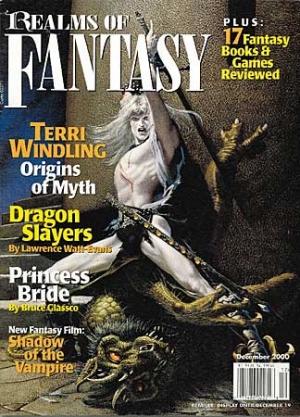
Cover by Michael Whelan

Lawrence Watt-Evans was born on July 26, 1954.

Watt-Evans’s short story “Why I Left Harry’s All-Night Hamburgers” was nominated for the Nebula and Hugo Awards in 1988 and won the Hugo Award. Watt-Evans was nominated for a second Hugo Award for best semi-prozine, as the co-editor, along with William Sanders, of Helix SF in 2008. Watt-Evans has published under the names Nathan Archer and Walter Vance Awsten. He has collaborated with Brenda Clough, Kurt Busiek, Christina Briley, Julie Evans, Esther Friesner, and Carl Parlagreco, and Dean Wesley Smith & Kristine Kathryn Rusch.

“The Man for the Job” was published in the December 2000 issue of Realms of Fantasy, edited by Shawna McCarthy. The story has not been reprinted has also appeared in The Lawrence Watt-Evans Fantasy MegaPack.

Watt-Evans takes on several fantasy standard tropes in “The Man for the Job.” The story opens with five siblings meeting with a wizard to get help in ridding themselves of an evil dragon. The group includes four brothers and their sister, who is insistent that they include her since her livelihood is at stake as well as theirs. The wizard, Gallopius, talks about magic items with them, noting that in days of yore, wizards hid magic items in strange, exotic, and stupid places where the wizards wouldn’t be able to retrieve them when needed. While Gallopius can lay hands on all his own enchanted items, they will need to complete a quest to find the Helmet of Balanced Justice to defeat the dragon.

The quest also subverts the typical quest story. The helmet is located relatively near to Gallopius’s home, and was hidden three hundred years earlier, protected by three guardians. Although Gallipius is able to tell them the nature of the guardians, they are not ready for the state they are in. Watt-Evans takes the idea of a centuries old protection to its logical conclusion, as all three guardians have failed to withstand the ravages of time and they manage to retrieve the helmet with some ease.

Read More Read More

Birthday Reviews: Brian M. Stableford’s “The Growth of the House of Usher”

Birthday Reviews: Brian M. Stableford’s “The Growth of the House of Usher”

Cover by Pete Lyon
Cover by Pete Lyon

Brian M. Stableford was born on July 25, 1948.

Stableford received the British SF Association Award for his short story “The House of Mourning.” His anthology Tales of the Wandering Jew won the Readercon Award for Best Anthology and his novel The Empire of Fear won the Lord Ruthven Award. He has also won several scholarship awards, including the Eaton Award for his book Scientific Romance in Britain: 1890-1950, the Pilgrim Lifetime Achievement Award from the Science Fiction Research Associastion, the IAFA Distinguished Scholarship Award, and the SF&F Translation Award. Stableford has published under his own name as well as the pseudonyms Francis Amery and Brian Craig.

“The Growth of the House of Usher,” the first of Stableford’s loosely connected tales of the Biotech Revolution, first appeared in the Summer 1988 issue of Interzone, issue #24, edited by Simon Ounsley and David Pringle. Gardner Dozois recognized it in The Year’s Best Science Fiction: Sixth Annual Collection the following year. It was also reprinted in David Memmott’s fanzine Ice River, issue 4 in June of 1989. John Clute, Pringle, and Ounsley selected the story for Interzone: The 4th Anthology. Stableford included it in two of his collections of stories about the Biotech Revolution with the similar titles Sexual Chemistry: Sardonic Tales of the Genetic Revolution and Sexual Chemistry and Other Tales of the Biotech Revolution.

Stableford acknowledges early in the story that the title of “The Growth of the House of Usher” is a call back to Edgar Allan Poe’s “The Fall of the House of Usher.” In Stableford’s story, set in the 23rd century, Rowland Usher has secluded himself away from his fellow man, living in a massive house of his own design in the delta of the Orinoco River in Venezuela. He has summed an own college friend to see the house and to let him know that Usher has chosen his friend to be his executor, for Usher suffers, as his father and sister suffered before him, from a deadly disease.

Despite being a science fiction story, focusing on using biotech to create buildings and improving biotech for even greater things, the story clearly belongs to the Gothic tradition, although while a lot of Gothic fiction is wary of technology (see Frankenstein), Stableford’s story embraces the possibilities. This is most obvious in the description of the massive home Usher has built, made of replicating biomatter which will continue to grow and improve long after he, and his friend, are dead. At the same time, even if technology and science can’t save Usher’s life, he still views it favorably, seeing the sacrifice of his own life to the disease as a means of helping science learn what ravaged his family in the hopes of preventing it in the future should it reappear.

Read More Read More

Birthday Reviews: Barry N. Malzberg’s “Tap-Dancing Down the Highways and Byways of Life”

Birthday Reviews: Barry N. Malzberg’s “Tap-Dancing Down the Highways and Byways of Life”

Cover by Ron Walotsky

Barry N. Malzberg was born on July 24, 1939.

Malzberg received the inaugural John W. Campbell Memorial Award for his novel Beyond Apollo. His novel Herovit’s War was nominated for the Jupiter Award and he’s had nominations for the Theodore Sturgeon Memorial Award, the British SF Association Award, and the Philip K. Dick Award. He has been nominated for the Hugo Award five times and the Nebula Award six times.

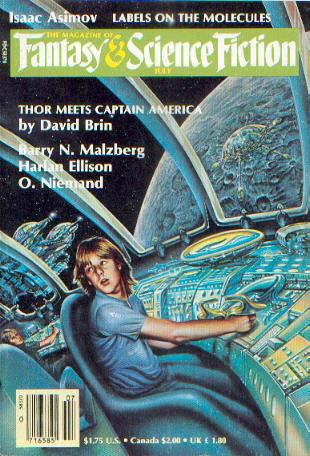
“Tap-Dancing Down the Highways and Byways of Life” was originally published by Edward L. Ferman in the July 1986 issue of The Magazine of Fantasy and Science Fiction. Although it wasn’t reprinted in English until appearing in The Very Best of Barry N. Malzberg in 2013, it was published in French, Italian, and German translations within seven months of its original publication.

It would appear that Cecil’s big mistake in “Tap-Dancing Down the Highways and Byways of Life” was robbing someone who not only knew who he was, but also knew his parents. As his victim holds back money, calls him out, and points out how disappointed Cecil’s parents will be to hear about his poor life choices, Cecil decides that the best way out of the situation is to shoot his victim in the head. Malzberg is not telling Cecil’s story, however, he is telling the story of the intended robbery victim.

Cecil’s victim is brought back to life, or possibly awoken from a virtual reality scenario, Malzberg is never really clear on the mechanism. What is clear is that the victim is supposed to react to the robbery in a specific way and is not doing what he is supposed to, notably, giving Cecil the money and following his instructions in order to live another day. His unnamed handlers give him multiple opportunities to correct the situation and he keeps finding himself facing an armed Cecil with a gun, eventually deciding that he can’t live as a complacent victim in the world his handlers are trying to shoe-horn him into.

Malzberg’s story takes on darker tones when the reader considers who the victim’s handlers are and what their motives could be. They could simply be preparing people to live and survive in a more violent world, accepting what they can’t change in order to live another day. On the other hand, they could be conditioning people to being victims, making it easier on the criminal and violent classes to prey on the innocents.

Read More Read More

A (Black) Gat in the Hand: W.T. Ballard’s Bill Lennox

A (Black) Gat in the Hand: W.T. Ballard’s Bill Lennox

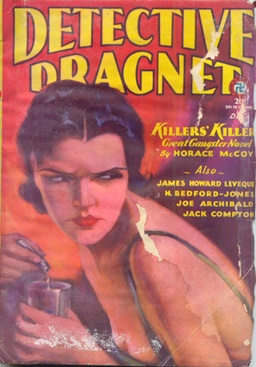
Gat_DetectiveDragnet_BallardOne of the authors that I’ve ‘discovered’ while working on A (Black) Gat in the Hand is W.T. Ballard. I had read a story here and there in various anthologies, but nothing stuck with me. I knew he was a Black Masker and had been successful as a writer of westerns. But I’ve just read a couple stories of his Hollywood ‘fixer,’ Bill Lennox and I was sold!

Ballard, who wandered out west when the Depression hit, had been trying to sell to the New York pulps with minimal success. He saw a Detective Dragnet Magazine with one of his stories in a store window (December, 1930). As he walked away, a man called out his name: it was Harry Warner, who he had known a little back in Cleveland, where the family had been making movie trailers for local organizations.  Warner asked what Ballard was doing in Hollywood. A bit embarrassed, the latter exaggerated a bit, bought that magazine and gave it to Warner, saying he was a freelance writer.

Warner and his brothers had just taken over First National Studios, and impressed with Ballard, Harry W. hired him as a screenwriter at a good salary. That gig lasted eight months until Ballard made a crack about Warner, not knowing the man was standing behind him. Fired!

Ballard was picked up by Columbia Pictures, who hired him to produce B-films for $10,000 each. To hit that target, Ballard had to write the script, direct and produce, and even move scenery for shoots. He endured this exhausting assignment for six months – but the two studio jobs gave him an invaluable inside knowledge of the industry.

In 1931, Ballard was struggling, trying to write and sell to Detective Story Magazine, which favored Agatha Christie/Mary Roberts Rinehart types of mysteries. At his uncle’s house (where he was living), he heard a radio ad for The Maltese Falcon, a movie starring Ricardo Cortez (Bogart hit gold in the third adaptation). He went to see the movie. As Ballard said in an excellent interview conducted by Stephen Mertz. “Hammett’s ear for words sounded the way I thought criminals and detectives should talk. It rang true, the way I wanted mine to do.”

The radio ad had mentioned Black Mask, which Ballard was unfamiliar with. After the movie he went around the corner, bought the latest issue and read it on the streetcar ride home. He was hooked.

Ballard didn’t want to write about the typical newspaper reporter. His friend Jim Lawson worked at Universal Studios and was often called on to get stars out of trouble. Ballard liked the idea, knowing he had the studio experience to write realistically.  Using the phone book to help with names, that very night, around midnight, he started writing. About five in the morning, he had a 10,000-word story featuring Bill Lennox. He mailed the manuscript off and went to bed.

Read More Read More

Birthday Reviews: Dean McLaughlin’s “The Permanent Implosion”

Birthday Reviews: Dean McLaughlin’s “The Permanent Implosion”

Cover by John Schoenherr

Dean McLaughlin was born on July 22, 1931.

McLaughlin’s career began in 1951 and his most recent story, “Tenbrook of Mars,” appeared in Analog in 2008 and won the next year’s Analog Readers Poll. His 1968 novella “Hawk Among the Sparrows” was nominated for both the Hugo and Nebula Award, losing to Robert Silverberg’s “Nightwings” and Anne McCaffrey’s “Dragonrider,” respectively.

“The Permanent Implosion” originally appeared in the February 1964 issue of Analog Science Fact & Science Fiction, edited by John W. Campbell, Jr. It was reprinted in 1966 in the anthology Analog 4 and was the cover story of the 1970 anthology The Permanent Explosion: Science Fiction Edited by John W. Campbell. McLaughlin included the story in his only collection, Hawk Among the Sparrows: Three Science Fiction Novellas, published in 1976. Stanley Schmidt chose the story for Analog: The Best of Science Fiction in 1985.

“The Permanent Implosion” is a puzzle story in which Mick Candido must try to resolve a problem that has been dropped in his lap. Candido runs a successful well capping company, called in to extinguish oil fires and make sure the wells are covered. He is drawn into a different sort of situation when the government calls upon him for help in capping a different sort of well, one for which Candido’s team doesn’t have any experience, but neither does anyone else.

Outside of Denver, a hole had opened between our world and the vacuum of space. The hole is sucking our atmosphere in an attempt to equalize the pressure on both sides; the eventual result will be an Earth with an atmosphere so tenuous that life is impossible. Candido and his team, with the government’s guidance; get to work.

The story is an exploration of patience and failure. The initial solution for which Candido’s team was called in fails to stop the leak, but he remains with the team, helping them implement other potential solutions, all of which fail. As the team becomes more and more despondent of ever finding a solution, Candido begins to look at the problem from a different point of view, eventually coming up with a solution which will also serve to make his fortune.

Read More Read More

Birthday Reviews: Martha Soukup’s “Sweet Bells Jangled”

Birthday Reviews: Martha Soukup’s “Sweet Bells Jangled”

Cover by George H. Krauter

Martha Soukup was born on July 20, 1959.

Martha Soukup received the Nebula Award in 1995 for her short story “A Defense of the Social Contracts.” She had been nominated for the Nebula Award four previous times. Soukup has also been nominated for the Hugo Award, the World Fantasy Award, The James Tiptree Memorial Award, and the Theodore Sturgeon Memorial Award. In 1988, she was a nominee for the John W. Campbell Award for Best New Writer.

“Sweet Bells Jangled” was published in the September 1995 issue of Science Fiction Age, edited by Scott Edelman. It has never been reprinted.

One of the most famous science fiction novels of all time is built around the concept of an earworm. In Martha Soukup’s “Sweet Bells Jangled,” earworms are paired with the concept of memes (which have evolved in meaning considerably since the story was published) in Laurie’s mind after a shoot-the-breeze conversation with her friend Chuck, who suggests without evidence that the unintentional ability to remember song lyrics could eventually fill up a person’s memory.

Although Chuck is making a joke, Laurie took the idea to heart and throughout the story, filled with random lines of song lyrics she hears each day, Laurie’s ability to hear anything other than the music or, indeed, to function on any level, becomes stunted. Because she isn’t able to articulate what is happening to her, and Chuck shrugs it off as part of a harmless joke, nobody is able to help her when the eventual shutdown of her brain occurs.

Read More Read More

Birthday Reviews: T.E.D. Klein’s “The Events at Poroth Farm”

Birthday Reviews: T.E.D. Klein’s “The Events at Poroth Farm”

Cover by Oscar Grand

T.E.D. (Theodore Eibon Donald) Klein was born on July 15, 1947.

In 1986, Klein won the World Fantasy Award for his Novella “Nadelman’s God” and also won the August Derleth Fantasy Award for his novel The Ceremonies. In 2012, World Horror Con named Klein a Grand Master. He was a two-time nominee for the coveted Balrog Award and was nominated for the World Fantasy Award seven times.

Klein’s first story was “The Events at Poroth Farm,” originally published in the fanzine From Beyond the Dark, edited by Edward P. Berglund in December 1972. Despite its fannish origins, the story was picked up by Richard Davis for The Year’s Best Horror Stories No. 3 and was translated into German for publication in that anthology. The story was also nominated for the World Fantasy Award and Gahan Wilson included it in First World Fantasy Awards. In 1984, Klein expanded the story to novel length and published it as The Ceremonies. The novella was published as a chap book in 1990. David Drake and Martin H. Greenberg reprinted it in A Century of Horror: 1970-1979 and Scott David Aniolowski included it in Return to Lovecraft Country. The story was also included in Eternal Lovecraft : The Persistence of H. P. Lovecraft in Popular Culture, edited by Jim Turner. Klein used it in his collection Reassuring Tales and S.T. Joshi used it in the anthology American Supernatural Tales. Peter Straub used it in American Fantastic Tales: Terror and the Uncanny from the 1940s to Now. Klein revised the story in 2012 for inclusion in the e-book The Cthulhu Mythos Megapack.

“The Events at Poroth Farm” is a Lovecraftian tale told as a series of diary entries bookended by a prologue and epilogue by the diary’s author, who has managed to survive the horror on the isolated farm where he rented a room for three months.

Read More Read More

In 500 Words or Less: A Short Fiction Roundup!

In 500 Words or Less: A Short Fiction Roundup!

oie_11175654znBnLB0voie_11175745eAgDEx2yFocusing a review into less than five hundred words is tough sometimes, but I feel like I’ve got the hang of it. The obvious next step? Talk about multiple books in one review!

This week I’m doing a roundup of some excellent short fiction I’ve read in the last few weeks. It covers a breadth of genres and styles, so hopefully some (if not all) of what I mention below appeals to you.

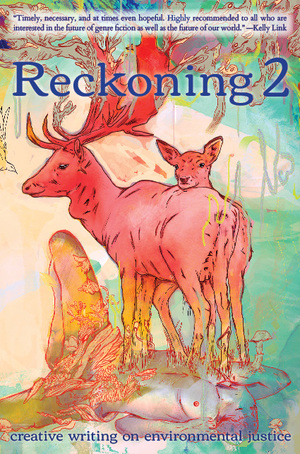
First off, I had the pleasure of receiving an ARC of the second issue of Reckoning, edited by Michael J. DeLuca, who I co-hosted the first #solarpunkchat with on Twitter in April. Reckoning focuses specifically on environmental justice, and Issue 2 is packed with a ton of experimental and forward-thinking work about sustainability, culture and the environment. Michael’s introduction concerning how to raise a child knowing their world will be fundamentally different than your own echoed a lot of my concerns about teaching, but the piece that blew me away was Marissa Lingen’s “The Shale Giants,” giving voice to the earth beneath us, which might not be patient and benevolent forever.

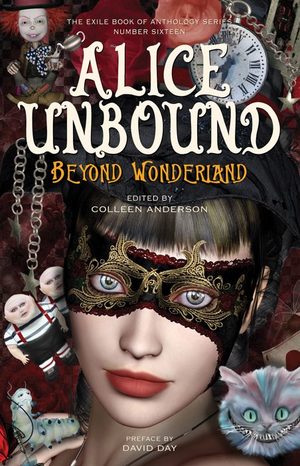
If you’re a fan of themed anthologies, get a copy of Alice Unbound from Canada’s Exile Editions, which riffs off Alice in Wonderland with SFF twists. There are too many great stories to mention here. Kate Heartfield, whose debut novel I reviewed recently, creates a tragic narrative around Carroll’s Gentleman in the Paper Suit in “Dressed in White Paper.” Geoff Gander and Fiona Plunkett turn Alice and her friends into Firefly­-esque freelancers, complete with a caterpillar alien, in “Full House.” Though the final reveal in Pat Flewwelling’s story of madness spreading through an airport is a little too on-the-nose for me, “Cyphoid Mary” is still the most terrifying piece in the anthology. But my absolute favorite is “The River Street Witch” by Dominik Parisien, told from the perspective of a young girl who believes she’s a witch with no control over her magic, but if you read between there’s much more at play — this is a story that will stay with you long after you’ve finished.

Read More Read More

Birthday Reviews: Stephen Robinett’s “A Penny’s Worth”

Birthday Reviews: Stephen Robinett’s “A Penny’s Worth”

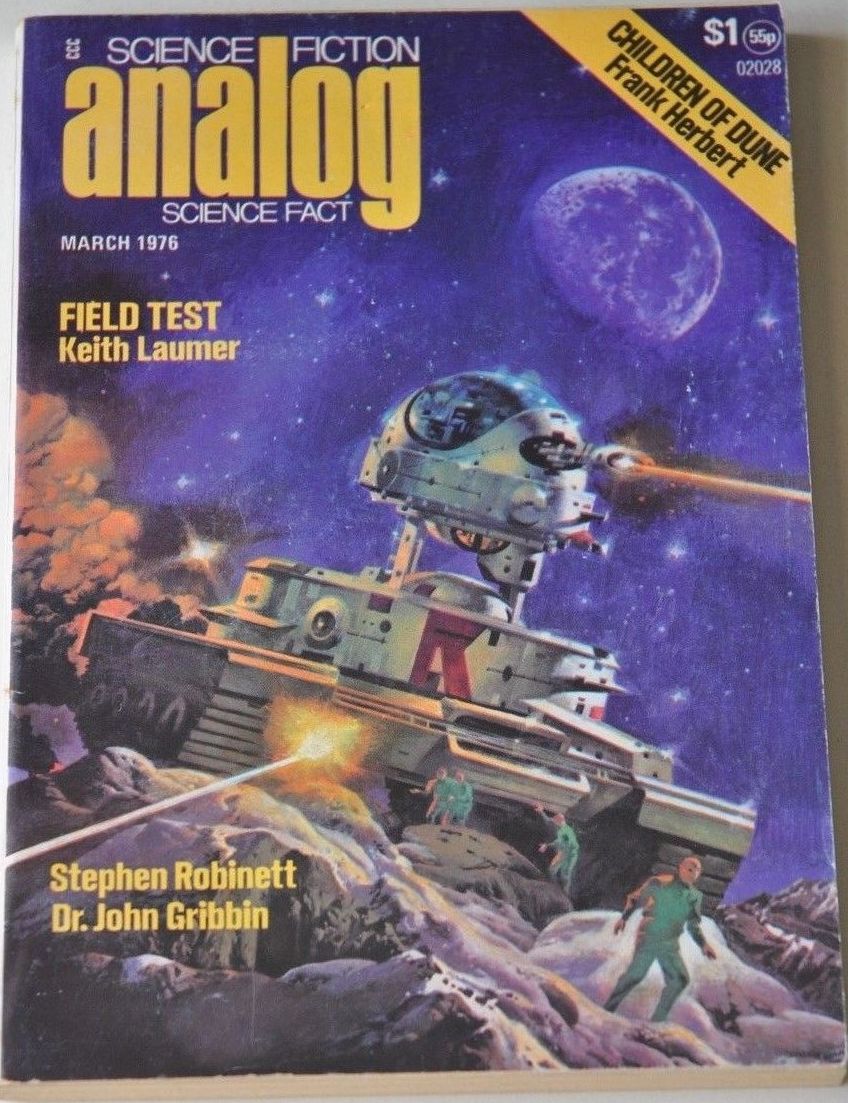
Cover by Vincent di Fate

Stephen Robinett was born on July 13, 1941 and died on February 16, 2004.

Until 1975, Robinette published using the name Tak Hallus. Although he has mostly used his own name since then, in 1976, he published the novel Mindwipe! using the pseudonym Steve Hahn.

“A Penny’s Worth” appeared in the March 1976 issue of Analog, edited by Ben Bova. It was the story’s only appearance.

Robinett created the lawyer Harry Penny for the story “A Penny’s Worth,” and Penny finds himself hired by a graduate student, Marshal Pierce, to defend Pierce against assault and battery charges. Although Pierce claims no recollection of assaulting Dr. Charles Morrow, there are two witnesses, Morrow’s wife and a neighbor, who saw the attack. The story follows Penny as he interviews witnesses and others with ties to Pierce and Morrow, to figure out what happened. The story is engaging, although the solution is telegraphed rather early on.

While Morrow and Pierce don’t know each other, there are several links between the two. Pierce worked as a graduate student for Ray Winslow, Morrow’s former, and now dead, partner. At one time Harry dated Nora, who went on to marry Winslow before leaving him for Morrow. Vernon Vernon, Pierce’s boss who fired him for stealing something after Winslow died, although Pierce claims he had Winslow’s permission to take it, also has ties to Morrow. What is clear to the reader from early on is that the medication Winslow had Pierce take somehow makes Pierce seek out Morrow to get vengeance for what Morrow did to Winslow.

Sometimes, however, plot isn’t the most important thing and so knowing the solution, rather than spoiling the story, provides a sense of foreshadowing. What caused the attack in this case is less important than Penny’s way of finding out what the reader has already figured out. His interviews with Nora, Morrow, and Vernon and his instructions to Pierce to help the boy avoid prison time for assault or worse, are the keys to the story and make it a very entertaining piece of fiction. Penny and his world seem as if they were developed to be an ongoing series, and Robinett would return to the character the following year in the novella “The Man Responsible.”

Read More Read More

Birthday Reviews: James Gunn’s “The Day the Magic Came Back”

Birthday Reviews: James Gunn’s “The Day the Magic Came Back”

Cover by Chris Moore

James E. Gunn was born on July 12, 1923.

In 1976, Gunn received a Worldcon Special Convention Award at MidAmeriCon for his book Alternate Worlds: The Illustrated History of Science Fiction. The same year the Science Fiction Research Association presented him with the Pilgrim Award. He was recognized with an Eaton Award in 1982. In 1983, his book Isaac Asimov: The Foundations of Science Fiction won the Hugo Award for Best Nonfiction Book. He received the Clareson Award from the SFRA in 1997. He received the Moskowitz Award in 2000 and was named a SFWA Grand Master in 2007. In 2009, he was inducted into the First Fandom Hall of Fame. Gunn was one of the Guests of Honor at LoneStarCon 3, the 71st World Science Fiction Convention held in San Antonio, Texas in 2013. Two years later, Gunn was inducted into the Science Fiction Fall of Fame in Seattle.

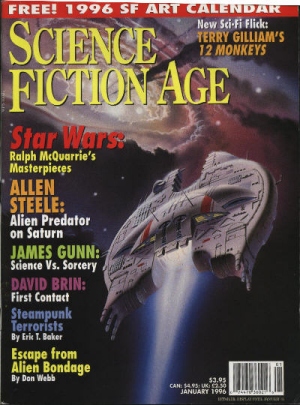
“The Day the Magic Came Back” was purchased by Scott Edelman for Science Fiction Age and appeared in the January 1996 issue. Gunn later included the story in his collection Human Voices, originally published in 2002.

When world class physician Dr. Knowland is unable to cure 9-year-old Linda Constant’s disease, her family brought in their preacher, Mr. Alma, to the hospital to pray for her. As she slowly became better, Knowland had to admit that she was cured more by Alma’s prayer than by Knowland’s medicine, and Knowland went in search of the faith healer to learn his methods.

Although what Knowland learned was a conflict between belief and science, he approached Alma’s technique with an open mind, coming to the conclusion that Alma was influencing people’s health through an unknown, and not provable or necessarily reproducible, means. The realization produces a fear in Knowland not because he frets for his job, he admits that science needs something to fall back on, but rather because it destroys his understanding of the fundamental way the universe works. Even if his science and medicine continue to work, his universe has suddenly become too unpredictable for his tastes.

Read More Read More