“The Distances Between Things”: Patricia A. McKillip’s The Changeling Sea
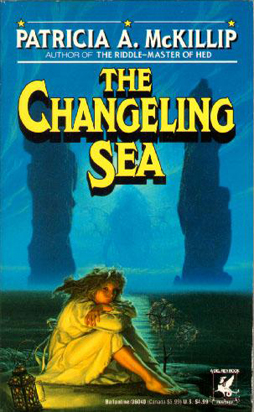 I’ve written a few times about my ongoing fascination with fantasy from the 1980s. That fascination led me to pick up a used copy of The Changeling Sea, a short 1988 novel by Patricia A. McKillip. McKillip isn’t specifically a 1980s writer — her first novel, The House on Parchment Street, was published in 1973, and she’s produced work steadily ever since; her last novel, The Bards of Bone Plain, came out in 2010 and a collection of short stories, Wonders of the Invisible World, was published in 2012. (You can find some reviews of her recent work at Black Gate: here Isabel Pelech looks at The Sorceress and the Cygnet, and here Thomas M. MacKay looks at Harrowing the Dragon). But having read some of her work from the 70s, specifically the Riddle-Master trilogy, I’d hoped to get a sense of how her work had developed through the 80s. And perhaps find the sort of unexpected angle on the fantastic some of the fantasy of that period provides.
And I did; I thought the book was excellent. It’s no surprise at all to see it was a finalist for the 1990 Mythopoeic Award. It’s precisely in the way it evokes the feel of a folktale, the feel of myth mixed with the matter of common life, that the book shines. It’s about love, and loss, and magic, and change. It has something of the feel of what now would be called young-adult fiction, with the specific kind of complexity that form can present: a young person encountering the adult world edge-on, struggling to understand what they’re finding, dealing with things that went wrong a generation ago, and trying to do no further wrong.
On a small island, one of seven making up a kingdom in a northern sea, a fifteen-year-old girl named Peri works at an inn. Her fisherman father has been taken by the sea a year ago, since which time her mother has drawn into herself. Finally, Peri can take it no more and casts a hex upon the sea. A prince becomes involved; and the magic takes a strange twist. A wandering wizard passes by. Things and people change, metamorphose magically and otherwise, and Peri must take a journey into the strange world under the ocean before the fate of land and sea will become clear.
 Last August,
 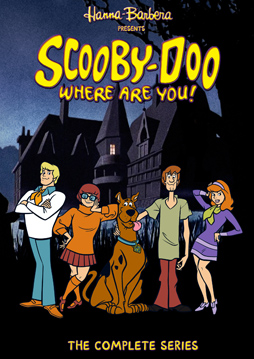 It’s been a while since I posted anything here at Black Gate. There’s no one reason; a number of things have kept me busy or occupied, most recently a persistent head cold and ear infection. I mention this because being under the weather has indirectly to do with the following post. Firstly, being sick led me to watch some TV shows which I now want to write a bit about. Secondly, my mental state shaped the way I thought about what I experienced; I can only hope now to capture the sense of coherence I had then. This essay will be more shapeless than usual, I’m afraid, an attempt to explain the connections that drifted through my mind between Alan Moore, Doc Savage, and Scooby Doo, among others.
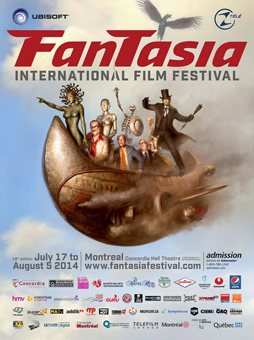 As I write this, I’m preparing for a vacation in the country. It’s an odd thing, in that the past three weeks have been a kind of vacation in themselves, as thanks to John O’Neill here at Black Gate and to the Fantasia staff, I was able to cover this year’s edition of the Fantasia International Film Festival. Still, watching (by my count) thirty-nine movies and writing about all of them was quite a project. Fun, though. I thought I’d take a quick post to wrap up my coverage by talking about what I’ve learned from the experience.
 I closed out this year’s Fantasia film festival with a movie on Wednesday and another on Thursday. Together they seemed to say something about the festival, in that they had virtually nothing in common. They’re from different countries, they’re different genres of film, they have wildly different budgets — and yet somehow they both seem to belong at Fantasia. Unsurprisingly, one played the big Hall Theater, while the other screened at the small De Sève.
 Last Tuesday saw the presentation of the official closing film of the 2014 Fantasia International Film Festival. Film festivals being what they are, there’d actually be another two days of films after that. In any event, I’d manage to see the closer, after catching two other movies earlier in the day.
 As I said in my last post, I went out of town for the first weekend of August, and thus missed a couple days’ worth of movies playing at the Fantasia film festival. I was able to catch up with some on Monday, though. Fantasia maintains a screening room, with workstations where journalists, industry people, and other accredited folks can watch movies on computer. It’s not the optimal way to experience a film — they’ve usually been burned onto a DVD or accessed through a private Vimeo account — but it’s serviceable if you can’t catch the movie any other way. The screening room usually loses rights to the movies shortly after they play at the festival, but when I went by on Monday, there were still quite a few available.
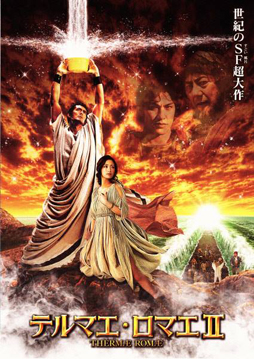 A week ago, on Thursday, July 31, I saw yet another movie at the Fantasia Festival. Then I left town for the weekend to attend to some business of my own. I got back in on Sunday, and went to see another movie Monday evening. By that time, I’d also been able to catch up on a couple of films that I’d missed over the weekend — but I’ll be talking about them later. For the moment, I’ll discuss the films I saw in the Fantasia theatres.
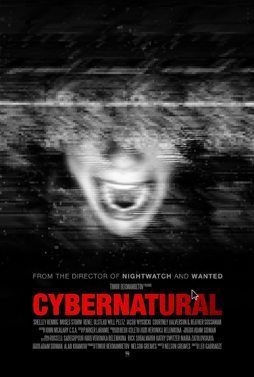 I didn’t see any films at Fantasia on Monday, July 28, and then on the 29th I saw two. One was Guardians of the Galaxy, which
 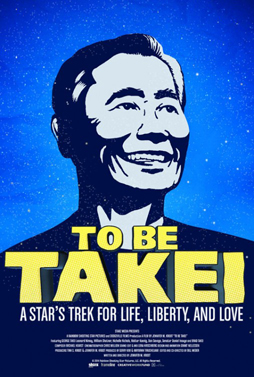 I saw two movies in the late afternoon and evening of the Sunday before last (the 27th). Both were documentaries. You’d think that the first one would have had the more obvious science-fiction content, being a biography of an actor who rose to fame playing a character on perhaps the best-known science-fiction TV show of all time — while the second film was an in-depth examination of what sounds like the most mundane substance in the world. This did not turn out to be the case. The old saying about truth, fiction, and strangeness applies.