 One of the oddest, most esoteric regrets in my life is that I long ago gave away my collection of the now defunct American Film magazine. Most of these, purchased primarily from sidewalk vendors in Manhattan, I do not care to recover; but I would give a great deal to have again the October issue from 1986. It contains a dialogue with film producer David Puttnam, and one small paragraph in that interview taught me more about collaboration than any other single event I know.
More on that in a moment. In the meantime, let me introduce one of Hollywood’s really fine on-screen adventures, The Duellists.
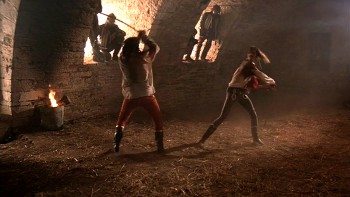
Now, I admit up front that as with The Horseman On the Roof, a title I explored a few weeks back, The Duellists contains no overt fantasy element; but what it lacks in sorcery, it more than makes up for in swords. Right out of the gate, Lieutenant D’Hubert (Keith Carradine, one of my very favorite actors) is ordered by a busy general to round up fellow cavalry man Feraud (Harvey Keitel) and escort him to the brig; it seems that Feraud has been dueling, illegally, with the mayor’s nephew. Feraud takes offense first to D’Hubert’s assignment and then to D’Hubert himself; he challenges him on the spot to a duel, an event D’Hubert, a reasonable man, ultimately cannot prevent.
Thus the wheel of this most simple of plots grinds into implacable motion: D’Hubert cannot ever contrive to avoid Feraud, and neither, in repeated duels, each instigated by Feraud, can ever quite kill off the other. Over the course of the Napoleonic wars, these two clash again and again in a battle both particular and symbolic. D’Hubert’s enlightened rationalism must stave off Feraud’s chivalric single-mindedness, and both, to D’Hubert’s dismay, must contend with the expectations of the times: that their differences constitute a “point of honor” (indeed, such was the title of the story on its U.S. publication), and that to settle this point, one of them must die.
But wait, you cry! What about David Puttnam and all those moldering magazines?
…
Read More Read More
 As I write this, April is just around the corner, and now that Hollywood’s best and brightest studios no longer know how to calculate the beginning of summer, I smell blockbuster season ripening fast on the vine. Just think, in mere weeks, we can all flock to see Star Trek: Into Darkness, Iron Man 3, Wolverine, Oblivion, Pacific Rim, Elysium, and Man of Steel.

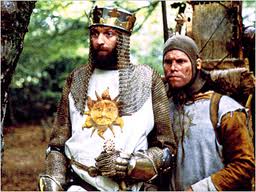 Just as an older generation recalls with perfect clarity where they were when they heard of Kennedy’s assassination, I know precisely where I first saw Monty Python and the Holy Grail (1975): perched on the floral-print sofa in my parent’s house, watching the film on a poor, weather-impacted PBS broadcast. I also remember falling right off that sub-par couch in paroxysms of laughter when the animator saved King Arthur’s band by conveniently suffering a heart attack.
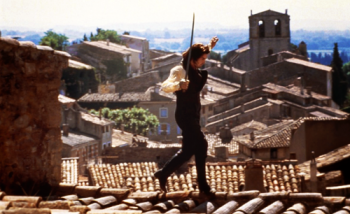 I didn’t know it at the time, but back when I was ten and surfing through horrendous Tarzan movies on rainy Saturday afternoons, The Horseman On the Roof (Le Hussard Sure le Toit, 1995) was the film I was actually hoping to see. Not that I would have understood much of what was going on, but the kinetic energy of it –– the film’s unswerving certainty that these events matter –– would have transported me right out of my seat.