Browsed by
Author: John ONeill

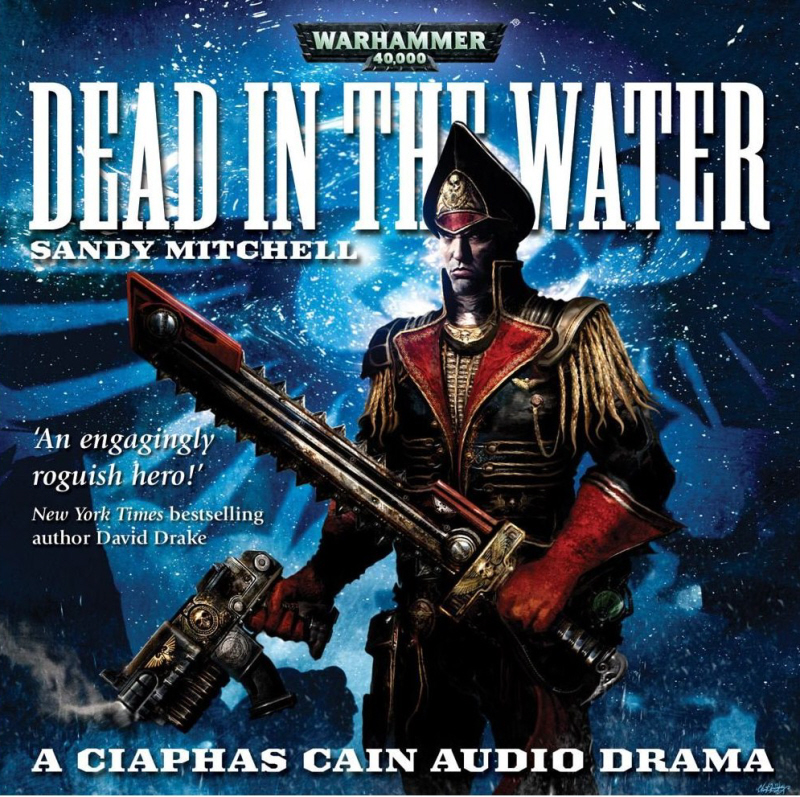
New Treasures: Dead in the Water, a Warhammer 40K Audio Drama
New Treasures: Dead in the Water, a Warhammer 40K Audio Drama

dead-in-the-water-sandy-mitchellLast week, I wrote a brief introduction to the Warhammer 40K universe, under the guise of a review of The Achilus Assault gamebook. It was a cheap gimmick, I know, but life is short and filled with great things you need to know about.

In the comments section Joe H wrote:

I love the WH40K setting, the thing that bothers me is that they have this vast sprawling galaxy full of wonders and terrors and way too much of the content seems to boil down to Space Marines vs. Space Orks… That’s why I was so intrigued by Rogue Trader — a WH40K setting that’s not just about FOR THE EMPEROR! I just wish we’d get more of that kind of thing in the novels. Are there any current novels that move outside of the Space Marine paradigm?

I love these kinds of questions. The kinds I actually have an answer to, I mean. And the answer in this case is yes.

There are several great series I could point you to, but because it’s after 9:00 pm and my family is impatiently waiting for me to start our family movie, I’m going to limit it to one: You should try the Ciaphas Cain novels by Sandy Mitchell. Commissar Cain is a revered hero of the Imperium, a man who’s seen action in some of the deadliest hot spots in the galaxy… and he’s pretty much done with that. All he wants to do is keep his head down and serve out his tour of duty… but alas, fate has other plans.

Cain is an entertaining rogue in a universe of dark horrors, and it’s a winning combination. There are several excellent omnibus collections of his novels available, but I recommend you start the same way I did: with Dead in the Water, a terrific one-hour audio drama that serves as the perfect intro to both Cain and the Warhammer 40K universe.

Cain is enjoying a quiet posting to a backwater river world when a squad on a routine mission goes missing. Pressed into investigating by his commanding officer, Cain quickly discovers that all is not what it seems… and a sinister opponent is manipulating events behind the scenes. The action is quick, the characters memorable, and the narration by Toby Longworth is excellent. The production quality of these Black Library Audio Dramas — with their dead-on sound effects, moody original music, and tight plotting — has been consistently excellent, and they have quickly become highly collectible. Already the early releases are out of print and starting to command collector’s prices on Amazon.com. I suggest you grab this one while you can.

Dead in the Water was published by Black Library in June, 2011.  It is one hour on a single CD, priced at $17.

Tangent Online: “‘Godmother Lizard’ Entranced Me From the Beginning”

Tangent Online: “‘Godmother Lizard’ Entranced Me From the Beginning”

claire-254Tangent Online reviews C.S.E. Cooney’s original fantasy novella “Godmother Lizard,” published at Black Gate on Sunday, November 10:

C.S.E. Cooney’s “Godmother Lizard” is a delightful fantasy tale about an orphan girl, Ro, and how she becomes a hero by saving her friends from their human-looking mother who was slowly eating them. It takes her two decades to accomplish this, but that’s part of the charm of this story. Cooney deftly uses that time to grow Ro and her friends into adults which changes them from victims to empowered.

I enjoyed the fantastical elements in Ro’s world. The essence of its magic is poignantly captured when Wyll, Jaks’ younger brother, gives Ro his living silver lizard bracelet for protection: “It wound in frantic circles around his finger, mewling all the time, until it had spiraled to rest a blunt triangular head upon his fingernail.”

The story language is rich and colorful, the growing relationship between Ro and Jaks reminiscent of chivalrous lords and ladies. The dialog has a pleasantly oblique edge to it which entranced me from the beginning. I highly recommend it.

I felt the same way when I first read it. “Godmother Lizard” is a marvelously creative fantasy set in a uniquely inventive world — one that Cooney returns to in her upcoming story “Life on the Sun.” Catch it right here as part of our upcoming line of Black Gate Original Fiction.

Read Louis West’s review in its entirety at Tangent Online, and read C.S.E. Cooney’s novella “Godmother Lizard” completely free here.

The complete catalog of Black Gate Online Fiction, including Judith Berman’s sword & sorcery tale “The Poison Well,” Donald S. Crankshaw’s 50,000-word short novel A Phoenix in Darkness, Aaron Bradford Starr’s adventure tale “The Daughter’s Dowry,” the 25,000-word dark fantasy novella “The Quintessence of Absence” by Sean McLachlan, Harry Connolly’s thrilling mystery “The Whoremaster of Pald,” and Jason E. Thummel’s adventure fantasy novelette “The Duelist” is here.

Dabir and Asim Discover England

Dabir and Asim Discover England

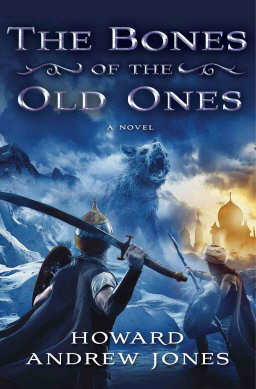
bones-of-the-old-onesOur Managing Editor Howard Andrew Jones posted the news on his blog on Friday, but I thought it was worth repeating here: new British publisher Head of Zeus has picked  up The Chronicles of Sword and Sand (known around these parts as the adventures of Dabir and Asim) for British publication.

The first volume, The Desert of Souls, was published here in the US on February 15, 2011, and the exciting sequel, Bones of the Old Ones, is scheduled to arrive in less than three weeks. Head of Zeus will bring both into print overseas for the first time beginning in April of 2013.

The Desert of Souls was called “An Arabian Nights adventure as written by Robert E Howard” by Dave Drake, and Bones of the Old Ones received a starred review from Publisher’s Weekly. In a recent feature review, SF Signal called the second volume “A damn good tale that not only pays homage to the masters, but sets its own print on the genre.”

Bones of the Old Ones is the best fantasy I’ve read in years. It’s a rollicking adventure that follows Dabir and Asim on a daring quest across the landscape of 8th Century Arabia, packed with ancient secrets, underground lairs, dread pacts, mysterious sorcery, desperate heroism, and moments of laugh-out-loud humor. The cast is much larger than The Desert of Souls, and the stakes are higher, as Dabir and Asim race against time to prevent an ancient sorcerous cabal from plunging the world into eternal winter.

Goodreads is offering signed copies of The Bones of the Old Ones — and copies of The Desert of Souls — to three lucky winners this month; visit Goodreads to enter. The winners will be announced December 19th. And now that The Desert of Souls is available in trade paperback, Amazon.com is selling the hardcover for just 10 bucks — get them while they last.

The Bones of the Old Ones will be released in North America on December 11. We first reported on it back in August.

Kobold Quarterly Magazine Goes Down Fighting

Kobold Quarterly Magazine Goes Down Fighting

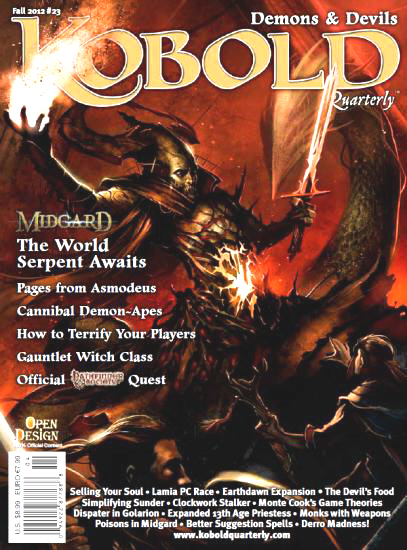
kobold-quarterly-fall-2012-smallThe terrific gaming magazine Kobold Quarterly — which we featured here just two weeks ago — has ceased publication. The final issue is #23, Fall 2012.

Publisher and editor Wolfgang Baur posted this announcement on Friday:

It’s a fact that in every fantasy roleplaying game… a kobold’s life is short. They’re wily and quick, but they have few hit points. Sooner or later they go down — fighting. That day has come for Kobold Quarterly magazine. After five years of publication, Shelly and I are closing the doors on the little fanzine that could.

I always hoped that Kobold Quarterly would someday be my full-time gig, but it was not to be. My sincere thanks go out to everyone who contributed to the magazine, starting with our stalwart subscribers, advertisers, authors, and artists. Thanks also to those who bought only an issue or two; for us, every sale was crucial…

And now, as adventurers do, we will gather in the tavern to hoist mugs of ale and talk about the monsters we slew and the treasures we won. And then we will begin planning and scheming for the next adventure. Kobolds might be easy to knock down individually, you see, but they always come in big numbers. The kobold crew will keep serving you with free articles, the free Courier newsletter, Kobold Press adventures and sourcebooks, and other projects.

Subscribers are being offered the option of a 150% refund in Kobold Store credit, or a 100% refund via PayPal or paper check. Contributors are being assured that even though the magazine is folding, Kobold Press is still going strong, and articles scheduled to appear in future issues may be picked up for other Kobold Press publications such as the Pathfinder New Paths line, Midgard Adventures, and other new releases.

Kobold Press will continue to publish the free Kobold Courier e-newsletter, as well as big commercial releases such as the The New Paths PDFs, Player’s Guides for Midgard, and two top-secret projects in the works for 2013. Read more about the excellent Midgard in Wolfgang’s recent Black Gate post.

While we know that the only constant in the gaming industry is change, the loss of Kobold Quarterly is a real blow to the field. It was an excellent magazine that captured the spirit and excitement of the best of the early gaming magazines, and it will be missed.

Black Gate Online Fiction: “The Poison Well” by Judith Berman

Black Gate Online Fiction: “The Poison Well” by Judith Berman

poisonwell5Manvayar’s old master had been exposed as a secret necromancer… would that horrific experience give Manvayar the insight he’d need to ferret out the truth behind a rash of sorcerous killings?

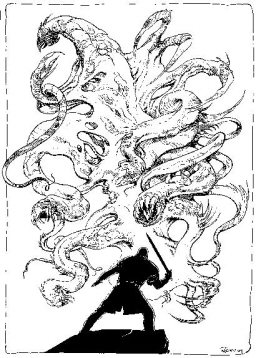
Suddenly the oppression in the air condensed into cold threat, and an overpowering stink of rotting flesh rolled over him. The mare screamed and bolted past Manvayar. He spun around. A speck hung for an instant in his vision, then swelled. First it looked like a cloud of bloody pus suspended in water. Then, still growing, it congealed into a tangle of pinkish webbing and glistening limbs. Some of the limbs ended in groping hands, some bore toothy leeches’ mouths.

The exhilaration of pure hatred rushed through Manvayar. The necromancer was here! He narrowed his attention to the width of a sword blade, reached to the roots of his soul and ripped out a piece of his own substance, which he formed into Nariyo words of command and hurled at the creature. The words sank into its flesh. It thrashed but kept swelling outward until it was twice as high as a man and its limbs writhed toward the manor windows.

A man was screaming. Inside the stables, horses whinnied and crashed against their stalls. The stench of putrefaction choked him.

Manvayar took a few steps forward. His sword was already in his hand.

“The Poison Well” originally appeared in Black Gate 7, and was widely acclaimed. Patrick Samphire at Tangent Online wrote:

Mage and warrior Manvayar fled his former master when he discovered his master was a secret necromancer. Now he is assisting the death priest, Seppan, in a search for a necromancer whose creations have killed two men. Their hunt leads them to an unwelcoming manor house where the deaths occurred… Berman is an excellent writer. She smoothly juggles the various elements of the story — the secret of the poison well, the hidden necromancer, the hostile family of the lord of the manor, and Manvayar’s past… Manvayar is haunted by vivid dreams of his former master, yet his master has no part to play in this story… the reader is left wondering whether “The Poison Well” is the first part of a series. I certainly hope so; this was a fascinating and well-written piece that deserves its place opening the issue.

“The Poison Well” is a complete 14,000-word novelette of adventure fantasy offered at no cost. As Patrick astutely surmised, it was the first in a thrilling series; the second installment, “Awakening,” which explores the back-story of Manvayar’s former master, appeared in Black Gate 10 and was nominated for a Nebula Award for Best Novella of 2007. We will present “Awakening” in its entirely next week.

You can see the complete catalog of Black Gate Online Fiction here.

Read the complete story here.

Vintage Treasures: Alfred Hitchcock’s Monster Museum

Vintage Treasures: Alfred Hitchcock’s Monster Museum

alfred-hitchcocks-monster-museum-smallLast month, my son came home from school and began poking through our library. “I have to read a short story collection for Lit block,” he explained.

I think “Lit block” maybe means English class. I’m not going to ask, I already get enough grief for not understanding what kids today are talking about. After a few minutes, Drew gave up. “I’ll check the school library tomorrow,” he said. Please. This is what eBay is for. And sure enough, after a short search, I found a collection he found suitably intriguing. With story titles like “Slime” and “Shadow, Shadow, on the Wall,” how could he not? There was a copy in great shape for just $2.75, and very soon it was ours.

Of course, I ended up being even more interested than Drew. Alfred Hitchcock’s Monster Museum was one of roughly a dozen anthologies published under Hitchcock’s name and ghost-edited by Robert Arthur, including 12 Stories for Late at Night, Scream Along with Me, and Stories That Scared Even Me. This one contains a terrific mix of pulp fiction from 1929 – 1954, from Murray Leinster (Will F Jenkins), Manly Wade Wellman, Theodore Sturgeon, and many others. Here’s the complete TOC:

A Variety of Monsters — Introduction by Alfred Hitchcock
“Slime” — Joseph Payne Brennan (Weird Tales, March 1953)
“The King of the Cats” — Stephen Vincent Benét (Harper’s Bazaar, Feb 1929)
“The Man Who Sold Rope to the Gnoles” — Idris Seabright (F&SF, Oct 1951)
“Henry Martindale, Great Dane” — Miriam Allen deFord (Beyond Fantasy Fiction, Mar 1954)
“Shadow, Shadow, on the Wall” — Theodore Sturgeon (Imagination, Feb 1951)
“Doomsday Deferred” — Will F. Jenkins (The Saturday Evening Post, Sep 24 1949)
“The Young One” — Jerome Bixby (Fantastic, Apr 1954)
“The Desrick on Yandro” — Manly Wade Wellman (F&SF, Jun 1952)
“The Wheelbarrow Boy” — Richard Parker (Lilliput, Oct 1950)
“Homecoming” — Ray Bradbury (Mademoiselle, Oct 1946)

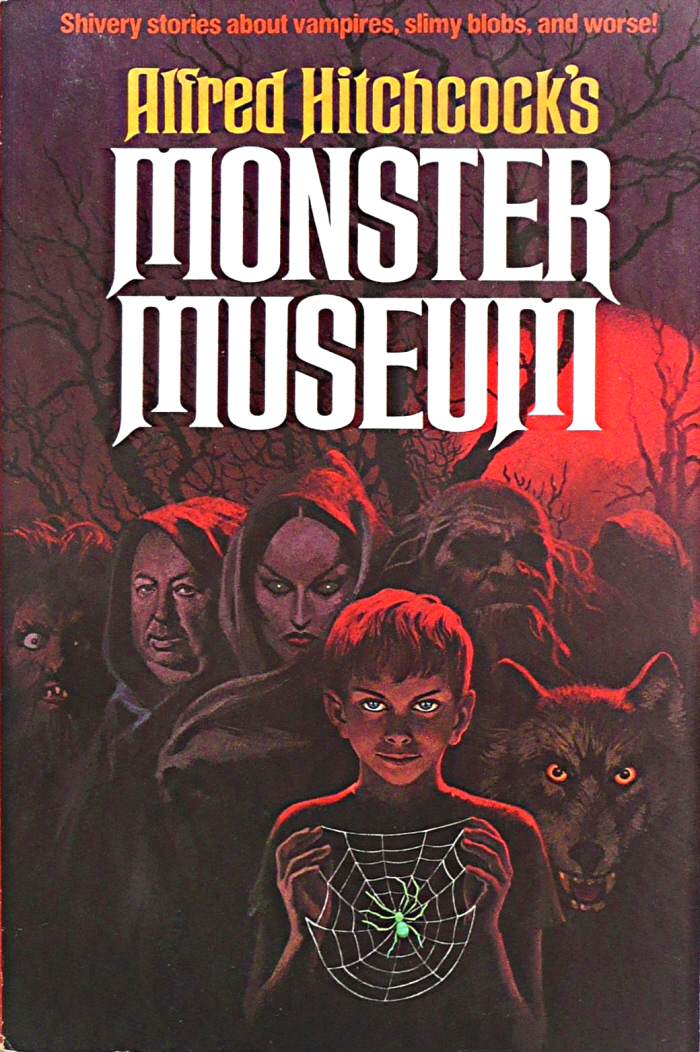
The paperback is abridged from the original 1965 hardcover, which also included “The Day of the Dragon” by Guy Endore, “The Microscopic Giants” by Paul Ernst, and Jerome Bixby’s “The Young One.” I prefer the trade paperback however, mostly because of the gorgeous and moody cover (click on the image at right for a bigger version).

Alfred Hitchcock’s Monster Museum was published by Random House in trade paperback in 1982; the original cover price was $2.50 for 213 pages.

Wake Up to a New World With Awakening: The Art of Halo 4

Wake Up to a New World With Awakening: The Art of Halo 4

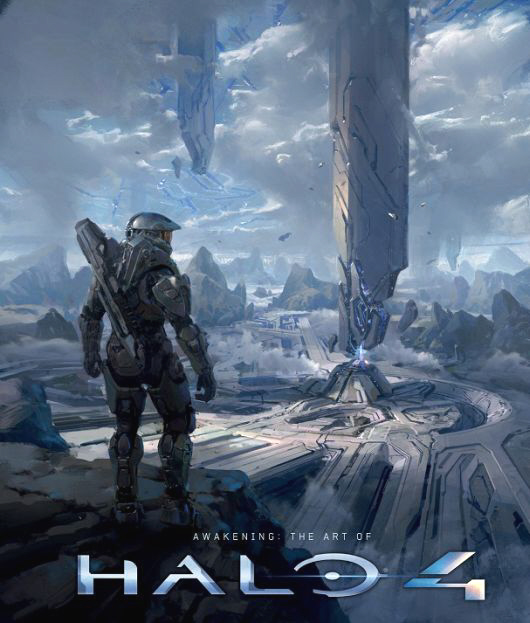
awakening-the-art-of-halo-4-smallI took the family to Best Buy yesterday to buy a new phone for my wife. They didn’t have anything below $250, so we trooped back to the car to return to the Verizon store. My teenage boys, flush with dog-sitting money, were the only happy shoppers, chortling excitedly in the back seat over a copy of 343 Industries’ Halo 4.

I got some scattered details over breakfast this morning. Master Chief, hot-babe AI Cortana, abruptly awakened from deep sleep, a Covenant fleet, a giant Forerunner planet, alien mysteries, and a lot of shooting. Sounds like Halo to me.

So when I sat down to sort through the week’s stack of review copies, my hand naturally gravitated towards the copy of Awakening: The Art of Halo 4, a thick oversize hardcover sent our way by Titan Books. It turned out to be an excellent choice, and  it thoroughly captivated my interest for the next 90 minutes.

Awakening is probably not a good choice if you’re not a fan of art, cutting edge computer games, or far-future science fiction. But if you’re interested in any of those things, you’ll find it very interesting and if, like me, you have more than a passing interest in all three, you’ll find it fascinating.

Awakening is packed with nearly 200 pages of full-color art, concept designs, and sketches from some of the top artists in the field, including Sparth, Robogabo, John Liberto, Glenn Israel, Jhoon Kim, and Thomas Scholes. The descriptive text, by “incurable Halo fanatic” Paul Davies, is brief and to-the-point, rarely more than a slender paragraph on each page. Davies wisely lets the artists do most of the talking, quoting Senior Art Director Kenneth Scott and concept artist Sparth at length.

And the art is indeed spectacular. The design breakdowns — for Master Chief, his mostly naked AI companion Cortana, numerous weapons, the truly splendid vehicle fleet, and the gun-toting alien Covenant and mysterious Forerunners — are detailed and a lot of fun, but it’s the gorgeous alien landscapes and breathtaking unexplored vistas that really fire the imagination. I guarantee there are sights here that you’ve never seen before, from the nebula-like clouds trapped between two vast constructs to the massive Didact ship, so large it can only be explored using a UNSC Broadsword fighter.  More proof that it’s computer entertainment pushing the sense-of-wonder envelope for SF and fantasy fans today.

Awakening: The Art of Halo 4 was published in hardcover by Titan Books on November 6. It is $34.95 for 192 pages. Get more info, including reproductions of some of the artwork, at the Titan website.

New Treasures: Legacy of Kings, Final Volume of The Magister Trilogy

New Treasures: Legacy of Kings, Final Volume of The Magister Trilogy

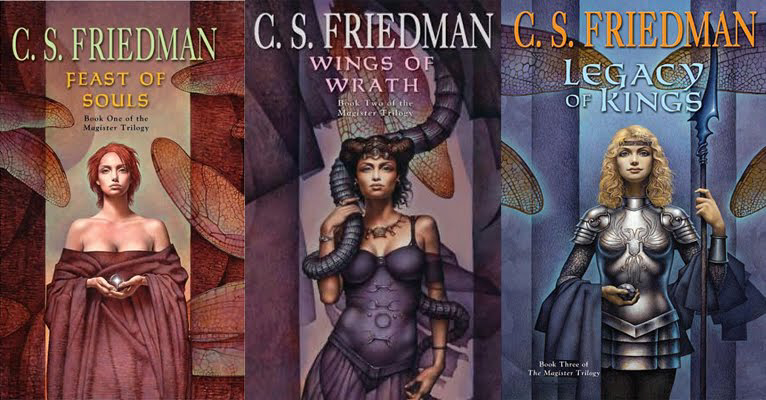
I rarely read introductory volumes of fantasy series these days. Truthfully, I don’t pay much attention to them. What I do pay attention to is the final volume, as that’s (usually) a sign it’s safe to sit down and enjoy a complete fantasy adventure. That’s why I was very pleased to see Legacy of Kings, the final volume of C.S. Friedman’s Magister Trilogy, arrive in paperback in September. It is the sequel to Feast of Souls and Wings of Wrath.

the-magister-trilogy-cs-friedman

I’ve followed Friedman since she published her first novel, In Conquest Born, in 1986. She is the author of The Coldfire Trilogy, the Braxi/Azea duology (In Conquest Born, The Wilding), and the standalone novels The Madness Season and This Alien Shore. Kings was originally released in hardcover in August 2011; the captivating cover sequence for the trilogy is by John Jude Palencar.

The young peasant woman Kamala has proven strong and determined enough to claim the most powerful Magister sorcery for herself — but now the Magisters hunt her for killing one of their own. Her only hope of survival lies in the northern Protectorates, where spells are warped by a curse called the Wrath that even the Magisters fear. Originally intended to protect the lands of men from creatures known only as souleaters, the Wrath appears to be weakening — and the threat of this ancient enemy is once more falling across the land.

Legacy of Kings was published by DAW Books in September, 2012. It is 498 pages, and priced at $7.99 for both the paperback and digital versions.

Vintage Treasures: The Power of Darkness — Tales of Terror, by Edith Nesbit

Vintage Treasures: The Power of Darkness — Tales of Terror, by Edith Nesbit

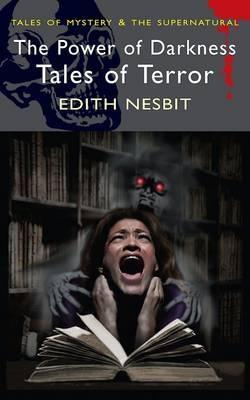
the-power-of-darknessYes, we’re talking here about Edith Nesbit, godmother of British fantasy and beloved author of The Enchanted Castle, Five Children and It, The Phoenix and the Carpet, and many others children’s classics. This is not some other Edith Nesbit. Right there on the back of my copy of the Wordsworth Edition paperback of The Power of Darkness — Tales of Terror are the words:

Edith Nesbit, best known as the author of The Railway Children and other children’s classics, was also the mistress of the ghost story and tales of terror.

Who knew? Not me. I thought it was scandalous when JK Rowling wrote a book with sex in it, but that’s nothing compared to the head-twisting British schoolkids must have received opening their copy of The Power of Darkness — Tales of Terror.

And what’s with the two titles? It’s like she couldn’t decide what to call it. “The Power of Darkness or Tales of Terror? Bloody Hell, I’ll call it both.” You tell ’em, Edith!

As an unanticipated side-effect of my gross ignorance of early 20th Century supernatural short fiction, I am surprised and delighted by this addition to the Wordsworth Tales of Mystery And The Supernatural imprint (or, as we like to call it, TOMAToS). But the rest of the line has been extremely impressive, so I’m willing to believe they’re not just pulling my leg with this one. Here’s the rest of the back cover copy, just to prove I’m not making this up:

‘The figure of my wife came in… it came straight towards the bed… its wide eyes were open and looked at me with love unspeakable.’

Edith Nesbit was able to create genuinely chilling narratives in which the returning dead feature strongly. Sadly, these stories have been neglected for many years, but now, at last, they are back in print. In this wonderful collection of eerie, flesh-creeping yarns, we encounter love that transcends the grave, reanimated corpses, vampiric vines, vengeful ghosts and other dark delights to make you feel fearful. These vintage spooky stories, tinged with horror, are told in a bold, forthright manner that makes them seem as fresh and unsettling as today’s headlines.

Vampiric vines! I’m putting this one right at the top of my to-be-read pile.

Read More Read More

Vintage Bits: In Search of the Lost Black Crypt

Vintage Bits: In Search of the Lost Black Crypt

black-crypt-smallSome 20 years ago, shortly after I graduated from the University of Illinois, I bought my first home computer. It was an Amiga 2000, essentially the same as the entry-level Amiga 500 but with a hard drive. The hobby computing industry — which is now dead — was booming in the early 90s, and there were thousands of fun things the dedicated hobbyist could do with a decent home computer. Video editing, BASIC programming, ray trace imaging, indexing Chicken Cacciatore recipes… and if you were cutting edge enough to buy a modem, you could even log into BITNET and post on those electronic bulletin boards everyone was talking about. Crazy.

All of that was very interesting. But I shelled out my $1,500 bucks for one reason, and one reason only: to play games. And that’s exactly what I did.

I played the role playing games I’d been aching to try out in my last year of grad school, while feverishly finishing my Ph.D. thesis: Pool of Radiance, Bard’s Tale, Dragon Wars, many others. I played late into the night, before dragging my weary butt into work at Amoco Oil the next morning. It was an exhausting and emotionally draining lifestyle but, let’s face it, those dungeons weren’t going to clean themselves out. Countless terrified townspeople in tiny electronic villages were counting on me, and I wasn’t going to let them down.

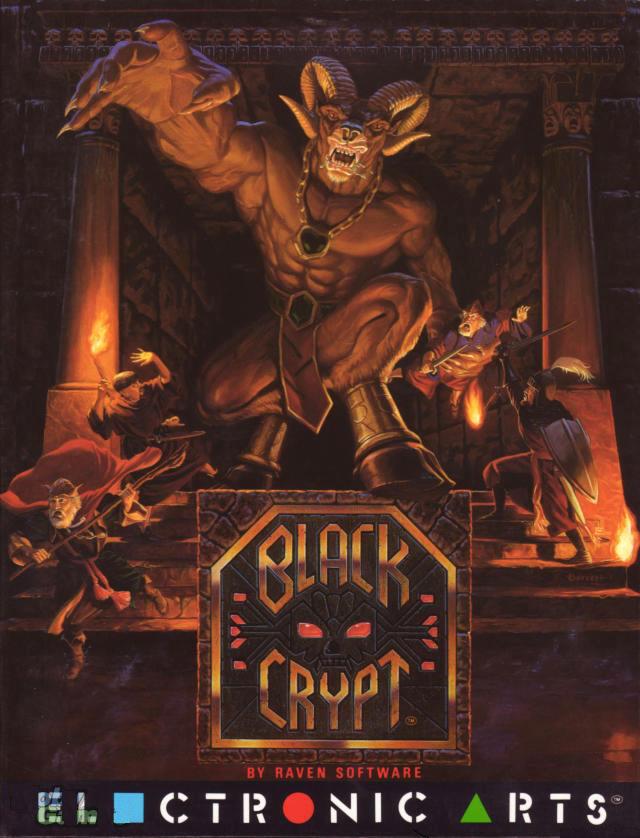
About a year after I bought my Amiga, in March 1992, Electronic Arts published one of the most acclaimed role playing games ever made for that platform: Black Crypt, the first release from Raven Software, future makers of the popular Hexen, Soldier of Fortune, Quake 4, and Call of Duty: Modern Warware 3. Inspired by the legendary game Dungeon Master, another famous Amiga title, Black Crypt was nothing less than a vast trap-filled dungeon crammed with monsters, secret passages, hidden switches, and magical loot. The graphics were gorgeous, and the wonderful sound effects — the distant clanking of trapdoors, odd footsteps, and telltale sounds of the teleporters — immersed players like never before, and made you want to play with the sound cranked up and the lights turned down low.

I played the first few levels and was mesmerized. Then, in November 1992, I got married and moved to Belgium, leaving my beloved Amiga behind. I thought about the game many times in the intervening years, as I returned to the States, got a job at a tiny software company, worked on Internet Explorer 1.0, and was at ground zero of the Internet revolution that transformed the entire country. Some time during those turbulent years, my Amiga was moved to the basement, where it quietly sits today, collecting dust.

In the last few weeks, I’ve been on a quest to find and complete Black Crypt. It’s a quest filled with exactly the kind of twists and turns you’d expect for a man determined to find a long-lost crypt, spoken of only in half-forgotten legend. While critics raved, Black Crypt was released when the Amiga was already in decline, and was never successful enough to be ported to any other platform. It vanished quickly, both from store shelves and collective memory. As I search for the right magical tools that will allow me to open the crypt, I’m well aware that it’s not going to be easy.

But that’s okay. After twenty years, one of the things I’ve learned is that true joy isn’t always in the destination. It’s in the journey.

Our most recent Vintage Bits articles were Sword of Aragon, Lordlings of Yore, and Battletech: The Crescent Hawk’s Inception.