Browsed by
Author: John ONeill

Read Last Year’s Best Online Reviews, Essays and Commentary in Speculative Fiction 2012
Read Last Year’s Best Online Reviews, Essays and Commentary in Speculative Fiction 2012

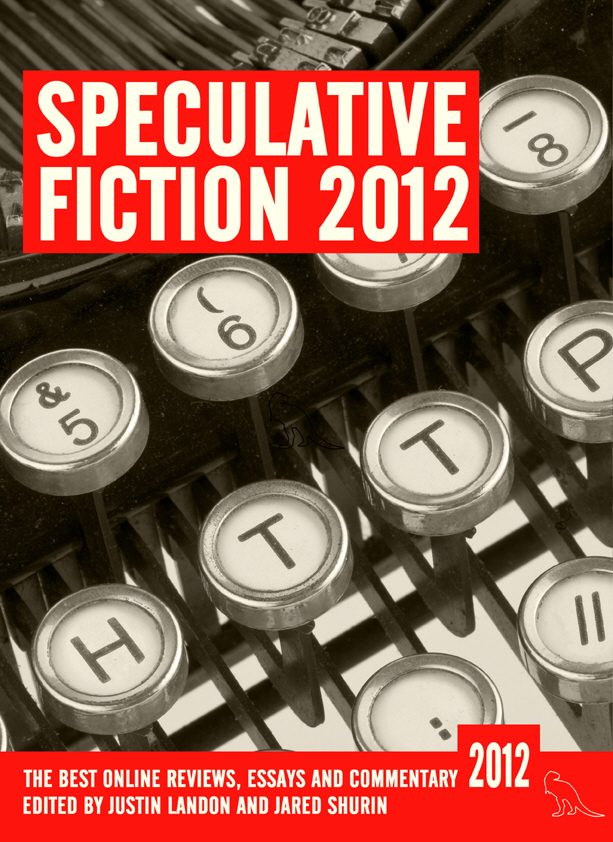
Speculative Fiction 2012It’s no surprise that some of the best and most insightful writing in 2012 took place on blogs.

Blogging — with its immediacy and ease of public access — has attracted some of the most gifted writers we have, and fantasy and SF readers are increasingly turning to the blogs and writers they trust for news and opinion. For the latest evidence, look no further than Speculative Fiction 2012, a new collection of the very best online reviews, essays, and commentary from Jurassic London press.

Speculative Fiction 2012 gathers over fifty of the best articles published last year, from the top tier of bloggers and authors in science fiction and fantasy. The contributor list includes some of the most acclaimed writers in the field, folks like Christopher Priest, N. K. Jemisin, Joe Abercrombie, Daniel Abraham, Elizabeth Bear, Myke Cole, Kate Elliott, Niall Alexander, Rose Lemberg, Kameron Hurley, Adam Roberts, Tansy Rayner Roberts, Sam Sykes, and Lavie Tidhar.

I’m very pleased to say that it also includes one of our own: Matthew David Surridge, whose February 2012 Black Gate article “Tolkien and Attila” is in the Table of Contents. Here’s what Matthew tells us:

This is out now, and has one of my Black Gate articles in it — to paraphrase the Amazon blurb, a look at what Tolkien learned from Attila the Hun. Happy to have a piece of mine in a very strong line-up! And worth noting: proceeds from the sale of the book go to a charity promoting international literacy and education.

You can read the announcement, including the complete list of contributors, here, and Matthew’s original article is here.

Speculative Fiction 2012 was edited by Justin Landon and Jared Shurin, with a foreword by Mur Lafferty. It published on April 23, 2013 by Jurassic London. It is 380 pages in paperback, priced at $11.99. There is no digital edition.

Vintage Treasures: The People of the Black Circle by Robert E. Howard

Vintage Treasures: The People of the Black Circle by Robert E. Howard

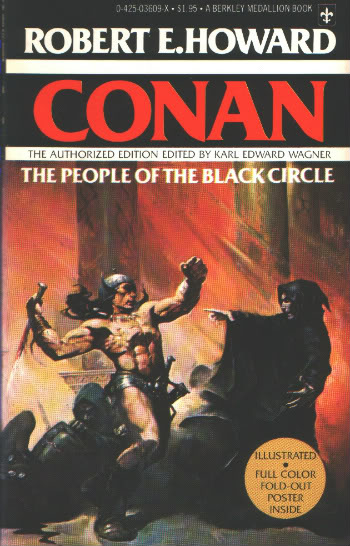
people-of-the-black-circleI may have more books by Robert E. Howard in my collection than any other writer.

I’m not certain, as I haven’t counted, and if you allow anthologies then he’ll be beaten out handily by folks like Isaac Asimov and Martin H. Greenberg. But the venerable Mr. Howard occupies more than two shelves in my library, which is astounding for someone who died at the age of thirty.

I came to Howard early. The first story I read by REH was “Pigeons from Hell,” which Charles Saunders mentioned in a speech he gave to the Ottawa Science Fiction Society in 1981, the year his groundbreaking Imaro was released. “Horror doesn’t usually scare me,” he told us. “‘Pigeons From Hell’ scared me.”

I think the second REH tale I read was the Solomon Kane tale “Skulls in the Stars,” which I enjoyed even more. (I wrote about the two Bantam Solomon Kane collections, Skulls in the Stars and The Hills of the Dead, last year.)

But I wasn’t a Conan fan. Most of it was prejudice — in those days, all those novels with barbarians on the cover were considered the lowest form of fantasy, and I generally snubbed them. Oddly, I don’t think I even associated Conan with Robert E. Howard.

I surreptitiously tried a Conan book in my early teens, a collection of tales mostly by L. Sprague de Camp and Lin Carter, if I remember correctly. Didn’t impress me. That was all I needed to confirm that I was better than this stuff and return to reading books of quality, like Perry Rhodan and Alfred Hitchcock and the Three Investigators.

All that began to change with The People of the Black Circle, a Christmas gift from my brother Michael.

Read More Read More

Intrigue and Dinosaur Beasts: Tangent Online on “The Sorrowless Thief”

Intrigue and Dinosaur Beasts: Tangent Online on “The Sorrowless Thief”

Ryan Harvey-smallJohn Sulyok at Tangent Online reviews Ryan Harvey’s sword & sorcery tale, published here on April 7:

The narrator, a beggar nearly given up on life, spends what little money he has in dream-smoke-filled drug dens, indulging in the illusions brought on by the smoke of the mokkah flower. What wanders in one night is no illusion, it is the thief Dyzan Ludd. He seems immune from the smoke, and immune from what has brought so many into the den: the Sorrow. These facts stir the narrator. He and Dyzan find themselves in conversation about Dyzan’s upcoming plan to rob a caravan coming from the north. It is a fool’s errand, but Dyzan doesn’t listen to reason…

Ryan Harvey’s “The Sorrowless Thief” exists as part of a larger science-fantasy series. The world of Dyzan includes few guns and many (magically) tamed dinosaur beasts… These surrounding details thicken the setting and the plot, adding a lot of intrigue to the events herein…

Ryan Harvey won the Writers of the Future Contest in 2011 for his story, “An Acolyte of Black Spires,” part of the science-fantasy series on the continent of Ahn-Tarqa, which is also the setting for “The Sorrowless Thief,” his ebook novelette “Farewell to Tyrn,” and upcoming novel Turn over the Moon. He writes a regular weekly column at Black Gate. Read John’s complete review here.

The complete catalog of Black Gate Online Fiction, including stories by Steven H Silver, Nina Kiriki Hoffman, Emily Mah, David C. Smith and Joe Bonadonna, Aaron Bradford Starr, C.S.E. Cooney, Vaughn Heppner, E.E. Knight, Howard Andrew Jones, Harry Connolly, and others, is here.

“The Sorrowless Thief” is a complete 7,000-word sword-and-sorcery tale. It is offered at no cost. Read the complete story here.

New Treasures: Dangerous Waters, by Juliet E. McKenna

New Treasures: Dangerous Waters, by Juliet E. McKenna

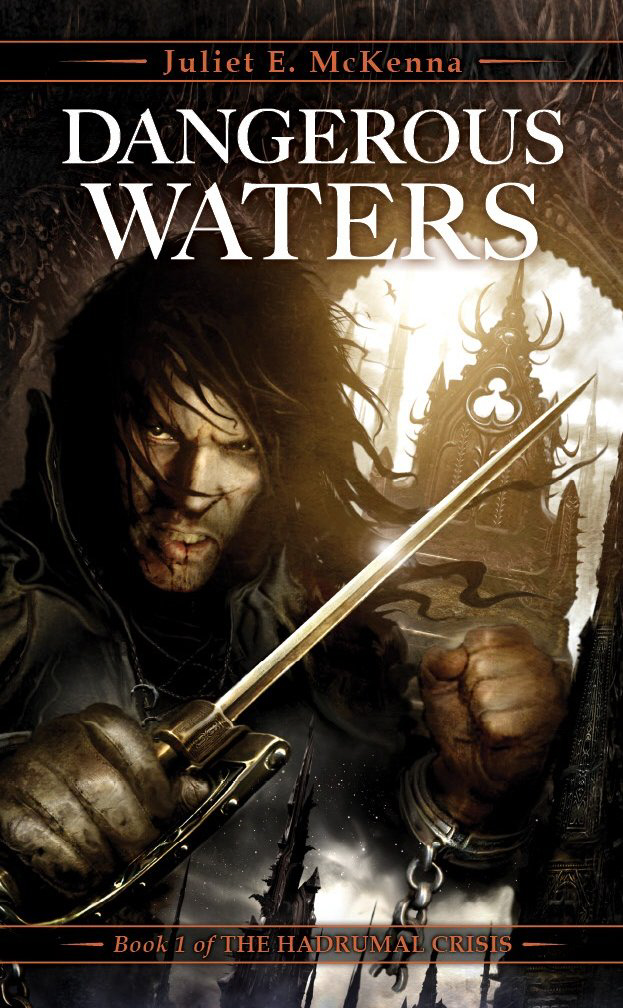
Dangerous Waters Juliet E McKennaI’m such a sucker for paperbacks. Seriously, put a rogue with a sword and a ship on the cover, and I’ve got that thing to the cash register faster than you can say, “Paper or plastic?”

I think it’s partly because I find paperbacks very inexpensive. That wasn’t always the case. When I  made my weekly pilgrimage to downtown Ottawa bookstores in my teens, clutching ten bucks of hard-earned babysitting money, that was barely enough to get 2-3 paperbacks — if I was selective.

I agonized over each choice. Keith Laumer’s The Time Bender, or Fritz Leiber’s Swords Against Death? Edgar Pangborn’s West of the Sun, or Arthur C. Clarke’s Imperial Earth? These are the life choices that kept me up at night.

Today things are easier. For one thing, paperback prices haven’t budged in over 15 years. I paid $7.99 for a paperback copy of Connie Willis’s To Say Nothing of the Dog in 1998, and I paid $7.99 for the copy of Juliet E. McKenna’s Dangerous Waters I bought last week.

That’s an incredibly long period for anything to be stable in publishing — look at how paperback prices quadrupled in the 15 years between 1965 (around a buck) and 1980 (around 4-5 bucks).

Paperback prices won’t stay this way for long. But while they do, I’m enjoying them. $7.99 (minus my 10% Barnes & Noble member discount) is still an impulse buy for me. Which means I can pick up a book based on nothing more than a cool cover, and take it home guilt free.

I have no idea what it says on the back of Dangerous Waters, but I think I’ll read it now and find out.

Read More Read More

Vintage Bits: Sword of Aragon

Vintage Bits: Sword of Aragon

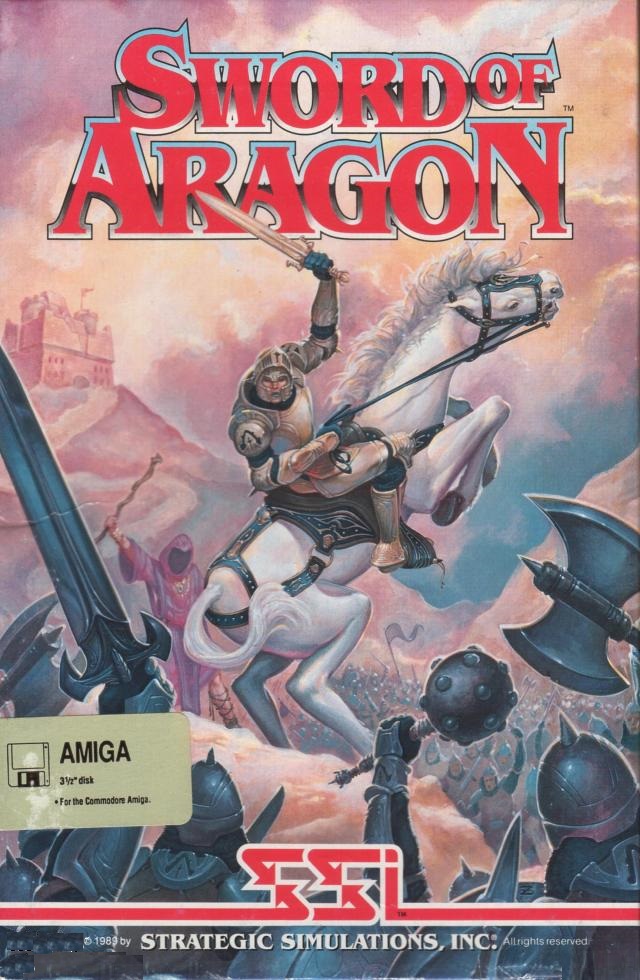
Sword of AragonI’m a huge fan of computer games, and especially role playing games. Perhaps the thing I enjoy most about them is they’re so clearly descended from the hobby I loved as a teen — desktop role playing and Dungeons and Dragons, itself a direct descendent of Sword & Sorcery as written by Robert E. Howard, Jack Vance, Roger Zelazny, and Fritz Leiber.

The things I cherished as a young man have grown up and conquered Western Civilization. The only thing that could be better would be if the Spider-Man and Avengers comics I zealously collected forty years ago suddenly spawned billion-dollar media properties — but come on, what are the chances of that?

But back to computer games. This isn’t going to be a computer-games-aren’t-as-great-as-they-used-to-be diatribe. The fact is, modern computer games are fabulous. I can sit on my couch for hours and be thoroughly entertained watching my son play games like Arkham City, Heavy Rain, Borderlands and Enslaved. These are truly immersive experiences, with captivating plots, great characters, and outstanding pacing.

Still, you’ll notice that I didn’t say I played these games. No, my enjoyment these days is pretty much limited to watching Drew play.

I don’t game much any more. That’s not because the games suck; it’s because I grew up with a very different kind of gaming experience, and the games I want to play just aren’t made any more.

I’m not asking for the industry to roll back 20 years. What I really want to do is play all those great old games once more — something that is sadly impossible, unless I can find a way to get my old IBM 286 machine to boot up again.

What games are those? Old school dungeon-crawls, like Wizardry, Pool of Radiance, Dungeon Master, and Dragon Wars. Science Fiction RPGs like Starflight and BattleTech: The Crescent Hawk’s Inception. Adventure games like The Lurking Horror and The Secret of Monkey Island. And tactical wargames like MechCommander.

And especially the brilliant blend of wargaming, role playing, and adventure gaming that is the underrated classic Sword of Aragon, one of the finest fantasy games ever made.

Read More Read More

First Teaser Trailer Released for Thor: The Dark World

First Teaser Trailer Released for Thor: The Dark World

Apparently, now that Marvel Comics has hit on a fabulously successful formula for its film properties, future movies are being released according to an ambitious Plan. The Plan ties together all the films in the Marvel Cinematic Universe, in a way that should be very familiar to anyone who has ever read Marvel comics.

The first picture in the Marvel Cinematic Universe is now considered to be 2008’s Iron Man (presumably ignoring all Marvel films that came before, like all three Spider-Man and X-Men pictures, Ghost Rider, Daredevil, Elektra, Fantastic Four, Wolverine, The Punisher, Blade, X-Men: First Class, etc.) Iron Man was the beginning of Phase One, a sequence which included The Incredible Hulk, Iron Man 2, Thor, Captain America: The First Avenger, and The Avengers.

Phase Two kicks off next month with Iron Man 3, followed by Thor: The Dark World, Captain America: The Winter Soldier, Guardians of the Galaxy and culminating in The Avengers 2, scheduled to arrive in May of 2015. Like Phase One, the films in this second set will share sub-plots and secondary characters, and dovetail into the plot for Avengers 2, details of which are a closely guarded secret (but will almost certainly involve Thanos and the Cosmic Cube — excuse me, The Tesseract.)

Whatevs. Today all we care about is that the first teaser trailer for Thor: The Dark World has been released, and it contains a satisfying quantity of ‘splosions and cosmic violence. The trailer also confirms the return of all the major stars from the first film, including Chris Hemsworth, Natalie Portman, Stellan Skarsgård, Idris Elba, Kat Dennings, Jaimie Alexander, Rene Russo and Anthony Hopkins — and Tom Hiddleston as Loki (yay!).

Thor: The Dark World is directed by Alan Taylor, and is scheduled for release on November 8th. You can see the complete teaser trailer for yourself below. And if you figure out what that giant floating hood ornament is, let us know.

New Treasures: Iron Kin, by M.J. Scott

New Treasures: Iron Kin, by M.J. Scott

Iron KinWe work in a genre ruled by series. It makes for some tough choices sometimes.

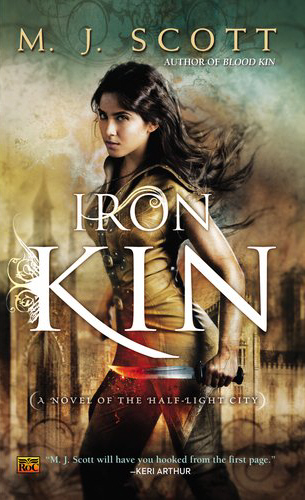
Case in point: I just received a review copy of M.J. Scott’s new novel Iron Kin. It looks like a fun, quick read with an intriguing setting and what could be a genuine POC on the cover:

Imagine a city divided. Fae and human mages on one side, vampire Blood Lords and shape-shifting Beast Kind on the other. Between these supernatural forces stands a peace treaty that threatens to shatter at the slightest provocation….

I was raised to do the right thing. But to my family that means staying safe behind the walls of human society. To be a respectable metalmage and never put myself at risk. But the treaty is faltering. And if it fails, nothing is safe. To help save the city and everyone I care about, I will use whatever means I can to ensure the negotiations to renew the treaty are successful — even if that means forging an alliance with a man who is the very opposite of the right thing….

Fen is trouble. Wild. He would rather bind himself in iron and drink himself into oblivion than learn to master the visions that come to him. Those visions might just hold the key to peace, and it seems that my power might hold the key to his control — if I can keep it around him….

Normally I’d plop down in my big green chair with my dog Pepper at my feet, and give it a try. Except for these tiny words at the bottom: A novel of the Half-Light City.

In the fantasy world, that’s code for: This isn’t the first book, dummy. According to a hasty Amazon search, Iron Kin is actually the third book, following Shadow Kin (2011) and Blood Kin (2012), neither of which I have.

And that brings us to those tough choices I mentioned. Do I set it aside and set out on a quest for the first one? Or do I settle in with Iron Kin, and figure things out as I go?

Read More Read More

Black Gate Online Fiction: “The Cremator’s Tale” by Steven H Silver

Black Gate Online Fiction: “The Cremator’s Tale” by Steven H Silver

Steven H SilverWhen the explosion appeared high above Pargama’s Tower, Hoggar the Cremator was sent to clean up the mess. But things are rarely what they appear to be — especially when dealing with wizards.

“One of my dim-witted apprentices was working in the secluded laboratory this evening,” Pargama said. “I regret to say he is no longer in this world. I have an important experiment which must be performed when Granhouck reaches its zenith and need Imuhagh’s remains collected by then.”

As Pargama spoke, the two men climbed the tower’s stairs, winding in a tight circle around the inner core of the tower. Eventually the two men stood at the heavy metal door at the uppermost reaches of the tower.

“You should have no problem collecting Imuhagh, but if you do, please ring the bell you’ll find on the table inside. Ōjín will come to give you assistance.” Without waiting for a response, Pargama turned and descended the stairway.

Hoggar found himself within the familiar walls of Pargama’s secluded laboratory. The walls were charred black. The floor was littered with broken furniture and glass. A few pieces of human bone could be seen around the room, but it was obvious that most of Imuhagh’s body had been burnt to ash. Hoggar dropped his bag onto the floor and reached to his belt for the small bag. Removing some more powder, he began the ritual to Lord Reyjnayak.

Steven H Silver has spent a great deal of his non-professional life involved with books. In addition to writing stories and poetry (and getting a few of them published), he’s edited three anthologies for DAW Books and two collections of Lester del Rey’s short fiction for NESFA Press. He launched ISFiC Press and spent eight years as the publisher and editor. Steven also publishes the Hugo-nominated fanzine Argentus.

The complete catalog of Black Gate Online Fiction, including stories by Nina Kiriki Hoffman, Ryan Harvey, Emily Mah, David C. Smith and Joe Bonadonna, Aaron Bradford Starr, C.S.E. Cooney, Vaughn Heppner, E.E. Knight, Howard Andrew Jones, Harry Connolly, and others, is here.

“The Cremator’s Tale” is a complete 5,300-word short story of weird fantasy. It is offered at no cost.

Read the complete story here.

What Makes a True Hero? Announcing the Winners of the Writing Fantasy Heroes Contest

What Makes a True Hero? Announcing the Winners of the Writing Fantasy Heroes Contest

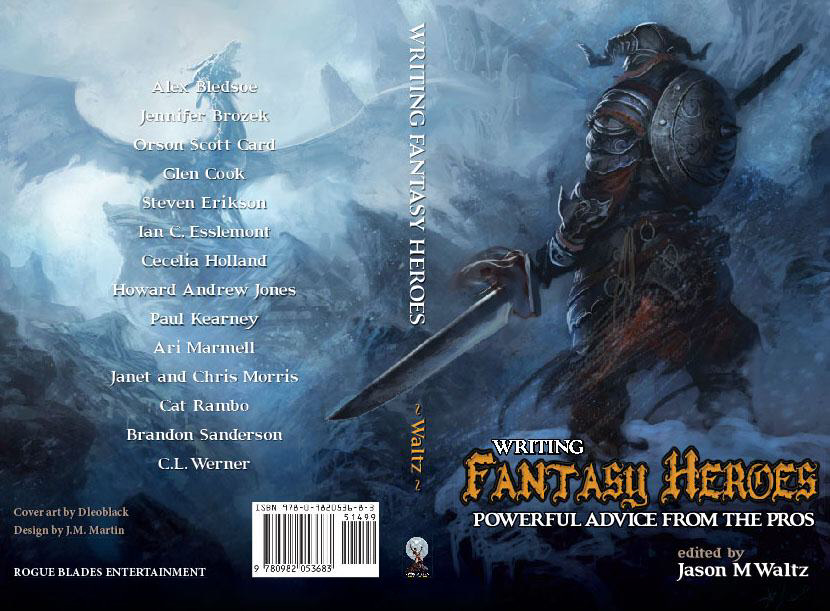
Writing Fantasy HeroesThree weeks ago, we asked Black Gate readers to tell us about their ideal hero in one paragraph or less. It could be a fictional character, or a general description of those qualities that make a hero ideal.

In return, we offered to award a copy of the new book, Writing Fantasy Heroes, edited by Jason Waltz and published by Rogue Blades Entertainment, to three lucky winners.

Those three winners will be randomly drawn from the list of all the entrants.

Before we announce the winners, let’s have a look at some of the best entries. As much as we’d like to, we can’t reprint all the entries we received, so we’ll limit it to the 20 we found most insightful, well written, or original. We’ll start with Daran Grissom, who tells us an ideal hero is:

Someone who, when confronted by the possibility of adventure, enters into it reluctantly, but with determination. A man or woman with a unique trait or skill who is delivered, by fate or vocation, to a place where he or she chooses to go above and beyond what is reasonably asked of them. An exceptional person, in exceptional circumstances, doing exceptional things. That is a hero.

A fine summary, and we’ll see plenty of examples in the next 19 entires — including Han Solo, Conan, Kane, The Gray Mouser, and of course John Wayne.

Read More Read More

Vintage Treasures: Chaosium’s Thieves’ World

Vintage Treasures: Chaosium’s Thieves’ World

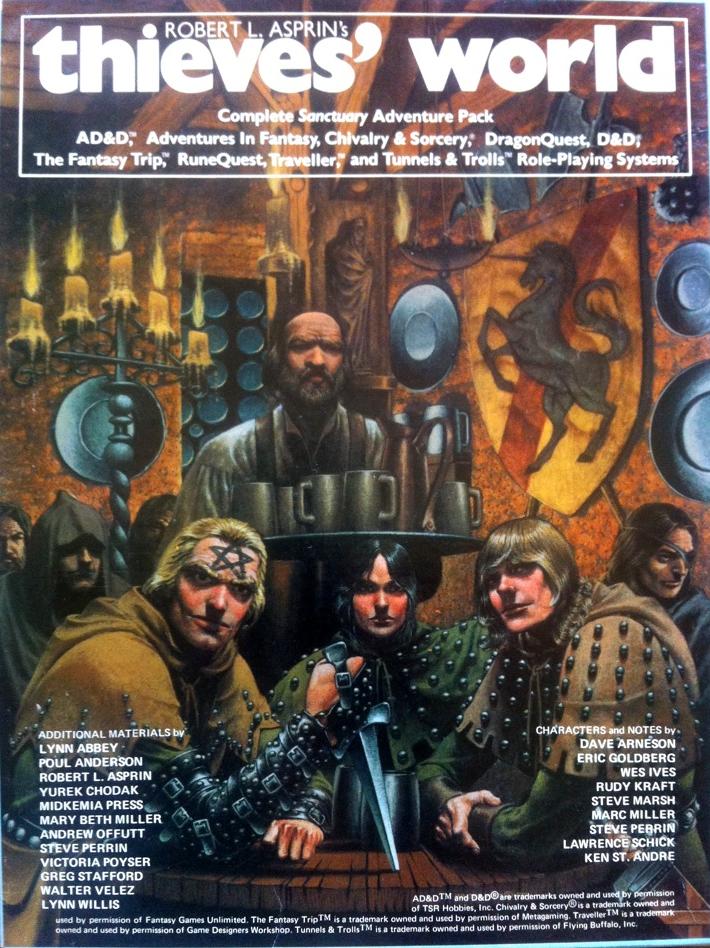
Thieve's World Chaosium-smallThere was a time when shared-world fantasy was brand new, and taking the genre by storm. That time was 1979, and the man at the helm was Robert Lynn Asprin, a midlist novelist who had never edited anything before in his life.

Robert Lynn Asprin was the guest of honor at one of the first science fiction conventions I ever attended, Maplecon 2 in Ottawa in 1979. He was a spirited and self-deprecating guest, telling stories of Joe Haldeman and Poul Anderson gently correcting his spelling and grammar (“These are the people I’m supposed to be editing?!”) as he midwifed the birth of what would become one of the most successful fantasy franchises of the 20th Century: Thieves’ World, the Ace paperback anthology that triggered an explosion in shared world fantasy over the next two decades. Thieves’ World eventually encompassed thirteen collections and over half a dozen original novels, published between 1979 and 2004.

It wasn’t the only new trend to emerge at the end of the 70s in fantasy fiction — in fact, it wasn’t even the biggest. The influence of Dungeons and Dragons was cresting at the same time, and with the publication of Margaret Weis and Tracy Hickman’s Dragons of Autumn Twilight, the first DragonLance novel, in 1984, the two genres finally collided, and neither would ever be the same again.

As fantasy fiction and gaming gradually blended throughout the 80s, it didn’t just mean that bookstores were flooded with gaming novels. Gaming stores likewise were invaded with a new generation of book-inspired titles, from Iron Crown’s Middle Earth Role Playing to Chaosium’s Call of Cthulhu, and TSR’s Conan and Lankhmar properties, just to name a few.

These two juggernauts of 20th Century fantasy, Thieves World and role playing, came together in 1981 with the release of the Thieves’ World boxed set from Chaosium, a singular accomplishment that has been called the “Rosetta Stone of early roleplaying.”

Read More Read More