Pulp Treasures Rediscovered: Tony Rome, Private Eye by Marvin H. Albert
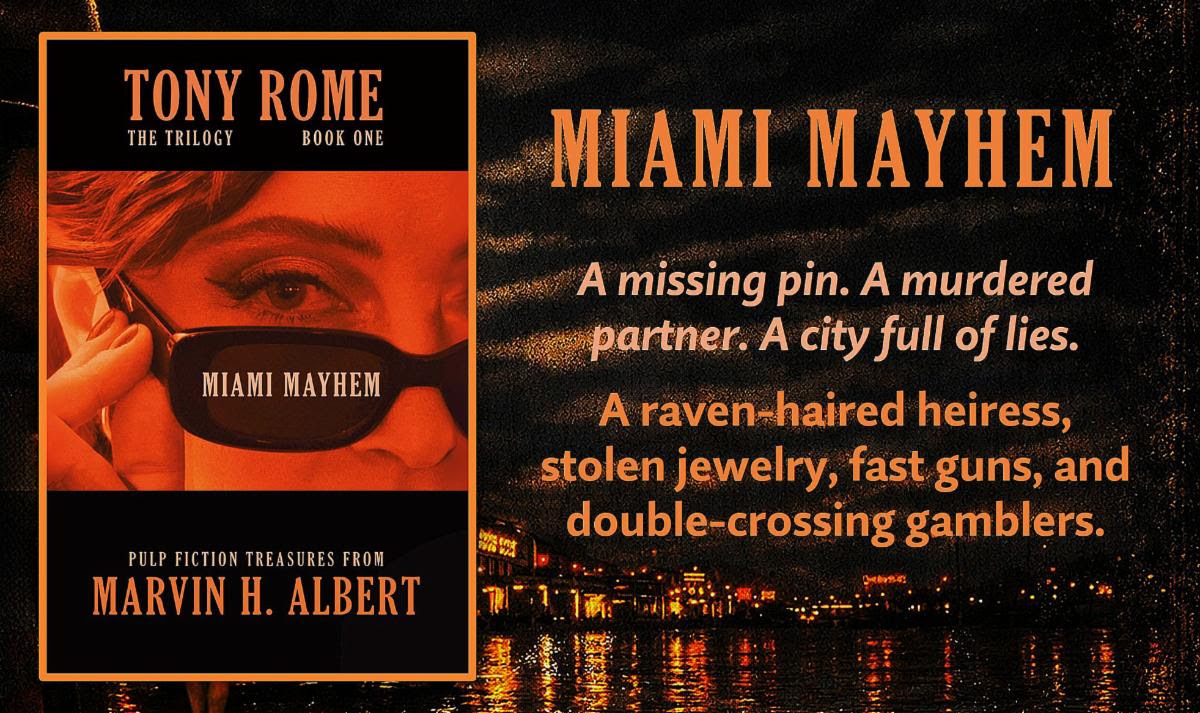
Twelve years ago, I wrote a piece for Black Gate about Marvin H. Albert’s unsung hardboiled private eye, Tony Rome. The post concluded with my suggestion, some might claim it was a plea, that an enterprising publisher would give these long out-of-print treasures a new lease on life. Here we are a dozen years later and that is exactly what has happened.
The paperback original (PBO to collectors) was the immediate successor to the pulp magazine as the home of pulp fiction. Marvin Albert was one of the bright lights of the paperback original market for detective fiction.
Albert’s work is revered in France, where he is considered a master of the hardboiled form, but he is largely forgotten stateside since his work lacks the literary polish of Dashiell Hammett or Raymond Chandler and was never shocking like Mickey Spillane. Albert may not have broken new ground, but he did excel at crafting hardboiled private eye stories in the classic tradition from the 1950s through the 1980s.

Much like Max Allan Collins or Michael Avallone, he also supplemented his income by adapting screenplays as movie tie-in novels for the paperback original market. Oddly enough, Albert specialized in bedroom farces for his movie tie-in assignments, in sharp contrast to his tough guy crime novels and westerns.
Albert utilized a number of pseudonyms during his career (although many of these titles were reprinted under his real name towards the end of his life). He published three hardboiled mysteries featuring a tough private eye called Tony Rome in the early 1960s. The books were originally published under the byline of Anthony Rome, as if to suggest the tales being told were real cases.
Tony Rome is best remembered today thanks to a pair of campy Frank Sinatra vehicles in the mid-1960s which portray the character as a middle-aged playboy drooling after bikini-clad lovelies half his age. The fact that the private eye operated out of a houseboat called “The Straight Pass” seems to have inspired John D. MacDonald’s Travis McGee private eye series, which launched later in the decade. The sad thing is such vivid recollections of the character do a terrible disservice to the books.

Tony Rome, on the printed page, is a private eye who carries a great deal of emotional baggage. He quit the Miami Police Department after his father (a police captain) committed suicide following public exposure by a political rival that he had once accepted a bribe early in his career. Tony quit the force and largely retreated from the world aboard his houseboat. He is most at home snorkeling in the beautiful and peaceful Atlantic Ocean. Crime routinely brings him ashore and Rome sees justice is done before retreating out to sea once more.
While no longer a young man, Tony has no interest in settling down or even seriously dating anyone. He feels the occasional attraction and pangs of loneliness, but in the end, he remains the loner who knows he is too damaged to be of use to anyone else. He is also surprisingly self-conscious of his gambling addiction and realizes he would make a poor husband and father with his various issues.
Lest one think the character wallows in clinical depression, it is worth noting that Tony’s troubled past has afforded him an understanding of life’s other outsiders. Tony views the strippers and junkies and lesbians, that are treated as objects of lust or ridicule ripe for exploitation by the lowlife users that populate Miami, as real people deserving of compassion. In that respect, Sinatra’s interpretation of the character is a stinging betrayal of the humanity of the literary original.
The first book in the series, Miami Mayhem (1960), plays like an update of Chandler’s The Big Sleep (1939), with its exposure of the dirty secrets wealthy families can afford to hide most of the time. The second title, Lady in Cement (1961), sees Tony stumble into the middle of a sordid mob connection after discovering the corpse of a nude woman in a block of cement while snorkeling in the deep blue sea. The third and final book, My Kind of Game (1962), sees Tony on a mission of vengeance when the surrogate father figure who mentored him in the private eye business is worked over while investigating big crime in a small town.
All three books have strong echoes of Chandler and the last has echoes of Hammett’s Red Harvest (1929). Every time I settled into thinking the story was purely a routine gumshoe caper, Albert would toss in an original wrinkle that would keep me off guard and hold my interest. All of the traditional hallmarks of the genre are present from the cop friend with a prickly relationship with the private eye to the detective as knight errant setting the world to rights by staving off the forces of chaos that threaten to overturn a surprisingly fragile society.

Tony Rome’s adventures are worth discovering, as are the talents of the criminally ignored Marvin Albert. For all those hardboiled purists who balk at continuation writers trying to resuscitate Philip Marlowe, discovering a Marlowe-inspired hero like Tony Rome should prove a more than acceptable alternative.
All three titles are back in print courtesy of Compass Rose Publishing; an independent publisher focused on brick-and-mortar bookstores rather than POD selling principally through Amazon. The brainchild of former Congressman turned author/filmmaker Robert Mrazek, a man who already built a lasting legacy in film preservation, land preservation, historical preservation, and protecting the rights of children.
Compass Rose Publishing steadfastly refuses to follow the modern publishing model by believing in promoting new talent, rediscovering lost classics, and helping brick-and-mortar bookstores survive. Like Charley Varrick, they are the Last of the Independents and a fitting home for authors new and old who don’t fit the modern mold.
William Patrick Maynard was authorized to continue Sax Rohmer’s Fu Manchu thrillers beginning with The Terror of Fu Manchu (2009) and The Destiny of Fu Manchu (2012). Both titles were recently reprinted by Cancelled Books. Maynard’s never-bef0re-published third novel in the series; The Triumph of Fu Manchu is scheduled for publication this Fall from Cancelled Books.
I’ve read his Ian MacAlister series several times. If you like tough, sweaty hard cases having tough, sweaty adventures in tough, sweaty places, he’s your man. Wish Albert had written more of these kind of novels.