In the Summertime: The Winter’s Tale by William Shakespeare
This news, which is called true, is so like an old tale that the verity of it is in strong suspicion.
Second Gentleman, Act V Scene ii
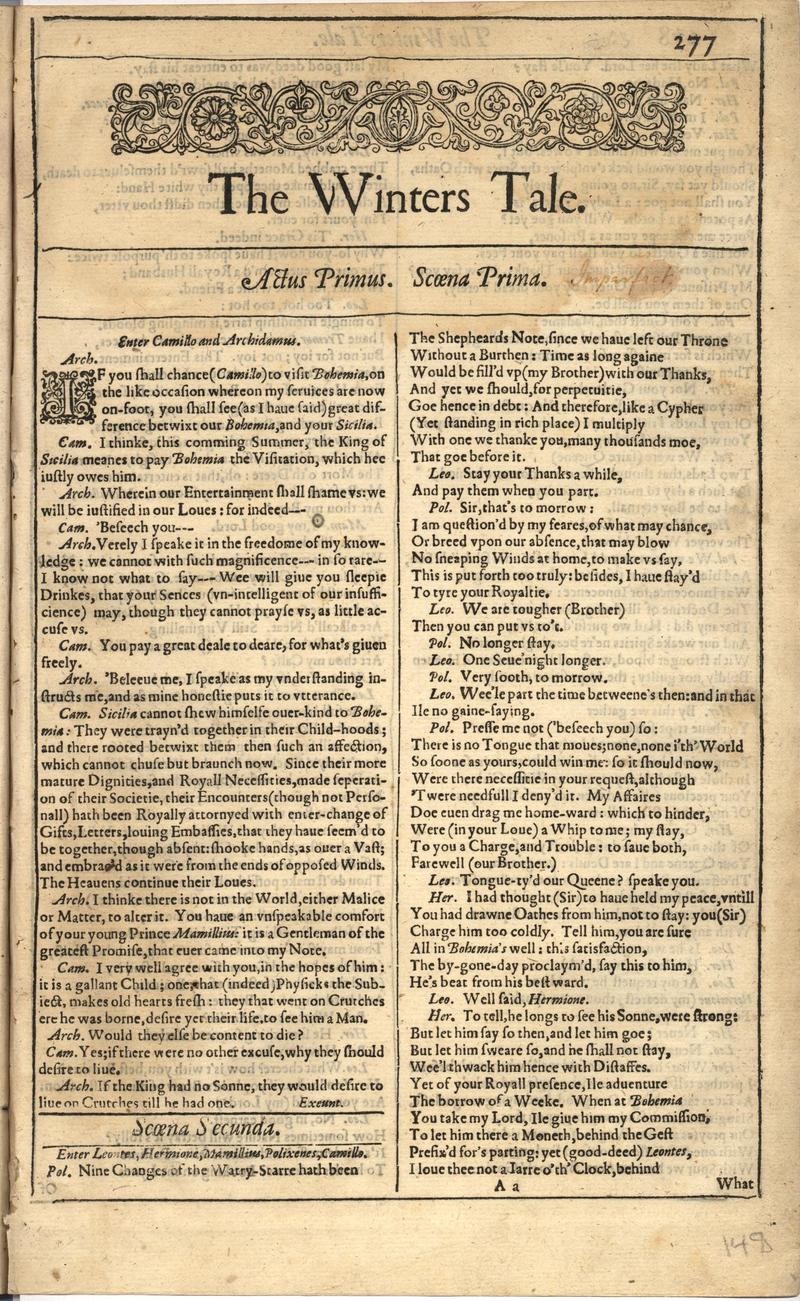
Over the past several years, I’ve written about three of Shakespeare’s plays; The Tempest, A Midsummer Night’s Dream, and Macbeth. All are steeped in the magical and wondrous. Part of the whole point of this column is to force myself to read some things I haven’t already. With plenty of the his plays left unread, I turned once more to his works. While no more of his works are as overtly supernatural, I knew there were elements to be found in at least one or two more. Perhaps, the most obvious is Hamlet, wherein a dead king’s ghost spurs his mopey son on to action. As I’ve read and seen it performed numerous times, I dug around a bit and came upon The Winter’s Tale. While in the end it’s doesn’t near the three first mentioned plays in mystical content, there is some, and, more importantly, it’s a fascinating and strange play.
First published in the First Folio in 1623, the exact date of the play’s composition remains uncertain. Nonetheless, most authorities consider it one of his latter works, probably written around 1610. It’s catalogued among his problem plays, a term first used by critic F.S. Boas to describe All’s Well That Ends Well, Measure for Measure, and Troilus and Cressida. These are plays that veer from the tragic to the comic, not sticking to a single major tone as do his comedies and tragedies. Later, The Winter’s Tale, Timon of Athens, and The Merchant of Venice were added to the list by others. Boas felt the plays allowed the exploration of complex themes in unique ways. That The Winter’s Tale veers from the terrible and tragic to the comic and pastoral before achieving reconciliation can definitely be seen in this light.
The title implies we are going to hear a story, one that might be told around the hearth on a cold winter’s night. Filled with implausibilities, it will draw us into a tale both tragic and comic, but in the end, provide us with a happy ending (more, or less) that we want to hear.
The play opens with two noblemen, Archidamus and Camillo, setting up the story for audience. The king of Bohemia has been visiting his great friend from childhood, the king of Sicilia. Such is there friendship that “there is not in the world either malice or matter to alter it.” In addition, the king of Bohemia’s young son is such a promising boy, every man in the kingdom hopes to live as long as possible to see how great a man he turns out to be. Alas, such blatant moments of foreshadowing can only spell disaster. And the disaster that comes shortly is monstrous.
King Polixenes of Bohemia has been a guest of King Leontes and the very pregnant Queen Hermione for “(n)ine changes of the watery star,” that is, nine months, and has decided it is time to return home. No matter what Leontes says, it is not enough to get him to stay longer. Affairs of state and his young son call him home.
Knowing her husband wants his friend to stay even just a few days longer, Hermione makes her own attempt to convince him to extend his sojourn in Sicilia. Part of their conversation includes Polixenes’ description of the two men’s boyhood friendship. It is incredibly perceptive in its understanding of boyhood innocence a feeling that the present is eternal as well as the dawn of maturity and love and lust.
HERMIONE Not your gaoler, then,
But your kind hostess. Come, I’ll question you
Of my lord’s tricks, and yours, when you were boys.
You were pretty lordings then?POLIXENES We were, fair Queen,
Two lads that thought there was no more behind
But such a day tomorrow as today,
And to be boy eternal.HERMIONE Was not my lord
The verier wag o’th’two?POLIXENES
We were as twinned lambs that did frisk i’th’sun,
And bleat the one at th’other. What we changed
Was innocence for innocence: we knew not
The doctrine of ill-doing, nor dreamed
That any did. Had we pursued that life,
And our weak spirits ne’er been higher reared
With stronger blood, we should have answered heaven
Boldly ‘Not guilty’, the imposition cleared
Hereditary ours.HERMIONE By this we gather
You have tripped since.POLIXENE So my most sacred lady,
Temptations have since then been born to’s: for
In those unfledged days was my wife a girl;
Your precious self had then not crossed the eyes
Of my young playfellow.
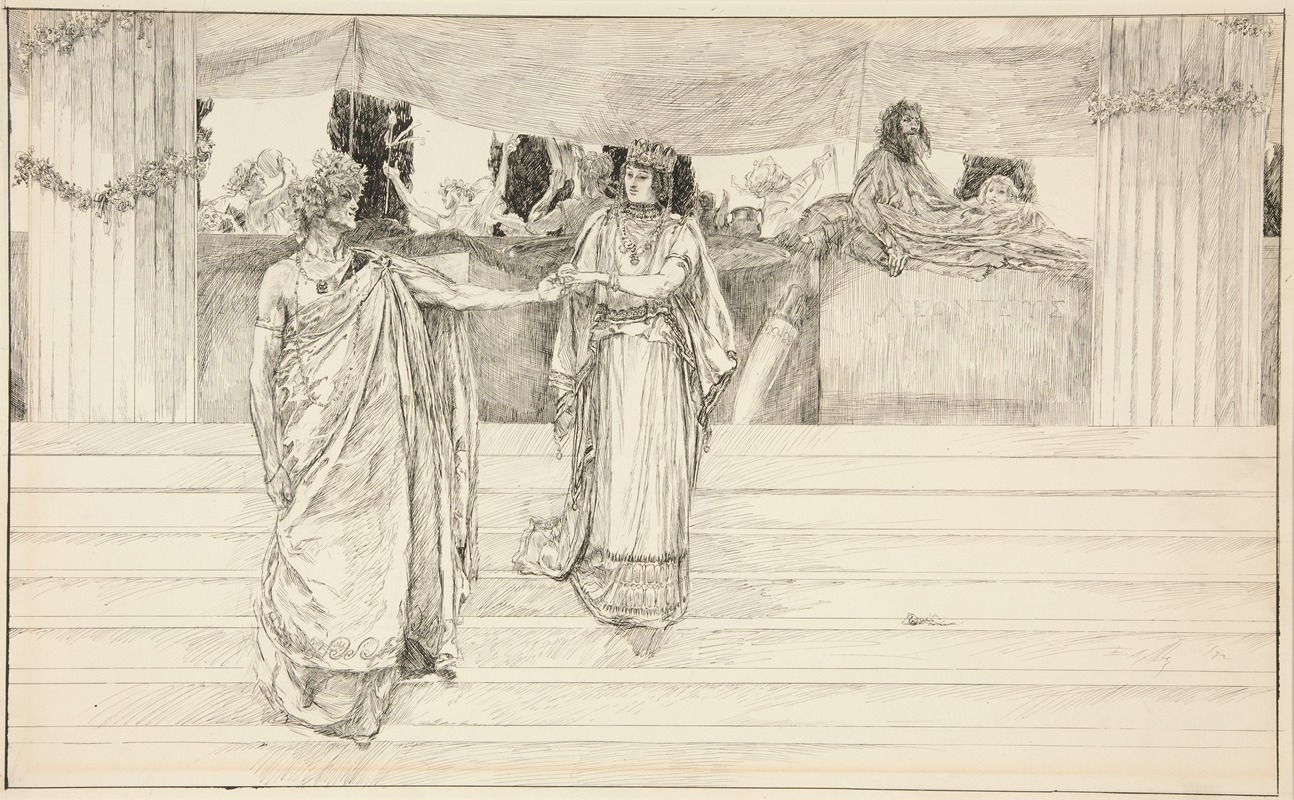
Almost as soon as Leontes learns that his friend will remain his guest at his wife’s request while all his own entreaties failed, something spasms in his mind. Recalling an old memory that his wife didn’t accept his marriage proposal on first offer, an overwhelming sense of betrayal wells up as if from an abyss.
Leonte’s jealousy, unwarranted as it is, comes across as madness or some sort of possession. This has a been a difficult thing for directors over the centuries, and oftentimes they have made Herminone’s and Polixenes’ interactions seem more troublesome. Antony Sher, the great Anglo-South African actor played Leontes in a Royal Shakespeare Company staging of the play. Conducting his own research into what might cause such a sudden overwhelming change in a person, he learned of a condition called morbid jealousy. Here’s a discussion of the production with Sher speaking at 7:08.
Increasingly convinced something untoward is happening between his wife and his friend, he coerces his disbelieving courtier, Camillo, to act as spy.
LEONTES Is whispering nothing?
Is leaning cheek to cheek? Is meeting noses?
Kissing with inside lip? Stopping the career
Of laughter with a sigh? – a note infallible
Of breaking honesty. Horsing foot on foot?
Skulking in corners? Wishing clocks more swift?Hours minutes? Noon midnight? And all eyes
Blind with the pin and web but theirs, theirs only,
That would unseen be wicked – is this nothing?
Why, then the world and all that’s in’t is nothing;
The covering sky is nothing; Bohemia nothing;
My wife is nothing; nor nothing have these nothings,
If this be nothing.CAMILLO Good my lord, be cured
Of this diseased opinion, and betimes,
For ’tis most dangerous.LEONTES Say it be, ’tis true.
CAMILLO
No, no, my lord!LEONTES It is. You lie, you lie!
I say thou liest, Camillo, and I hate thee,
Pronounce thee a gross lout, a mindless slave,
Or else a hovering temporizer, that
Canst with thine eyes at once see good and evil,
Inclining to them both. Were my wife’s liver
Infected as her life, she would not live
The running of one glass.
From there, things get worse. Camillo is engaged to betray Polixenes and kill him. Instead, he warns him of Leonte’s madness and the two escape to Bohemia.
Driven further into madness, Leontes calls out Hermione for her supposed infidelity and claims the child she carries must be illegitimate. He has her imprisoned, where she gives birth. When her lady-in-waiting, Paulina, presents the baby to the king, he castigates her for such an act.
LEONTES A callat
Of boundless tongue, who late hath beat her husband,
And now baits me! This brat is none of mine:
It is the issue of Polixenes.
Hence with it, and together with the dam
Commit them to the fire!PAULINA It is yours;
And, might we lay th’old proverb to your charge,
So like you, ’tis the worse. Behold, my lords,
Although the print be little, the whole matter
And copy of the father: eye, nose, lip;
The trick of’s frown; his forehead; nay, the valley,
The pretty dimples of his chin and cheek; his smiles;
The very mould and frame of hand, nail, finger.
And thou, good goddess Nature, which hast made it
So like to him that got it, if thou hast
The ordering of the mind too, ’mongst all colours
No yellow in’t, lest she suspect, as he does,
Her children not her husband’s.LEONTES A gross hag!
And, losel, thou art worthy to be hanged,
That wilt not stay her tongue.
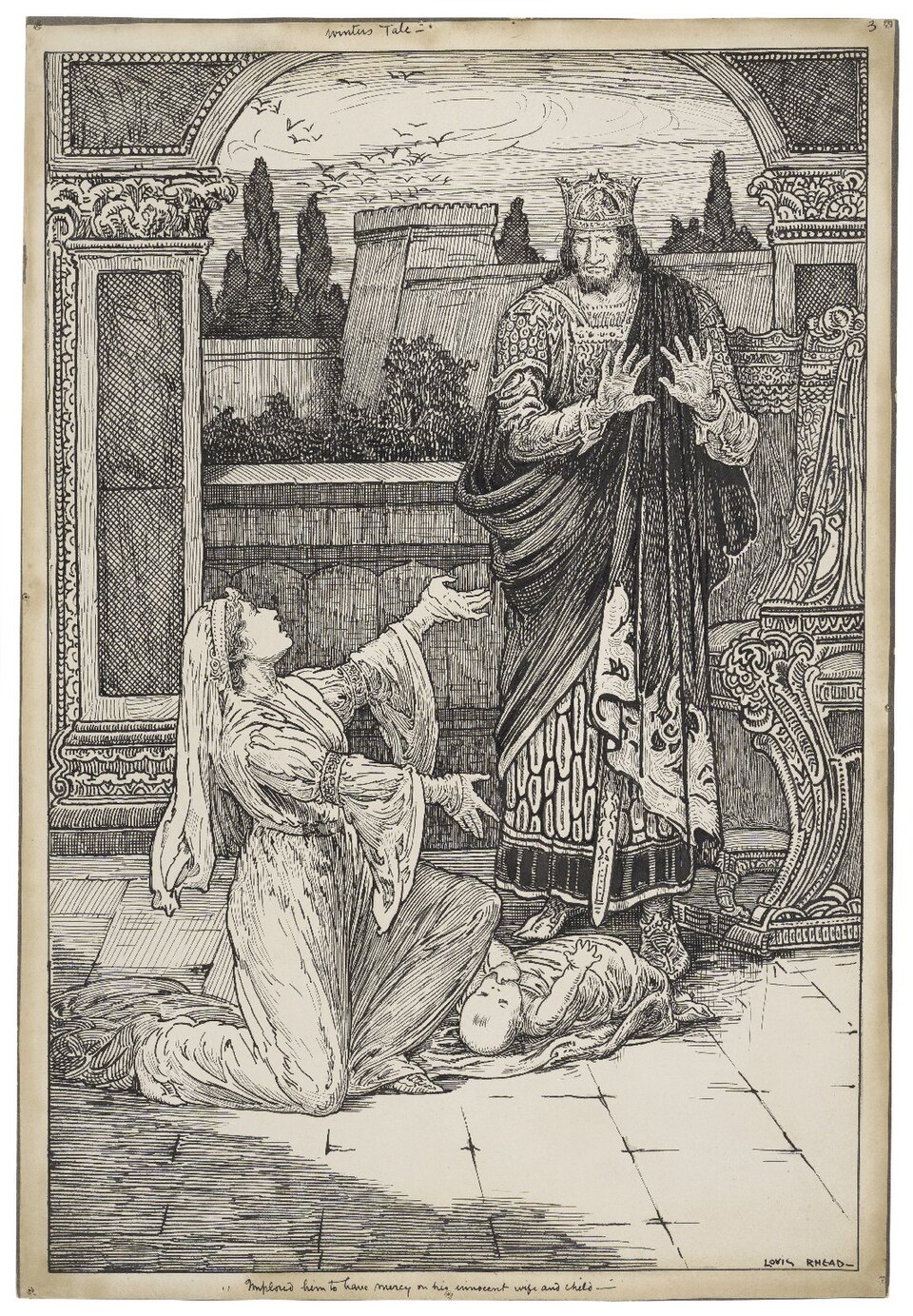
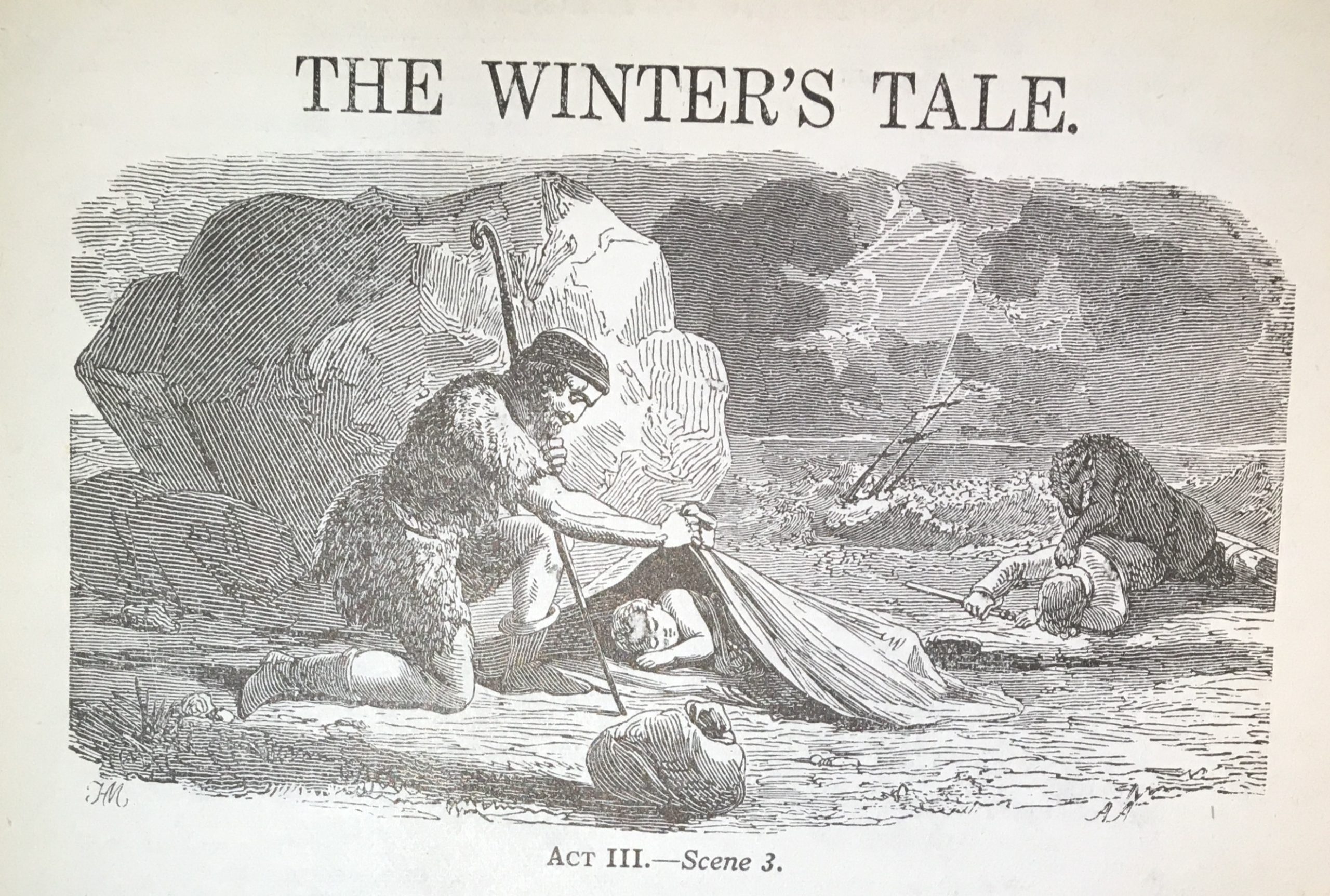
Leontes then commands Paulina’s husband to take the child and leave her in some barren place where she might thrive or die as the case might be. This later leads to one of the most famous bits of stage direction: Exit, pursued by a bear.
When he decides to try Hermione for committing treason in the form of adultery, he also sends two courtiers to the Oracle at Delphos in order to prove the veracity of his claim. Instead, they return in the midst of the trial bearing the Oracle’s condemnation of Leontes.
Hermione is chaste; Polixenes blameless; Camillo a true subject; Leontes a jealous tyrant; his innocent babe truly begotten; and the King shall live without an heir, if that which is lost be not found.
Leontes, so deep in his insanity and rage, rejects the proclamation, insisting “(t)he sessions procced: this is mere falsehood.”
In the very next line, a servant enters to inform the king his son has died, worn out spiritually and physically by the claims against his mother. On hearing the news, Paulina tells the king, Hermione died as well. All this is enough to break the king. Convinced this is a punishment from Apollo, he declares that Hermione and their son be buried together and once a day for the rest of his life he will visit it to express his shame and regret. Late we learn that he has kept true to his word, even if with an occasional prodding from Paulina, the only person other than Hermione who ever stands up to him.
One grave shall be for both: upon them shall
The causes of their death appear, unto
Our shame perpetual. Once a day I’ll visit
The chapel where they lie, and tears shed there
Shall be my recreation. So long as nature
Will bear up with this exercise, so long
I daily vow to use it. Come,
And lead me to these sorrows.
It is then we learn that Antigonus has not simply abandoned Hermione’s daughter, but brought her to Bohemia. A ghost, presumably of his queen, directed him there. Before melting away with a shriek, the spirit told him he would never see his wife, Paulina, again. The aforementioned bear makes sure of that. The infant, on the other hand, is unnoticed by the beast, and instead, rescued by a shepherd and his son. With her, they find a packet contain gold and jewels that will confirm her noble birth should it ever need to be proved.
It as this point the play shifts a major gear. Time itself, and a chorus, enter the stage and tell us that sixteen years have passed. Turning our eyes to Bohemia, it tells us that Polixenes’ son, Florizel, and Hermione’s daughter, Perdita have grown up. If one wants to know what happens next, then watch.
We quickly learn that Polixenes’ on learning his son has fallen in love with a shepherdess, moves to prevent any further from happening. A prince’s marriage is an affair of state, not something that can thrown away on such a girl. He and Camillo, disguised as shepherds themselves, set off for a festival where Florizel and Perdita are to be betrothed.
The audience, knowing the truth of Perdita’s origin, gets to sit back and watch as the various characters are moved into place for the stunning, and possibly magical, conclusion involving a repentant Leontes and a curiously lifelike statue of his wife.
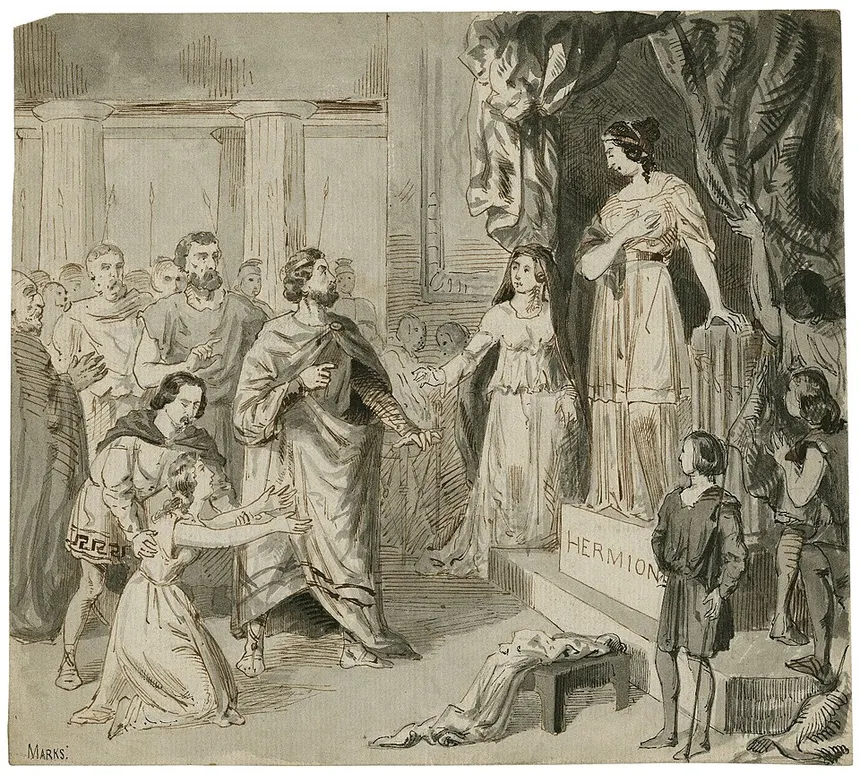
Along the way we are treated to the comic shenanigans of the scoundrel, Autolycus, a grifting seller of broadside ballads. In various disguises, he picks pockets and otherwise swindles attendees of the festival. In the end, even he, too, benefits from the play’s reconciliatory end.
Redemption is found for Leontes at the end of The Winter’s Tale. He is reconciled with Hermione, who is restored to life, perhaps, or, simply emerged from sixteen years in hiding. He finds his daughter and she is betrothed to the man she would’ve married all along, had things not gone so very wrong. But, as with most great crimes, there were things done that cannot be undone. Leontes’ son is still dead. That “gallant child; one that indeed physics the subject, makes old hearts fresh. They that went on crutches ere he was born desire yet their life to see him a man,” is gone, never to return. There can be forgiveness, but full restoration is impossible.
I need to return to this play in the future. Leontes’ madness and the destruction of his family is as powerful as Lear’s self destruction. Lear’s pettiness, the need to hear his daughters’ love expressed in words, is obvious. Leontes’ fall is triggered by no visible or obvious thing, and I find that mystery more painful The scenes with his accusations against Hermione and her trial are devastating. Her nobility in the face of his shameful actions is doomed, but beautifully depicted.
Unlike King Lear‘s apocalyptic finale, there is restoration and reconciliation at the end of The Winter’s Tale. Living in a time when there seems to be little call for or offering of redemption, it almost feels shocking. That’s a powerful thing in any day or age and I want to think more on that. The other play I’ve written about that features restoration and forgiveness, is The Tempest. Young lovers are brought together and a king is restored to his throne. Of course, the worst crimes happen before the play’s beginning, and many of the worst events in the play come across as comical. Still, it would seem an older Shakespeare was intent on exploring a way out of the death and destruction of his previous tragedies. That’s definitely something we could all bear to think on.
Here’s the full production, starring Antony Sher
Fletcher Vredenburgh writes a column each first Sunday of the month at Black Gate, mostly about older books he hasn’t read before, though not always. He also posts at his own site, Stuff I Like when his muse hits him.
Wasn’t Troilus and Cressida an epic rather than a play?
Apparently, it’s a bawdy comedy in Shakespeare’s hands that ends in despair, with the death of Hector. It takes place during the Trojan War, with Troilus being another of Priam’s sons.
Morbid jealousy as a medical condition explains a LOT. Not just in the play, but in history. Leontes really is such a frustrating character to try to like, but this makes it much easier to do. Suddenly, I’m glad for the redemptive aspects. I wonder if Shakespeare personally knew someone suffering the regrets of having acted in madness, and at least partially wrote Winter’s Tale as an attempt to comfort.
He definitely had fun writing the stage directions about the bear. “Alright, stage manager, since you’ve been whinging about not being challenged, lately, let us see how you handle this.”
Brings back memories. Was our Shakespear setpiece in Matric English. Actually a pretty decent tale as I recall.