A Gender Fluid Future on the Moon: John Varley’s Steel Beach
 |
 |
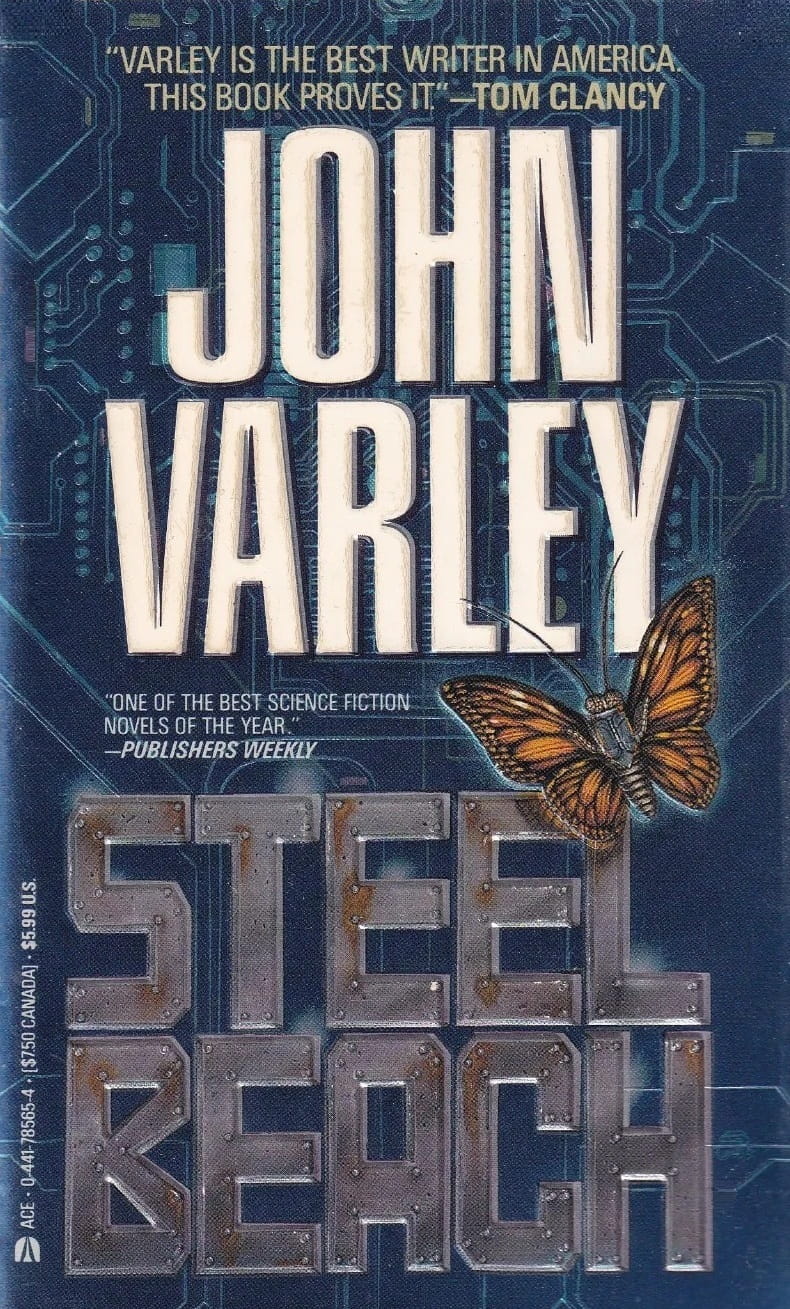
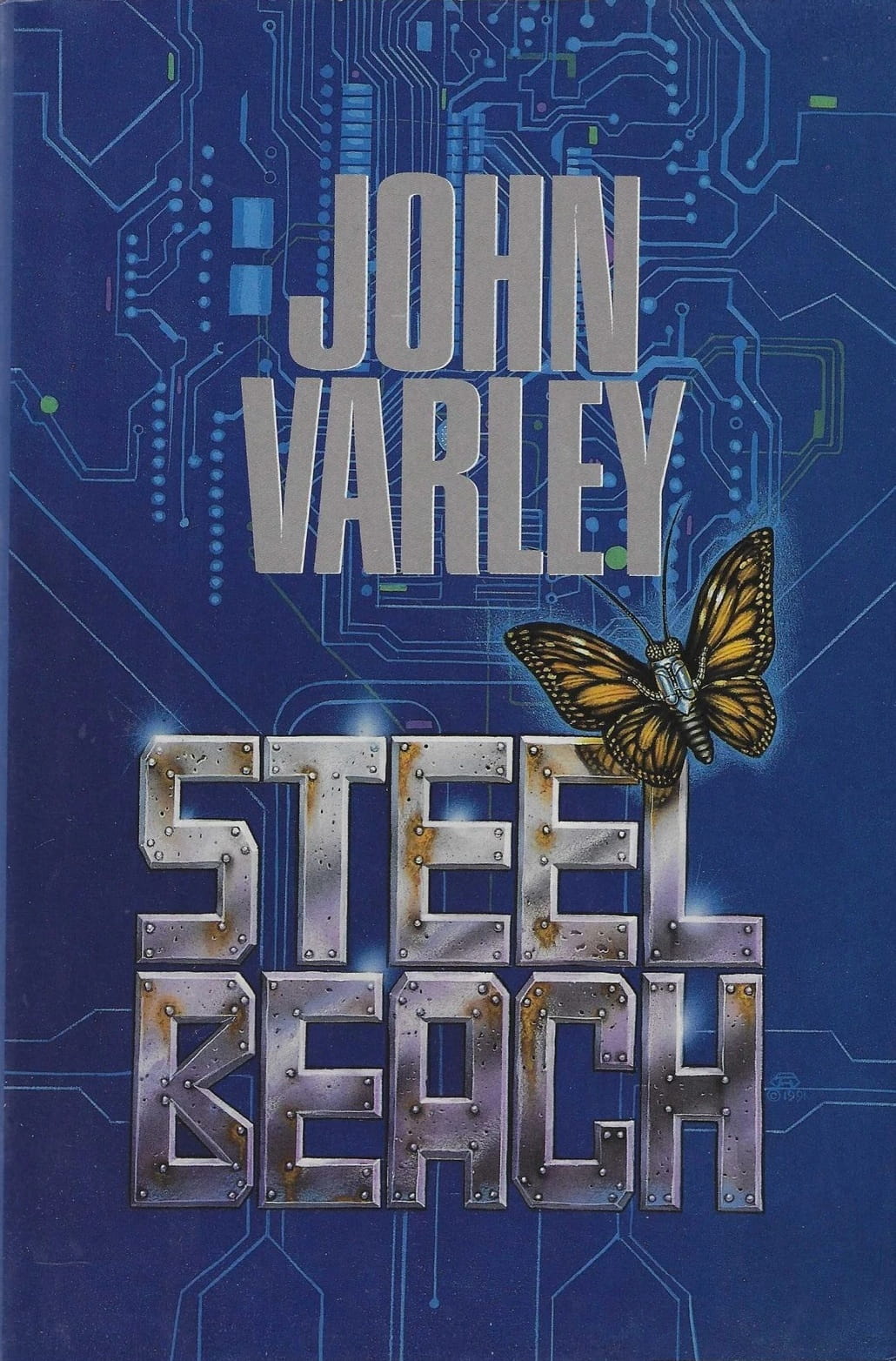
Steel Beach (Ace Books, August 1993). Cover by Todd Cameron Hamilton
My hot take for 2026: books are ephemeral.
Old news, perhaps, but did any spec-fic writer know this better than John Varley? In 1992’s Steel Beach, he positively revels in his own unimportance while offering blistering, adroit editorials on everything from indolence to anatomy. But who remembers this book today? And how many remember the name John Varley?
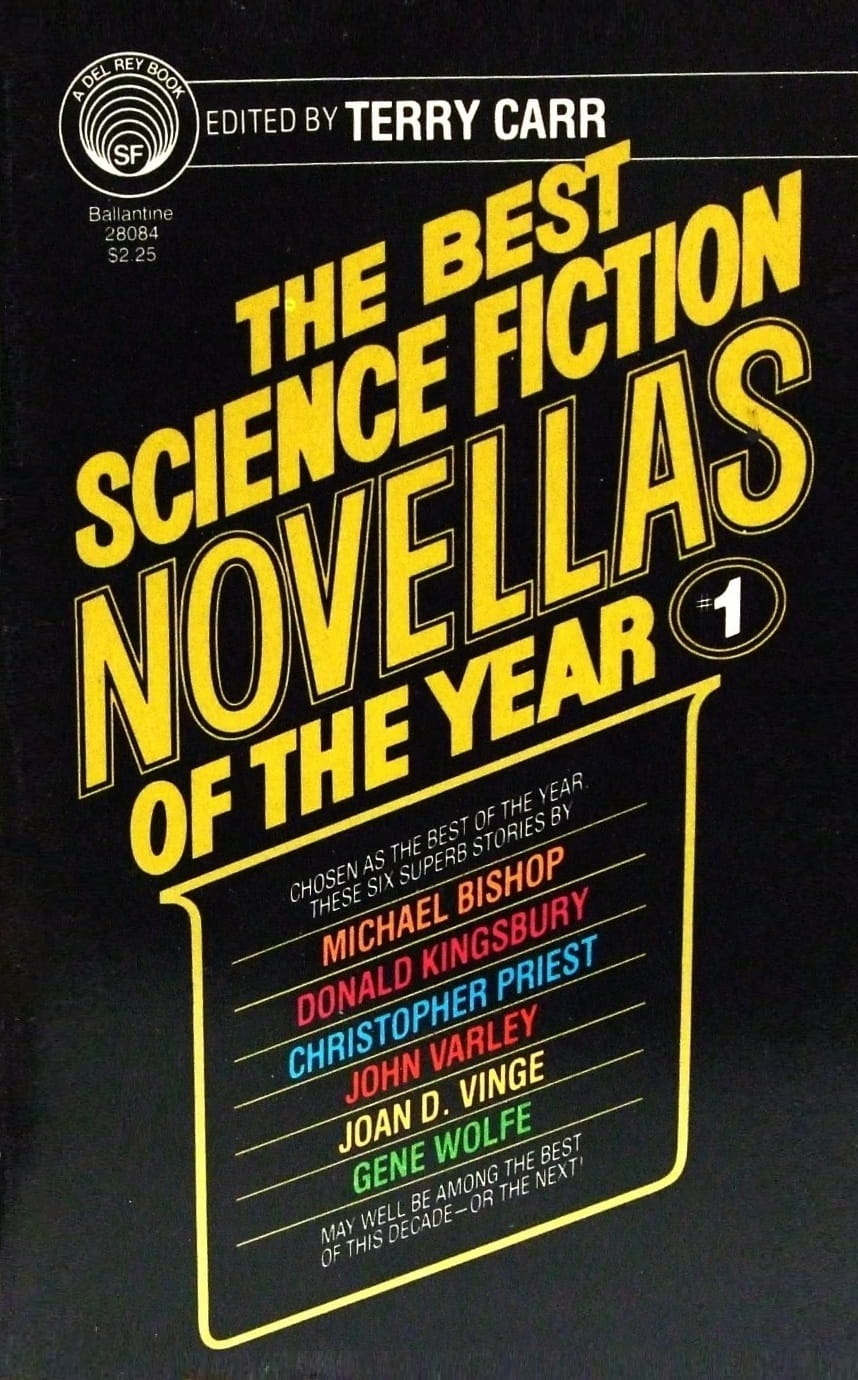
I first encountered Varley’s Nebula-winning short, “The Persistence of Vision,” on a 1988 cross-country camping trip. The Terry Carr-edited Best Science Fiction Novellas of the Year #1 was and is chock-full of good material, but it was Varley’s story that haunted me, in part because it tacitly asks readers whether they would put out their own eyes for love – and I must confess that I didn’t like the question, much less my reflexive, fully sighted answer.
[Click the images for totally metal versions.]
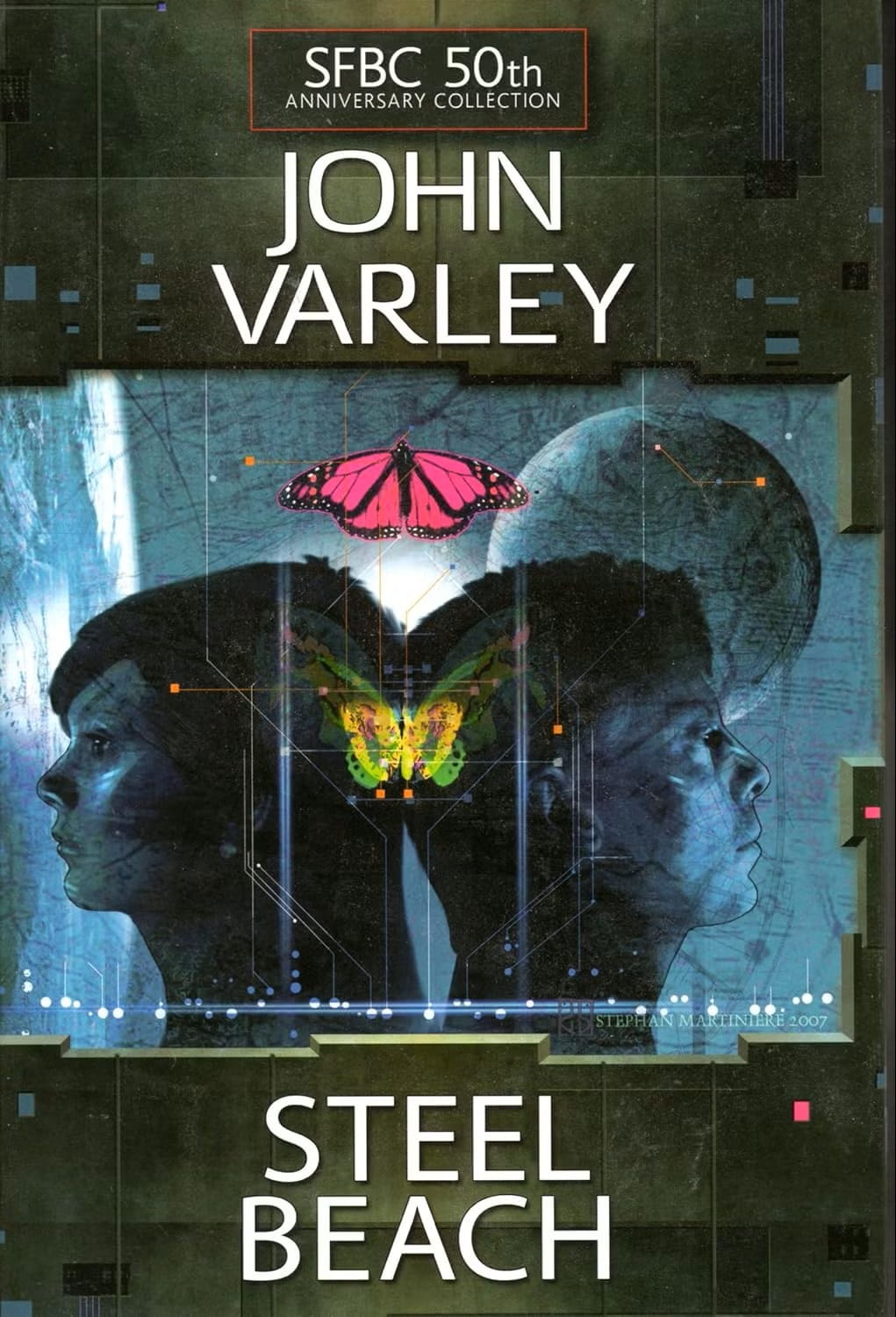
I re-read it twenty years later, and discovered that my crush on the story had metastasized to full-blown love. I picked it up anew just after COVID, and was blown away all over again. That’s how it is with good art. You can shove it into a corner for a time, but then it steps back into your path and clocks you like a young Muhammed Ali.
Oh, and since I’m in confessional mode, I’ll just mention that once upon a time, I got Johns Varley and Crowley mixed up, and set about reading Little, Big thinking that Varley had written it. My apologies to the estimable and hopefully immortal John Crowley. (For more on Little, Big, click HERE.)
At any rate, and despite my reverence for “The Persistence of Vision,” I had never sought out a John Varley novel – and at this point, seeking is most definitely required. He doesn’t pop up on the sci-fi and fantasy sections of my local book store, and most of his work appears to be out of print.
That’s certainly the case with Steel Beach, which Publisher’s Weekly once said was “One of the best science fiction novels of the year,” while Tom Clancy (of all people) called Varley “the best writer in America. This book proves it.”
Did the reading public care? Given how few water-cooler convos take up the subject of Varley, I’d have to say that the answer is no. Dust to dust, and publication to ashes.
 |
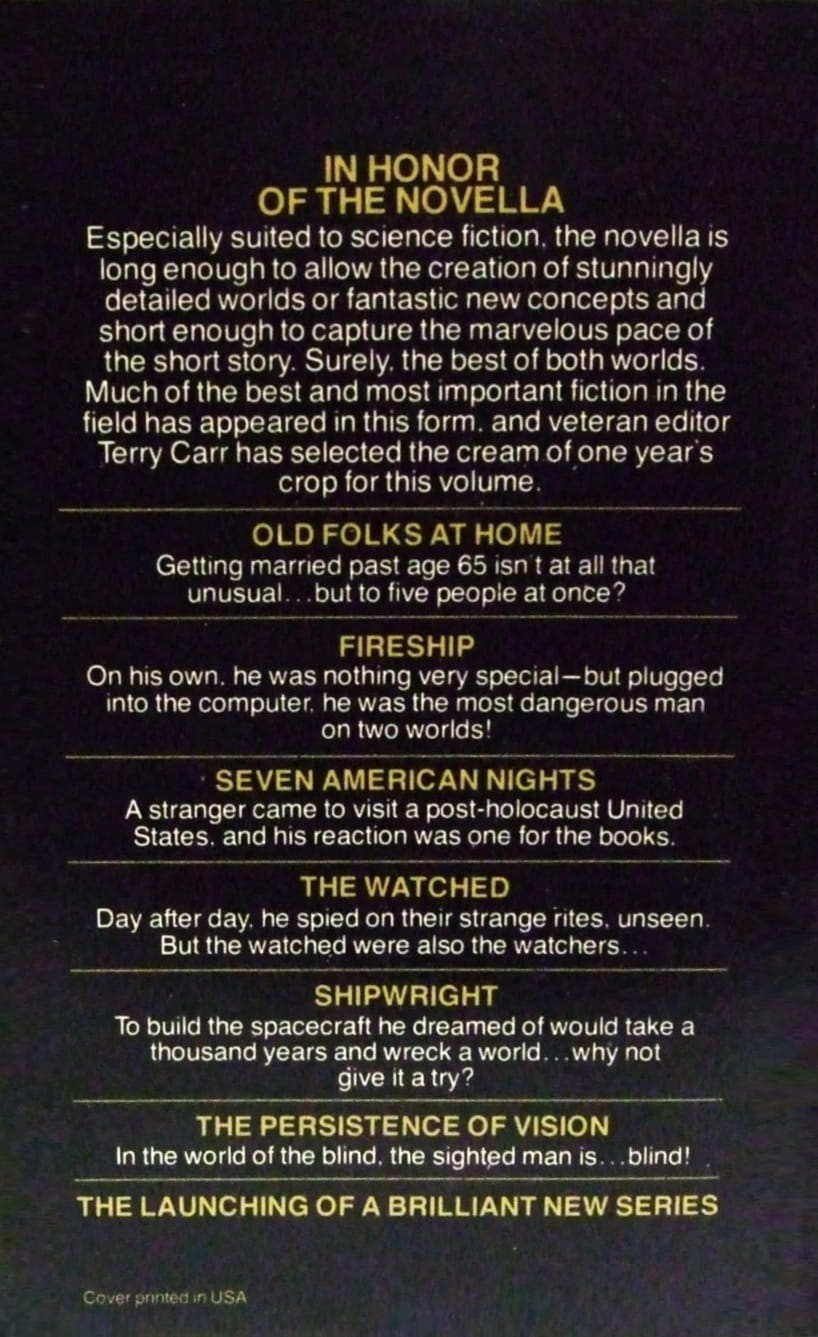 |
The Best Science Fiction Novellas of the Year, edited by Terry Carr (Del Rey, September 1979)
Should we care now? It depends on what you, gentle reader, want out of a book. I’ve cracked my share of covers and have rarely encountered a work less focused on plot, or pace. We’re a long way from pulp fiction here. What Varley has constructed is a sort of discursive essay on why human beings should not commit suicide, and he uses his main character, tabloid reporter Hildy Johnson, as a lab rat.
Call it a bildungsroman with gender fluidity built in – and in that aspect, Varley proves to have been decades ahead of our current debates about transsexuality. In the world of Steel Beach (a moon colony), changing one’s biological sex is a mere afternoon’s work, and since people within these pages tend to live for two hundred years or more, nearly everyone tries a gender-switch or two. It’s presented as little more than an involved version of modeling a new hair-style.
All of which is great fun, but it’s not really in the service of story. In Steel Beach, Varley is engaged in a sort of Socratic dialogue, one in which Hildy’s encounters with regular folk, the colony’s governing computer, and a breakaway sect of “mad” scientists all serve to test the author’s notions of evolution, or perhaps forced evolution, and why life is worth living. Several times, we encounter brontosaurs, and brontosaur burgers.
By story’s end, Hildy (who, if you recall, began the book as a man) has become a single mother, but in hiding, thanks to a computer-generated rebellion that feels dangerously contemporary. Meanwhile, a friendly bulldog makes a heroic last stand, Hildy’s favorite dive bar burns to the ground, and somebody finally runs a rail line from Old Texas to pioneering Pennsylvania. On the moon. In the future.
 |
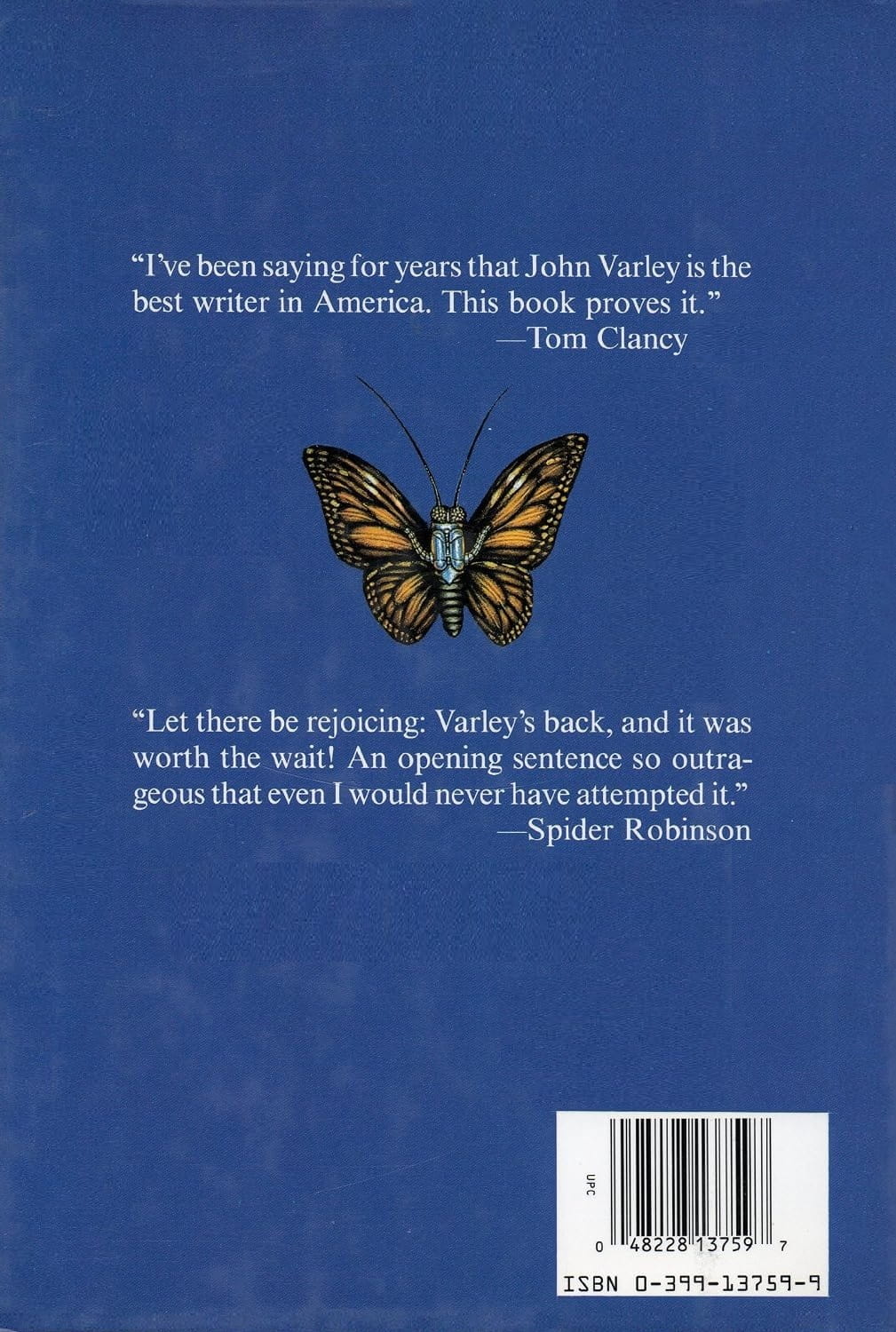 |
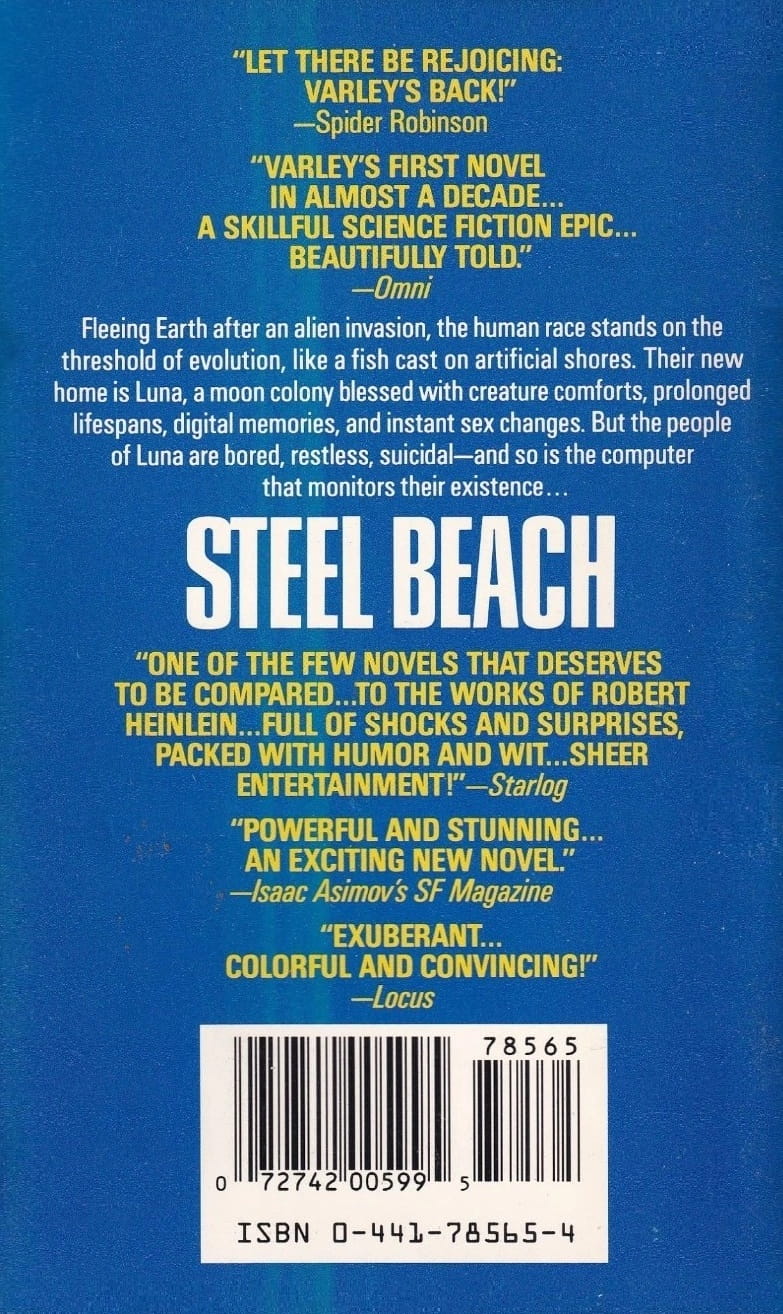
Steel Beach, first edition (Ace/Putnam, July 1992). Cover by Todd Cameron Hamilton
It makes, I’m sorry to say, for a bit of a slog.
Or, to come at it from a different angle, Steel Beach serves as hard evidence that the most impactful fictions, whether purveying Big Ideas or heart-wrenching melodrama, are usually best served at speed, with velocity and rising tension, the kind that a downstream readership can keep track of in real time.
That said, the prose is clever, and often hilarious. Varley drops sly references with admirable constancy, and doesn’t suffer fools. One example: on page 176, there’s an off-the-cuff reference to “Old Man River,” but if you don’t already know the song, you’ll miss the joke entirely. I’m quite sure that Varley, dedicated smart-ass that he is, dropped a great many references which I failed to so much as notice.
Varley passed away in 2025. He left behind a prolific body of work and a sponsorship-free website, which you can visit HERE.
Onward, and swords together.
Mark Rigney is a writer and long-time Black Gate blogger. His latest S&S story, “The Icehawk,” is set to debut in Issue #3 of Battleborn, later this year. His work on this site includes original fiction and perennially popular posts like “Genre 2012: the Ghetto Remains the Same.” About his new novel, Vinyl Wonderland, reviewer Rich Horton said, “I was brought to tears, tears I trusted. A lovely work.” His favorite review quote so far comes from Instagram: “Holy crap on a cracker, it’s so good.” A preview post can be found HERE, while his website lives over THERE.

I enjoyed a lot of Varley’s books back in high school and college–particularly the Titan trilogy. I’ve had this since it was published and honestly I can’t remember if I read it or not.
But it was wild when he wrote a whole series of novels that basically copy the story from Andy Griffith’s Salvage One!!
What? Varley left us?! No!
…TBR list on hold. Gotta gather up the Varleys from my shelf and hold a reading wake. With ice cream.
The name totally rings a bell so that I feel like I’ve read SOMETHING by him but looking at his wikipedia nothing is standing out that I have definitely read…
Sorry to say that yes, Mr. Varley has left us. Yes, I’ve heard good things about the Titan trilogy. And again, I cannot speak highly enough of “Persistence of Vision.”
I particularly enjoyed Picnic on Nearside and millennium. And blue champagne. His short stories are always enjoyable and thought-provoking.
The Titan trilogy is fantastic, but it does get very weird in places. His writing reminds me in some strange ways of Chris Claremont.
This year is the 50th anniversary of Samuel R. Delany’s ‘Trouble on Triton’, which I re-read to prepare for a discussion at Readercon. And as I read it, I kept thinking, “Ah, so this is where Mr. Varley got his Eight Worlds inspiration.” They make a lovely pair, Delany and Varley. Of course, ‘Steel Beach’ name-checks Robert Heinlein, so I should also nod in that direction with ‘Moon is a Harsh Mistress’ and its similar computer-run Lunar colony.