Dark Muse News: Reviewing Arcane Arts and Cold Steel by David C. Smith
 |
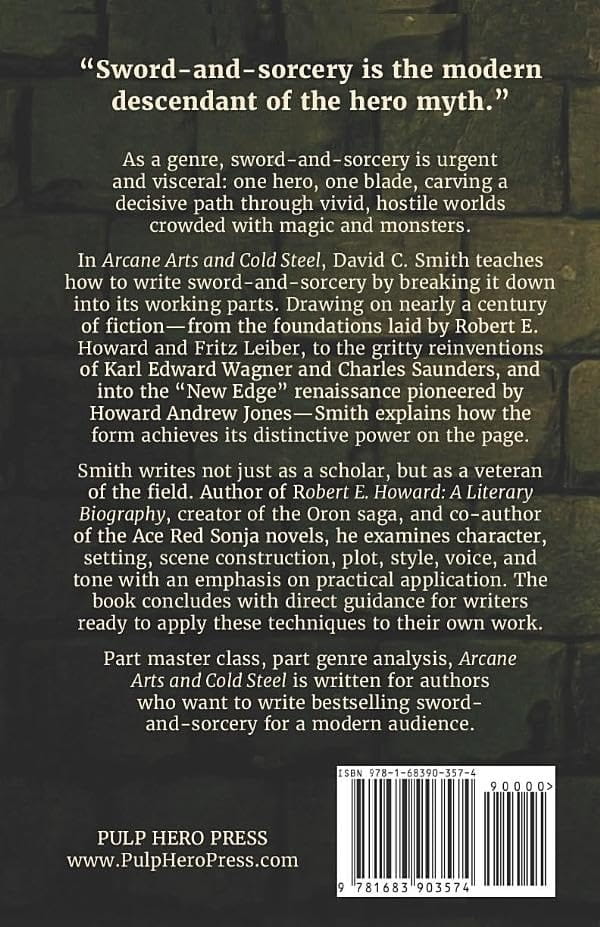 |
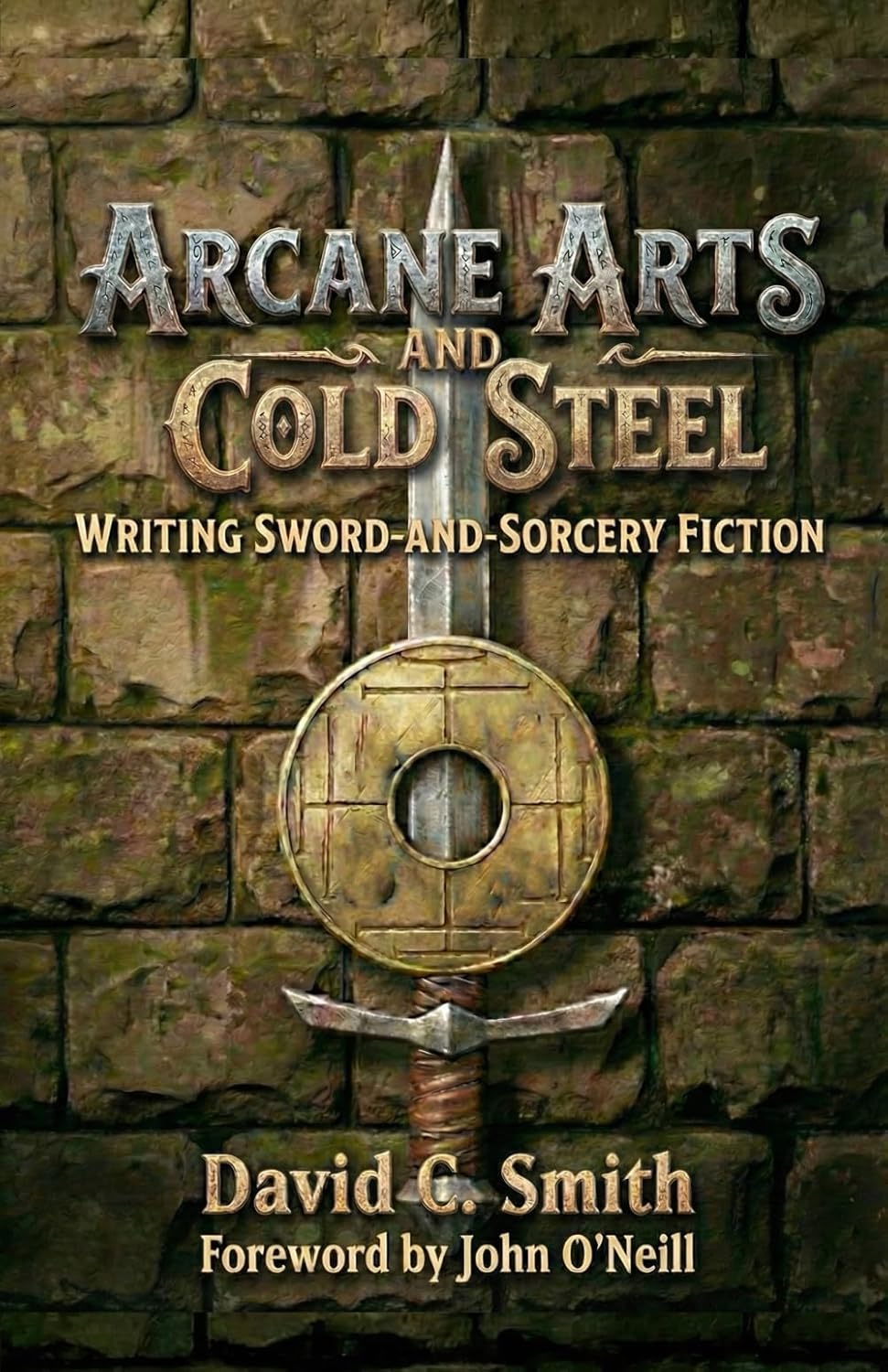
Arcane Arts and Cold Steel (Pulp Hero Press, December 24, 2025)
From History to Writing Sword and Sorcery, Pulp Hero Press has us covered
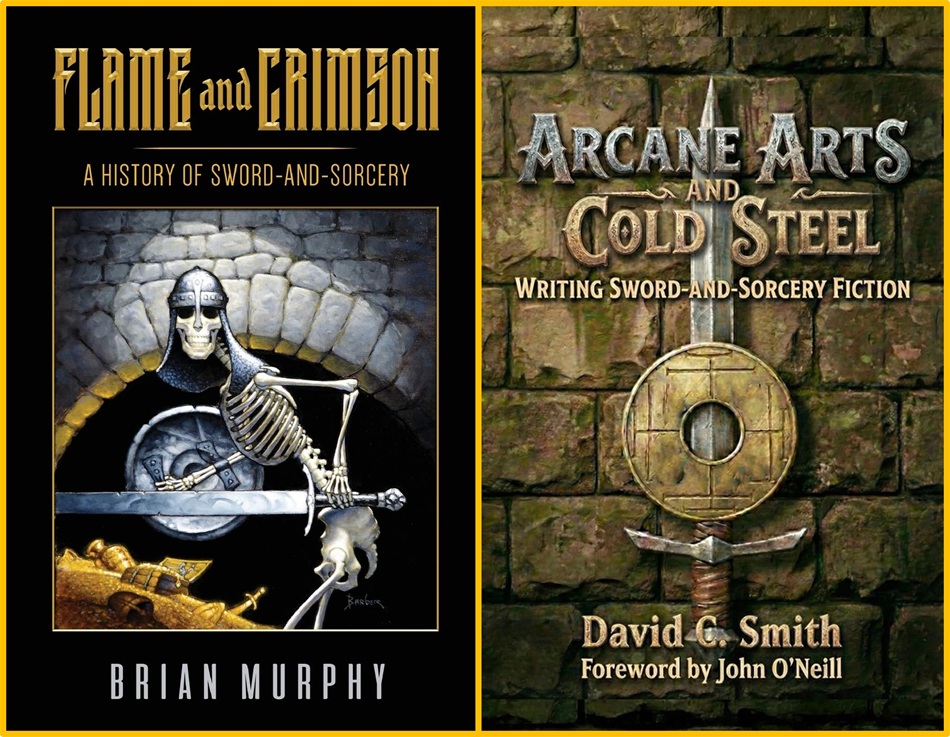
In 2019, Pulp Hero Press published Brian Murphy’s Flame and Crimson: A History of Sword-and-Sorcery, which was notably covered by David C. Smith (link to review) and John O’Neill (link) on Black Gate. O’Neill highlighted that Brian Murphy was one of the earliest contributors to Black Gate, from way back in 2012! Six years have passed since the publication of Flame and Crimson; whereas the subtitle and focus of that was a history of Sword & Sorcery (S&S), Pulp Hero Press just followed with a sequel focused on writing it, penned by David C. Smith with a foreword by John O’Neill.
This post covers the complementary book Arcane Arts and Cold Steel: Writing Sword-and-Sorcery Fiction (Pulp Hero Press 2025, 298 pages). Greg Mele recently posted a Black Gate article on how this book is The Literary Sorcerer’s Toolkit; read that to learn more about the author.
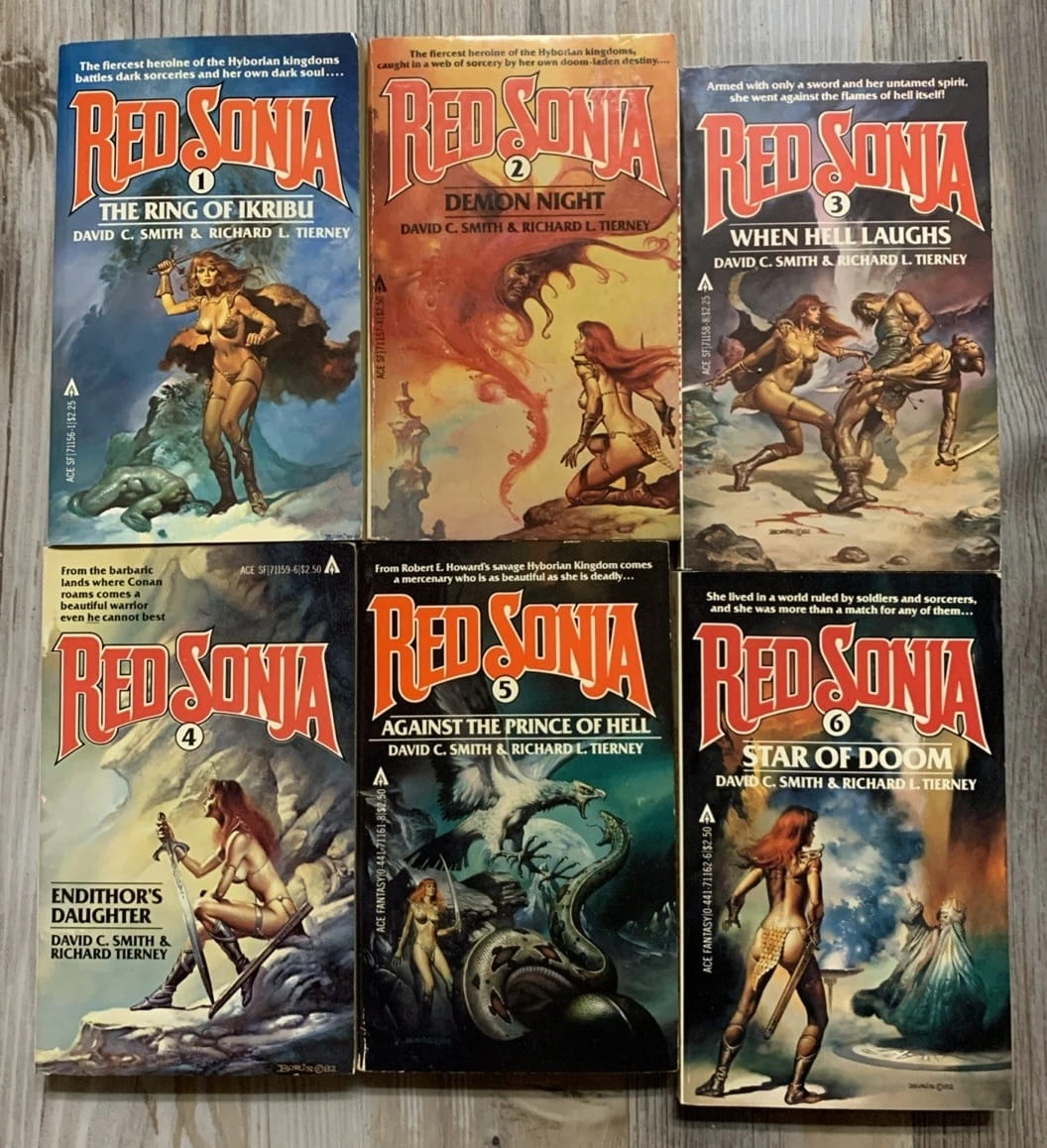
In short, David C. Smith (Wikipedia page) is a writer of horror, historical, and suspense fiction, and is also a medical editor and essayist. He is best known for his heroic fantasy novels (i.e., Oron and the Attluma books), including his collaborations with Richard L. Tierney featuring Robert E. Howard’s Red Sonja heroine. He has written plenty of nonfiction, too, and won the 2018 Atlantean Award from the Robert E. Howard Foundation for Outstanding Achievement, Book, for Robert E. Howard: A Literary Biography.
Read this to learn the contents of the Arcane Arts and Cold Steel in more detail.
Frankly, it feels like John O’Neill has been moderating a panel on Sword & Sorcery since 2019, Brian Murphy covered the history of S&S, while David C. Smith covered writing perspectives, and Pulp Hero Press captured the transcript in book form.
Let us quickly recap some of Flame and Crimson to set up Arcane Arts and Cold Steel content.
What Sword-and-Sorcery is, and What it is Not
Brian Murphy opened with a chapter defining “What is Sword-and-Sorcery” before following with eight chapters on the linear history of it. He quoted David C. Smith from the very beginning!
We can give you clues to what it is — and what it is not. It is not high fantasy. High fantasy dresses up life and offers comfort; it is romantic. Our fiction is dark, often very dark, in the same way that unsettling dreams are never far from nightmares, and not at all comforting.
– David C. Smith, “Introduction,” Swords of Steel
Murphy’s Base S&S Elements (general, historic expectations of S&S):
- Men (and women) of action
- Dark and dangerous magic
- Personal and/or mercenary motivations
- Horror/Lovecraftian influence
- Short episodic stories
- Inspired by history
- Outsider heroes
David C. Smith reviewed Flame & Crimson
At long last, we have a history of the sword-and-sorcery genre, and a very welcome and erudite study it is. Brian Murphy is to be commended for his honest appreciation of our frequently dismissed and often mocked genre. He intelligently surveys the expanse of the sword-and-sorcery field warts and all, low points and high, putting the genre into its proper literary perspective.
To present a linear history of the sword-and-sorcery genre is, in fact, to dissect a Yggdrasil of many branches, which is precisely what Murphy has done here…
He bookends his study with two important chapters, with his initial question “What is Sword-and-Sorcery?” ultimately addressed in the final chapter, “Why Sword-and-Sorcery?” In between, he takes us on a journey beginning with the roots of what is to come
Arcane Arts and Cold Steel
Motivated to Write, and Lie!
John O’Neill’s introduction to Arcane Arts and Cold Steel clarifies our loves of lies! He covers humans’ need for storytelling, converging from 17,000-year-old cave paintings summarizing wild hunting expeditions, to 5,000-year-old astronomical myths guiding the evolution of civilizations, to general fiction, and our need for heroic myths. To paraphrase, “there is potential inside us to accomplish things we can hardly dream of” and heroic myths fuel our fire.
O’Neill writes:
What tools do we have to teach [our children] to resist in the face of a terrible, implacable, or unexpected foe? You already know the answer. The answer is myth. Story. Fiction. Lies.
Expect a review of writing approaches, not a step-by-step S&S writing workshop
Arcana Arts and Cold Steel is about writing, but it is not a stringent workbook for the reader to follow. It is more of a compendium of reviews, collections of excerpts and quotes, and even reviews of other reviews. It is a free-form cookbook that simultaneously showcases over a hundred writers’ and reviewers’ work while categorizing examples for the writer to model. If you do not intend to write, you will walk away with a detailed survey of S&S literature and its fan base, and expand your perspectives of what S&S literature has become (and what it can be). Writers will gain access to countless examples of characters, plots, milieus, practical applications, and styles.
Over three years ago, I had the chance to peruse a draft of Arcana Arts and Cold Steel, and I encouraged David Smith to consider a more direct step-by-step guide. He replied kindly to me via email about that approach: “Who has the right to tell someone how to be their own writer?” Well, he had the credentials for that, but not the ego. Yet he was still driven to compose a book about writing S&S. In the end, the book is a splendid mix of David Smith’s insight blended with so many representations from the broader S&S community that it feels like an encyclopedic love letter to the entire fan base. The Appendix Author Interview relates his development and approach toward the book.
 |
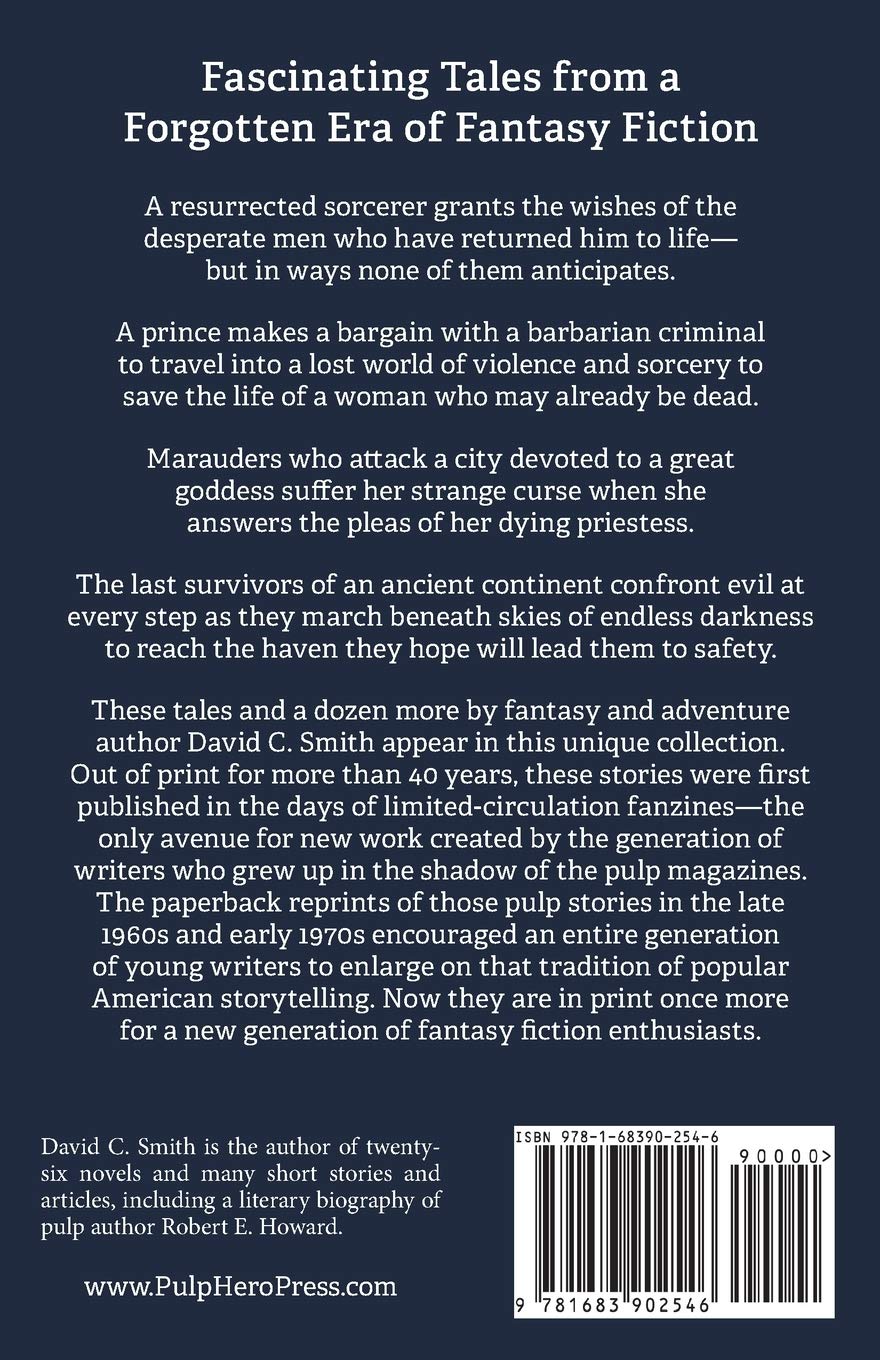 |
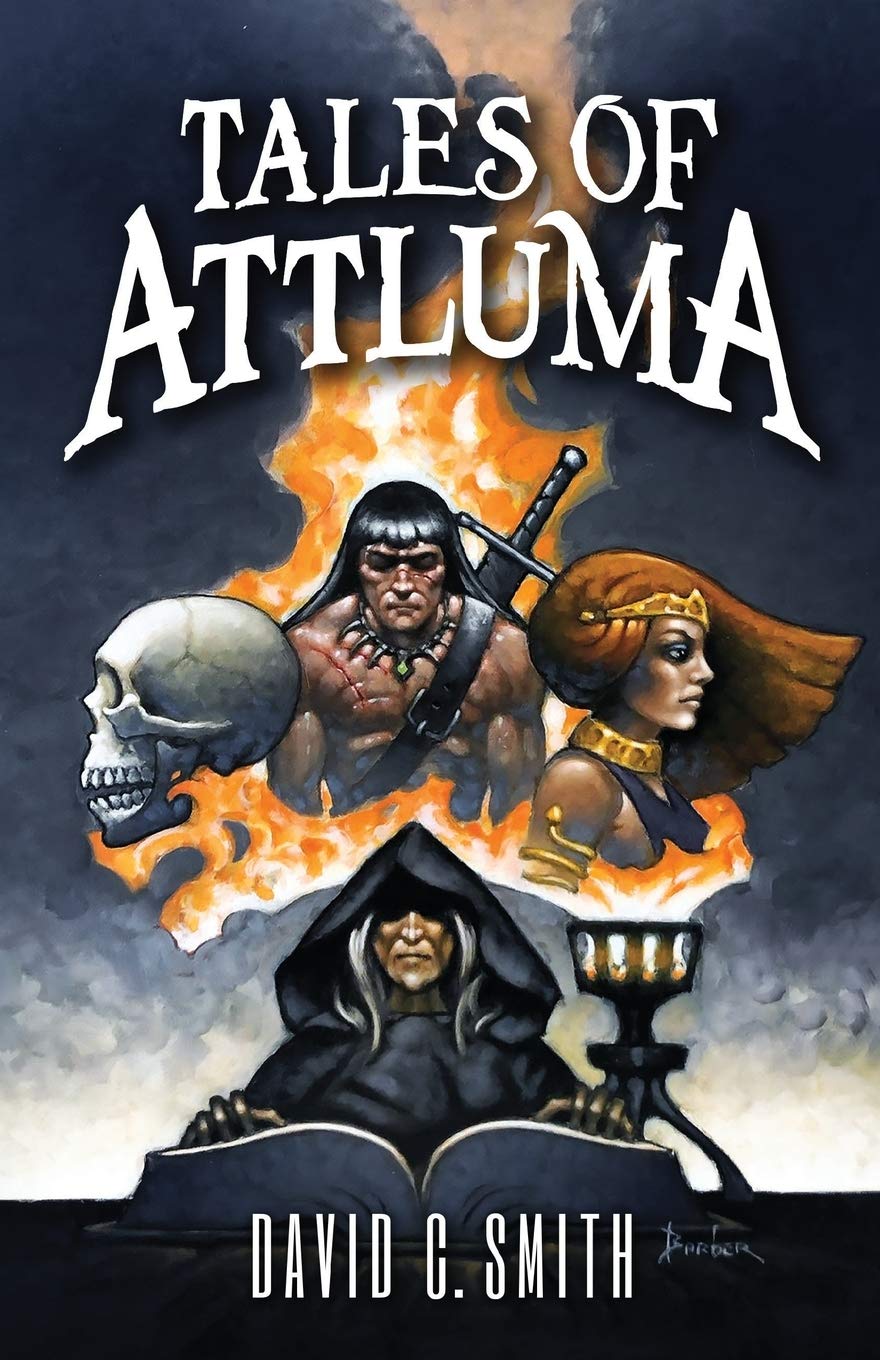
Tales of Attluma by David C. Smith (Pulp Hero Press, December 24, 2025). Cover by Tom Barber
You initially had the idea of having this be a book on how to write sword-and-sorcery stories.
I did. Who am I to tell anyone how to write? You sit down, you start, you learn by doing while referring to writers you like by dissecting how they’ve done what they’ve done. But my friends kept calling it Dave’s “how-to write sword-and-sorcery” book and made the case that offering guidance or ideas to readers would be helpful. Why write a book called “Writing Sword-and-sorcery Fiction” without giving people some ideas about actually writing sword-and-sorcery fiction? They were right. So I added the section doing that to complement the material in the main text.
I’d already come up with the ideas years ago on creating characters. Wrote it for an online writing group. So I had that, and when I reviewed it, I found some good common sense ideas in there. It wasn’t strictly prescriptive. I have a think skin whenever I hear a voice that sounds even vaguely imperative or prescriptive. Don’t tell me what to do! But when I thought of it as giving helpful advice or suggestions, I was fine with it. Started typing and went to town with a lot of ideas. So I hope those pages are worthwhile.
David C. Smith — Page 260-261
Arcane Arts and Cold Steel Contents
1. Sword & Sorcery Fiction: What it is and what it is not (pages 1-72)
This is a 70-page, condensed (and less chronological) version of Flame and Crimson‘s history that sets the stage for writing S&S.
2. Story Structure (pages 73-186)
- Character and Setting
- Must a protagonist be human?
- Flat and round characters
- Plots and scenes
- Style, voice, and tone
- Theme
3. The New Edge: Current Sword-and-Sorcery Fiction (187-229)
In this section, David Smith surveys the rapidly diverging contemporary flavors of Sword & Sorcery. Howard Andrew Jones (HAJ, our beloved champion of S&S and its fan base, who passed in January 2025) coined the term “New Edge” to capture a rebirth of sword and sorcery. In 2008, as Managing Editor at Black Gate, HAJ posted his ‘manifesto’ regarding a resurgence brewing in Sword & Sorcery fiction: Honing A New Edge Part 1 & Part 2 (these originally appeared in the introductory editorials Issue 3 & 4 as “The New Edge”).
This sentiment resonated with many authors and editors, and a decade after its posting, directly inspired the creation of New Edge Sword & Sorcery Magazine (though editor Oliver Brackenbury has a slightly different definition than that of HAJ, read Oliver’s interview at BG for more).
4. Final Words
-
Appendix I: Writing Sword-and-Sorcery Fiction (p231-252)
-
Appendix II: Recommended Reading (p253-256)
-
Interview with the Author (p257-264)
More David C. Smith on Writing S&S
As complete as Arcane Arts and Cold Steel is, there is more in David Smith’s head to tap. As an editor and literature guru, he has keen takes on syntax, which he sprinkles throughout the book. I privately hoped for a reprint, or relook, of his “The Writer’s Style: Sound and Syntax in Howard’s Sentences” (published in The Dark Man, February 2013). That essay, like many of The Dark Man (The Journal of Robert E. Howard Studies)‘s articles, delved into Robert E. Howard’s writing. Reading Smith’s Arcane Arts and Cold Steel motivated me to reread Smith’s article which dissects the Father of S&S’s syntax:
- Natural Order of Sentences and Plain Style
- Alliterative Devices, Conventional Phrases, archaic Flourishes, and Diction (poetic
- Color
- Use of Present Tense (mixed with past)
“You sit down, you start, you learn by doing while referring to writers you like by dissecting how they’ve done what they’ve done.”
— David C. Smith
S.E. Lindberg is a Managing Editor at Black Gate, regularly reviewing books and interviewing authors on the topic of “Beauty & Art in Weird-Fantasy Fiction.” He has taken lead roles organizing the Gen Con Writers’ Symposium (chairing it in 2023), is the lead moderator of the Goodreads Sword & Sorcery Group, and was an intern for Tales from the Magician’s Skull magazine. As for crafting stories, he has contributed eight entries across Perseid Press’s Heroes in Hell and Heroika series, and has an entry in Weirdbook Annual #3: Zombies. He independently publishes novels under the banner Dyscrasia Fiction; short stories of Dyscrasia Fiction have appeared in Whetstone Amateur S&S Magazine, Swords & Sorcery online magazine, Rogues In the House Podcast’s A Book of Blades Vol I & II, DMR’s Terra Incognita, the 9th issue of Tales From the Magician’s Skull, Savage Realms Magazine, and Michael Stackpole’s S&S Chain Story 2 Project.
It’s curious to see how many aspiring S&S authors still see Conan the Cimmerian as a template, especially given how the first Conan story came out in 1932 and how subsequent practitioners of the genre (into the Eighties, anyhow) tried to subvert that very same template. What makes Howard’s stories work is their inimitable prose style, not the philosophy underpinning them – all the more so as Conan’s value system seems to vary from one story to the next (while invariably being attributed to his mysterious barbarian code).
In general, I think the current emphasis on the heroic in S&S kind of misses the point. Isn’t that what High Fantasy is for? What made late era S&S so appealing was how it tried to subvert the very tropes that Howard created. That’s how genres evolve.
I think Conan and REH is brought up a lot because it was seen as the first (OG) S&S template.
You bring up a great point…which is… What are the other templates?
David Smith offers many other templates (role models in writing) here since S&S continues to evolve.
I think Smith makes his loyalties pretty clear? He’s a Conan fan. He’s dismissive of Elric and Kane on the grounds that their supernatural aspect renders them unsympathetic as they are – more or less – invulnerable, while Conan is a character readers can identify with. Is this true? Elric is essentially a Junkie who relies on his sword to survive while the central irony of Kane’s existence is that he is imbued with a supernatural constitution and a high degree of intelligence but that his every enterprise is doomed (he IS cursed, after all).
Seth, thanks for this appraisal of the book. I appreciate it! Yup, it was a labor of love over the course of years, and I do keep a pretty firm grip on what I think of the essentials of s&s fiction, but we’re definitely in a new era of advancement, and that is a good thing. Conan was of his time; we continue to hear his echoes; many of us can relate. But we have new writers now who deserve our attention. My hope is that good work will always find its audience.