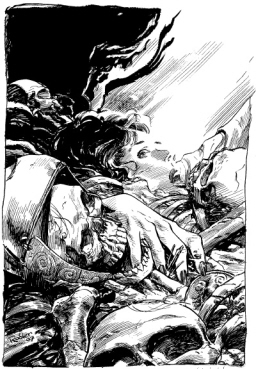
The nightmare began when, thinking someone had called out, she opened her eyes and saw the leathery face of a corpse as close to her as a lover’s. She started up with a cry, heart pounding, certain she would find herself in her bed with her own warm and living lover. But she found only bony hands tangled in her hair, and the smell of cold decay.
She tried to jump to her feet, but beneath her dead men were piled up layer on layer and she could get no purchase. Whimpering, she clawed her way toward the only door of the dim chamber. Bones snagged her skirts, skulls rolled under her hands. At last she reached the doorway and fled up the narrow stair into darkness—
Rubble blocked the stair. She dug at the loose stones, breaking all her nails; she pounded on them, screaming for help. She screamed until she had no more breath. No one came to let her out.
Panting, she slumped against the wall. It had to be a nightmare that she had been walled into a crypt. But what nightmare was like this, with cold grinding into her bones and the smell of the dead as thick in her throat as temple incense?
A corpse shifted on the pile and she spun in terror. But the sound was just the disturbed bodies settling back to equilibrium.
Or was it? She stifled another scream as a skull tumbled down the pile, rolled leering to a stop —
Trembling, hugging herself, she slid down to sit upon a stair. The corpses gazed back at her. It looked as if years had passed since they had been laid here. Only scraps of dried flesh adhered to their faces. Their swords were broken, their armor rusted, the quilted leather of their jackets had rotted to fragments like old leaves. They lay with arms outflung and jaws agape, as if they had fallen in battle and been piled up before the first rigor of death passed off.
The dead lay still now, but as they stared at her, she became ever more certain that she did not imagine their restlessness.
They must, she thought suddenly, have been walled up to stop them walking.
An instant after that terrible realization, a much fiercer panic roared down on her.
Because why else would she have been buried with them?
She herself must be one of the dead, and only dreaming now that she woke alive.
But, but —
She tried to fling logic in the face of her terror: the restless dead could dream only of their former lives. She did not know this place.
And unlike the disconnected landscapes of dream, nothing changed in this crypt, not the blank stone walls, not the jumbled dead receding into shadow, not the pain from her broken nails or the gritty stone under her palms. Not the cold or the awful smell. How could she be dead and feel all that?
No, the dream had been that voice calling out to her, and now she was truly awake — whatever she had woken to.
She tried to calm her racing heartbeat and think. A powerful sorcerer, she had read — somewhere, some time — could create places beyond the Gate of the living world, necromantic tumors grown in the guts of the divine realm. That sort of place might not be governed by nature at all, but only by the sorcerer’s caprice.
But still —
If natural law ruled this tomb, she ought to wonder where the light came from. The illumination was scant, but sufficient to distinguish stone from sword and corpse from corpse. Where daylight found its way in, there ought to be a way out.
The dead faces stared. Finally she gathered the courage to descend back into the tangle of bodies.
At first she held her skirts close to her legs and stepped with panicky care onto shrunken limbs and brittle ribs, but soon, whimpering again from the awfulness of it, she was reduced once more to crawling over the dead men.
When she had gained the brightest part of the tomb, she did indeed find the source of the light. High over her head, a handful of stones had fallen from the vaulted ceiling.
She teetered on the corpses in despair, wondering if she could pile them high enough to reach that tiny glimmer — and wondering how long it would be before one of the dead woke up to clutch at her. Here in their midst, the bated restlessness was like snakes sliding on the soles of her feet.
Then something flickered at the edge of her vision.
A fresh surge of panic swung her around. In a shadowy corner, a dead swordsman leaned against the wall, proffering her a — something — of an improbably bright yellow.
As she waited, transfixed, for him to move again, his posture stirred her memory: the handsome cavalier presenting her with his love-gift, a necklace of tourmalines the colors of sky and sun. How she had loved that trinket, and the one who had given it —
The yellow scrap in the corner trembled once more.
Again she started and nearly lost her footing. But this time she was almost sure the swordsman hadn’t stirred.
Heart pounding, she inched toward him. At last she drew close enough to see that what had caught her eye was not gold, not a shred of cloth or enamelwork miraculously preserving its color. Nor did the swordsman in fact hold it in his hand. Between his dead fingers, a spider had woven a web, and the yellow scrap was caught there.
A newly fallen beech leaf. Dead, too, but right now a more exquisite sight than all the gold in the world.
The leaf shivered, and a draft of fresher air feathered her cheek, smelling not of decay but of damp earth. She peered into the gloom beyond the swordsman. A fall of dirt and rocks covered another heap of corpses, and mixed in the dirt were more leaves, yellow and brown. No light penetrated to this part of the crypt. But the draft, those leaves...
She lifted her skirts and edged gingerly past the swordsman, onto the rock fall. On her first attempt to scrabble up, she dislodged a current of earth that carried her back down. Again she swam up, on all fours now, feet tangling in her skirts, until she could feel a draft blowing on her face. When she thrust an arm into the unseen opening — a rabbit hole? — her hand struck a tree root. Hope gave her the strength to grab the root and haul herself up, pulling soil down on her head, until a cascade of rubble fell away to reveal daylight. She dragged herself over the lip of the hole and collapsed in relief.
Above her hung a cloudy sky bright enough to hurt her eyes. Leaf-strewn snow covered the frozen ground. The air was even colder here.
After a while, brushing off dirt and snow, she climbed to her feet. A maze of ruined walls surrounded her. Bare trees sprouted from what must once have been streets and courtyards. She recognized nothing.
Hugging her jacket around her — its embroidered wool was too thin for this season — she cast about for a way through the ruins. After a few false turns, she reached an avenue mostly free of brush and fallen stones. This led her to a wide, snow-blanketed plaza. On the far side, a tower reared up against the overhanging mountain cliff. The tower stood in far better condition than the surrounding ruins.
At the sight of it, new cold shivered over her skin, and she pulled back into the shadow of a wall.
Suddenly she knew this plaza. Knew this city. How beautiful it had been in spring sunshine: the broad paved streets scrubbed clean, the walls plastered, whitewashed, and hung with colored pennants. Here the cavaliers had paraded on their prancing horses, armor and harness polished mirror-bright. Here peasants and merchants in their red-embroidered best had set up booths, had danced and sung for the God of Flowers, had poured libations of strong liquor onto the ground and down their own throats. How happy her lover had looked that evening as they walked through the festival! He had taken off his armor and garlanded his hair with jonquils, and when he bent his head to murmur in her ear she could smell their sweet perfume.
She strained after his name but could not remember it. But she remembered his funeral. So many had fallen in the battle, they had burned his body with green wood that popped and smoked. In an attempt to escape her unbearable grief she had taken a new lover the same night.
That boy’s name was gone, too.
Terror spiked up in her like grass sprouting as she realized all the names were gone, even her own. It was as if they, too, had been walled into a crypt.
But — was that a voice calling in the distance?
She listened but heard only her own breathing, her own heartbeat.
The tower loomed above the plaza, a blot of cold darkness. She could not remember the name of the sorcerer who had ruled the city from there, but she remembered how much he had terrified her.
She hurried away, turning down the avenue that led to her house. A part of her knew that her home, too, must lie in ruins, but what a shock when she found it utterly tumbled down, not a single stone standing on another —
Her feet carried her onward. The avenue wound down the hill, curving past walls that had once enclosed the gardens of the Temple of the Queen of Heaven’s Mercy. Then the valley below the city came into view.
Shock jolted her again. The landscape her eye expected — villages, fields, hedgerows, the high road unfurling toward the southern hills — had been obliterated by a dark forest unbroken except by the river and its snow-lined banks. She could see not a single building, not a single smudge of smoke. Nothing stirred in an immense silence.
But this was her city. Those mountains blotting out half the sky, habitation of the gods: she had seen them every day of her life. How many years had passed for that forest to grow? How had she come to be the only living creature here? Alone — she, the highborn lady who never sat or walked by herself, never ate or prayed by herself, never willingly slept by herself...
At this moment, she was more alone than she could compass.
Down in the valley, a dark bird like a small, slim hawk soared above the river. As she watched it, memory stirred and brought forth a name: aleya, the black kite.
Aleya had been her own name, given because of her black hair.
And she remembered, then, the siege of the city. In the last days the city had run out of wood to burn its dead and had piled the corpses into cellars. With so much magic loose, they had walled them up in fear the dead would walk.
She must have been placed in one of those cellars before the very end.
But she could not be dead. Look at her breath fogging the air, look at the tracks her feet pressed into the snow. Surely no half-corporeal revenant could make prints so crisp! Aleya bent to scoop the snow and watched it melt on her fingers into muddy droplets. Alive.
As she straightened, she saw another set of footprints.
After a moment Aleya walked toward them, heart jumping. The tracks looked like a woman’s as well and were no larger than her own, although they had been made by heavy brogues in the country style rather than a lady’s demi-boots. The footprints made a double track, entering and leaving, through a gap in the walls of the temple garden.
Who had made the tracks — a peasant stealing from the garden? It was hard to believe that rare medicinal plantings could have survived, when the temple itself had crumbled to rubble.
Surely, though, such a thief would come to her aid, beautiful as she was and schooled in every grace, so obviously highborn — if only out of hope of reward.
Aleya stepped to the gap in the garden wall and peered in. The hair on her nape prickled: here and there amidst the overgrown tangle stood neatly pruned trees and shrubs.
Wind gusted past her, so like human whispers that she swung around.
No one stood there. But Aleya did notice then how the winter afternoon had faded. Purple gloom had gathered under the mountain, and now it was spreading through the city.
Another cold gust of wind soughed down from the heights, bearing more of the wordless whispers. At the foot of the mountain wall, in the darkest shadows, walls and roofs faint as smoke were congealing atop the citadel ruins.
Panic gripped her. Aleya turned and ran after the footprints, down the avenue, down the hill. The twilight deepened as she descended. On all sides now, phantom armories, counting-houses and feasting halls wavered like reflections in an uneasy pool. Shadows of people ghosted into being, warriors in plumed armor, apprentices hurrying with a chest.
The lost city of her memory was building itself in the twilight. When Aleya passed the gate to a nobleman’s courtyard, longing almost turned her back. Light spilled from an unseen door, and she half-glimpsed shapes in bright clothing. Her memory added music, laughter and repartee, lovers exchanging hidden smiles. For a moment she was certain that inside that house she would find herself, and her name, and all those she had loved and left behind.
But the only sound from the courtyard now was the wind.
Aleya fled onward, following the prints toward the gate of the city. The wind whipped her hair and rattled the trees, it whined over broken stones, it whispered in her ear with a thousand lost voices. Shadow men and women reached for her. She ran faster. The wind built until it was a rockslide roaring down on her, an avalanche seeking to crush her into its cold belly.
At last the wall of the city rose before her. But the gate was closed, and a troop of silent men raised spears to turn her back. The avalanche roared close above her head. As the momentum of terror carried her forward, Aleya saw, through phantom guards and phantom wood and iron, that the true gate had fallen. Some courage she did not know she possessed gave her strength to shove through the dead men. Their touch was almost solid now, like cold rags clinging to her limbs, but she twisted free to scramble over the fallen lintel-stones of the gate. Beyond lay no more guards, only trees and the snowy high road arrowing away under their branches, and that line of footprints.
As Aleya hesitated for an instant, afraid of what might wait in the forest, a step sounded behind her —
A booted foot crunched on ice-rimed stone.
On hands and knees, she glanced up. The lord of the city stood there, in breeches and jacket and over it, carelessly, a plain brown cloak. The wind that ripped at her hair did not stir his clothing. Beyond, his guards stood at silent attention.
Aleya knew: the shepherd had come for his straying sheep.
“I never gave you my soul,” she whispered.
"Oh, but I took it anyway,” said the sorcerer.
[The complete version of "Awakening" appears in Black Gate 10.]