More Thoughts on Realism and Fantasy
Though I’ve understood since childhood that not everybody shared my love of the fantastic, it wasn’t until quite a ways into my adult years that I realized this must be in large part due to differences in how people’s imaginations operate. One spur to this realization was an on-air comment by a local arts-and-culture talk show host that she couldn’t get into a book where things happened that couldn’t in real life (yes, a statement we could unpack at length). At the time I was observing my young son discover stories. It was clear to me that he derived some of the greatest pleasure from precisely those things that never could happen in real life. Moreover, the stories he invented to tell me from two years onward (which I wrote down whenever I could) were gleefully fantastic: night being stolen, his father putting on breasts, the street sucking our house off its foundations. From watching his friends I also was able to see that not all kids do love the fantastic equally; he was close to one end of some bell curve. When the differences show up so early, they start to look like something innate.
The term mimesis is sometimes used to describe techniques of realistic fiction–as imitation, in other words, of something that already exists. All kinds of questions occur here with regard to how people, whether adults or small children, form judgments about what real life consists of and what constitutes an imitation of it, or a violation of its principles. Many of these principles are culturally constituted. Laura Bohannon’s much-anthologized article, “Shakespeare in the Bush,” describes how the Tiv rejected Hamlet as unacceptably unrealistic, on the basis of, among other things, the motivations of nearly every character. Others arise out of an individual’s experience. For those born with synaesthesia, there would be nothing at all unreal about descriptions of numbers possessing color, or (my own case) sounds having a tactile component.
According to Wikipedia, imagination is a “term is technically used in psychology for the process of reviving in the mind, percepts of objects formerly given in sense perception.” In this view, in other words, imagination is mimetic in the purest sense–it “revives in the mind” what one has already experienced. I suspect that the psychologists initially formulating this definition shared the type of imagination described by our talk-show host. For others like my son and myself, the mind is just as prone, or more so, to gravitate to things that one hasn’t experienced, that violate the expectations and principles of real life. The Calvin cartoon in which he has to fend off an attack by his breakfast oatmeal is iconic for me in this regard.
 “So just what is science fiction?” asks editor Lou Anders in the preamble to his second and latest volume of Fast Forward, an annual collection of original genre stories (you can find my review of the first edition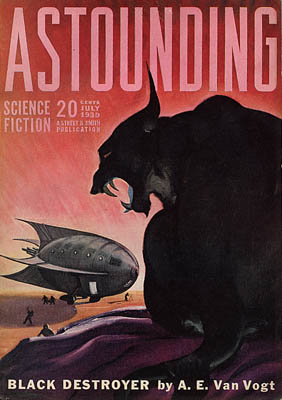
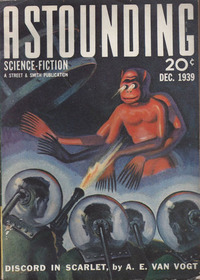
 Clint Eastwood never starred in or directed a sword-and-sorcery or heroic fantasy movie, and since he’s declared his retirement from acting with 2008’s Gran Torino, chances are he never will. That’s too bad, since the leathery, iconic actor might have made a nice fit into certain dark fantasy worlds. Michael Moorcock thought he would have made an excellent Eric John Stark; I agree. But Eastwood as a performer and director was more interested the realistic American landscape, and he never got near the world of the overtly fantastic.
 Naughty or nice? Well, the holidays being my favorite excuse to procrastinate, I’ll have to reluctantly admit to ‘naughty.’ Being naughty, I’ve left my blog entry to the last minute. I’ve had a few New Yearsie ideas I thought I might advance, the kinds of things having to do with resolutions — mostly of the writing variety. But writing has been well enough covered at Black Gate of late and, while I know we have a lot of writers in our audience, I can’t help but think the thing that really pulls us all together, and sets us apart from, well, from a great many people who would never pick up a work of fiction let alone investigate the website of a fantasy magazine, is that we are all readers. First and foremost, that defines us.
 I used to know a responsible person who had a brilliant method of evading responsibility. Whenever you asked him anything, he would say, “What you’re really asking is two things here.” And an exhaustive discussion of his quibble would ensue and, in the end, the matter would merit more thought (but, naturally, no action). He was a kind of genius, if being useless is a category of genius.