Seventh Sanctum and Randomness
Normally, I get verbose on my posts here at Black Gate. But I’ve had a busy week, the crunch comes down on the last day, and I don’t have time for a long amble through my usual obscura. So today I’ll dash through with a link to one of my favorite “writing experiment” sites.
Seventh Sanctum is a website of randomness. It contains an array of “generators” that can create instant character names, evil organizations, magic weapons, and super-powers. The bulk of the site consists of anime- and RPG-slanted generators, most of which were coded as a “lark,” in the words of the site’s creator. “Roll up a bunch of results. Use them. Make a ton of money. Or use them in a fanfic or an RPG.”
However, I’ve gotten a lot of writing practice ideas from the category of generators under the heading “Writing.” A general heading that covers a number of great randomizers that can hatch up story settings, themes, and “what-if” scenarios. For example, today on Writing Challenges (my favorite of the generators), I pulled out this confluences of different elements for a strange tale: “The story ends during a war. During the story, an organization begins recruiting. The story must have a lost soul in it. The story must involve some oil at the end.” That was enough to keep me scribbling in my composition notebook for at least an hour; and even if I develop a story that doesn’t contain any of those elements, battering the ideas about always develops something of interest I can use later. One of my favorite short stories I wrote in the last year emerged from using Seventh Sanctum’s What-if-Inator. The finished work had almost nothing to do with the original “what-if” from the site, but I probably wouldn’t have started the journey without the push.
Any writer could get a few decent exercises from Seventh Sanctum—maybe even a the start of something more serious—and you can always waste some time with the Humorous Fantasy Classes generator. (I like the “Stripper-Lancer” and “Valkyrie Salesman.” Both might work in a Risus campaign.)
 As a follow-up to
 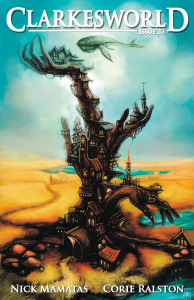 Issue 33 of Clarkesworld Magazine features a
  The People That Time Forgot (1977)
 I’m looking forward to China Miéville’s new novel, The City and the City. In the meantime, here’s an
  I’ve only ever heard the terms ‘escapism’ and ‘escapist’ used as pejoratives and, quite often, used to describe things that I enjoy. We all know what these terms mean, and especially what they are implicitly communicating: the notion that escapist entertainment is a crutch, a way of running away from reality. But also, and I think that this is more important, that it has no redeeming value as art or as educational material.