Browsed by
Category: Series Fantasy

New Treasures: Firebrand by Gillian Philip

New Treasures: Firebrand by Gillian Philip

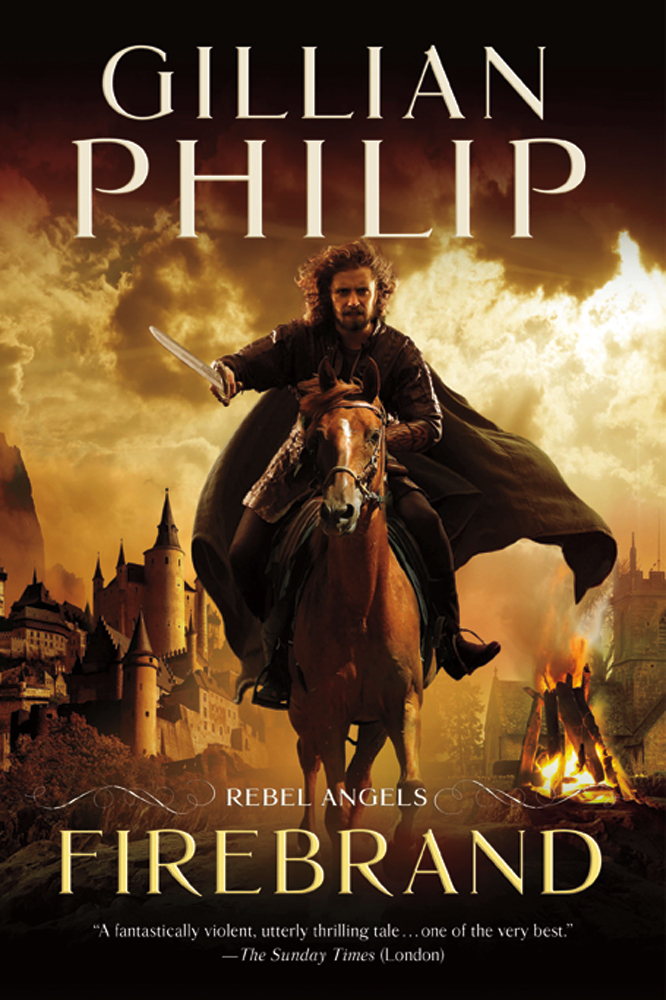
Firebrand Gillian PhilipHere in the U.S., Gillian Philip is known primarily for her Carnegie Medal–nominated contemporary novel, Crossing the Line, and the YA dystopian title, Bad Faith. In the UK however, she’s also known for her popular YA fantasy series, Rebel Angels, which the Sunday Times of London called “The best fantasy of 2010.”

Filled with twisted court intrigue — and even more twisted monsters from the realm of faery — Firebrand seems like exactly the kind of fast-paced adventure Black Gate readers are interested in.

Now Tor has brought the first volume, Firebrand, into print on this side of the pond, in a handsome hardcover edition with a new cover by Steve Stone.

At the end of the sixteenth century, religious upheaval brings fear, superstition, and doubt to the lives of mortals. Yet unbeknownst to them, another world lies just beyond the Veil: the realm of the Sithe, a fierce and beautiful people for whom a full-mortal life is but the blink of an eye. The Veil protects and hides their world… but it is fraying at the edges, and not all think it should be repaired.

Discarded by his mother and ignored by his father, sixteen-year-old Seth MacGregor has grown up half wild in his father’s fortress, with only his idolized older brother, Conal, for family. When Conal quarrels with the Sithe queen and is forced into exile in the full-mortal world, Seth volunteers to go with him.

But life beyond the Veil is even more dangerous than they expected, and Seth and Conal soon find themselves embroiled in a witch-hunt—in which they are the quarry. Trapped between the queen’s machinations at home and the superstitious violence of the otherworld, Seth must act before both of them are fed to the witch-hunters’ fires…

The second and third volumes, Bloodstone and Wolfsbane, are already in print in the UK. Interestingly, while all three books are marketed as YA there, Tor has mainstreamed them here in the US. It’s an interesting switch, and I’m curious to see how the market reacts.

Firebrand was published by Tor Books on February 19. It is 365 pages, priced at $24.99 in hardcover and $11.99 for the digital edition.

Martha Wells’ Emilie and the Hollow World On Sale Today

Martha Wells’ Emilie and the Hollow World On Sale Today

Emilie and the Hollow World-smallMartha Wells is one of our superstar contributors. In fact, it’s probably not an exaggeration to say that, in terms of raw ability to move sales, she was the superstar contributor to Black Gate.

Every magazine has authors who help sales. But it wasn’t until we published Black Gate 10, containing Martha’s Giliead & Ilias story “Reflections,” that I really saw what a single author could do. Subscriptions started to pour in, with letters from excited fans asking for “More Martha Wells!” We were happy to comply.

Novels are where she truly built her career, however — including The Fall of Ile-Rien trilogy, The Cloud Roads trilogy, and the Nebula-nominated The Death of the Necromancer. Today her first young adult novel, Emilie and the Hollow World, arrives in bookstores, and Martha discussed the ups and downs in her career that led her here with refreshing candor on her blog:

This is the third book I finished back in 2009, during my career crash that lasted from around 2006-2007 to 2010. A career crash for a writer is kind of like if you had a job where you’ve been going in to work every day and everything seems fine. But then gradually, over time, you realize you’ve been fired, and they don’t want you there and they aren’t going to pay you and everyone you work with knows this. It’s just that no one has told you.

The novel follows the adventures of young Emilie, whose clumsy attempt to run away and join her cousin in the big city lead her to stowaway on the wrong ship, where she’s quickly caught up in a grand adventure involving an experimental engine, an attempt to ride the aether currents, and a journey to the interior of the planet — not to mention sabotage, an encounter with the treacherous Lord Ivers, and the strange race of the sea-lands.

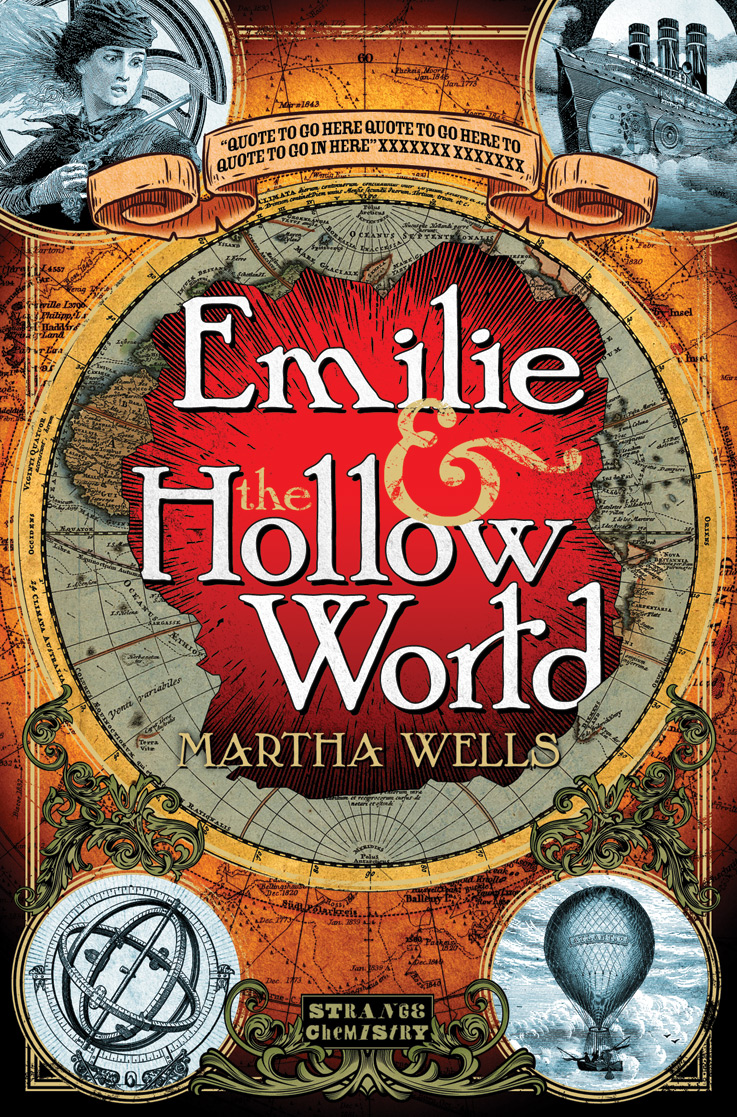
Emilie and the Hollow World was published today by Strange Chemistry. It is 304 pages in paperback for $9.99 ($6.99 for the digital edition). The only version of the cover we have is the pre-publication version (which still has a placeholder quote), but you can see all the detail on this handsome cover by clicking on the image at right.

New Treasures: Dream Castles: The Early Jack Vance, Volume Two

New Treasures: Dream Castles: The Early Jack Vance, Volume Two

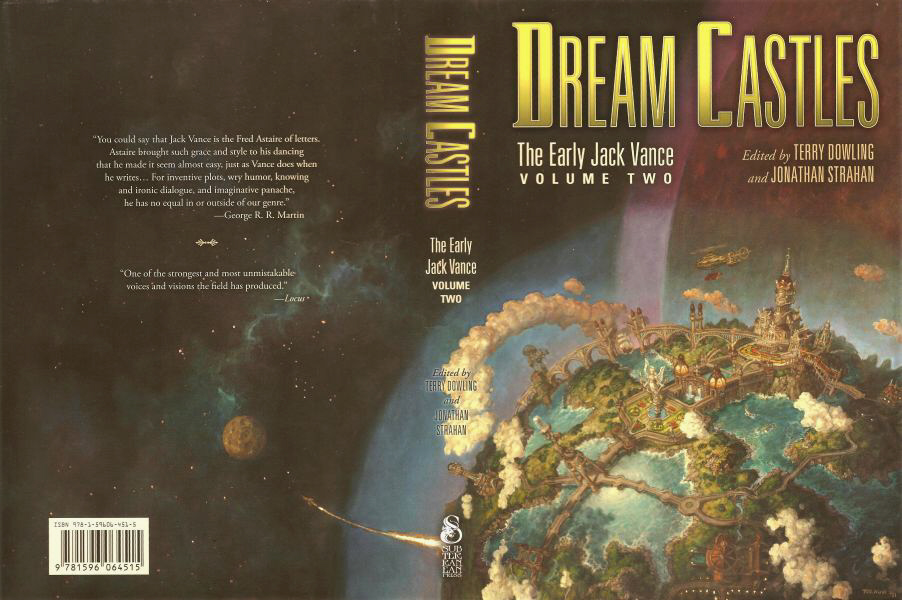
Dream Castles-smallI spent this past weekend at Capricon 33, a local Chicago science fiction convention. The panels and readings were excellent, and perhaps the highlight was a Saturday night panel titled “Judging a Book by Page 119.” Steven Silver, Rich Horton, Kelly Strait, and Helen Montgomery read page 119 of some of their favorite novels, and the audience was left to guess the book. Someone in the back row correctly identified Poul Anderson’s The High Crusade, and I was pretty close with Robert Holdstock’s Mythago Wood trilogy (although I got the exact book wrong), but the panelists  managed to stump us on Iain M. Banks Consider Phlebas, Patrick Rothfuss’s The Name of the Wind, Saladin Ahmed’s The Throne of the Crescent MoonRange of Ghosts by Elizabeth Bear, The Little Country by Charles de Lint, and many others.

I can’t spend more than an hour or two at a good convention without realizing I’m not reading enough good books. I scurried to the Dealer’s room first chance I got and spent a few bucks in an attempt to rectify the situation. I found plenty of great treasures, but the real gem of the lot was the sole copy of the out-of-print Dream Castles: The Early Jack Vance, Volume Two, which I stumbled on at Larry Smith’s table.

I’ve been looking for a copy of Dream Castles for nearly a year — ever since I bought the first volume, Hard Luck Diggings. Both were published by Subterranean Press, and both gather early pulp fiction from one of the greatest 20th Century science fiction and fantasy writers.

Dream Castles collects short stories and novellas from Astounding Science Fiction (“I’ll Build Your Dream Castle,” Sept. 1947), Marvel Science Stories (“Golden Girl,” May 1951), and many other pulps — including Fantastic Science Fiction Fantasy, Space Science Fiction, and Orbit Science Fiction. The short novel, “Son of the Tree,” originally appeared in the June 1951 issue of Thrilling Wonder Stories.

Read More Read More

Carrie Vaughn Steals the Show

Carrie Vaughn Steals the Show

kitty-steals-the-show-smallI was reviewing science fiction magazines for SF Site when I first encountered Carrie Vaughn. It was in the Fall 1999 issue of Patrick Swenson’s Talebones, one of the best of the small-press magazines, that I read her story “The Girl With the Pre-Raphaelite Hair,” which I noted in my review “delivers a wallop… A tightly-written tale with a powerful ending.”

Not bad for her first science fiction story. Carrie published more than 50 over the next decade, carving out a name for herself. But it was her debut novel, Kitty and the Midnight Hour (2005), that truly catapulted her to stardom. Featuring late-night DJ (and secret werewolf) Kitty Norville — who hosts a Denver talk show about Werewolves, Vampires, and other supernatural creatures — the book was an instant success. The fourth in the series, Kitty and the Silver Bullet (2008), hit The New York Times Best Seller list, and she’s repeated that impressive feat with at least four subsequent volumes.

This industry is hard on new writers, and over the last ten years I’ve seen it defeat more than a few talented authors. So it’s a genuine pleasure to watch someone climb to the very top of the field, from her first short story to the tenth volume of her bestselling series, on nothing more than hard work and talent. If you haven’t tried Carrie Vaughn yet, her latest effort, Kitty Steals the Show, makes a good jumping-on point:

Kitty has been tapped as the keynote speaker for the First International Conference on Paranatural Studies, taking place in London. The conference brings together scientists, activists, protestors, and supernatural beings from all over the world — and Kitty, Ben, and Cormac are right in the middle of it.

Master vampires from dozens of cities have also gathered in London for a conference of their own. With the help of the Master of London, Kitty gets more of a glimpse into the Long Game — a power struggle among vampires that has been going on for centuries — than she ever has before. In her search for answers, Kitty has the help of some old allies, and meets some new ones, such as Caleb, the alpha werewolf of the British Isles. The conference has also attracted some old enemies, who’ve set their sights on her and her friends.

All the world’s a stage, and Kitty’s just stepped into the spotlight.

Kitty Steals the Show was published on July 31 by Tor Books. It is 342 pages, priced at $7.99 for both the digital version and the mass market paperback.

New Treasures: Jeffrey E. Barlough’s What I Found at Hoole

New Treasures: Jeffrey E. Barlough’s What I Found at Hoole

what-i-found-at-hoole-smallJeffrey E. Barlough’s Western Lights series may be the best fantasy books you don’t know about.

I didn’t know about them either, until Jackson Kuhl’s review of Strange Cargo in Black Gate 8. Jackson has called Barlough “a wonderful yet unappreciated fantasist… a talent I invite everyone to sample.” In his review of Anchorwick, the fifth novel in the series, he summarized the intriguing setting this way:

In a world where the Ice Age never ended, a cataclysm has reduced humanity to a slip of English civilization along North America’s western coastline. It’s neither steampunk nor weird western; the technology is early 19th century. It’s kinda-sorta gaslamp fantasy, except there doesn’t seem to be any natural gas. Barlough’s creation is best described as a Victorian Dying Earth — gothic and claustrophobic yet confronted by its inhabitants with upper lips held stiff. As the books are fantasy mysteries, the less said about their plots, the better… mastodons and mylodons mixed with ghosts and gorgons? Yes, please.

Now the seventh novel in the series, What I Found at Hoole, has arrived in a handsome trade paperback from Gresham & Doyle. It picks up at the end of the second volume, The House in the High Wood, which was a nominee for the 2002 Locus Award for Best Fantasy Novel.

Mr. Ingram Somervell has been called to the remote village of Hoole, in the uplands of Ayleshire, to inspect some property bequeathed to him by an uncle he had never met. Almost at once he finds himself plunged into mysteries that confound him. Why had Clement’s Mill, a dilapidated old mill that did no milling, been left to him… Why had his uncle ordered the old chapel on the fellside and its coffin-crypt sealed after the arrival of Miss Petra, his ward and heir? What was the ghostly yellow light that had been seen on Cowdrie Beacon? And what to make of the frightful dreams hinting at some unimaginable catastrophe plaguing young Somervell since he came into Ayleshire?

These novels, with their oddly pastoral cover art — the cover to this one, F.H.Tynsdale’s A Country Cottage and Church, is from the 19th Century — are an entertaining mix of genres, blending fantasy, gothic mystery, and even a dash of period comedy straight out of P.G. Wodehouse. Don’t miss them.

What I Found at Hoole was published by Gresham & Doyle on November 1st. It is 259 pages and priced at $14.95 in trade paperback. There is no digital edition.

New Treasures: Three Parts Dead by Max Gladstone

New Treasures: Three Parts Dead by Max Gladstone

three-parts-dead-smallThe fall is a big time for fantasy releases. We see a lot of press releases and advance proofs in the build-up to the holiday season, and everyone here has their favorites. I’m usually a fan of serial fiction — Fritz Leiber’s Fafhrd and the Gray Mouser tales, Jame Enge’s Morlock the Maker, Howard Andrew Jones’s Dabir and Asim novels — and I’m always on the lookout for the next breakout fantasy series.

But this year the book that most grabbed my attention was a first novel by Max Gladstone. I first saw the cover hanging on the wall at a Tor party at Wiscon in May, and I’ve been anxiously awaiting it ever since. Set in a decaying city on the verge of destruction, Three Parts Dead offers a high-stakes tale of dead gods, necromancers, and dark dealings in a richly-imagined urban landscape.

A god has died, and it’s up to Tara, first-year associate in the international necromantic firm of Kelethres, Albrecht, and Ao, to bring Him back to life before His city falls apart.

Her client is Kos, recently deceased fire god of the city of Alt Coulumb. Without Him, the metropolis’s steam generators will shut down, its trains will cease running, and its four million citizens will riot.

Tara’s job: resurrect Kos before chaos sets in. Her only help: Abelard, a chain-smoking priest of the dead god, who’s having an understandable crisis of faith.

When Tara and Abelard discover that Kos was murdered, they have to make a case in Alt Coulumb’s courts — and their quest for the truth endangers their partnership, their lives, and Alt Coulumb’s slim hope of survival.

Set in a phenomenally built world in which justice is a collective force bestowed on a few, craftsmen fly on lightning bolts, and gargoyles can rule cities, Three Parts Dead introduces readers to an ethical landscape in which the line between right and wrong blurs.

Three Parts Dead was published by Tor Books on October 2. It is 333 pages, and sells for $24.99 in hardcover and $11.99 for the digital version.

Cynthia Ward Reviews The Gods of Opar

Cynthia Ward Reviews The Gods of Opar

farmer08_bGods of Opar: Tales of Lost Khokarsa
Philip José Farmer & Christopher Paul Carey
Subterranean Press  (576 pp, $65.00 Limited Edition Hardcover, $45.00 Trade Edition Hardcover)
Reviewed by Cynthia Ward

Once upon a time, in a lost civilization known as West Germany, the Kreuzberg Kaserne U.S. Army Base let fifth graders leave school grounds at lunchtime. Every week, I crossed the street to the little base bookstore. In the late winter of 1972, I bought the first DC Comics issue (#207) of “Tarzan of the Apes” because I wanted to learn how the heck a human being ended up living with apes. When the writer/artist, the late, much-lamented Joe Kubert, ended his adaptation with Edgar Rice Burroughs’s original cliffhanger, I read Burroughs’s sequel, The Return of Tarzan, to finish the origin story. Then I found myself devouring every other Burroughs book reprinted in the early 1970s.

I couldn’t have been the decade’s only new Burroughs fan, because by the mid-1970s, his estate had authorized two different Tarzan-related series by other authors: the Bunduki novels by J.T. Edson and the Ancient Opar novels by Philip José Farmer. Both series produced a novel or two and then, as far as I knew, ended. The tie-in titles went out of print, their copyright was probably owned or controlled by the Burroughs estate, and Philip José Farmer died in 2009. I figured none of these books would ever see another reprint.

I figured wrong, because Subterranean Press has just released Gods of Opar: Tales of Lost Khokarsa, which is an omnibus of the two Ancient Opar novels by Philip José Farmer – Hadon of Ancient Opar (1974) and Flight to Opar (1976) – together with a third, new novel in the series, The Song of Kwasin, by Philip José Farmer and Christopher Paul Carey (Black Gate recently ran essays from Carey about the history of his remarkable collaboration with Farmer, and his discussion of Farmer’s ambitious creation, the lost civilization of Khokarsa.)

Read More Read More

The Bloodlands Novels of Christine Cody

The Bloodlands Novels of Christine Cody

bloodlands2I’ve been having fun with the Bloodlands novels of Christine Cody. Her website calls them “a post-apocalyptic Western fantasy series,” and that’s probably the best way to describe them.

Technically they’re science fiction, since there’s a near-future SF vibe and a post-disaster setting. “The New Badlands” is a vast and devastated American West where a handful of survivors retreated underground to escape changing and deadly weather, and a sequence of unrelenting apocalyptic events that have ravaged the country.

But at heart they’re really fantasy as the Badlands aren’t just filled with lethal storms, desperate survivors and brutal gunslingers — they’re also crawling with monsters, including vampires.

The marketing copy from Ace Books left me in mind of Deadlands, the weird western role playing game from Pinnacle Entertainment that breathed new life into the RPG genre in the 90s. But the author credits her inspiration to classic westerns. This is from the dedication to Bloodlands:

A big shout-out goes to all those Westerns that provided us with High Plains Drifters, Shanes, and Pale Riders, plus all the greedy ranchers and gunslinging villains, feisty homesteaders and rugged pioneers. I wanted to twist and reshape those wonderful tropes into something new while recalling the old. Most important, though, I wanted to pay homage to the mysterious cowboys who have wandered across dusty landscapes to face down the bad guys.

Fair warning to those looking for a pure-blooded adventure series: these books have an outcast female protagonist, and a brooding and misunderstood vampire named “Gabriel.” And there’s kissing.

The technical term for books containing both kissing and vampires is “paranormal romance,” and that’s exactly what these are. If sweaty make-out scenes with the undead make you uncomfortable, then back away now.

Read More Read More

David Soyka Reviews Prince of Thorns

David Soyka Reviews Prince of Thorns

prince-of-thornsPrince of Thorns (Book One of The Broken Empire)
Mark Lawrence
Ace (324 pp, $29.95, Hardcover August 2011)
Reviewed by David Soyka

This is pretty brutal.  Relentlessly brutal, right from the opening paragraphs:

Ravens! Always the ravens. They settled in the gables of the church even before the injured became the dead. Even before Rike had finished taking fingers from hands, and rings from fingers. I leaned back against the gallows post and nodded to the birds, a dozen of them in a black line, wise-eyed and watching.

The town-square ran red. Blood in the gutters, bloom on the flagstones, blood in the fountain. The corpses posed as corpses do. Some comical, reaching for the sky with missing fingers, some peaceful, coiled about their wounds. Flies rose above the wounded as they struggled. This way and that, some blind, some sly, all betrayed by their buzzing entourage.

“Water! Water!” It’s always water with the dying. Strange, it’s killing that gives me thirst.

And this the ostensible hero talking in Prince of Thorns, the first in a (you guessed it) projected trilogy collectively called The Broken Empire.  So, we’re clearly in anti-hero land, in the “shit and blood” sub genre of sword and sorcery that aims to rub your face in what rusty blades, poor sanitation and disease actually do to people living under medieval conditions, in stark contrast to high fantasy depictions of noble quests in which divinely provident good triumphs over corrupt and therefore ultimately doomed to fail evil.

Read More Read More

Return to : Reviving a Masterpiece

Return to : Reviving a Masterpiece

The new Norilana edition of a must-read fantasy classic, NIGHT’S MASTER by Tanith Lee.

Fantasy readers…rejoice!

The fact that Tanith Lee’s TALES FROM THE FLAT EARTH has been out of print for years has been a blatant injustice done to all lovers of epic fantasy. Now, thanks to Vera Nazarian’s Norilana Books, one of the field’s great masterpieces is once again available to the public.

The individual books of the FLAT EARTH series (each of which is a stand-alone novel) are being released in hardcover and trade paperback on a roughly annual basis, and feature gorgeous new cover treatments and artwork. If you haven’t yet discovered the FLAT EARTH books, I envy you. You are in for a spectacular reading experience.

The first book in this landmark series is NIGHT’S MASTER (1978), which was nominated for a Best Novel World Fantasy Award. It introduces the time-lost world of ancient sorcery where Azhrarn the Prince of Demons and his fellow Lords of Darkness roam the flat world creating mischief, drama, and tragedy across the primeval human kingdoms.

The book is rich with lyrical prose, jewel-bright imagery, dark beauty, and ironic myths. Human protagonists come and go, while the real main character is Azhrarn, who is despicable yet inhumanly handsome, evil yet oddly compassionate, godlike yet flawed, and an unlikely champion of a doomed humankind. Let all would-be fantasy writers savor the flavor of Lee’s sumptuous prose. This is how it’s done, people.

Read More Read More